


There’s a quiet fear that follows many people after they leave the church. It does not always appear immediately. At first there’s relief. Sometimes anger. Sometimes a strange, exhilarating sense of freedom.
But eventually another question arrives.
If the story I was given about life isn’t true, what gives life meaning now?
For many of us, religion answered that question long before we were old enough to ask it. There was a plan. A purpose. A divine author shaping the arc of existence. We were told our lives mattered because they fit inside that cosmic design.
When that framework disappears, something deeper than belief is shaken.
The old worldview claimed that life had built in purpose. Philosophers call this teleology, the idea that existence itself is directed toward a goal or intention. Remove that assumption and the world can suddenly feel uncertain.
If there’s no divine script, people begin to wonder whether life is accidental.
And if life is accidental, does meaning disappear with it?
This is the quiet anxiety many former believers carry. It doesn’t always show up in conversation, but it lingers in the background.
Yet something surprising often happens once the old structure fades.
Meaning becomes clearer.
Not smaller. Clearer.
Because it turns out that meaning was never stored inside the institution that claimed to deliver it. It was always present in the lives we were already living.
The Myth That Religion Owns Meaning
Religious institutions often speak as though they possess a monopoly on purpose. The message, sometimes spoken openly and sometimes implied, is that without belief in God life must become empty or morally adrift.
Yet if we look honestly at the world, that claim simply doesn’t hold up.
Consider where meaning actually appears in human life.
A parent holding a newborn child.
A son caring for a mother whose memory has begun to fade.
A teacher staying after class to help a struggling student.
A neighbor bringing food to someone who is grieving.
A doctor working through the night to save a life.
None of these moments require a theological framework in order to matter. They matter because they express care, responsibility, and connection.
Human meaning has always lived inside these experiences.
Religion often supplied language to describe them, but it didn’t create them.
Meaning Isn’t Assigned. It’s Made.
One of the largest psychological shifts people experience after leaving church involves the way they think about purpose.
In many religious traditions, meaning is assigned from above. God has a plan. Your task is to discover your place inside it and remain obedient to that design.
Outside that framework, meaning works differently.
It isn’t assigned.
It’s made.
It grows through attention to the world and responsibility toward others. It appears in relationships, curiosity, service, creativity, and love.
This idea isn’t new. For centuries philosophers have wrestled with the same question. Thinkers from Viktor Frankl to Albert Camus explored how human beings create meaning even in a universe that doesn’t promise it in advance.
Their conclusion was surprisingly hopeful.
Meaning doesn’t require cosmic guarantees.
It requires engagement with life.
This realization can feel unsettling at first. If meaning isn’t handed down by authority, then we must participate in its creation.
But there’s also something deeply dignified about that shift.
Human beings aren’t passive characters waiting to discover the script of their lives. We’re participants in shaping it.
The meaning of a life unfolds through what we do with the time we’re given.
The Quiet Sources of a Good Life
When people ask about the meaning of life, they often expect a grand answer.
In reality, meaning usually arrives quietly.
It appears in the commitments we keep and the care we extend to others.
A gardener watching the first green shoots rise from the soil.
A volunteer helping someone navigate a difficult moment.
A writer shaping words that might comfort a stranger they’ll never meet.
A friend showing up during a hard season when it would have been easier to stay home.
These aren’t dramatic acts. They rarely attract public attention. Yet they form the fabric of meaningful lives.
For centuries religion framed these acts inside a sacred narrative. Once that narrative fades, the acts themselves remain.
They still matter.
Perhaps even more.
Because now they matter simply because they help make the world more humane.
Moral Purpose Without Divine Supervision
Another fear people sometimes carry after leaving religion concerns morality.
If there’s no divine judge watching over human behavior, what keeps people from doing whatever they want?
The assumption behind this fear is that goodness requires supervision.
But many former believers discover something different.
When moral behavior is no longer tied to divine reward or punishment, it often becomes more authentic.
Kindness isn’t performed in order to satisfy a higher authority. It’s chosen because another person’s well being matters.
Honesty is practiced not because someone might be watching, but because trust is the foundation of human community.
Justice becomes important not because heaven demands it, but because suffering in the real world is something we refuse to ignore.
In a curious way, moral responsibility can become stronger once it’s no longer outsourced to heaven.
If there’s no cosmic referee keeping score, the work of justice belongs to us.
The Freedom to Write Your Own Story
One of the hardest adjustments after leaving church is learning how to live without a predetermined script.
For years many people were taught that their lives were part of a divine plan. God had a specific purpose for them. The challenge was to discover it and remain faithful to it.
Without that narrative, life can feel uncertain.
Yet there’s another way to see this moment.
The absence of a predetermined script means that human beings possess a remarkable freedom.
We decide what kind of people we’ll become.
We decide what work matters to us.
We decide how we’ll treat others.
We decide what legacy we’ll leave behind.
This freedom can feel intimidating. It carries responsibility. There’s no celestial authority guaranteeing that everything will work out.
But it also allows for something deeply human.
A life that’s consciously chosen.
Practice
Building Meaning Through Living
If meaning grows through engagement with life, we can practice noticing where it already exists.
Start with a simple reflection.
Think about five moments in your life that felt deeply meaningful. Not the most impressive moments, but the ones that felt significant in a quiet way. Notice what those moments have in common. Most people discover that they involve connection, care, growth, or contribution.
Another practice is a weekly question.
At the end of each week ask yourself, where did I help something grow. That growth might involve another person, a community effort, a creative project, or a small act of kindness.
Pay attention to beauty and connection in everyday life. A walk in nature, a thoughtful conversation, a shared meal. These experiences often reveal meaning more clearly than abstract ideas.
And finally, build something that didn’t exist before. A piece of writing. A garden. A mentorship relationship. A local effort that improves your community.
Meaning rarely arrives as a revelation.
More often it grows where effort and care meet.
Closing Reflection
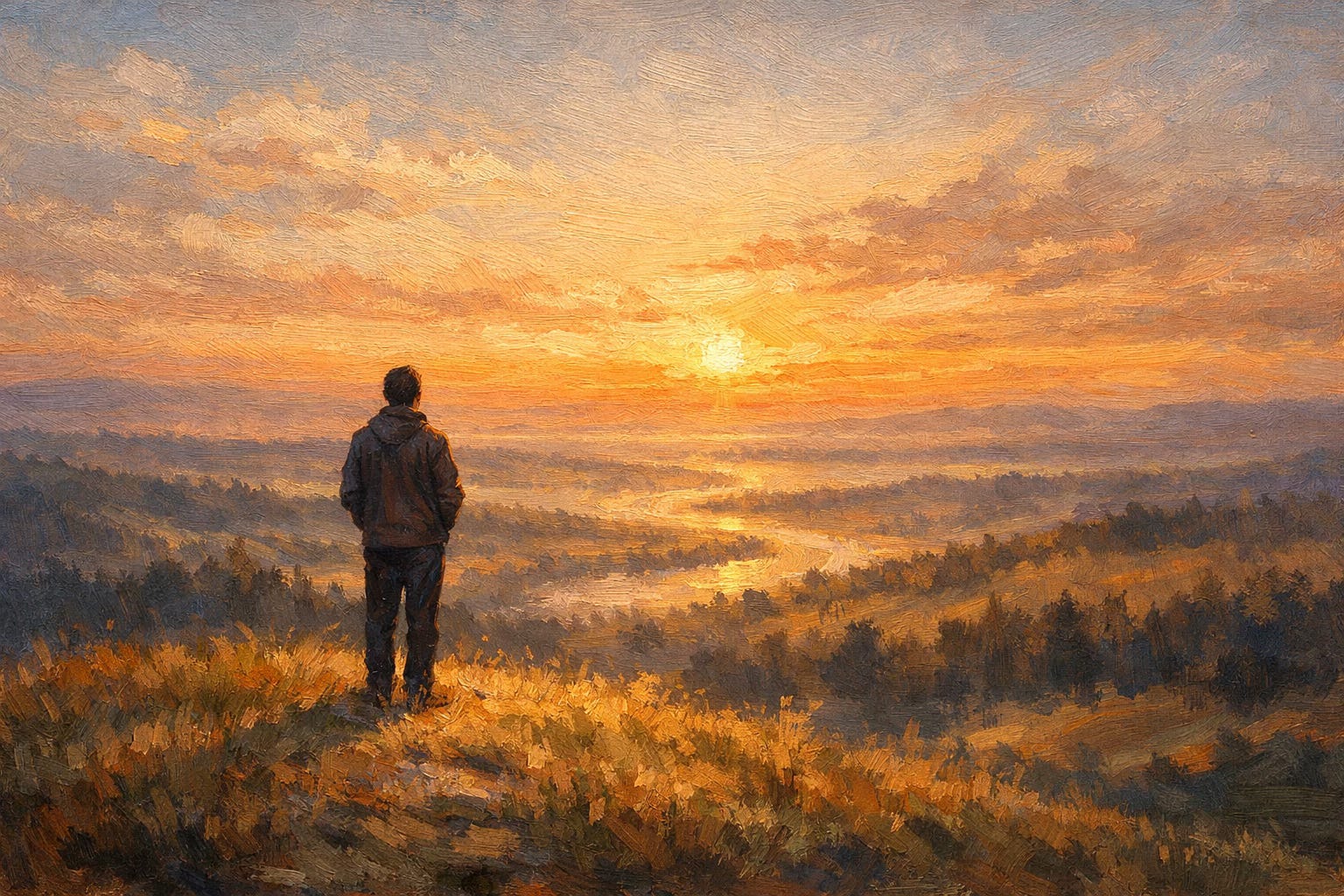
Leaving church can feel like stepping into a wide open landscape.
At first the openness may feel unsettling. The old maps are gone. The familiar language of certainty no longer fits.
But something slowly becomes visible in that open space.
Meaning was never confined to the walls of a sanctuary.
It was present in the lives we were already living. In the people we love. In the work we do. In the ways we care for one another.
The church may have claimed ownership of those things.
It never actually possessed them.
Once the door closes behind you, the world doesn’t become empty.
It becomes open.
And meaning, it turns out, was waiting there all along.
In the Next Episode
The final essay in this series steps back and looks at the long arc.
What does life look like years after leaving church. After the anger fades. After the fear settles. After the old identity dissolves.
Not the moment of departure.
But the life that comes after.
A life lived honestly, thoughtfully, and fully in the open world.
Please Support the Work
Light Against Empire is free for all. If my words have value to you and you’re in a position to help, you can chip in with a monthly or yearly donation. Your support keeps the writing alive, the lights on, and the fire burning.
Further reading:


Beautiful. Thank you Dino. Susan