


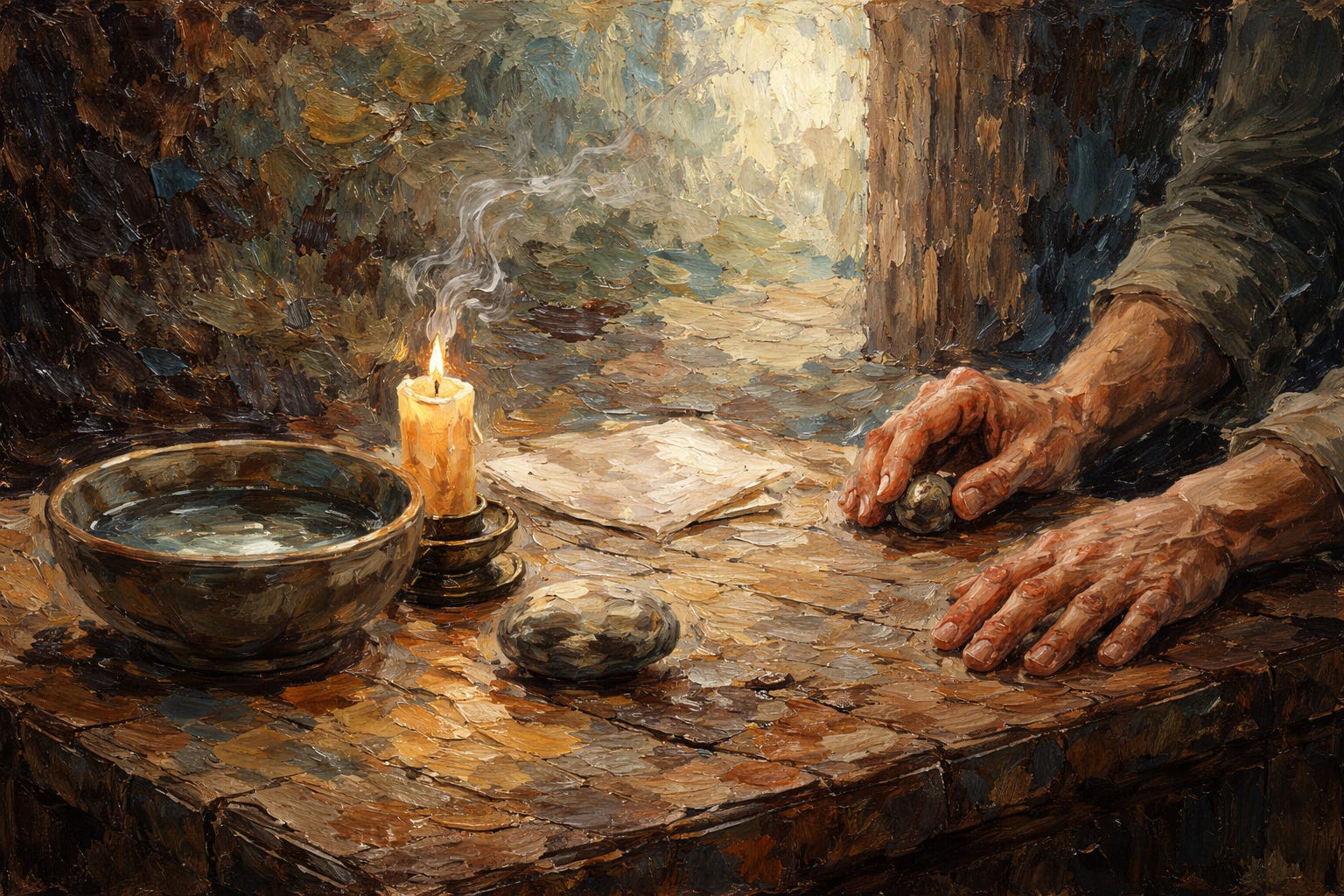
This essay is part of Life After Leaving Church, a series focused on practical ways to rebuild meaning, structure, and care after stepping away from organized religion.
Ritual Without Belief
I keep meeting people who feel a lot and don’t know what to do with it.
They aren’t numb. They aren’t disengaged. They’re flooded. Grief backs up. Gratitude flickers and vanishes. Decisions pile up like unopened mail. Endings arrive without ceremony. Beginnings happen without orientation. Everything feels important and unresolved at the same time.
We talk about it constantly. We name it. We post about it. We try to think our way through emotions that were never meant to live only in the head.
Something’s missing.
Not belief. Not doctrine. Not a return to structures we no longer trust.
What’s missing is somewhere for emotion to go.
For most of human history, ritual handled that work. Not perfectly. Not always kindly. But effectively. Ritual took what was too large, too slippery, or too heavy to carry alone and gave it form. It gave grief a schedule. Gratitude a gesture. Decisions a boundary. Change a mark in time.
When belief collapsed, ritual quietly went with it.
We kept the feelings. We lost the containers.
This isn’t an argument for faith. It’s an argument for practice.
Why Ritual Still Works
Ritual works whether you believe in anything or not. It works because your nervous system responds to structure. It works because the brain relaxes when it knows where something starts and where something ends. It works because action settles emotion more reliably than explanation ever will.
Ritual doesn’t require meaning handed down from anywhere. It requires sincerity. Attention. A willingness to do something on purpose.
That’s it.
The brain doesn’t like endlessness. Open loops exhaust it. Emotion without edges turns into noise. Ritual creates edges.
A beginning.
A middle.
An end.
That sequence alone calms the system. When you act with intention, even in a small way, your body receives the message that something’s being handled. Not fixed. Not erased. Handled.
Repetition matters too. When emotions run high, thinking gets expensive. Repeating a simple action reduces the load. You’re not deciding what to do. You’re doing the thing you already decided.
None of this requires myth. The nervous system doesn’t check your worldview before responding.
What it responds to is attention.
Which is why sincerity matters more than symbolism. The body doesn’t care if a gesture’s ancient or invented. It cares whether you’re present while doing it.
A plain action done sincerely works better than a beautiful one done on autopilot.
What Ritual Is and Isn’t
It helps to say what ritual isn’t.
Ritual isn’t superstition. It isn’t performance. It isn’t productivity wearing incense.
Ritual’s deliberate action tied to an inner state. It’s time bound. It’s chosen. You know when it starts. You know when it ends.
Borrowing religious forms often fails for secular people because borrowed meaning rarely sticks. If you don’t believe the story behind the action, your body knows it. That doesn’t mean ritual itself is false. It means it has to be yours.
You’re allowed to invent ritual. You’re allowed to discard it when it stops working. You’re allowed to revise it as you change.
There’s no authority coming to audit your process.
A few principles carry most of the weight.
Do something with your body.
Mark time clearly.
Use few words.
End decisively.
Repeat only if it still works.
Ritual isn’t loyalty. When it goes stale, let it go.
Giving Grief a Place to Land
Grief doesn’t need solving. It needs holding.
One of the cruellest lies we tell each other is that grief moves on a schedule. It doesn’t. What it does need is a place to land so it doesn’t spill into everything else.
Choose one small object that carries the weight of what was lost. Not the most important thing. Something manageable.
Set a specific time. Hold the object. Say nothing. When the time’s up, place the object somewhere intentional. A box. A drawer. A shelf. Somewhere that marks it as held rather than banished.
You’re not letting go. You’re setting it down.
Or write what you’d say if there were no consequences and no replies. Don’t polish it. Don’t reread it for meaning.
When you’re done, destroy it completely.
The act of writing externalizes the grief. The act of destruction ends the loop.
Or set a timer for ten minutes and sit with the grief without interruption. When the timer ends, stand up. Change rooms. Drink water.
Grief without limits overwhelms. Grief with limits becomes survivable.
Sometimes you’ll feel relief. Sometimes fatigue. Sometimes nothing.
Nothing still counts.
Gratitude, Decisions, and Change
Gratitude fails when it becomes dishonest.
Forced appreciation teaches the body not to trust itself. Narrow gratitude works better.
Name one specific thing you’re grateful for. Not a category. Not a personality trait. A moment. A sound. A small mercy.
Name it once. Stop.
Touch something real while acknowledging it. A table. A wall. The ground.
End the day with one small closing act. Turning off a light. Closing a notebook. Washing a cup.
Decision making’s where ritual earns its keep.
When thinking stalls, action can restart the system. Ritual doesn’t make decisions for you. It helps you accept that you’re choosing without certainty.
Name the decision. Set a fixed delay. During that time, don’t revisit the question. When the delay ends, choose.
Or walk two routes, each tied to a different option. Notice how your body feels, not what it argues.
Transitions matter for the same reason.
Pause at a doorway before entering a new phase. Name what’s ending. Step through.
If an identity’s ending, write its name down and retire it intentionally.
Choose one small action that belongs to the new chapter and do it immediately.
Marking change matters more than celebrating it.
Practice
This isn’t something to master. It’s something to try.
Choose one emotion that’s been lingering. Not the loudest one. Just the one that keeps showing up.
Choose one small action that fits it. Something simple enough that you won’t talk yourself out of it.
Decide when it begins.
Decide when it ends.
Do it once.
When it’s finished, don’t evaluate it. Just notice whether the emotion feels held, even slightly, instead of loose.
If it helped, you can repeat it.
If it didn’t, you can let it go.
Nothing’s wasted.
Sincerity Over Symbolism
This is the center of the whole thing.
Ornate ritual often fails because it demands performance. Quiet ritual works because it asks for honesty.
The test’s simple.
Would you still do this alone.
If the answer’s no, simplify it.
Ritual’s allowed to age. It’s allowed to stop. What matters is that it serves the emotion rather than replacing it.
This isn’t a system. It’s a practice.
Ritual isn’t about belief. It’s about care. Care for the parts of us that don’t speak in language.
Emotion ignored becomes noise.
Emotion given form becomes something you can live with.
Please Support the Work
Light Against Empire is free for all. If my words have value to you and you’re in a position to help, you can chip in with a monthly or yearly donation. Your support keeps the writing alive, the lights on, and the fire burning.
Further Reading:


This is lovely and wise. Rituals/Sacraments are what I miss about church.
I miss the Doxology and Gloria Patri. I miss communion and prayer. When I taught Sunday School and led youth group I incorporated the “three Rs”: Routine (structure), Ritual, and Relationship. Creating some meaningful rituals of my own, or borrowing them from my church life will be a thoughtful exercise.
Except I don’t want to be alone with my rituals.
I know church is community, but I rarely felt a part of that community. I think my natural shyness made me too self conscious to fully appreciate that what I felt (exclusion) wasn’t entirely accurate. It takes humility to fully belong in community, and I think my ego interfered with the process of belonging.
Your writing has given me a lot to consider and reconsider. Thank you.
Thank you for your thoughtful writing. I will try some of these ideas. I also recall the words of a friend I met in my protest/activist group who said “I’m just searching for community.” May we find our way.