


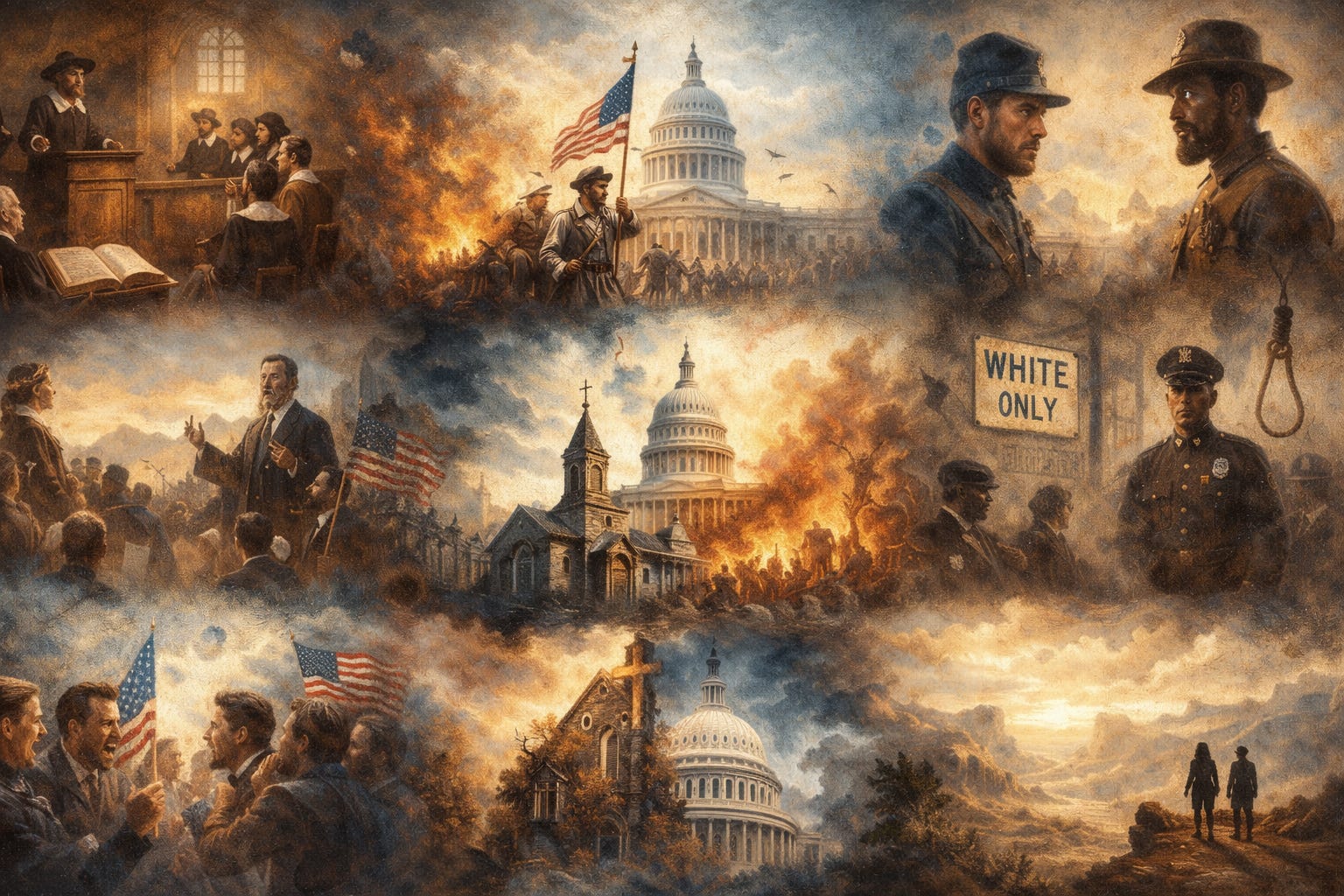
This page gathers the full seven-part series of The Puritan Spine in one place. Each essay can be read on its own, but together they trace a single argument across four centuries, following the moral temperament that shaped America before it became a nation and still shapes how it governs, divides, and imagines itself. If you’re new to the series, this is the best place to begin.
Why Read The Puritan Spine
American politics is not only shaped by laws, parties, or personalities. It is shaped by a much older emotional inheritance, a moral temperament formed before the nation itself.
The Puritan Spine traces that inheritance across four centuries, showing how habits of judgment, purity, discipline, and chosenness migrated from religion into civic life and still shape how Americans argue, divide, punish, and imagine belonging. Each essay stands alone, but together they form a single excavation of the moral architecture beneath our democracy.

Part I: a Temperament Became a Nation Before the Nation Was Born
The series begins before there was a nation to govern. This essay explores the emotional logic of early Puritan life and how its habits of scrutiny, discipline, and moral sorting settled into American culture long before the theology faded. It asks what happens when a people build a society on the assumption that the world is a moral test.

Part II: When Puritanism Disguised Itself as Freedom
The Revolution did not erase Puritan moral logic. It reframed it. This essay shows how religious covenant language evolved into civic destiny, how virtue replaced salvation, and how chosenness became national mission. America declared independence from Britain, but not from its emotional inheritance.

Part III: Puritan Logic Saturated Early America Without Anyone Noticing
As the nation expanded, secularized, and diversified, its moral temperament did not weaken. It spread. Reform movements, revivalism, frontier individualism, and market ideology all carried forward Puritan reflexes in new forms. The country became deeply Puritan in tone without naming it.

Part IV: Civil War as America’s Puritan Crisis
The Civil War was not simply a clash of opposites, but a rupture within a shared moral architecture. Both North and South interpreted suffering as proof of righteousness and believed themselves chosen. This essay examines how a shared temperament made compromise nearly impossible.

Part V: Reconstruction Hardened the Puritan Spine into Law
After the war, moral fervor hardened into structure. Reconstruction’s collapse and the rise of Jim Crow embedded judgment, hierarchy, and punishment into law. This essay traces how an emotional inheritance became institutional reality.

Part VI: Reconstruction Hardened the Puritan Spine into Law
After the war, moral fervor hardened into structure. Reconstruction’s collapse and the rise of Jim Crow embedded judgment, hierarchy, and punishment into law. This essay traces how an emotional inheritance became institutional reality.

Part VII: America Escape the Logic Its Soul Was Built On?
The final installment brings the arc forward. If America keeps reenacting a drama of purity and backlash, what would it mean to step outside that logic? This essay asks whether democracy can endure without an elect and a damned, and what humility might make possible.
Light Against Empire is free for all. If my words have value to you and you’re in a position to help, you can chip in with a monthly or yearly donation. Your support keeps the writing alive, the lights on, and the fire burning.
Further Reading:
