


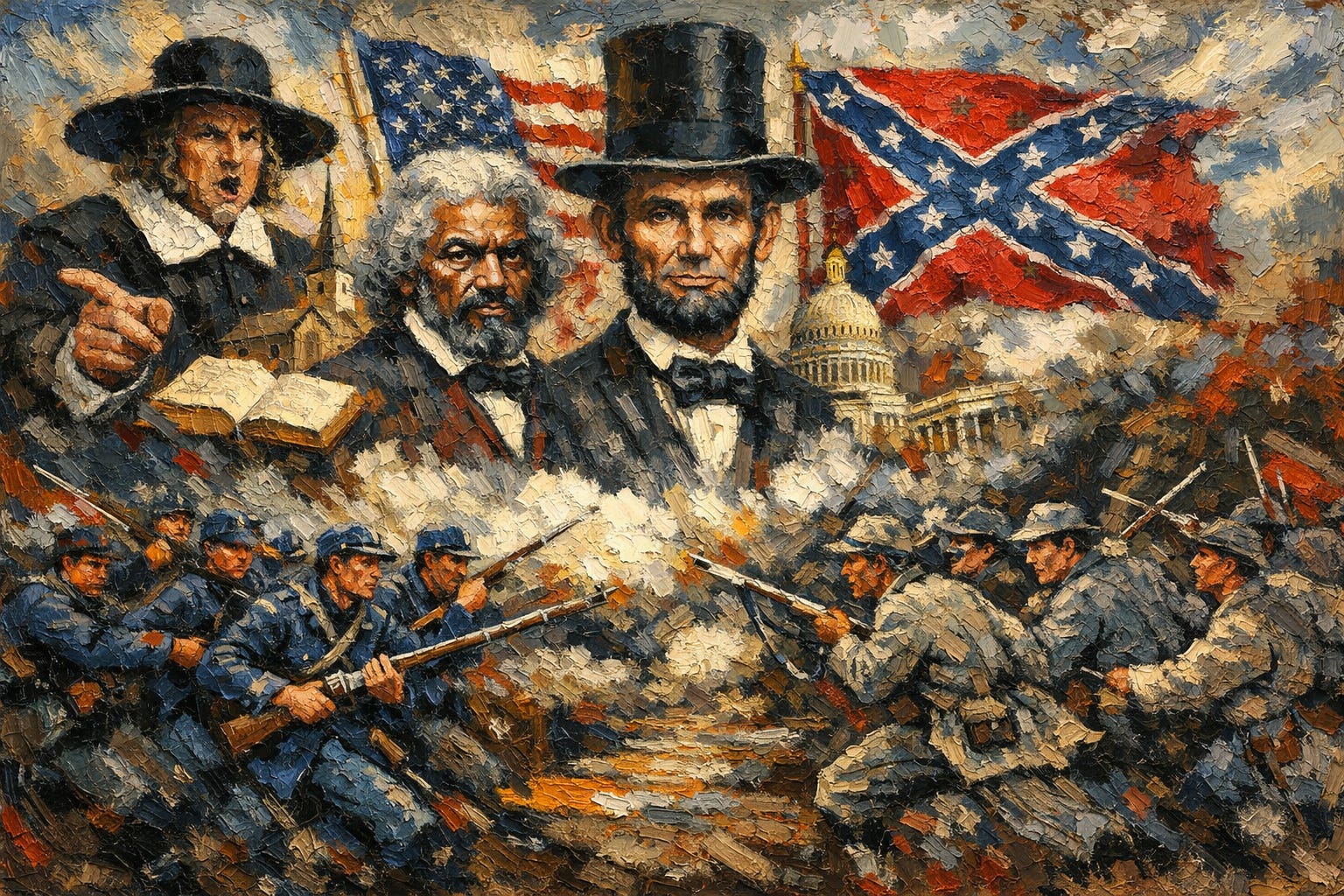
“I love the religion of our blessed Savior. I hate the corrupt, slaveholding, women-whipping, cradle-plundering, partial and hypocritical Christianity of this land.” — Frederick Douglass
The Civil War is often taught as rupture, a singular moral explosion that tore the nation in half and then, through terrible sacrifice, stitched it back together. It’s framed as the unavoidable collision between two incompatible worlds, one facing forward toward freedom, the other clinging backward to bondage. The story offers clarity. It offers villains and heroes. It offers, perhaps most importantly, closure.
But that story’s incomplete. And in its incompleteness, it hides the more unsettling truth.
The Civil War wasn’t the collision of two moral universes. It was the violent fracture of one. It was a civil war not only of geography and arms, but of temperament. A single inherited moral psychology turned inward, each side fluent in the same ethical grammar, each convinced it alone carried the true burden of righteousness.
This wasn’t a war caused by moral indifference. It was caused by moral absolutism hardened beyond political repair.
And the war didn’t kill that absolutism. It refined it.
The Same Moral Grammar, Two Incompatible Verdicts
By the middle of the nineteenth century, Americans didn’t merely argue about interests. They argued about meaning. They didn’t debate policy alone. They debated judgment.
Both North and South inhabited a moral universe shaped by inherited Puritan logic, even where formal theology had receded. History was understood as directional. Nations were moral actors. Collective fate carried moral weight. Suffering was rarely accidental. It was explanatory.
This emotional architecture didn’t require explicit belief in God to function. It worked just as effectively through appeals to destiny, progress, honor, civilization, or natural order. What mattered wasn’t doctrine but structure, the habit of interpreting events as verdicts rather than contingencies.
By the time sectional conflict intensified, both regions shared this grammar completely. What they didn’t share was the conclusion.
The North increasingly viewed the nation as morally compromised by slavery, a republic betraying its own claims. The language of sin migrated seamlessly into political life. Slavery became not merely unjust but corrosive. Its presence polluted institutions, distorted labor, warped civic life. Delay became complicity.
The South, meanwhile, didn’t reject judgment. It redirected it. It cast itself as the faithful steward of an ordered world under siege. Hierarchy was reframed as responsibility. Stability became virtue. Resistance to Northern pressure was portrayed as obedience to a higher law that transcended transient majorities.
Each side believed it was answering history’s call. Each side believed the other was either blind or faithless. And because both were working within a moral system that demanded clarity and action, disagreement quickly escalated into condemnation.
Once condemnation replaces persuasion, politics begins to fail.
The Northern Conversion, Judgment as Progress
The North’s moral transformation didn’t occur overnight. It was uneven, compromised, and often hypocritical. Racism remained entrenched. Economic exploitation continued. Political expediency shaped many decisions. Yet beneath these contradictions, a decisive shift occurred.
Slavery ceased to be framed as a regrettable inheritance and became an intolerable wrong.
This shift wasn’t simply legislative. It was emotional. Reform movements drew deeply from the inherited logic of moral urgency. If slavery was sin, then moderation was cowardice. If injustice was absolute, then compromise was betrayal. The nation was no longer merely failing its ideals. It was under indictment.
Politics began to absorb the language of revival. Conversion replaced persuasion. Moral clarity replaced negotiation. Those who hesitated were no longer cautious. They were suspect.
In this environment, suffering itself was reinterpreted. War ceased to be only a tragic possibility. It became imaginable as a purifying ordeal. Pain acquired meaning. Sacrifice became evidence.
This logic sustained extraordinary resolve. It allowed staggering loss to be borne without collapse. It gave coherence to grief. But it also narrowed moral imagination. When progress itself becomes judgment, dissent becomes obstruction. When history’s cast as a tribunal, disagreement becomes guilt.
The danger wasn’t that the North cared too much about justice. It was that justice, once fused to certainty, left little room for restraint.
The Southern Inversion, Judgment as Preservation
The South’s response drew from the same moral inheritance but turned it inward. Where the North spoke of redemption through change, the South spoke of righteousness through continuity.
Southern leaders and thinkers didn’t deny morality. They insisted upon it. They argued that social hierarchy reflected divine or natural order. That stability wasn’t cruelty but care. That dismantling inherited structures would unleash chaos, violence, and moral decay.
This wasn’t merely rationalization. It was a worldview that understood itself as moral precisely because it resisted novelty. Preservation became an ethical act. Secession was framed not as rebellion but as fidelity.
As conflict intensified, this logic hardened. The Confederacy cast itself as a righteous minority standing against an aggressive moral empire. Defeat, when it came, didn’t invalidate the story. It completed it. Suffering became sanctification. Loss became proof.
This inversion proved remarkably durable. If righteousness is measured by endurance rather than outcome, then failure can’t correct belief. It can only deepen it. Grievance becomes identity. Memory becomes armor.
The same emotional architecture that once disciplined communal life now sustained a politics of wounded honor and defiant innocence.
Why Compromise Collapsed
The collapse of compromise’s often attributed to extremism, political incompetence, or the failure of statesmanship. These explanations aren’t wrong. They’re insufficient.
Compromise requires shared uncertainty. It assumes that no party fully possesses truth, that outcomes are provisional, that governance is an ongoing negotiation among competing goods.
Puritan moral logic rejects that premise.
Its power lies in clarity. Its strength is conviction. It doesn’t ask what’s workable. It asks what’s right. And once that question’s answered, negotiation appears immoral.
By the 1850s, American politics had absorbed this logic completely. Each side believed yielding would betray not merely interest but the moral universe itself. Peace without victory looked like complicity. Delay looked like cowardice.
History, in this framework, doesn’t invite deliberation. It demands verdicts.
Once both sides adopted this posture, politics ceased to function as mediation. It became performance. Each speech addressed history rather than opponents. Each concession risked moral contamination. The war didn’t erupt because Americans abandoned morality. It erupted because they embraced it so absolutely that no shared political space remained.
The War as Moral Catastrophe, Not Moral Resolution
The war that followed was vast beyond anticipation. It destroyed slavery and preserved the Union. These outcomes matter. But they didn’t resolve the nation’s moral inheritance.
Victory sanctified certainty. The North interpreted suffering as proof that judgment had been necessary. Reflection yielded to commemoration. Complexity yielded to narrative.
Defeat didn’t dissolve Southern conviction. It transformed it. Loss was woven into a story of noble resistance and unjust punishment. The emotional architecture adapted and endured.
What didn’t occur was moral integration. The war decided outcomes without reconciling meanings. It taught the nation that violence could settle disputes without settling the narratives beneath them.
This was the deeper catastrophe.
The nation emerged territorially intact but psychologically divided. Each side carried forward its own account of righteousness, grievance, and vindication. The architecture that made compromise impossible before the war now made reconciliation shallow afterward.
The war closed a chapter. It didn’t end the book.
What Survived the Battlefield
After the fighting ended, the Puritan emotional architecture remained. It didn’t soften. It reorganized.
Moral certainty hardened into ideology. Grievance became heritage. Memory was curated rather than examined. Redemption was deferred, declared premature, or endlessly postponed.
The nation learned to live with unresolved judgment. It learned to distribute moral clarity unevenly. It learned to invoke history selectively.
This wasn’t reconciliation. It was containment.
The architecture survived because it was useful. It animated reform movements. It fueled resistance. It provided moral energy during crises. But it also preserved the habit of absolutism. The reflex to divide the world into innocence and guilt. The suspicion of compromise. The confidence that history would choose sides.
The Civil War didn’t extinguish this temperament. It taught it new forms.
Closing Beat
The war ends.
The moral temperament doesn’t.
The Puritan emotional architecture survives the battlefield, divided but alive.
Still righteous.
Still aggrieved.
Still convinced history will vindicate someone.
It doesn’t disappear.
It waits.
It adapts.
It prepares for its next transformation.
And the nation, whether it recognizes it or not, carries it forward.
A Question for the Reader
If the Civil War was a conflict between two versions of moral certainty, not between morality and immorality, what does that suggest about how we handle moral disagreement now?
Recommended Reading
This Republic of Suffering
A study of how the Civil War reshaped Americans’ relationship to death, sacrifice, and meaning. Faust shows how mass suffering forced both North and South to reinterpret loss as moral proof, spiritual trial, or national obligation. The book pairs perfectly with this essay’s claim that suffering didn’t resolve moral conflict but hardened it, giving grief a political and ethical afterlife that still shapes the country.
Battle Cry of Freedom
A 1988 historical study by historian James M. McPherson. Published by Oxford University Press, it offers a sweeping, single-volume account of the American Civil War and its antebellum origins. The book won the Pulitzer Prize for History and is widely regarded as the definitive synthesis of the conflict’s political, social, and military dimensions.
Redeeming America
Lienesch follows the evolution of religious and moral political thought from the colonial period through national crisis, showing how redemption narratives migrated into secular politics. He connects Puritan inheritance to later reform movements and national self-understanding, including the Civil War era, where political conflict was framed as moral trial rather than policy dispute.
The American Jeremiad
This is the keystone text for understanding how Puritan moral logic survived long past Puritan theology. Bercovitch traces how the jeremiad, the rhetoric of collective sin, judgment, and promised renewal, became America’s default moral language. While the book doesn’t narrate battles, it explains precisely why the Civil War could be framed by both sides as righteous suffering in service of destiny. It’s the best single explanation for how moral absolutism made compromise feel like apostasy.
Coming Next in The Puritan Spine
We move into the aftermath, where victory failed to produce moral settlement and defeat hardened into grievance. Reconstruction wasn’t simply a political project. It was a moral reckoning the nation didn’t know how to complete.
Old certainties didn’t dissolve. They scattered.
Redemption was promised, delayed, and quietly abandoned.
Judgment remained, but responsibility blurred.
What follows isn’t healing. It’s a meandering drift.
This next essay explores how the Puritan emotional architecture, fractured by war, reassembled itself in new forms, shaping memory, resentment, reform, and retreat. The battlefield went silent. The moral struggle didn’t.
History didn’t close the case.
It changed the venue.
Please Support the Work
Light Against Empire is free for all. If my words have value to you and you’re in a position to help, you can chip in with a monthly or yearly donation. Your support keeps the writing alive, the lights on, and the fire burning.


