


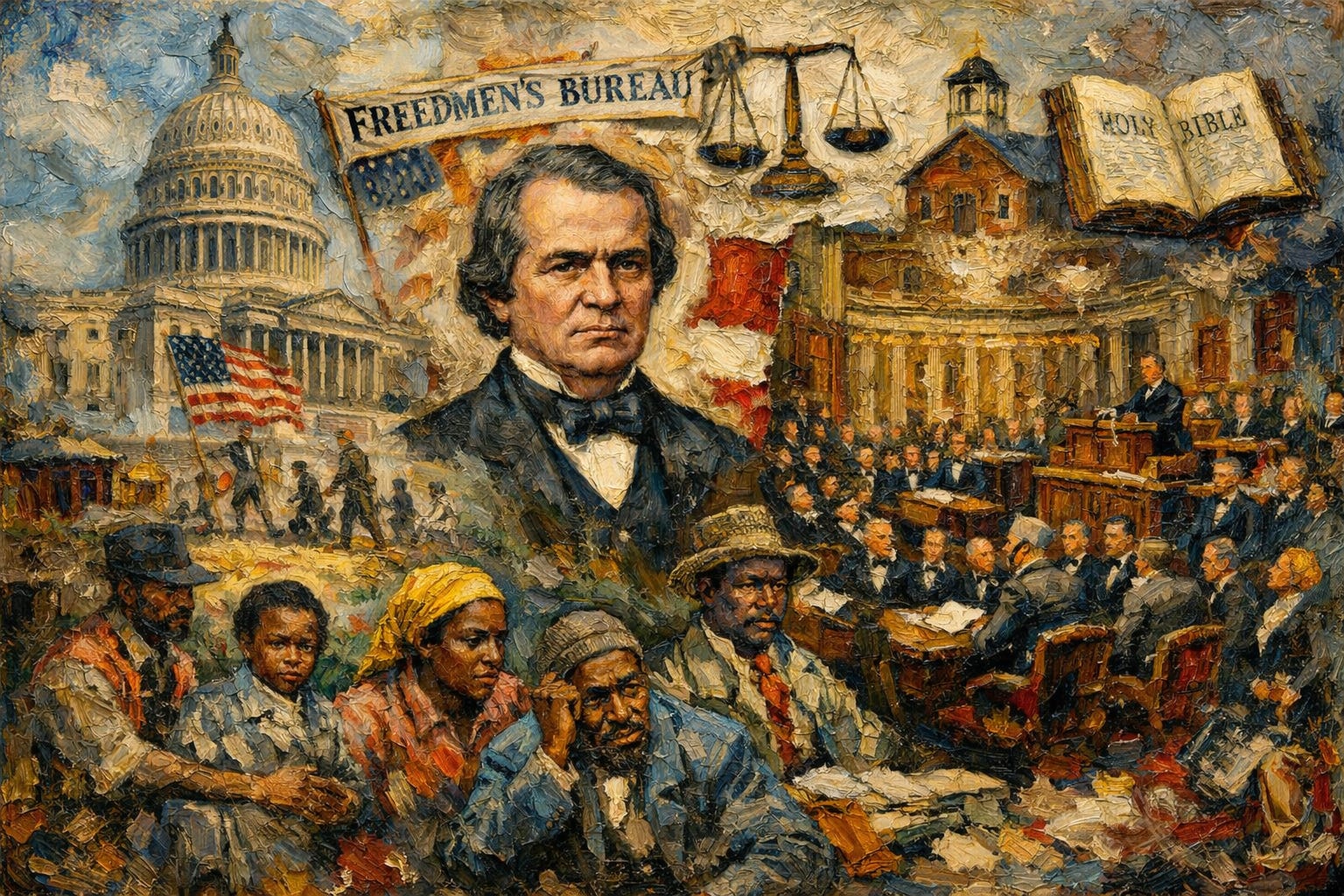
The slave went free, stood a brief moment in the sun, then moved back again toward slavery.”
— W. E. B. Du Bois
Opening
The Civil War ended with surrender. It didn’t end with understanding.
That difference matters more than we usually allow.
When the guns fell silent, the republic stood in a rare and dangerous place. It’d survived its own tearing. It’d been forced to see, without illusion, what its moral architecture had produced. Slavery hadn’t been an accident or a regional quirk. It’d been defended by law, justified by theology, protected by commerce, and tolerated by those who benefited while claiming distance.
The war burned that truth into the national body.
And then, almost immediately, the country began looking for a way not to look anymore.
Reconstruction’s often described as a period of rebuilding, of legislation, of administrative effort. That description misses the point. Reconstruction wasn’t primarily technical. It was a moral trial. It asked whether the nation would finally apply its inherited moral logic to itself, or whether it’d once again redirect judgment downward, absolving power while disciplining those already wounded.
For a brief moment, the answer wasn’t yet decided.
Then the country chose relief over reckoning, quiet over clarity, unity over truth.
What followed wasn’t reconciliation. It was absolution without repentance.
The Puritan spine didn’t break in this moment. It learned how to remain upright without bearing weight.
Reconstruction Was a Moral Trial, Not a Policy Era
Reconstruction failed because we’ve misnamed what it was.
We tend to treat it as a policy era that ran out of political will. Amendments were passed. Governments formed. Troops were stationed. Schools opened. Then support thinned. The project collapsed. History moved on.
That framing’s comfortable. It turns moral abandonment into logistical fatigue.
But Reconstruction was never about paperwork. Law was the instrument, not the aim. The deeper question was whether the same moral seriousness once applied to individual sin would finally be applied to collective power. Whether a society built on moral accounting would now account for itself.
That question proved unbearable to those who’d won.
Victory brought exhaustion, not humility. Survival began to feel like vindication. The blood already shed was treated as payment enough. The ledger, it was decided, could close.
But a ledger closed without reckoning doesn’t disappear. It’s hidden.
Reconstruction didn’t demand perfection. It demanded honesty. It asked the nation to name what it’d built, who’d benefited, and who now deserved repair rather than supervision.
What failed wasn’t Reconstruction’s ambition. What failed was power’s willingness to feel shame.
The Invention of American Innocence
After the war, a new story quietly took hold.
The country had suffered enough.
That belief carried a devastating implication. Suffering itself became proof of virtue. Endurance replaced accountability. Survival replaced confession. The fact that the Union had held together was treated as moral exoneration.
This’s where American innocence is born.
Not innocence as ignorance, but innocence as entitlement. The belief that hardship cleanses without transformation. That paying a price once entitles a nation to stop paying attention. That pain endured erases responsibility owed.
Forgiveness arrived without confession. Unity was declared without justice. Healing was announced without asking who’d been wounded or who remained exposed.
The Puritan moral instinct didn’t disappear. It narrowed. Judgment remained fierce, but it was aimed safely away from systems and upward power. Moral scrutiny was preserved for individuals, especially those already burdened.
Exceptionalism changed shape here. It stopped meaning “we’re bound by higher standards” and became “we’ve already paid our dues.”
Once that shift occurs, reckoning becomes unnecessary. Memory becomes optional.
When Moral Energy Enters the Market
Moral language doesn’t vanish when it leaves public life. It relocates.
As Reconstruction faltered, another register of judgment grew louder. Work ethic. Discipline. Productivity. Self reliance. These ideas were inherited, but now they carried the full weight once borne by spiritual reckoning.
Virtue was measured in output.
Worth was measured in accumulation.
Failure was framed as personal deficiency.
This wasn’t a rejection of Puritan logic. It was its continuation by other means.
Where salvation’d once been read in signs of election, it was now read in material success. The market became the new moral tribunal. Prosperity signaled worthiness. Poverty signaled failure, not dispossession.
This transfer accomplished something powerful. Judgment was preserved while responsibility vanished. If outcomes reflect merit, then systems require no examination. History requires no repair.
Reconstruction’d asked the nation to confront structural injustice. The market offered an easier story. Everyone stands where they belong.
Moral clarity survived. Moral courage didn’t.
Compromise Becomes Culture
Reconstruction didn’t end with a single betrayal. It ended through accumulation.
Each compromise felt reasonable on its own. Federal responsibility was reduced in the name of harmony. Enforcement softened in the name of restraint. Moral obligation was quietly handed back to local authority.
States’ rights became a way to avoid national conscience. Order became more important than justice. Peace became more valuable than truth.
The violence that followed wasn’t spectacular. It was procedural. Embedded in routine. Normalized by distance.
This’s how a society learns to function while lying to itself.
By the time Reconstruction officially ended, the moral work’d already been abandoned. What remained was governance without accountability, memory without inheritance, and law without moral imagination.
The Puritan spine didn’t resist this turn. It’d always prized order. It’d always trusted hierarchy. It’d always been uneasy with disruptions that threatened stability, even when justice demanded them.
Order Without Justice
A society can endure enormous contradiction if it values stability above all else.
After Reconstruction, the United States perfected this skill. Institutions held. Elections continued. Courts functioned. Commerce expanded. Normalcy returned.
But justice was no longer the measure. Order was.
This shift allowed violence to be regulated rather than confronted. Exclusion to be managed rather than dismantled. Inequality to be explained rather than repaired.
Law replaced conscience. Procedure replaced responsibility. The system learned how to keep moving without asking what it was preserving.
This isn’t moral collapse. It’s moral efficiency.
The Puritan spine thrives here. It loves rules. It loves discipline. It loves clarity about who stands where. What it resists is upheaval that exposes inherited advantage.
Reconstruction represented that threat. Its abandonment ensured that future demands for justice’d be framed as disorder rather than necessity.
Memory Managed Instead of Inherited
What a nation remembers determines what it can confront.
After Reconstruction, memory didn’t disappear. It was curated. The war became a story of shared suffering rather than moral rupture. Reconstruction became a story of overreach rather than abandonment.
This’s how forgetting becomes patriotic.
The past’s smoothed. Conflict softened. Responsibility dissolved into atmosphere. What remains is resilience unburdened by accountability.
When memory’s managed rather than inherited, continuity vanishes. The present appears disconnected from its origins. Inequality seems accidental. Violence seems aberrational.
The Puritan spine depends on memory. But it prefers selective memory. Memory that affirms order. Memory that absolves power. Memory that warns individuals while excusing systems.
Reconstruction threatened that preference. It demanded honest inheritance. Its failure ensured that future generations’d inherit outcomes without context.
The Spine That Learned to Disguise Itself
By the end of Reconstruction, the Puritan structure hadn’t collapsed. It’d adapted.
Moral certainty remained. Judgment remained. Hierarchy remained. What disappeared was responsibility upward.
The nation retained confidence in its righteousness while abandoning the work required to sustain it. The spine stood straight, but it no longer carried weight.
This adaptation explains what follows. Why moral language remains fierce but selective. Why order’s defended even when unjust. Why suffering’s acknowledged but rarely repaired.
The reckoning wasn’t lost. It was deferred
Closing Beat
The Cost of What Was Left Unfinished
Reconstruction didn’t fail. It was abandoned.
The consequences weren’t immediate. They were generational. They settled into habits, institutions, and stories we still repeat.
What America refused to face then didn’t disappear. It waited.
The Puritan spine still holds the nation upright. But until reckoning replaces innocence, it’ll do so without mercy, without honesty, and without courage.
The ledger remains open.
A Question for the Reader:
Where have we mistaken survival for innocence, and what did that allow us to avoid?
Recommended Reading:
Reconstruction: America’s Unfinished Revolution, 1863–1877
The definitive account of Reconstruction as a moral and political crossroads, not a footnote. Foner shows how genuine possibilities for justice were consciously abandoned, and how that abandonment shaped American law, race, and power for generations.
The New England Mind
A deep examination of the moral logic inherited from Puritanism itself. This book helps readers see how habits of judgment, order, and certainty survived even as responsibility drifted away from power.
Coming Next in The Puritan Spine
If Reconstruction marked the moment America chose order over reckoning, the next chapter shows what that choice produced.
As moral responsibility retreated from public life, it did not disappear. It hardened. It reorganized itself around industry, expansion, efficiency, and control. The language of virtue moved from the soul to the system, from confession to productivity, from justice to results.
The next essay traces how the Puritan spine reshaped itself for the modern age, blessing growth without restraint, power without accountability, and success without memory.
This is where moral certainty becomes machinery.
This is where innocence learns to scale.
Please Support the Work
Light Against Empire is free for all. If my words have value to you and you’re in a position to help, you can chip in with a monthly or yearly donation. Your support keeps the writing alive, the lights on, and the fire burning.
Further Reading:


