



What Krugman Got Wrong About Why We Lose
This piece started as a response to something Paul Krugman wrote about Iran, drones, and the four-million-dollar missiles we’ve been using to shoot down thirty-five-thousand-dollar ones. It’s turned into something bigger than that, so let me walk you through where it’s headed before I ask you to come along.
Earlier this year I wrote a seven-part series called The Puritan Spine, about how the moral bones of New England’s first settlers never really left American life, they just stopped announcing themselves. The need to sort the elect from the damned. The itch to put a face on disorder. The habit of reading every outcome as a verdict instead of an accident. That series was history, four hundred years of it, and it ended on a hard question, whether a country built to police individuals can ever learn to look at its systems instead.
This piece is about watching that same old habit at work right now, in the writing of a Nobel laureate, over a war most of us are still trying to wrap our heads around.
Here’s where I land. Krugman’s right that Trump and Hegseth are vain, boastful men running a war machine neither one understands. He’s wrong that they’re the disease. They’re the fever, the part you can see, showing up once something underneath has already broken down. The system that let four-million-dollar interceptors chase thirty-five-thousand-dollar drones for a decade wasn’t built by either man and won’t get torn down by whoever comes next either. We built it. People like us, voting like us, looking away like us, generation after generation, because a villain was always easier to find than a mirror. And it won’t get fixed by blame. It gets fixed, if it ever does, by folks refusing to let their representatives off the hook, again and again, long after the news has moved on to the next name. That’s my case. Let me walk you through it.
The number that should embarrass everyone
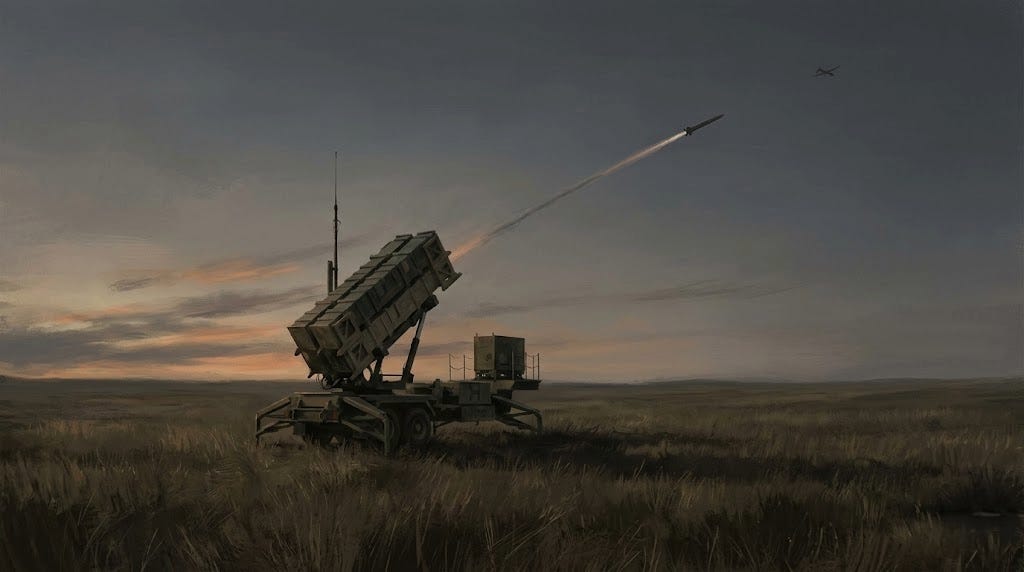
Start with the number Krugman ran. Four million dollars to shoot down a $35,000 drone. That ratio isn’t a fluke. It’s the Patriot missile system, and it’s been the Patriot missile system for years, through administration after administration, through secretaries of defense who came and went, through congressional oversight committees that had the data sitting right in front of them and renewed the contracts anyway.
In any sane system, a weapons program that costs that much against a target that cheap gets killed, or at least gets seriously reworked. Somebody loses a job. A line item gets cut. That’s not what happens here. It never happens here. The cost overrun gets read as seriousness. The years of delay get read as rigor, proof the engineers are being careful instead of proof the program’s failing. A budget that keeps ballooning past every projection becomes its own evidence the work must matter, the same way a rising GDP number gets treated as a sign of national health no matter who it’s actually reaching or what it’s actually measuring.
Nobody in Washington has to defend the Patriot system on what it does. Its budget is the defense. Sit in on next year’s appropriations hearing and you’ll watch it happen live. Some senator looks down at a line that’s tripled since the last markup, nods, and votes yes, because a number that big has to mean something’s working. Nobody at that table asks about the kill ratio. The question never on the floor is whether this still makes sense against a $35,000 drone. The question is how much more it needs.
Spending as sacrament
Here’s where the older pattern shows up, the one I spent seven essays chasing back to its root. Once you secularize moral judgment, prosperity starts looking like worthiness and poverty starts looking like failure instead of bad luck. The market becomes the new courtroom. The same logic that decides whether a person deserves what they’ve got eventually decides whether a program deserves what it’s been given. A defense budget that keeps growing doesn’t read as a problem. It reads as proof the program’s doing something right, because in this country, growth has always run awfully close to grace.
That’s not corruption in the simple, somebody’s-stealing sense. It’s a religion working exactly the way it was built to work, where spending is the sacrament and growth is the proof, and asking whether the thing being funded actually does its job starts to feel a little like asking whether the bread on the altar really transforms. You don’t interrogate a sacrament. You take part in it or you don’t, and refusing is what marks you, not the sacrament itself.
That’s also why almost nobody in either party will say out loud, on the record, that the whole acquisition system is broken. Not because they don’t know. The folks inside that system know better than anyone how badly the math fails. They don’t say it because the system’s been built, contract by contract, hearing by hearing, to make saying it feel like an attack on something sacred instead of an observation about a spreadsheet.
Why criticism reads as betrayal
There’s a second layer that makes this even harder to say out loud, and it’s not about money. It’s about the flag.
Defense spending doesn’t sit in the same bucket as farm subsidies or highway funding. It’s wrapped in patriotism so tight that questioning the program can feel, to plenty of folks, indistinguishable from questioning the soldier standing next to it. Support the troops turns into support the contract. Nobody planned that on purpose, most of the time. It just happened, the way sacred things pick up protection without anybody ever formally voting on it.
That’s the trick that lets a senator who privately knows a weapons program is obsolete vote for it anyway. Not because the senator’s corrupt, though sometimes that’s also true, but because killing the program reads, to a base watching for betrayal, like turning your back on the military itself. You can’t audit a symbol. You can only honor it or get accused of dishonoring it, and most politicians, like most of us, pick whichever option doesn’t get them called a traitor on cable news.
So you end up with a defense budget guarded by two kinds of reverence at once. One says the spending itself proves the program’s sound. The other says any challenge to the spending is a challenge to the country’s honor. Squeeze between those two and there’s almost no room left for the plain, boring, necessary question of whether the thing actually works.
The instinct underneath the instinct
Here’s the part that took me longest to see clearly, even after seven essays circling it. There’s a difference between moral accounting and moral policing. Accounting asks how we’re doing. Policing asks who failed. The first one leaves room to grow. The second wants a verdict, and wants it now.
This country was built by people running a moral accounting system, watching for signs of grace, reading outcomes as evidence. Somewhere along the way, watching curdled into something harder. Once moral order becomes a thing that has to be guarded instead of grown, disorder stops being a question. It’s a threat now. Correcting it quietly isn’t enough anymore. Somebody has to be seen paying for it, or the whole order feels shaky.
That’s the same shift sitting underneath every defense hearing where the spending gets protected and every newspaper column where the blame lands on one man instead of the machine he inherited. Disorder doesn’t stay nameless for long around here. It gets a face, fast, because a face is something we know how to deal with, and a forty-year procurement culture isn’t.
Why Krugman, of all people, missed it
Here’s what makes this worth chewing on instead of filing away as one more broken system among the rest. Paul Krugman’s spent a career, a Nobel-Prize-winning one, explaining that systems behave according to their incentives and their structure, not according to the personal virtue or vice of whoever’s currently running them. That’s the whole discipline, stripped down to the studs. Incentives over individuals. Structure over story.
So when he looked at the most expensive, most embarrassing military failure in a generation and reached first for Trump’s vanity and Hegseth’s costume warrior routine, it’s worth asking why he didn’t reach for the explanation his own training would normally favor. I don’t think it’s because he doesn’t know better. I think it’s because the villain explanation is the one his readers, and most readers, actually want.
A villain can get voted out. A forty-year procurement culture, propped up by sacred spending and sacred symbolism both at once, can’t be voted out. It can only be slowly, expensively, unglamorously rewired, with no triumphant headline waiting at the end of it. That doesn’t satisfy the part of us still listening for a verdict. It never has, not since the first sermon about who’d fallen from grace and who hadn’t.
The mirror
Here’s where this gets uncomfortable, and not just for Krugman.
If you read his piece and nodded along at Trump’s name, you weren’t doing anything different than what folks did for generations before you with whatever name fit the moment. You wanted the villain too. The villain comes with an exit. Vote him out and the story’s got an ending you can point to. Diagnose a forty-year disease running through a procurement system, a defense lobby, and a culture that can’t tell spending from virtue or criticism from betrayal, and there’s no ballot box waiting at the end of that sentence. There’s just the slow, unglamorous work of agreeing the thing’s broken at all, and most of us would rather have the verdict than do that work.
I’ll put myself inside that sentence before I stand outside it pointing fingers. My four decades in military and civil service taught me the same lesson over and over, that it’s a lot easier to find the one bad actor in a broken system than to admit the system was built to produce him. A bad actor can be removed, publicly, with consequences everybody can see. A system that keeps producing bad actors has to be rebuilt from the studs, and rebuilding doesn’t come with a perp walk waiting at the finish line. It comes with years of unglamorous work nobody writes a victory lap column about.
So when I say Krugman left something on the table, I’m not standing apart from the habit he’s working inside. I’ve caught myself reaching for the individual instead of the institution plenty of times, because the individual was right there in front of me and the institution was hard to see whole, scattered across decades and committee rooms and budget lines that never make the evening news. The pattern doesn’t spare the person pointing it out. That’s exactly what makes it a pattern instead of just somebody else’s mistake.
Now what
I don’t have a program to hand you here, and I’d be the first to question anyone who claims they do. This isn’t a problem ten thousand people fix by showing up at the right rally, and it isn’t a problem one good president fixes by signing the right order. Eisenhower warned us about this exact machine in 1961, on his way out the door, and we didn’t listen then either. The system we’re talking about has had sixty-some years to root itself deeper since that warning, one quiet decision at a time. It’ll take something close to that long to unbuild, if it ever gets unbuilt at all.
We don’t need less moral seriousness about how this country spends its money or fights its wars. We need to quit confusing the spending itself with the virtue, and quit treating every failure like a character flaw looking for a face to wear. That’s not throwing the whole inheritance overboard, not the seriousness, not the discipline, not the conviction that got us this far in the first place. It’s learning to carry all of that without needing it to end in somebody’s perp walk. And it means calling your representative often enough, plainly enough, and persistently enough that ignoring the question costs more than answering it.
“The nation” isn’t some separate thing waiting on somebody else’s reform. It’s the running total of what each of us is willing to look at honestly and what we’re not. A nation that keeps choosing the villain over the diagnosis is just a pile of individual readers choosing the villain over the diagnosis, one column, one comment section, one dinner table argument at a time. That includes me, writing this. It includes you, reading it. The only discipline either of us actually has is refusing to let the name be where the thinking stops.
Somewhere, a long way from any appropriations hearing, taps is playing. Not for a soldier this time. For the system that called his death the cost of doing business, and for a country still too busy naming villains to bury it.
Friends, if my writing has been worth your time, buy me a one-time Ko-Fi below. It goes a long way toward keeping the writing free for everyone.

Further Reading:
Some of my conclusions in the above article were drawn from The Puritan Spine.


One of your best.....thank you!