


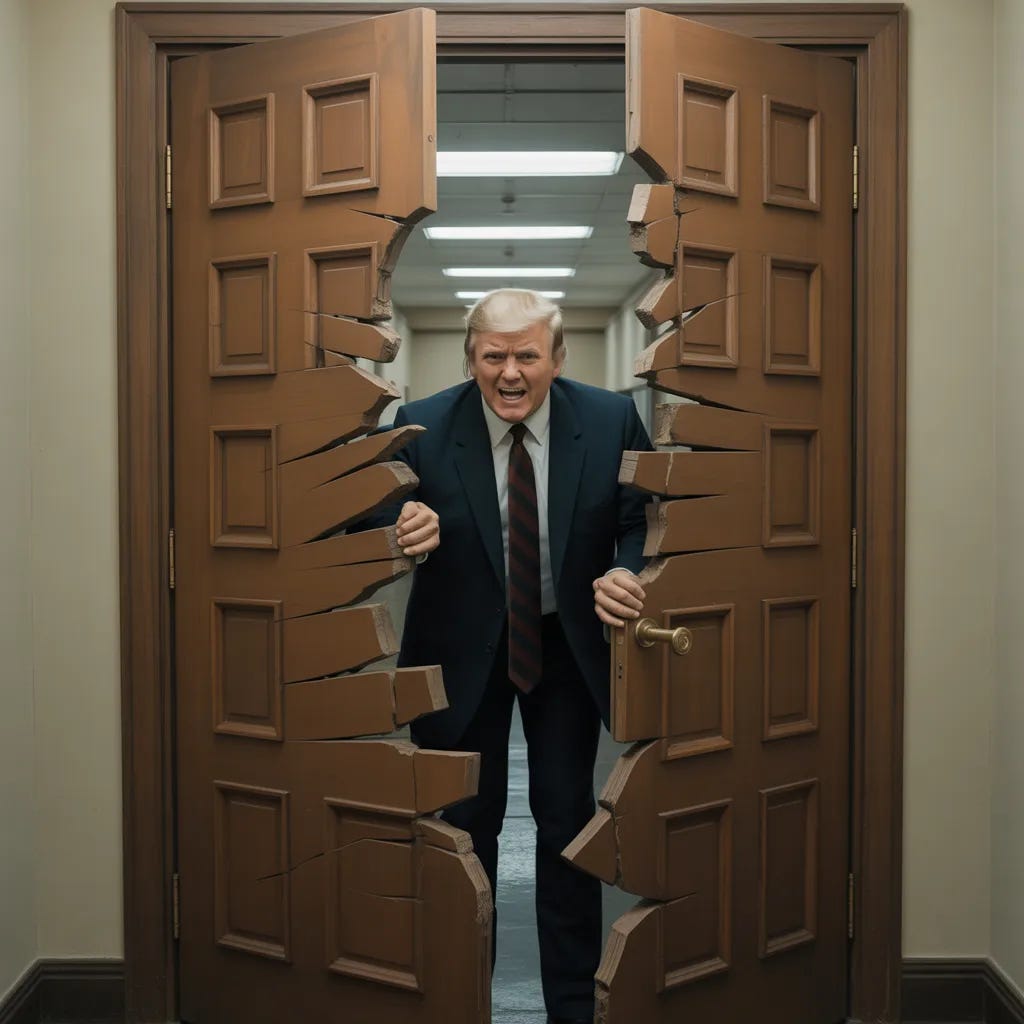
"The late, great Hannibal Lecter. He's a wonderful man."
There is a particular comfort in the dementia explanation. I understand why the opposition landed there and why it stuck. It arrives pre-loaded with a kind of moral softening we extend almost instinctively to people whose minds appear to be failing. The word salad, the repetition, the apparent confusion, the Hannibal Lecter endorsements delivered with genuine warmth at campaign rallies. “He’s a wonderful man. He oftentimes would have a friend for dinner.” It’s easier, emotionally, to file that under cognitive decline than to sit with the alternative.
The alternative is harder. It requires us to say the quiet part out loud, in print, under our own names.
Wendy Lawrence did exactly that this week. Her piece ( see below) is the clinical argument the opposition has been too comfortable to make, and I want to extend it, not because I have the professional credentials she brings to the page, but because the pattern she identified deserves more voices willing to follow it to its conclusion. I’m a former federal analyst, not a clinician. What I bring is two decades of reading complex records carefully and a tolerance for conclusions that make people shift in their seats.
So let me tell you what the record shows, read against the clinical framework Wendy established.
The dementia frame rests on a category error. Wendy’s piece draws the clinical distinction precisely: degenerative disease progresses through structural collapse, neurons die, connections fail, the decline is directional and irreversible. What the observed behavioral record describes is a different mechanism entirely. Stimulant exposure, chronic sleep deprivation, long-term pharmacological disruption of prefrontal function. The symptoms can look similar from the outside. Word salad is word salad. Repetition is repetition. But the mechanisms are nothing alike, and the distinction isn’t academic.
Degenerative disease erases a person. Stimulant-driven disruption amplifies one.
Martha Stout, the Harvard-trained clinical psychologist whose work on sociopathy remains a foundational text in the field, defines the condition as the complete absence of conscience operating alongside predatory social intelligence. Not diminished conscience. Absent. The configuration generates sustained, calculated harm without internal restraint, and it does so across time, not in episodes, not in clusters of bad years, but as a consistent operating architecture. When you run stimulant disruption through that foundation, with the prefrontal brakes already compromised and the dopaminergic system running hot, you don’t get deterioration. You get amplification of what was already there.
That’s the argument Wendy makes. I believe she’s right. And the evidentiary record across decades, not the last few years of political life, supports it with a consistency that deterioration cannot explain.
Start with what’s sworn. A 1990 divorce deposition placed allegations of physical aggression, coercion, and forced sexual contact into the legal record. Contemporaneous reporting carried those claims into public view. Whatever subsequent clarifications addressed in terminology, the underlying description remained in sworn testimony, placed there by a woman under oath. That’s 1990. Whatever cognitive decline the opposition wants to date the onset of, it wasn’t 1990.
Move forward to the Howard Stern appearances, documented across recordings from 1993 through 2015. Explicit commentary about a daughter’s developing body. Comparisons between avoiding sexually transmitted infections and the experience of combat. Sexual boasting delivered without hesitation or social filter across more than two decades of appearances. These aren’t episodes of confusion. They’re a behavioral signature, consistent, unguarded, and repeated across an enormous span of time.
The DSM-5 criteria for Antisocial Personality Disorder include persistent disregard for the rights of others, deceitfulness, impulsivity, irritability, aggressiveness, reckless disregard for the safety of others, and consistent irresponsibility. The clinical literature is careful to note that a formal diagnosis requires professional evaluation. I’m not offering one. What I’m offering is the observation that a documented record spanning thirty-plus years maps onto those criteria with a consistency that a reasonable person can identify without a medical license.
In 2023, a federal jury found liability for sexual abuse and defamation in Carroll v. Trump. The court affirmed conduct consistent with rape under common understanding. This wasn’t a political finding. It was a civil jury evaluating evidence and reaching a conclusion. Add it to the ledger.
Then there is the Jane Doe complaint. Filed in federal court in 2016. Alleging that Donald Trump raped and physically struck a thirteen-year-old child at parties connected to Jeffrey Epstein, a financier federal prosecutors would later characterize as operating a systematic sex trafficking enterprise constructed to isolate minors from every institution capable of protecting them. The complaint alleged not a single act but a sustained campaign: binding, striking, explicit death threats delivered to a child to ensure her silence. A second minor alleged to have been present and subjected to the same conduct. The complaint was withdrawn before adjudication. No court evaluated the evidence. No findings were issued.
I want to be precise about what that means and what it doesn’t. It means no court resolved the question. It does not mean the complaint evaporated. It exists in the federal record. And a child too frightened to proceed, in a documented pattern that includes NDA-enforced financial settlements, litigation threats against adult accusers, and decades of applied financial pressure against women who spoke publicly, is not the same as a complaint without weight. The withdrawal fits the pattern as cleanly as everything else in the record.
Read together, these data points don’t describe a man whose mind is going. They describe a man who has operated this way across his entire adult life, inside whatever thin constraints wealth and lawyers and enforced silence provided, until the constraints were removed entirely. The stimulant disruption Wendy documents doesn’t explain the 1990 deposition. It explains why the volume is higher now. The brakes were cut. The engine was always this.
Which brings me to what the dementia frame costs the opposition, and this is the argument I don’t think has been made clearly enough.
When you locate the problem in biology, you imply that a younger, healthier version would have been acceptable. You shift the accountability from the man to the mechanism. You extend, however unconsciously, the same moral softening we give to people whose minds are genuinely failing them, to a person whose record suggests something categorically different. The dementia frame isn’t just clinically imprecise. It functions as a partial exemption. And the opposition has been handing it out for years while calling it analysis.
The frame also let the rest of us off the hook for having chosen it. The depositions were reported. The Carroll verdict was front page. The Jane Doe complaint was filed in federal court and covered by journalists who understood exactly what they were reading. None of this was hidden. We reached for the dementia frame because the correct one made demands we weren’t prepared to meet. It implicated the party apparatus that rationalized him, the media organizations that covered the word salad and left the depositions in the archive, and every one of us who looked at the record and decided the discomfort of the truth was someone else’s problem to carry. We chose the frame that cost us the least. What it cost us was the reckoning.
On April 1, 2026, Trump delivered a primetime address fusing claims of resolution with explicit escalation threats, asserting unilateral authority over the use of force, presenting closure as imminent while preserving every option for immediate expansion. “We are very close to finishing this, but if they move even slightly, we will hit them harder than ever before.” That’s not confusion. That’s control, performed for an audience, calibrated to the moment. The accordion hands Michael Cohen identified across years of direct proximity as the physical tell of active deception were presumably present. The performance was intact.
Wendy closed her piece with the line that should be posted above every editorial desk covering this story. The grip tightens while misdiagnosis holds the door open.
The door has been open a long time. Wendy’s right that misdiagnosis held it there. What she’s too generous to add is that a lot of us felt the draft coming through and called it weather.
Federal lawsuit filed: June 20, 2016. Withdrawn: November 4, 2016. Four days before the election. No court evaluated the evidence.
Friends, if my writing has been worth your time, buy me a one time ko-fi below. It goes a long way toward keeping the writing free for everyone.

Further Reading:

Excellent, as always, Dino! Thank you for adding to Wendy's in depth research and explaining it so that everyone can clearly understand the mental decline of the prez.
I’m starting to think this myself. This is ASPD / black triad stuff. Trump needs to be removed from power asap before it’s too late and the world suffers catastrophic consequences.