


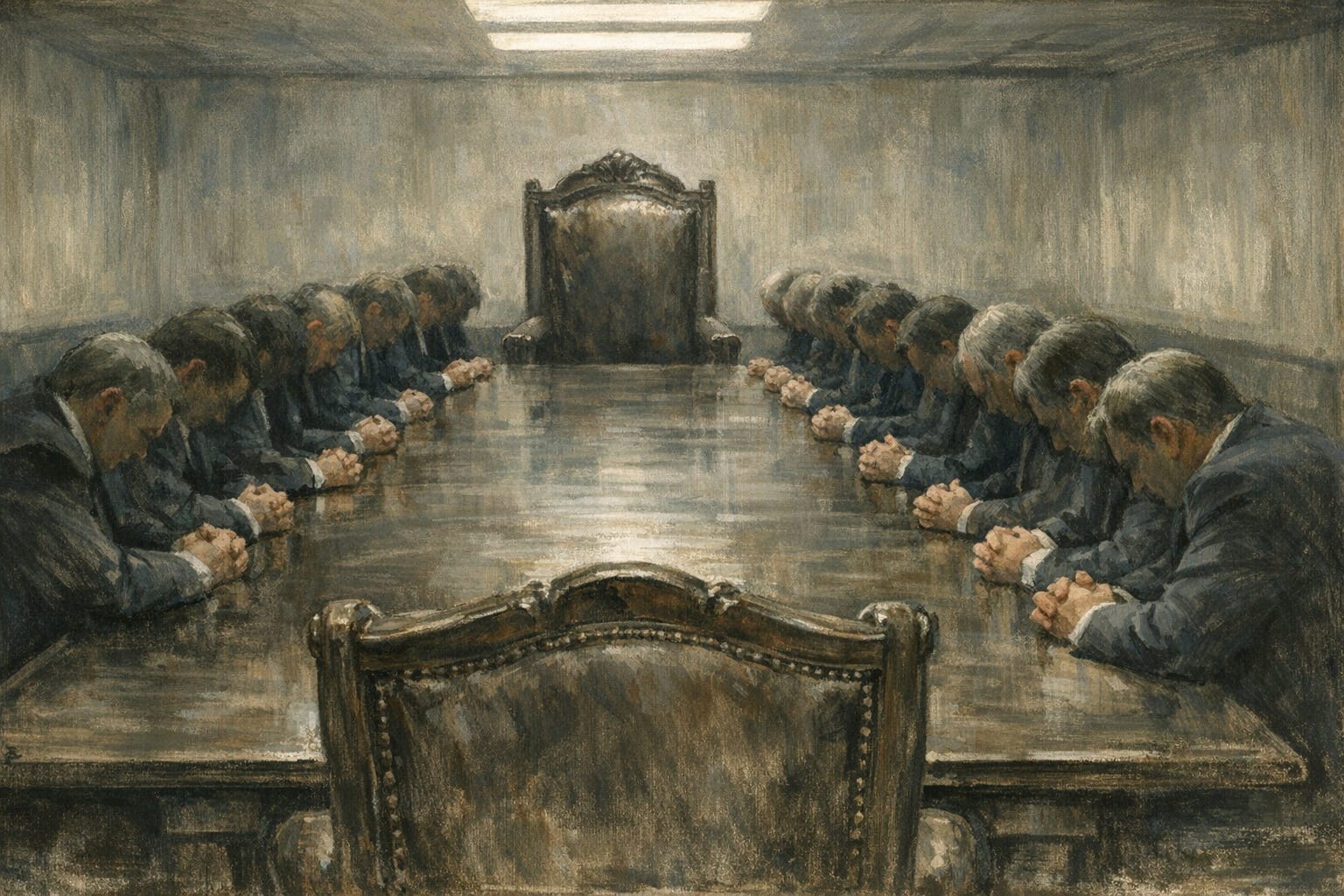
Paul Krugman published a piece this week called “The Dumpster Fire of the Vanities,” and I believe it’s worth your time. He’s sharp, he’s well-sourced, and his central observation (that Trump’s catastrophic failures and his cabinet’s nauseating flattery are not in tension but are actually feeding each other) is one of the more honest things written about this presidency. I’d call it a doom loop, and so does he. The sycophancy isn’t incidental to the failure. It’s carrying the whole point.
But Krugman stops short of the hardest question, and he knows it. He actually tells you he’s stopping short. Why has the American right been so willing to do this? “Good question,” he writes, “and one I’ll try to answer another day.” On Memorial Day. In an essay about the structural collapse of republican governance. I’m not criticizing Paul. He’s earned the right to pace himself. But “another day” is doing a lot of work in that sentence, and I think the question is too important to leave on the shelf.
I’m not Paul, but let me try anyway.
The easy answer is that Republicans are cowards. And some of them are. But cowardice alone doesn’t explain what we’re watching. Cowards hedge. Cowards stay quiet. What we’re seeing in Trump’s cabinet isn’t strategic silence. It’s an active, competitive genuflection. These are people tripping over each other to heap praise on a man who has lost every trade war he started, cratered consumer confidence, and managed to turn the nation’s closest allies into reluctant adversaries. You don’t do that out of mere cowardice. You do it because the institution you serve has changed its purpose, and you’ve changed with it.
He’s right that the cult of personality around Republican presidents didn’t begin with Trump. Reagan’s canonization started while he was still in office. The “Mission Accomplished” carrier landing for George W. Bush was staged political theater on a scale that should have embarrassed everyone involved. These were real events, and the right’s willingness to treat its presidents as near-mythic figures has a long pedigree.
But I’d argue those were qualitatively different things, and the difference matters more than it might seem.
Reagan-era hagiography was, in the main, political branding. It was the party selling an image to the country. Bush’s carrier stunt was a communications strategy, badly conceived and worse executed, but still aimed outward, at voters. The flattery was performative, yes, but it was performing for an audience beyond the room. What Krugman documents in Trump’s cabinet meetings is something else. One in every six sentences in those meetings either flatters Trump, credits Trump, or attacks his opponents. That’s not messaging. That’s ego maintenance. The audience is one person, and the goal is to keep that one person stable enough to get through the week.
That shift, from outward-facing political theater to inward-facing emotional management, tells you something important about how the institution has changed. A political party that uses flattery as a branding tool is still, at some level, accountable to voters. A governing apparatus that uses flattery as a management technique has collapsed the distance between the institution and the man. The party no longer contains Trump. Trump contains the party. And everyone in that cabinet knows it.
Which brings me to the structural piece, the part I think deserves more attention than it usually gets.
What we’re watching isn’t just a personality cult. It’s a personality cult that has been formalized into law. The Roberts Court’s immunity ruling didn’t happen in a vacuum. It happened after thirty years of conservative legal theory moving, with some consistency, toward the idea that executive power should be concentrated, insulated, and largely unchallengeable. “Unitary executive theory” sounds like a term a law professor invented to bore students, but its implications aren’t boring at all. It holds that the entire executive branch answers personally to the president: not to Congress, not to independent statute, not to tradition. To the president. One person.
Roberts hasn’t fully endorsed that theory in so many words. But the immunity ruling puts the sitting president above criminal prosecution for official acts. And Roberts’ own language, describing the president as “the only person who alone composes a branch of government,” is doing a lot of constitutional work in a very small space! Combined with a Congress that has, for practical purposes, abdicated its oversight function, you don’t need to formally declare a monarchy. You just need enough pieces in place that the king can govern like a king regardless of what the paperwork says.
The question Krugman defers is the one that actually matters: why did the right let this happen, and why did they build the legal architecture to make it permanent?
I’ve spent time in federal government, and I’ll keep repeating what I think I learned there, for whatever it’s worth. Large organizations don’t abandon their principles all at once. They do it through a long series of small accommodations, each of which seems defensible in isolation. You let one thing slide because the stakes seem low. You rationalize the next one because you already let the first one go. By the time you’re deep enough in that the pattern is visible, you’ve already made too many accommodations to reverse course without indicting yourself.
The Republican Party has been making those accommodations for decades. They started by tolerating Nixon’s abuses, then Reagan’s Iran-Contra, then Bush’s post-9/11 executive overreach. Each time, they found a rationale. National security. Party unity. The greater good. And each time, the institutional muscle that might have said “no, this is too far” atrophied a little more.
There were people inside those institutions who knew better. Some said so, quietly, and were sidelined. Most didn’t say anything at all. The personal calculus kept coming up the same way, the cost of resistance exceeded the benefit, and the institution seemed large enough to absorb the damage without their help. That calculation was wrong every time someone made it, and the cumulative error is what you’re looking at now.
By the time Trump arrived with his particular combination of shamelessness and appetite for power, the resistance infrastructure that should have been there simply wasn’t. Not because Republicans are uniquely evil, but because they’d spent forty years dismantling the habit of saying no to their own side.
Krugman calls the current situation “the culmination of decades of right-wing sabotage of everything that made America great.” I think that’s right, but I’d add one thing: it wasn’t always conscious sabotage. A lot of it was drift. Willful drift, yes, but drift. The people who built those accommodations early on probably didn’t imagine they were building a ramp to authoritarian rule. They thought they were being pragmatic. That’s what makes it so hard to stop. You can fight a conspiracy. It’s a lot harder to fight a culture.
What Krugman calls a doom loop, I think of as a ratchet. Every turn makes the next turn easier and the reverse harder. Trump demands more deference because he keeps failing. The deference ensures he keeps failing. And the legal architecture built around him makes it progressively more difficult for any institution to apply a corrective brake. Congress won’t. The Court has signaled it won’t. That leaves the voters, and you can see from the polling that a significant part of the country is paying attention. But polling and governing are different things, and right now, the mechanisms that translate public opinion into institutional correction are under considerable strain.
Paul asks the right question. He just doesn’t answer it, and I understand why. The answer is long, and it’s not flattering to anyone, including those of us who watched it happen and didn’t raise the alarm loudly enough or early enough. The rot didn’t happen in the dark. It happened in front of us, incrementally, and most of the country, myself included, kept hoping the system had more tensile strength than it did.
The honest reckoning is that we kept grading on a curve. Every new outrage was measured against the last one rather than against any fixed standard of what a republic requires. And so the bar moved, quietly, year by year, until we looked up and realized the bar was gone.
It turns out a republic is only as durable as the people inside it who are willing to defend it. And for a long time now, the people with the most to lose from defending it have been the ones with the most power to do so.
The cabinet meeting flattery Krugman documents is almost beside the point now. It’s the visible symptom of something structural. You fix symptoms by treating the disease, and the disease is that we’ve built, piece by piece and accommodation by accommodation, a system in which the people who are supposed to check power have every personal incentive to ratify it instead. Until that changes, the doom loop keeps looping, and the ratchet keeps turning.
I’m sure that’s not a comfortable thought for anyone. But comfortable thoughts sure as hell didn’t get us here, did they?
Friends, if my writing has been worth your time, buy me a one time ko-fi below. It goes a long way toward keeping the writing free for everyone.

Here is Paul Krugman’s inspirational post:


Dino thanks for your shares. They help me to understand the crazy but not to ignore it