


"The majority does not need to threaten. It leaves the body alone and goes straight for the soul." — Alexis de Tocqueville
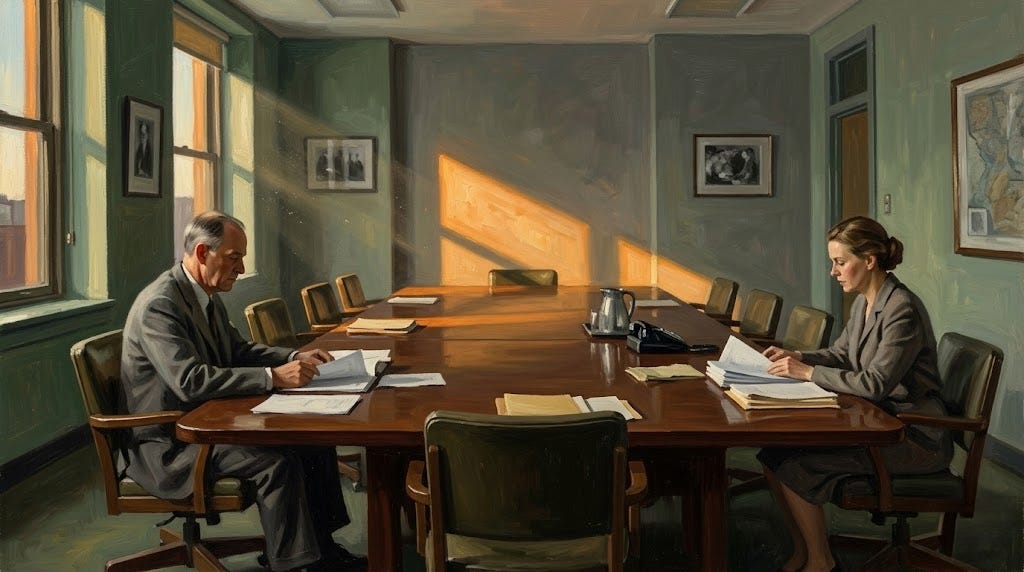
There’s a meeting most people have sat through at least once. The problem in the room is obvious. The senior person present is wrong. Everyone knows it. Nobody says so. Not because the facts are unclear, not because the evidence is thin, but because the math got run under the table before anyone pulled out a chair, and the answer came back the same for everyone: not today, not here, not worth what it’ll cost. So the meeting ends. People file out. In the hallway, in pairs, in voices dropped just enough, the true assessment finally gets made.
Too late to matter. Right on time to become habit.
Wendy Lawrence wrote a sharp piece about how Republican governance became a method of deliberate institutional decay, and how Trump’s specific contribution was to make what had been carefully managed impossible to ignore anymore. She’s right, and I’d encourage you to read her full argument. Link at the bottom. What her piece sent rattling around in my head was a question she raises but doesn’t quite land on: why didn’t the institutions hold? Not just the Republican Party. All of them. The agencies, the military commands, the Senate, the inspector general apparatus, the whole immune system of a republic under stress. Why the quiet?
The political economist Timur Kuran spent a career mapping what he called preference falsification, which is a clinical way of describing something most of us have done by Tuesday morning of any given week. When telling the truth is expensive and silence is cheap, most people stay quiet. They don’t announce the decision. They don’t experience it as cowardice, usually. They call it reading the room. Picking their battles. Being strategic. The expressed beliefs of any group under sufficient pressure end up bearing almost no relationship to what that group actually thinks, because everyone is running the same silent calculation and arriving at the same answer. And because everyone is performing, everyone assumes the performance around them is genuine. The manufactured consensus looks real because everyone is manufacturing it at the same time, each person convinced the others mean it.
My god, does that sound familiar.
If you’ve spent years inside large federal bureaucracies or military commands, you know exactly what this feels and sounds like. It’s the report that is technically accurate in every particular and completely misleading in its overall impression, because the overall impression was the part nobody could write down. It’s the after-action review that catalogs every failure except the one that would have implicated someone still in the building. It’s the briefing that gets pre-filtered through three layers of staff before it reaches the principal, each layer trimming a little more of the uncomfortable truth until what arrives is a polished, warm version of what the principal already believes. Nobody lied. Nobody told the whole truth either. And everyone went home feeling more or less okay about it, which is perhaps the most damning part.
Tocqueville was circling this when he wrote about the tyranny of democratic majorities. His specific worry wasn’t the strongman or the mob. It was quieter than that: in democratic societies, he thought, the anticipation of disapproval becomes so thoroughly internalized that open coercion grows unnecessary. People silence themselves before anyone asks them to. He called it a tyranny that leaves the body alone and goes straight for the soul. Accurate as far as it goes. But Tocqueville was describing organic social pressure, the kind that grows up naturally in any community with strong norms.
What the Republican Party built over thirty years was something more intentional than that. The think tanks, the donor networks, the primary threat, the media apparatus that would end a career before the Sunday shows if someone broke script: none of that is ambient cultural pressure. It’s infrastructure. Deliberately constructed with a specific product in mind. And the product was a party full of people who knew better and said nothing, not because they lacked the information, but because the consequences of having it out loud had been made crystal clear.
Jeff Flake knew. Mitt Romney knew. There were dozens of others, and their silence wasn’t private. It was load-bearing. It held the fiction upright at exactly the moments when the fiction was most exposed and fragile. A political scientist observing from a safe distance calls that preference falsification. Someone who’s watched it operate from inside a hierarchy recognizes something older and less academic. It’s what happens when an institution stops protecting the people who tell the truth and starts, quietly and efficiently, protecting the people who don’t.
Kuran’s most unsettling finding is that preference cascades, when they finally tip, are almost impossible to predict in advance. Because private doubt is invisible, the threshold at which it becomes public expression is invisible too. Systems that look impregnable come apart with a speed that startles everyone, including the people who wanted them to collapse. The East German government fell in weeks. The Soviet bloc unwound in months. Each had looked, from outside and from inside, like a structure with years left in it. What it actually had was a population that had been falsifying its preferences for so long the habit had become identity.
Watch the current Republican Party with that in mind. Watch the silence of the people who know. Count the former officials who discovered their conscience approximately six months after leaving the room where it would have made a difference. Read the memoirs. The memoirs are the after-action reviews of people who couldn’t tell the truth while the situation was still live. There’s a word for that in certain professional cultures, and the word isn’t heroism.
Which brings me to the booth.
We are born alone. We die alone. In a democracy, we vote alone too, and that last one doesn’t get said nearly enough. The voting booth is the one place in civic life where the entire apparatus of manufactured consensus cannot follow you. Party pressure stops at the curtain. The donor network has no sight line past it. The memory of what happened to Liz Cheney exists in public space, not in that small private one. The booth was designed as a sanctuary, the one moment where the gap between public performance and private belief can close without cost to anyone.
And yet most people don’t experience it as sanctuary. They experience it as exposure. As the particular loneliness of possibly being wrong and outnumbered at the same time, with no one to confirm you made the right call until the tabulations come in, if then. The preference falsification that ran in every public space before election day doesn’t evaporate at the curtain. It follows people in. Voting your private conviction when everything around you has been broadcasting a different consensus takes something that doesn’t get acknowledged honestly in a country that likes to believe its citizens vote their conscience as a natural matter of course.
Many don’t. Many vote the performance they’ve been rehearsing in public because the performance has become the belief, or near enough that the distance stopped feeling meaningful. That’s not stupidity. That’s the specific gravity of manufactured consensus doing exactly what it was built to do, all the way into the one room it was never supposed to reach.
The Senator who flies home rather than casting the hard vote and the citizen who votes the party line rather than the private judgment are making the same calculation at wildly different scales. The cost of honest expression feels prohibitive. The warmth of the expressed consensus feels like safety. Neither of them is wrong about the short-term arithmetic. Both of them are catastrophically wrong about what it costs a republic when enough people run the same numbers simultaneously.
Now. The after-action review and the battle damage assessment are cousins people routinely confuse, and the confusion matters. The after-action review happens when you’re back at base, the shooting has stopped, and the organization has the breathing room to ask honestly what went wrong and how to do it better next time. It’s a learning tool. It assumes there’s a next time. The battle damage assessment is a different animal entirely. You run it while the situation is still live, under bad information, with one question on the table: what’s still standing, and what do we do about it right now. Not next quarter. Not after the midterms. Now.
The reason that distinction belongs in this conversation is that America has been trying to conduct an after-action review of its democratic institutions while those institutions are still taking fire. The courts, the press, the civil service, the inspector general apparatus, the electoral machinery: all of it under deliberate and sustained pressure while the commentary class writes careful retrospectives about how we got here. You don’t get to write the thoughtful post-mortem while the building is still coming down. The after-action report is a luxury. Battle damage assessment is what the situation actually calls for, and the first finding of any honest BDA is this: the damage is still compounding, and debating the methodology is not the same as stopping it.
That changes what’s being asked. The ask is to speak now, in the room, at the table, before the meeting ends and everyone migrates to the hallway to say in lowered voices what they wouldn’t say out loud. The ask is the vote that doesn’t falsify anything. The memo that says what it means in the first paragraph. The testimony that doesn’t trim itself for the principal’s comfort before it arrives.
Civic courage has never been abstract. It’s always been a specific person in a specific room deciding whether to say the true thing when silence is cheaper and safer and considerably warmer.
The quiet in the room has a cost. We’ve been running that tab for decades. Everyone pays it eventually. The ones who stayed quiet just get to pay it last, and privately, and with the particular weight of knowing the bill was theirs to begin with.
Friends, if my writing has been worth your time, buy me a one time ko-fi below. It goes a long way toward keeping the writing free for everyone.

Further Reading:

Dino, “NOBODY SAID A WORD” was beyond excellent! Thank you.
https://www.nbcnews.com/news/us-news/florida-doctor-indicted-allegedly-removing-patients-liver-instead-sple-rcna331696
Surgeon mistakenly removed a liver, thinking it was a spleen. They are in entirely different locations and look totally different. People working in OR realized but didn't speak up.