


"We tell ourselves stories in order to live." — Joan Didion, The White Album
The Believer
She did everything right.
She showed up in 2016, stunned like the rest, and decided never again. She donated in 2018, canvassed in 2020, hosted phone banks in her living room in 2022. She followed the right accounts, read the right newsletters, shared the right articles. When the 2024 numbers started coming in, she was watching with friends, a bottle of champagne open, cautiously hopeful because the people she trusted had told her to be. The models looked good. The enthusiasm gap had closed. The nonvoter pool was finally, finally going to show up.
It didn’t.
She’s every third person you know who took this seriously, who put in the hours, who believed that sufficient effort plus sufficient information would produce a different result. She believed it because everyone she read told her it was true. The wave was coming. The numbers supported it. Democracy, battered but not broken, would self-correct because that’s what democracies do.
What nobody told her, what the newsletters and the podcasts and the monetized outrage machine carefully avoided telling her, is that the numbers didn’t actually support it. Not if you read them honestly. Not if you asked what the nonvoter pool really looked like once you opened it up, or what history says about electorates that choose this way twice with full information, or what structural interference does to a polling model built for a level playing field.
She was failed. Not by her own effort or her own intelligence. By a press ecosystem with a powerful financial incentive to tell her the wave was coming, because the alternative, telling her the truth, doesn’t retain subscribers. Outrage keeps people engaged. Hope keeps them paying. An honest account of the actual terrain does neither.
The Math Nobody Wants to Read
Start with the numbers, because the numbers are where the fiction begins.
Donald Trump received 77.3 million votes in 2024. Kamala Harris received 75 million. The gap between them, the actual margin of this supposed mandate, was roughly 2.3 million votes out of 155 million cast. That’s not a landslide. That’s a country almost perfectly divided, with a handful of states tipping the arithmetic one way. Some mandate.
Then there are the 89 million.
That’s approximately how many eligible Americans didn’t vote. And for years, the Democratic recovery narrative has treated that number as the solution to every problem it can’t otherwise solve. Sufficient motivation, sufficient organizing, sufficient get-out-the-vote machinery, and those 89 million become the wave. They’ve been the theoretical wave for three election cycles now. They didn’t show up in 2016, or 2020, or 2024, but the theory persists because the theory is useful. It gives the fundraising email a reason to exist. It gives the podcast a note of hope to end on. It keeps the whole operation running.
Here’s what the theory requires you not to look at. In 2024, nonvoters split 44 percent preferring Trump and 40 percent preferring Harris. That’s not a Democratic reserve army waiting to be mobilized. That’s an unmotivated electorate that mirrors, almost exactly, the motivated one. And it’s a reversal. In both 2016 and 2020, nonvoters leaned Democratic. Something shifted. The people who couldn’t be bothered to vote used to break toward the left when anyone asked them. Now they don’t. That shift is not a footnote. It’s the story.
There’s a framing I find useful here, even if it’s meant to be hopeful. The Environmental Voter Project calculated that if “Did Not Vote” had been a presidential candidate in 2024, they would have beaten Donald Trump by 9.1 million votes and carried 265 electoral college votes. People cite this as evidence of the untapped pool. I’d argue it’s evidence of something else entirely: that the pool exists, that it’s large, and that it has repeatedly and consistently declined the invitation. At some point the question stops being how do we motivate them and becomes why haven’t we been able to, across multiple cycles, with increasing stakes, and what makes anyone think 2026 or 2028 will be different.
The pool exists. It’s been asked, repeatedly, with increasing urgency and increasing stakes. It has consistently declined. At some point that’s not a mobilization problem. That’s an answer.
The Lock
If the nonvoter pool is the first comfortable fiction, Republican voter loyalty is the second. And it’s harder to dislodge because it isn’t really about politics anymore.
The assumption baked into most Democratic recovery thinking is that Trump voters who privately regret their choice will eventually act on that regret. That sufficient economic pain, sufficient policy failure, sufficient visible chaos will peel enough of them away to shift the math. It’s a reasonable theory. It’s also largely wrong, and the reason it’s wrong has less to do with politics than with identity.
Voting Trump in 2024 wasn’t just a political act for most of his coalition. It was a declarative statement about who they are, delivered publicly to everyone around them. Their family. Their neighbors. Their coworkers. Their church. They didn’t just pull a lever in a private booth and go home. They put up yard signs and wore hats and had Thanksgiving arguments and told anyone who pushed back exactly what they thought of the other side. The vote is now part of their self-presentation in ways that make reversal enormously costly, independent of whether the policy outcomes justify it.
Private regret, and there is some, doesn’t translate to changed votes. It translates to silence. To not bringing it up. To quietly adjusting the internal story so that whatever went wrong is someone else’s fault, the Democrats, the media, the global economy, anyone but the choice itself. The psychology here isn’t unique to Trump voters. It’s how humans handle the social cost of being wrong publicly. The difference here is that the cost of being wrong isn’t abstract. It’s showing up in grocery receipts and pharmacy bills and shuttered local offices.
This is why the “sufficient pain” theory only works under a very specific condition. The pain has to be severe enough, personal enough, and clearly enough attributable to the choice itself that the social cost of staying silent exceeds the social cost of changing. That’s a very high bar. People lose their homes and blame the bank. People lose their jobs and blame immigrants. The human capacity for motivated reasoning under conditions of identity threat is not a marginal factor. It’s the dominant one. We are very good at not seeing what we can’t afford to see.
There’s a third possibility worth naming, because readers will reach for it and deserve an honest answer. Some of the people who voted Trump and now feel the burn of that choice won’t vote Republican again, but they won’t vote Democratic either. They’ll just stay home. Silent. Too proud to switch, too disappointed to repeat. And on the surface that looks like it helps. One fewer Republican vote is one fewer Republican vote.
Most people don’t think through the arithmetic. Abstention and a vote are not the same thing. A Republican staying home removes a vote from one column. It doesn’t add one to the other. The Democrat still has to get there. In a close district, a wave of soft Republican abstention only moves the needle if the Democratic candidate is already within range, which in a gerrymandered map is far less often true than it should be. Abstention is a gesture. It’s not a vote. And in the specific structural conditions we’ve been describing, gestures don’t flip seats.
There is one segment where movement is possible. College-educated suburban voters, particularly women, who went to Trump in 2024 on economic anxiety but don’t have deep tribal investment in MAGA as an identity. They voted Trump the way you might try a new doctor. Transactional, not devotional. Their vote wasn’t a declaration of who they are. It was a calculation about what might work. Calculations can be revised when the outcomes disappoint.
That’s the real margin. Not the 89 million. Not the persuadable progressive who stayed home. Not the silent Republican nursing buyer’s remorse on the couch. A relatively thin slice of soft Republican suburbanites whose relationship to this vote is transactional enough that a different calculation is still possible. It’s a small target, and the recovery narrative doesn’t like small targets because they don’t fill arenas or drive donation spikes or make for rousing newsletter copy. But it’s the honest one.
Pain Made Attributable
The soft Republican suburbanite is the real margin. But knowing that doesn’t give you a program. It gives you a condition to watch for.
The condition is this: economic pain, personal and undeniable, that can be traced back to a specific set of decisions made by people she voted for. Not pain in the abstract. Not GDP figures or deficit projections or think-tank models about long-term structural damage. The kind of pain that arrives in an envelope, or a pink slip, or a conversation with a doctor about what the insurance will no longer cover. The kind that is impossible to intellectualize away because it is sitting across the breakfast table from you every morning.
That kind of pain exists. It’s coming in waves for a lot of people who voted Trump in 2024. Tariffs are not an abstraction to a small manufacturer in Ohio who just watched her input costs jump thirty percent. The dismantling of federal agencies is not an abstraction to a nurse in a rural county whose clinic just lost its federal funding. The pain is real and it is landing on real people, some of whom pulled the lever for this. They just don’t necessarily know that yet.
The question is whether they’ll connect it to the cause. And that’s where the administration has been genuinely skilled. The recovery narrative mostly doesn’t credit that, because crediting your opponent’s competence is its own kind of uncomfortable. But it should, because the blame displacement operation running out of this White House is not accidental. It’s a strategy, executed with real consistency. The price increases are the fault of corporate greed. The job losses are the fault of the previous administration. The clinic closures are the fault of wasteful government bureaucracy that needed cutting anyway. Every arrow that should point toward a policy choice gets redirected before it can land.
The information ecosystem that a significant portion of the Trump coalition lives inside is specifically designed to intercept that arrow mid-flight and send it somewhere else. And it has a powerful ally: a press that this audience has been trained for years to distrust. So the pain lands, and the alternative explanation arrives almost simultaneously, and for many people the suffering becomes evidence of the other side’s failures rather than this one’s.
For attribution to work, the pain has to break through all of that. It has to be personal enough that no alternative explanation quite fits. It has to arrive faster than the counter-narrative can be constructed. And it has to land on people whose identity investment in the choice is low enough that reconsidering doesn’t feel like self-annihilation.
That’s a narrow window. It may open. The economic trajectory of the current administration’s trade policy alone could force it. But it’s not something that can be organized or scheduled or turned into a canvassing operation. It either happens in the lives of enough of the right people, in enough of the right districts, before November 2026, or it doesn’t.
The woman with the phone bank couldn’t control that. Neither can you. What you can control is whether you’re honest with yourself about what you’re actually waiting for.
The Press in the Silo
I want to be precise about what I’m accusing the press of, because it isn’t lying. I want to be clear about that before anyone gets their back up.
The journalists covering this moment are, by and large, working hard and working honestly. They’re documenting the executive overreach, the court defiance, the dismantling of institutional norms with skill and at genuine professional risk. The reporting exists. The facts are available. Nobody is making them up.
What’s being made up, or made comfortable, is the frame around the facts. The recovery narrative. The implicit promise, embedded in the outrage, that the outrage is productive, that it’s building toward something, that the documentation of damage is also, somehow, the beginning of repair. That promise is not supported by the evidence. But it’s the promise that keeps the audience engaged, and an engaged audience is the only thing standing between a publication and irrelevance.
This is not a conspiracy. It doesn’t require editors in a room deciding to mislead their readers. It requires only the incentive structure that actually exists. Digital media runs on engagement. Engagement runs on emotion. The two emotions that drive the most consistent engagement are outrage and hope, and the most powerful combination is outrage with hope attached, the sense that the terrible thing you just read about is also, if you stay engaged and donate and share and show up, defeatable. Remove the hope and you have outrage with nowhere to go. Readers don’t renew subscriptions for that. Donors don’t respond to fundraising emails that end with “and frankly we’re not sure any of this will work.”
So the hope stays. The specific vessel keeps changing because it keeps failing to deliver. But the hope itself is non-negotiable because the hope economy requires it. The next thing is always coming: the midterms, the court case, the special election, the poll showing the Republican incumbent underwater. When one vessel fails, another appears. The model depends on it. The subscribers depend on it. And so the circle goes.
What gets quietly left out is what we’ve been discussing in this essay. The 44/40 nonvoter split. The identity lock on Republican voters. The structural interference that polling models aren’t capturing. The fact that what political scientists who study democratic recovery already know requires conditions not currently present. None of that makes the newsletter. Not because the journalists don’t know it, some of them do, but because there’s no way to package it that serves the model. Honest diagnosis without a treatment plan is not a product anyone has figured out how to sell.
I’m writing this in a publication that has its own incentives, its own audience, its own relationship to the hope economy. I’m aware of that. The difference I’m trying to maintain, the only one that matters, is between writing what the audience wants to hear and writing what the evidence actually supports. Those two things have been drifting apart for years. This essay is an attempt to say so plainly, which means it will probably be shared approvingly by people who agree with it already and ignored by everyone the argument most needs to reach.
That’s the silo. I’m in it too. We all are.
The Midterm Mirage
The number making the rounds in Democratic circles right now is 70 percent. That’s the approximate probability, according to several prominent forecasting models, that Democrats retake the House in November 2026. It gets cited in newsletters and shared on social media and offered as evidence that the correction is coming, that the system is working, that the accountability moment is just a cycle away. People say it with relief in their voices.
The underlying fundamentals the models are measuring are real. Presidential approval ratings at this level have historically predicted significant House losses for the incumbent party. The generic congressional ballot favors Democrats by margins that, in past cycles, would comfortably translate to a House majority. The models are reading real signals.
What the models are not reading is the condition of the playing field itself. Models are built on historical data. What’s happening now has limited historical precedent, and the precedents that do exist aren’t comforting.
Start with voter rolls. Systematic purges of voter registration databases, justified under the language of election integrity, have been accelerating in competitive states. The people most likely to be purged are younger voters, renters, and voters in majority-minority districts, demographics that break Democratic. A purge doesn’t show up in a generic ballot poll. It shows up on election night, when people who believed they were registered discover they aren’t.
Then there are the district lines. Gerrymandering works by packing opposition voters into a handful of unwinnable districts while spreading your own voters across many winnable ones. The result is a map where a party can lose the popular vote and still hold a majority of seats, by design. The post-2020 redistricting cycle produced exactly those maps, giving Republicans a structural advantage in the House independent of vote share. They haven’t changed. A Democratic wave in the popular vote doesn’t automatically translate to a Democratic majority in seats when the geography has been engineered to prevent it.
Ballot access compounds all of it. Restrictions on early voting, mail balloting, and drop box availability hit Democratic-leaning voters hardest, particularly in the states where House seats are actually competitive. These restrictions have been expanding, not contracting.
None of the forecasting models account for what happens between elections either. Democratic recoveries require resources. Organized opposition requires funding, institutional infrastructure, the kind of civic machinery that takes years to build and can be dismantled considerably faster. The systematic redirection of public wealth, the defunding of agencies and programs that might otherwise generate organized resistance, the concentration of economic power in fewer hands aligned with the current order, none of that shows up in a generic ballot poll. But it makes reversal progressively harder with each passing month, regardless of what the polls say. The playing field doesn’t just tilt on election day. It tilts every day in between.
Then there’s the question nobody in the forecasting business wants to ask directly. The administration has floated the idea of posting military or law enforcement personnel at polling locations under the banner of election security. The Posse Comitatus Act prohibits using the military domestically for law enforcement purposes. But enforcement of that prohibition runs through the Justice Department, which is no longer operating as an independent institutional actor. A legal barrier without an enforcer is just a sentence on a page.
What happens if the results are contested? The infrastructure for challenging, delaying, and selectively certifying election results was built and tested in 2020 and 2022. It didn’t succeed then. It’s more developed now, better staffed, better legally theorized, and operating in an environment where the Justice Department’s posture toward election interference investigations has changed considerably.
There’s a reason the opposition has never quite caught its footing through any of this. The administration understood from the beginning that the normal legal and legislative metabolism of American government is slow. Federal rulemaking takes months. Litigation takes years. The response to that reality was volume. One hundred and forty-three executive orders in the first term alone. Agencies dismantled, workforces slashed, programs halted, all faster than any single legal challenge could keep pace with. You can’t block 143 executive orders with the same political bandwidth you’d use to fight three. The opposition's exhaustion isn’t a side effect. It’s the strategy.
Political scientists who study democratic backsliding have a name for where this leads. They call it dirty democracy. Elections still happen. Both parties retain a feasible prospect of winning. But the rules of the game are no longer mutually accepted, and the competition has been transformed in ways that drain elections of what they’re supposed to mean. The term is clinical. The condition it describes is not. And it’s the condition you’re living in when you look up one day and realize the flag you’ve been saluting has fewer stars than you remembered.
A 70 percent probability assumes a game being played by the rules the game has historically been played by. That assumption gets less safe every month. The playing field was surrendered, and the models haven’t caught up to that yet.
The Founders’ Flag
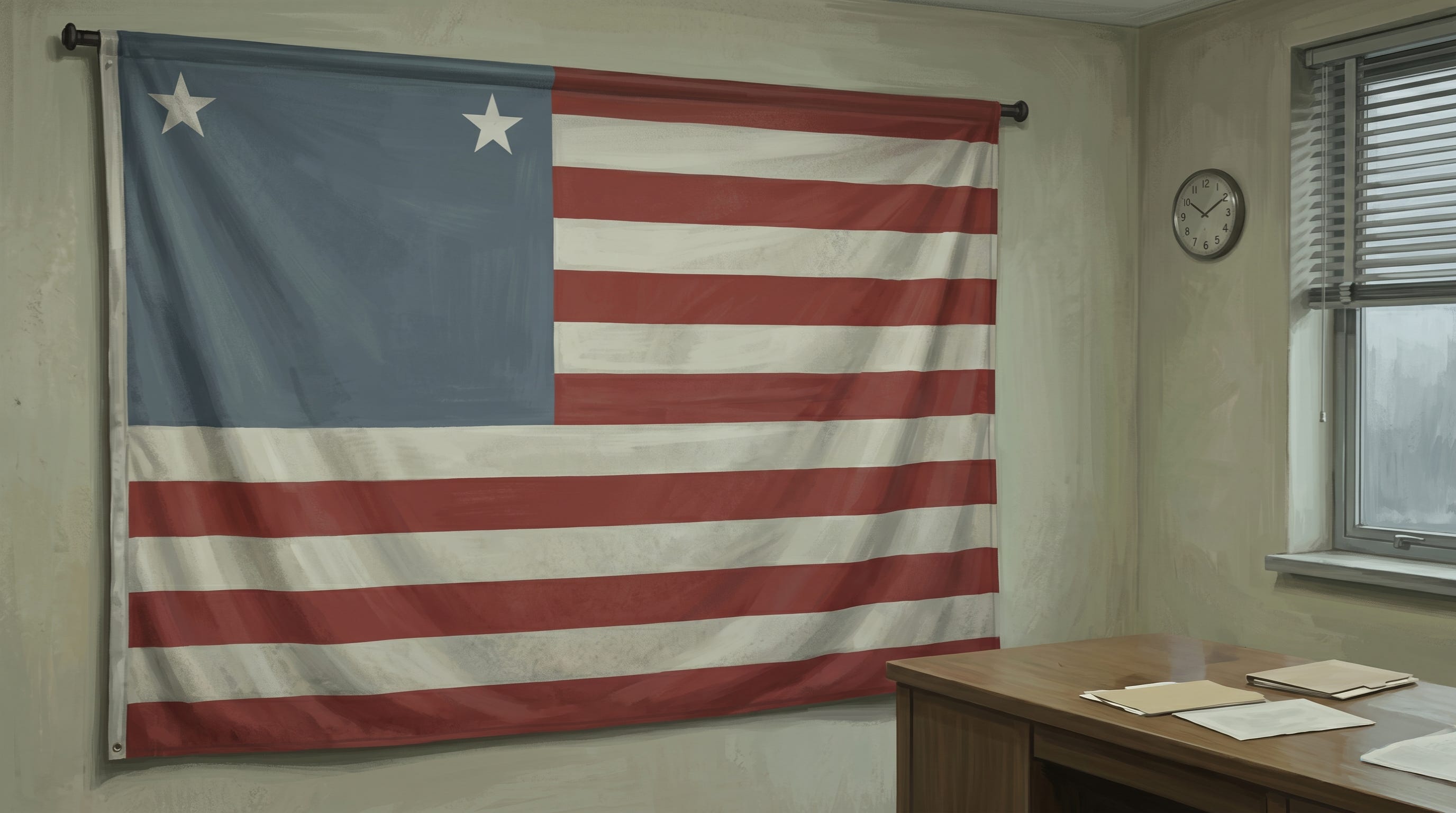
There’s an image from Margaret Atwood’s Handmaid’s Tale that keeps returning to me as I write this. In the television adaptation, a small American flag hangs in what appears to be a government office in Canada. It shows two white stars and the faint outlines of 48 others, the ghost shapes of states that have fallen to Gilead, present enough to see, drained of everything that made them real. Not a symbolic reduction. An actual count of what remains. The flag doesn’t mourn what’s missing. It simply represents the new reality as though that reality was always the destination.
That flag isn’t Gilead’s flag. Gilead has its own: a red field with a black sun and a yellow dove carrying an olive branch, peace symbolism pressed into the service of a theocratic state, with no irony about what it destroyed. Gilead didn’t drape itself in a diminished version of what came before. It burned the before entirely and built something unrecognizable in its place.
Atwood didn’t predict this moment exactly. Nobody did. But she understood something about how democratic erosion works that doesn’t announce itself as destruction. It announces itself as preservation. And that’s precisely what makes the two-star flag the right image for where we are, not because America is Gilead, it isn’t, but because we are somewhere in the long quiet middle, watching the stars disappear one at a time while the people removing them insist the flag has never been more whole.
That’s the mechanism she understood most clearly, and the one the current moment keeps confirming. How quickly the unthinkable becomes an administrative routine. How collaboration happens not through dramatic conversion but through incremental accommodation. Nobody wakes up one morning and decides to accept the unacceptable. They accept something slightly uncomfortable, and then something slightly more uncomfortable than that, and at each step the previous position has already been absorbed into the new normal. The cliff edge that looked like solid ground from a distance looks like solid ground from up close too, because you arrived there one small step at a time. And voila!
What makes this moment genuinely strange is the iconography the people doing the removing have chosen to drape themselves in. The founders are invoked constantly by this movement. Reverently. Almost liturgically. The Constitution is held up as sacred text by people actively concentrating the exact power the Constitution was architected to prevent. The founding documents are quoted in defense of positions the founders would have recognized as the tyranny they spent their lives designing against. My god, the irony would be funny if the stakes weren’t what they are!
The cynics among them know what they’re doing. The founders are useful cover. Wave the flag, cite the framers, and the machinery of what you’re actually building gets mistaken for restoration rather than demolition. That’s a strategy and it’s working.
The true believers are the more consequential phenomenon, and the harder one to reckon with. They’ve arrived at a place where they simultaneously worship the founders and support everything the founders feared, and they cannot see the distance between those two positions. The fracture isn’t hidden from them. It’s invisible to them. They haven’t suppressed the contradiction. They’ve genuinely resolved it, through a process that feels like patriotism from the inside. You can’t argue someone off a cliff they don’t know they’re standing on.
The erosion didn’t start with Trump. He is the most visible symptom of a process well underway before he arrived, arguably for decades. The systematic defunding of public education. The collapse of local journalism, which was the connective tissue of civic life at the community level. The replacement of political disagreement with political identity, the shift from “I vote differently than you” to “I am a different kind of American than you.” The deliberate construction of parallel information ecosystems so sealed that shared factual reality became optional. The decades-long project of making government fail so that government failure could be cited as evidence that government shouldn’t exist. None of that is Trump. Trump is what came through the opening those processes created.
And then there is the trap I can’t write around without dishonesty. If an honest majority of Americans have concluded that the founders’ America no longer serves their interests, then I am bound, as someone who believes in democratic self-governance, to honor that majority’s right to say so. The mechanism I believe in has produced a majority that is using that mechanism to dismantle the mechanism. My integrity requires me to acknowledge their right to do it, even as it ends something I love.
Madison was obsessed with the tyranny of the majority. It’s why he built counter-majoritarian institutions into the constitutional architecture, the Senate, the courts, the Bill of Rights, protections meant to be beyond the reach of any majority however large. Those protections are now being dismantled by the very majority they were designed to restrain. He saw this coming. For all the good it did, apparently.
I count the stars. There are fewer than I remembered. I can’t quite recall when that happened. And the people around me insist I was always miscounting.
What Clarity Costs
She’s still out there, the woman who did everything right. She donated again last month, because the email said the stakes had never been higher and she believed it, or needed to, which may be the same thing at this point. She’s following the forecasts. She knows about the 70 percent. She doesn’t know about the 44/40.
Nobody told her.
The nonvoter pool that isn’t blue. The identity lock that converts private Republican regret into silence rather than changed votes. The soft suburban margin that is the only real target and can’t be reached by canvassing or donation drives. The playing field that was surrendered while the models kept assuming level ground. The press that is working honestly within an incentive structure that makes honest diagnosis commercially nonviable.
None of it adds up to a program. I want to be direct about that. If you’ve read this far looking for the actionable conclusion, the thing you can do that the recovery narrative has been too timid to name, I don’t have it. I wish I did. The variables that matter most right now are not in your hands or mine. They’re in the lives of people in suburbs we don’t live in, making calculations we can’t control, in an information environment specifically engineered to prevent the kind of attribution that would change their minds.
What I have instead is an argument for clarity as the only honest starting point.
Acting from inside a fiction is expensive. Eight years is a long time to spend on a theory of change that the data doesn’t support. That’s real time and real money and real emotional labor spent on something that has failed repeatedly and will likely fail again for reasons that have nothing to do with effort or commitment. She deserved better information. The people selling her the hope economy knew, or should have known, that the theory was thin. They sold it anyway because the alternative didn’t have a business model.
Clarity doesn’t fix the structural problems this essay has described. The playing field stays surrendered whether you know about it or not. The identity lock holds whether you understand the psychology or not. The hope economy keeps running whether you’ve named it or not. Knowing the actual terrain doesn’t change the terrain.
But it changes what you do on it. Knowing the nonvoter pool isn’t a reserve army means you stop spending money on mobilization efforts targeting people who have declined the invitation three cycles running and start thinking about where effort might actually move something. Understanding the identity lock means you stop trying to argue Trump voters out of positions that are no longer really about policy and start paying attention to the thin slice of transactional voters in specific districts where the margin is real. Naming the hope economy means you stop mistaking the outrage cycle for political progress and start asking harder questions about what progress would actually require.
Small adjustments. Nowhere near sufficient. I know that. But they’re adjustments made from solid ground rather than from inside a story that keeps promising a wave that the math doesn’t support.
The fifty-star flag is still flying. For now. What this essay is really arguing is that the removal is already underway, slow enough to be deniable, quiet enough that most people can’t name the moment it began. Atwood’s two-star flag isn’t where we are. It may be where we’re going. And the people taking the stars are doing it while insisting, with considerable conviction, that they’re the ones keeping the flag whole.
We can at least refuse to do that. We can count accurately. We can say what we see. We can stop calling the diminished thing whole just because calling it whole is more comfortable than the alternative.
Clarity won’t save the flag. But nothing else even starts without it.
Friends, if my writing has been worth your time, buy me a one-time Ko-Fi below. It goes a long way toward keeping the writing free for everyone.

Further Reading:

Thank you for putting so much thought and historical perspective into this essay about the many decisions and choices we made to get to where we are today. That's we, as in all who had the opportunity to vote and We The People.
Dino, thank you for everything you write and for explaining things.