


I’m not writing this as breaking news, and I’m not pretending to have access to some hidden briefing. I’m writing because patterns tend to show themselves if you’ve spent enough years watching how governments move when pressure starts to build.
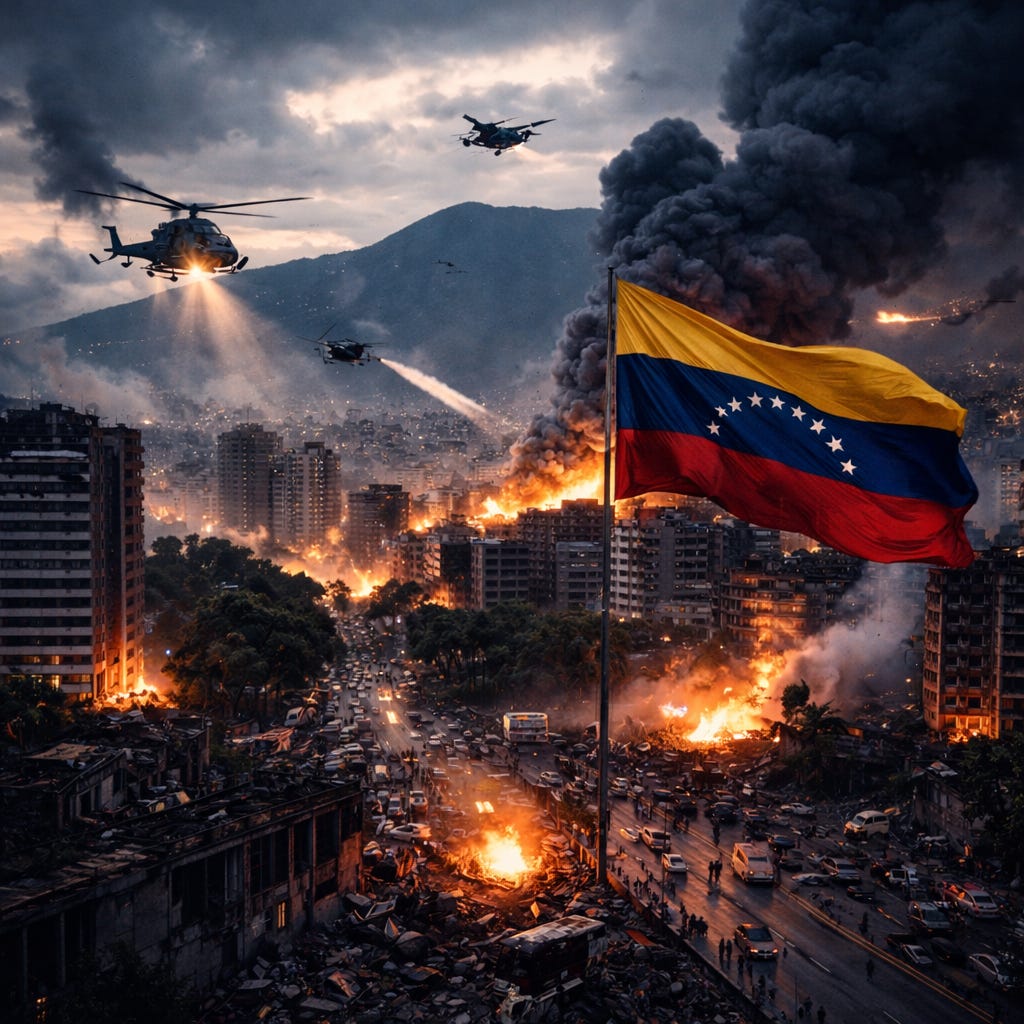
I spent a long stretch of my life working around national security. Not in a way that grants special authority, but in a way that teaches you how incentives quietly shape decisions. You learn the difference between what leaders say out loud and what they assume everyone will understand without being told. You learn that when an administration explains a foreign action in clean moral language, that explanation is almost never the whole story.
So when the United States strikes Venezuela, the public reasons arrive right on schedule. Stability. Deterrence. Regional order. Protection of interests. You can practically finish the sentences yourself. They’re familiar because they’re meant to be. They’re the safest things to say aloud.
What you hear less clearly are the pressures that make an action like this appealing at this particular moment.
One of them is attention. Foreign action doesn’t erase domestic problems, but it competes with them. Legal exposure fades into the background. Legislative paralysis feels less urgent. Media focus narrows. Opposition messages become harder to sustain. None of this requires secret plotting. It’s simply how public focus behaves under strain.
Another is narrative simplicity. Inside the country, politics is tangled, compromised, and exhausting. Abroad, stories can be told cleanly. Threat. Response. Strength. Even when the facts are messy, the structure feels reassuring. That kind of clarity steadies a base that may be feeling fatigue or doubt, and it does so without having to answer uncomfortable questions.
Then there’s tempo. Acting abroad forces everyone else to react. Courts slow. Congress hesitates. Critics argue about process while the moment slips past. Speed favors whoever moves first, and that lesson isn’t new. It’s been understood by administrations across decades, regardless of party.
Venezuela itself isn’t a random choice. It sits at the intersection of energy interests, regional influence, and long-standing ideological shorthand. It has been framed for years as a warning story. That means it can be invoked without much explanation. Not morally simple, but politically legible.
There’s also an institutional reality that rarely gets named. National security systems are built to act. When they’re set in motion, they justify budgets, authorities, and continued relevance. That doesn’t mean actions are invented to serve bureaucracy. It does mean there’s very little internal gravity pulling toward restraint once movement begins.
And finally, foreign crises have a way of postponing accountability at home. Not forever. Not completely. But long enough to dull impact. Long enough to change the rhythm of inquiry. Long enough for exhaustion to do its quiet work.
None of this requires believing leaders sit around scheming distractions. The more unsettling truth is simpler. When an administration faces unresolved strain, it tends to choose options that shift the frame. External action does that reliably.
That doesn’t mean there are no real concerns involved. It doesn’t mean force is never justified. It means the reasons offered to the public are usually the most defensible ones, not the fullest ones.
The risk isn’t that citizens ask hard questions. The risk is that tidy answers feel comforting when the situation isn’t tidy at all.
I’m less interested in passing judgment than in naming the pattern. Because once you notice it, you start seeing how often action abroad appears just as patience at home is wearing thin.
Attention is limited. Governments understand this. They don’t always misuse it on purpose, but they rarely ignore its value.
If we want to keep our footing, we have to hold more than one truth at once. That national security matters. That power prefers clean stories. And that when the noise suddenly shifts outward, it’s worth asking what just became easier to overlook.
That habit, more than outrage, is how people stay oriented when events start moving fast.
G’mornin, Dino. First thing that came into my mind was shifting focus from Epstein files and other factors that are pending. Unfortunately, we’ve given power to a bully-a true narcissist.
Dino, Believe it or not I have been thinking the same-Venezuela is a distraction. I am clearly not any kind of scholar in the political area. Epstein Files! Jack Smith and 1/6! The felon’s health, the chaos, etc. You can articulate this in a poetic manner that reads with ease. Thank you! Susan