


“Every empire begins by blessing itself.” —Anonymous
This essay is part of The Shape of the Right: An Autopsy of American Conservatism, a ten-part exploration of the ideas, myths, and moral compulsions that shaped the American Right. I’m not here to sneer or to support it, but to understand how a movement that began with sermons and self-discipline grew into a politics of grievance and spectacle. Each essay stands on its own, but together they form an autopsy, not of a party, but of a moral psychology that still thinks it’s the soul of the nation.
When Faith Put on a Uniform
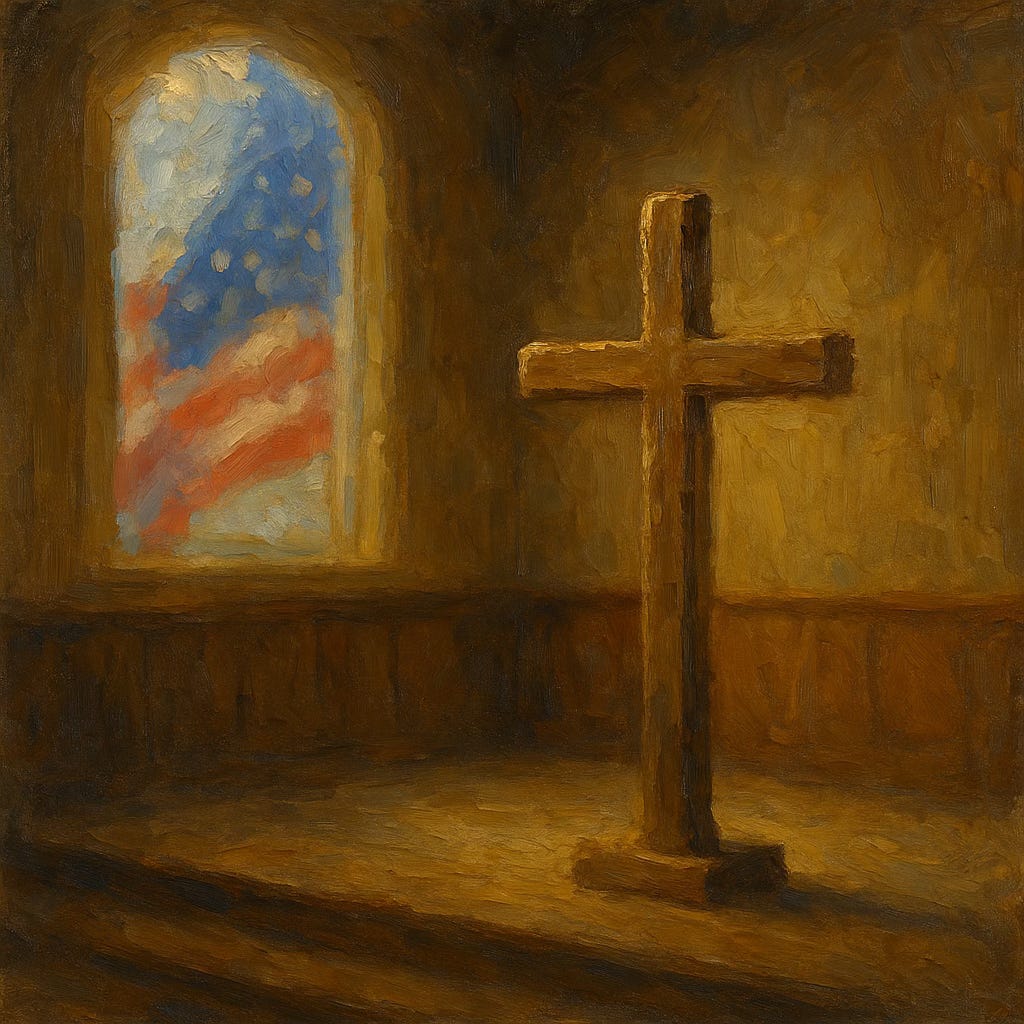
There is a moment I still return to more often than I probably should. I walked into a small sanctuary on a quiet weekday afternoon, the kind of hour when sunlight slips through dusty stained glass and settles anywhere it pleases. I remember the hush. I remember the smell of old hymnals. And I remember the flag, standing tall and proud beside the altar, positioned just a little closer to the center than the cross itself. It was such a small detail. Yet something in the room felt rearranged, like the furniture had been moved when no one was looking.
I stood there for a long minute trying to decide if my reaction was melancholy or simply confusion. Maybe both. Maybe I was witnessing something the congregation itself had not noticed. The cross seemed almost polite in its displacement, as if it were accustomed to watching nations and empires inch past it on their way to glory. It had seen this sort of thing before. I suspect it recognized the scene long before I did.
At the time, I didn’t have the vocabulary to explain what unsettled me. All I had was a faint ache that pressed behind my ribs, the ache of watching two cherished symbols share the same air in a way that felt more competitive than companionable. Patriotism had found a pew, and faith had welcomed it with the warm handshake of an old friend. And because this is America, we barely blinked. We told ourselves it felt natural. A country needs a little ceremony. A faith needs a little pageantry. And so we let this marriage of symbols unfold as if it were the most ordinary thing in the world.
But over the years I’ve realized that what I saw that day wasn’t simply a polite arrangement of flags and furniture. It was the quiet moment when a story I loved began to trade its meaning for a different kind of power. It was the moment when the cross put on a uniform. And I’ve been trying to understand that moment ever since.
How Nationalism Baptized Itself
Whenever I revisit the earliest chapters of our history, I can feel how deliberately our founders sprinkled their civic ideas with a thin sheen of religious language. They weren’t trying to found a sacred empire. They were trying to hold together a fragile republic. They borrowed the vocabulary of virtue because it was familiar and evocative, and it helped people feel anchored in something bigger than politics.
But human beings are meaning making creatures, and we’re quite talented at drifting from metaphor into theology without noticing the crossing. Over time, the gentle God bless this nation became the confident God chose this nation. The humble appeal for blessing transformed into an assumption of divine partnership. I’ve met people who speak of America not simply as a country but as a covenant, a place whose borders were drawn on parchment and in heaven at the same time.
Sometimes I imagine God trying to fill out a census form. Under employment he writes occasional consultant. Under permanent address he writes wherever compassion is practiced, though I visit your country when the schedule permits.
I understand the appeal. Believing your country carries a sacred mission is comforting, especially in chaotic times. It gives suffering a purpose. It gives identity a crest. It gives history a halo. But halos are heavy things. They cast long shadows. And once a nation convinces itself it is chosen, it becomes very hard to remember that chosen people are meant to serve others, not rule them.
The Cross Becomes a Branding Tool
I’ve spent a lifetime in rooms where the cross was used as an emblem of moral seriousness, and I’ve also been in rooms where the cross became a tag line for political marketing. The first kind of room feels like warm soil. The second feels like a merchandising booth. And the shift between the two often happens quietly, the way a riverbank erodes one grain at a time.
I still remember a conversation from my years in public service. A colleague, earnest and exhausted, told me he was tired of faith being used as a password to enter political spaces. He said he felt like he needed to carry a laminated list of approved beliefs just to prove he belonged in certain meetings. I nodded because I knew exactly what he meant. The cross was becoming less a reminder of compassion and more a watermarked stamp of legitimacy.
Then there are the moments that are so absurd they walk right up to the edge of comedy before stepping gently into sadness. I once saw a man praying over his rifle at an outdoor rally. His head was bowed. His voice was trembling. His hand rested on the weapon with the tenderness of someone blessing a newborn. I didn’t know whether to laugh or to look away out of respect for the sincerity he clearly felt. Even the disciples didn’t try to consecrate their fishing nets. Yet here we were, trying to sanctify objects that speak more of fear than faith.
Not a Wedding, More Like a Merger
What we now call the blend of Christianity and nationalism was never a marriage of hearts. It was a merger of interests. Churches desired greater cultural influence. Politicians desired moral credibility. Each offered the other what it lacked. And the result was a partnership so effective that many people forgot it was transactional.
I’ve watched political candidates quote scripture with the enthusiasm of first year actors reading unfamiliar lines from an assigned play. I’ve watched pastors deliver policy endorsements that sounded suspiciously like campaign commercials. Somewhere along the way, morality became a marketing strategy, and spiritual language became a way to brand legislation.
There is now a kind of believer who sees the Constitution as an extension of holy writ. I’ve even heard people refer to the Founders with the same tone one uses for prophets. Sometimes I wait for the day when someone delivers a sermon on the Capitol steps announcing blessed are the tax cuts, for they will comfort the donor class.
When Christianity Became a Costume for Power
I’ll never forget watching a politician hold up a Bible for the cameras, his hand stiff, his posture awkward, his eyes darting like a person who had been handed a creature he didn’t entirely trust. The book was an object in a performance, a prop meant to convey reverence without requiring any.
Images like that always leave me uneasy because they remind me how easily faith becomes an accessory in the theater of power. I have seen the same play repeated in countless churches during campaign seasons. A smiling candidate. A grateful congregation. A few carefully chosen lines about values. A patriotic hymn thrown in for good measure. It’s all very polished. And all very hollow.
The pageantry does something to us. It trains us to believe that performance is sincerity, that spectacle is conviction, that holding a sacred object is the same as being shaped by it. In that environment, symbols lose their ability to challenge us. They become costumes we wear rather than truths we practice.
The New Creed of American Empire
What troubles me most is that this fusion of nationalism and Christianity has produced a new creed. Not the creed of compassion. Not the creed of humility. A creed of triumph. A creed that declares dissent sinful and criticism unpatriotic. A creed that treats the flag as a sacred icon and the nation as an infallible institution.
This creed needs enemies. It thrives on grievance. It requires an us so clearly defined that the them becomes a moral necessity. I’ve seen how quickly people who embrace this creed move from pride to suspicion, from suspicion to hostility. Once you believe your country is holy, it becomes tempting to see anyone who questions it as profane.
And this holy empire mentality shows up in the smallest details. I’ve heard people debate whether protests dishonor fallen soldiers. I’ve heard people argue that questioning a president is a form of rebellion against God. And I’ve heard people say they love the country too much to let democracy get in the way. That last one still makes my jaw tighten. I once heard a man say it at a county fair while eating a funnel cake the size of a car tire. The absurdity almost made me smile. But the conviction in his voice stopped the smile halfway.
The Psychological Comfort of a Holy Nation
I don’t think people fall into this creed because they’re cruel. I think they fall into it because life feels unsteady, and a sacred nation feels like solid ground. We underestimate how deeply humans long for clarity, for belonging, for a story that tells them who they are and why they matter. Nationalism promises all that in a single sweep. It offers identity wrapped in ceremony. It offers meaning tied with patriotic ribbon. It offers certainty in a world that rarely gives any.
And there is something touching in that longing, even if the outcome is troubling. I’ve felt the longing myself, that desire for a story that holds all the brokenness of the world together in a neat frame. I understand why people want a country they can revere without reservation. I just worry about what we sacrifice in the process.
When the Flag Replaces the Cross Completely
The more I watch this unfold, the more I see how fully the symbols have switched places. The cross asks us to serve. The flag asks us to win. The cross calls us to humility. The flag calls us to pride. The cross warns us about the seduction of power. The flag promises the thrilling rush of it.
And yet the fusion is so complete that many people don’t sense any contradiction. They speak of Jesus as if he were a champion of dominance rather than a teacher of compassion. I once heard someone insist that Jesus would have made an excellent strong man leader. I didn’t know whether to laugh or send them a discreetly wrapped Bible with a note that said please start here, and bless your determination.
When faith becomes a mascot for the nation, it loses its ability to challenge the nation. And faith that cannot challenge power isn’t faith. It’s ornament.
Where This Leaves Us, and Me
I’ll admit that this subject cuts deeply. I spent more than four decades serving the country in one uniform or another, in one role or another, trying to do the work of citizenship with as much integrity as I could manage. And during those years I met people whose decency humbled me. I also met people whose behavior reminded me that patriotism can be a very elastic word.
What pains me now is watching the moral depth of faith get obscured by the theater of nationalism. When cruelty presents itself as conviction, I feel a heaviness settle in my chest. When leaders claim sacred authority while violating the very teachings they cite, I feel the sorrow of someone watching a beloved story being rewritten in real time.
There were moments, especially in recent years, when I worried I might lose my ability to love the country without flinching. But then I would remember conversations with ordinary citizens who still believed in mercy. I would remember the quiet heroism of people who served without fanfare. I would remember acts of kindness that the cameras never bothered to film.
And I would realize that the country isn’t lost. It’s contested. It’s conflicted. It’s struggling to decide whether it will worship power or practice humility. And I suppose I’m still here because I’m not ready to surrender that struggle.
Closing Meditation
I keep returning to the image of the cross standing quietly in a sanctuary while the flag flaps outside in the wind. One invites transformation. The other invites allegiance. One asks us to love those who wrong us. The other asks us to defeat those who oppose us. One calls us to humility. The other rewards dominance.
I’m not asking anyone to reject the flag. I’m asking people to remember it isn’t holy. A nation can be cherished without being consecrated. A faith can be practiced without being packaged for political theater. And perhaps if we remember that, we might rediscover a gentler patriotism, one rooted in service rather than supremacy.
Sometimes, late at night, I imagine a sanctuary at dawn. The light is pale. The air smells of wood and wax. The cross stands in its quiet place. The flag outside lifts in the breeze. And I wonder what kind of nation we might become if we learned to let the cross do what it was meant to do, guiding our hearts, while letting the flag do what it was meant to do, guiding our civic responsibilities.
I don’t have the complete answer. I’m still asking myself what stays sacred in me when everything around me feels branded and sold. And I wonder if you’re asking the same question.
If you’d like to support this work:
Light Against Empire is free for all. If my words have value to you and you’re in a position to help, you can chip in with a monthly or yearly donation. Your support keeps the writing alive, the lights on, and the fire burning.
Further Reading:


Thought-provoking words. Thank you.