


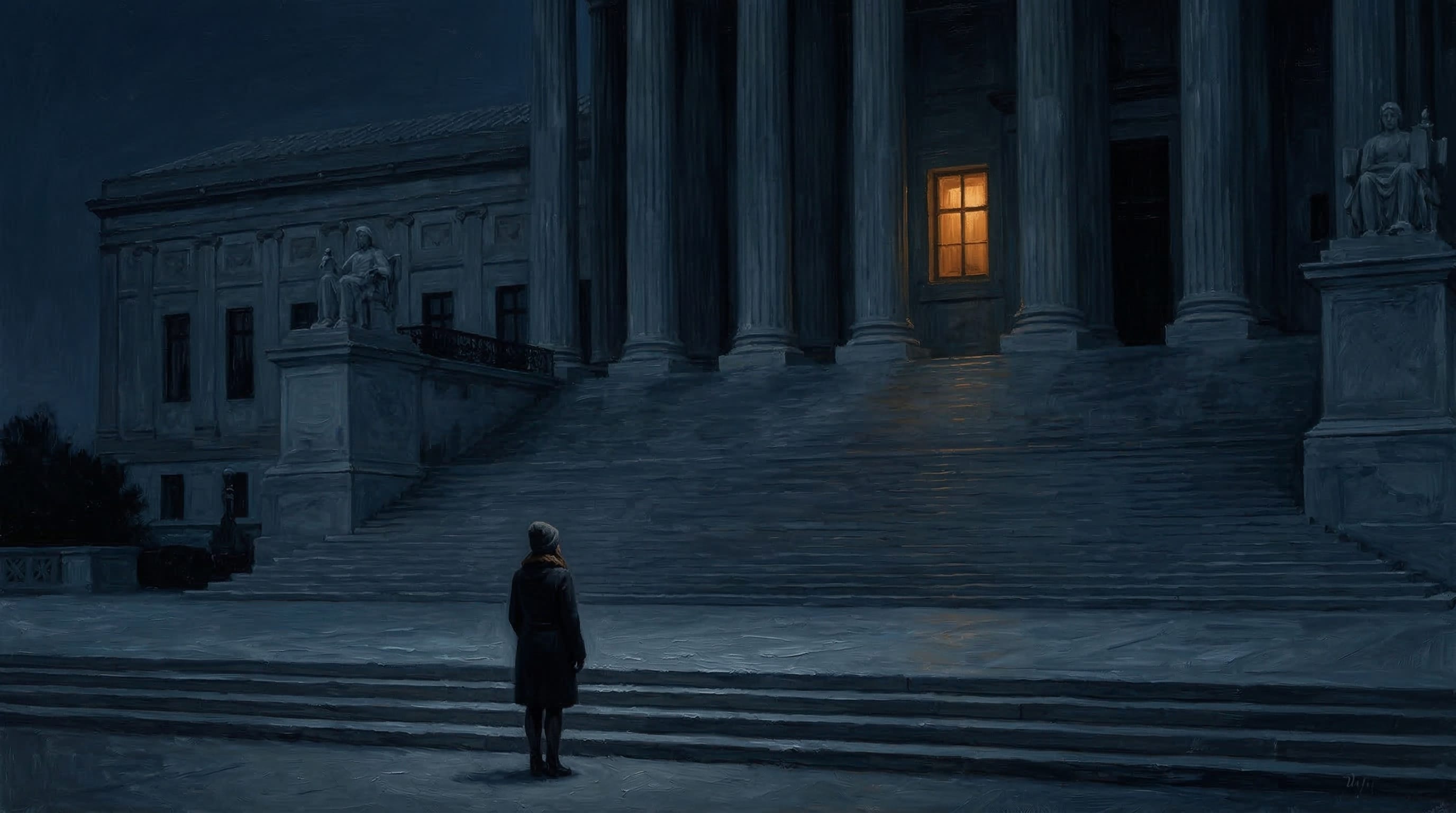
She spoke to the FBI four times. That’s not an allegation or an inference. It’s documented in an FBI Serial Report and in the Maxwell discovery material logs, both of which are in the public record. She was approximately thirteen years old when the incident she described occurred. The year was 1983. The FBI took what she said seriously enough to forward the lead to its Washington headquarters, to include her account in an internal slide deck circulated among investigators under the heading of prominent names. Four interviews. Fifty-three pages of documents and notes, tracked through serial numbers stamped on the government’s own filing system.
Only the first interview is in the public database. That interview doesn’t mention Donald Trump.
The other fifty-three pages aren’t there.
You were promised those pages. Here’s what happened to them.
June 2024. Fox News. Rachel Campos-Duffy asks Donald Trump directly whether he’ll release the Jeffrey Epstein files if elected president. He says yes. September 2024, Lex Fridman’s podcast, a larger audience, the same question. He says it again. These weren’t vague campaign promises. They were specific commitments, made on camera, to an electorate that wanted those files by margins that cut across every partisan line in American politics. Seventy-four percent of Republicans. Seventy-eight percent of independents. Nine in ten Democrats. The promise wasn’t risky. It was the easiest thing he said in the entire campaign, because the hunger for it was genuine and broad and the powerful men whose names were in those files couldn’t exactly campaign against it.
He won. He came back to power. And then the management began.
To understand what happened to the Epstein files, you have to understand what the files actually are, and what they were always understood to contain.
Jeffrey Epstein was a convicted sex offender who ran a trafficking network that moved underage girls to powerful men across three decades. He operated properties in Manhattan, Palm Beach, New Mexico, and two private islands in the US Virgin Islands. He built relationships with presidents, princes, financiers, academics, and heads of state with a patience and specificity that wasn’t accidental. He kept records. He kept photographs. He kept flight logs. He kept the kind of documentation that powerful men in his position keep because documentation is collateral, and collateral was the currency he actually traded in.
He died in a federal facility in August 2019, one month after being indicted, under circumstances the official record describes as suicide and a large portion of the American public has never fully accepted. The men who’d used his network were, with one exception, never charged. The one exception was Ghislaine Maxwell, his primary enabler, now serving twenty years. The men themselves walked.
The files that accumulated across two decades of federal investigation into Epstein and Maxwell represented the closest thing to a full accounting that existed. Survivors’ attorneys had described, in specific terms, FBI interview memorandums in which their clients named the men they’d been trafficked to. Flight logs. Financial records. Email correspondence. The infrastructure of a network that the government had investigated for twenty years and prosecuted almost nobody for.
This is what Trump promised to release. This is what 74 percent of his own voters wanted to see.
What they got requires some patience to describe, because the mechanism of what happened is the story.
The Epstein Files Transparency Act passed the House of Representatives 427 to 1. The Senate passed it unanimously the same day. The lone dissenting vote was a Republican congressman from Louisiana whose reasoning he didn’t explain publicly. Every other elected member of the United States Congress, from both parties, voted to force the release of the files. Trump signed the bill into law the following morning. He did it without reporters present.
The law was explicit in language that deserves quoting directly because the gap between the language and what followed is the whole essay. No records were to be withheld or redacted on the basis of, and these are the statute’s words, embarrassment, reputational harm, or political sensitivity, including to any government official, public figure, or foreign dignitary. The law gave the Attorney General thirty days. December 19th, 2025 was the deadline.
What arrived on December 19th was this: heavily redacted documents, hundreds of pages entirely blacked out, including a consecutive 255-page series and a 119-page grand jury transcript. Within hours of posting, sixteen files disappeared from the public website without explanation. They couldn’t even hide what they were hiding without people noticing. Members of the public discovered within days that copying and pasting the blacked-out text into other applications revealed what officials had intended to conceal. What spread across social media was information about the trafficking network’s members and methods that the Justice Department had specifically decided you shouldn’t see.
The failures ran in both directions simultaneously, which tells you something about the priorities at work. Perpetrators were shielded. Survivors were exposed. Forty-three victims’ full names appeared unredacted in the files. Home addresses were visible in keyword searches. Attorneys for survivors called it the single most egregious violation of victim privacy in one day in American legal history. The Justice Department had been given a list of 350 victims on December 4th, three weeks before the release, specifically so their names could be protected. It didn’t perform a basic keyword search to verify that it had done so.
The men whose names were in the files as potential perpetrators were redacted. The women whose names were in the files as victims weren’t. That asymmetry isn’t an accident of bureaucratic sloppiness. It’s a set of choices made by named people with legal authority over a defined process. Someone decided which names needed protection. The decision they made is documented in the output.
By early January 2026, less than one percent of the files had been publicly released, according to a DOJ letter to Congress. The administration that had promised transparency was administering a document management process that was, by the government’s own accounting, 99 percent incomplete five weeks after the legal deadline had passed.
Then came the releases in waves, a second, a third, a fourth, a fifth, culminating in a January 30th dump of over three million pages that Deputy Attorney General Todd Blanche announced at a press briefing with language worth examining. The department had complied with the act, he said. There was no protecting Trump. When asked directly whether the files had been managed to shield the president, he said: “I think that there’s a hunger or a thirst for information that I do not think will be satisfied by the review of these documents. And there’s nothing I can do about that.”
Read that sentence again. The deputy attorney general of the United States, at a press briefing about the release of files documenting decades of child sex trafficking, told the American public that their appetite for accountability was a problem he couldn’t help them with.
He also wasn’t telling the full truth about the three million pages. The DOJ acknowledged that six million pages potentially qualified as responsive to the law. It released half. Nearly three million pages were withheld, the department said, for stated reasons: the presence of child sexual abuse material, the obligation to protect victims’ rights, ongoing investigations, foreign language documents, and materials sealed by judges.
Each of those is a legitimate category of exemption. Here’s the problem.
The specific serial numbers stamped on the documents in the Epstein files database don’t lie. And NPR, tracking those serial numbers through FBI case records, Maxwell discovery logs, and the files themselves, found the gap I described at the start of this essay. A woman had accused Trump of sexually abusing her when she was approximately thirteen years old. The FBI interviewed her four times. Only the first interview, which doesn’t mention Trump, is in the public database. Fifty-three pages of interview documents and notes, catalogued by the Justice Department through its own filing system, aren’t there.
The law said no records withheld for political sensitivity including to any government official. The President is a government official. The fifty-three missing pages contain interviews about allegations against the President. The law that the President signed said those pages couldn’t be withheld for his protection.
They were withheld.
Now watch what the Attorney General said about it.
February 11th, 2026. Pam Bondi sits before the House Judiciary Committee. Representative Ted Lieu shows video footage of a younger Trump at a party alongside Epstein. He asks whether underage girls were present. Bondi says: there’s no evidence that Donald Trump has committed a crime. Not no verified evidence. Not no charges have been brought. No evidence. Full stop, under oath, before Congress.
At the moment she said it, the FBI files under her authority contained four rounds of interviews with a woman who said otherwise. Three of those interview sets were offline. The first, which doesn’t mention Trump, wasn’t. Bondi told Congress there was no evidence. The evidence was in her building. The serial numbers that would let you find it were in documents her department had already released.
Two Democratic congressmen, Ted Lieu and Dan Goldman, sent a formal letter to Deputy Attorney General Todd Blanche calling for a special counsel investigation of Bondi for perjury. The letter cited the specific 21-page internal DOJ slideshow summarizing witness testimony that had already been released, testimony that directly contradicted the statement she’d made under oath.
Bondi didn’t retract the statement. She doubled down.
The House Oversight Committee voted to subpoena her. The vote was 24 to 19. It passed with Republican support, including a motion brought by Republican Representative Nancy Mace of South Carolina, who said publicly that the Epstein case was one of the greatest cover-ups in American history, that videos were missing, audio was missing, logs were missing, and that the DOJ was more focused on shielding the powerful than delivering justice. These aren’t the words of a Democrat looking for opposition ammunition. They’re the words of a Republican member of the House Oversight Committee describing her assessment of a Justice Department run by a Republican Attorney General serving a Republican president.
Then there’s the detail that requires its own paragraph because it’s not a secondary fact. It’s the thing that tells you what the architecture is.
When members of Congress visited secure DOJ facilities to review the unredacted Epstein files, the Justice Department was logging their search history. Representative Robert Garcia, the ranking Democrat on the Oversight Committee, went public with it. The department under review was recording what the reviewers were reading.
Garcia also called for Bondi to resign after learning that the same release that withheld fifty-three pages of interviews about allegations against the President had exposed the identities of dozens of survivors who’d never been publicly linked to Epstein. He described it as doxxing. The attorneys who’d spent years protecting those women used the same word.
Here’s where a fair reader pushes back, and the pushback deserves its full hearing.
The allegations against Trump in the Epstein files are, as the Justice Department correctly notes, unverified. The FBI marked most tips from its National Threat Operations Center as unverifiable or not credible. Trump’s never been charged with any crime related to Epstein. He’s denied knowledge of Epstein’s criminal conduct. His name appears thousands of times in the released documents, and the large majority of those appearances are references in news articles, gossip emails, and political commentary, not criminal allegations. The women who’ve gone public as Epstein survivors haven’t accused Trump of wrongdoing.
Go further. Grant the argument its full weight. The DOJ was managing an archive of six million pages, under extreme public pressure, on a deadline that gave them thirty days for a job that would reasonably take years. Redaction errors at that scale aren’t automatically evidence of intent. The department was simultaneously trying to protect victim privacy and meet a statutory deadline and respond to congressional oversight and manage an unprecedented document release. Institutional chaos produces exactly the kind of asymmetric errors, perpetrators protected here, victims exposed there, that appeared in this release. The chaos explanation isn’t nothing.
What the chaos explanation can’t account for is the serial numbers. The way NPR tracked the missing pages didn’t depend on the content of the allegations. It depended on the government’s own filing system. The gap exists whether the underlying allegations are true or false. You can explain away redaction inconsistencies as sloppiness. You can’t explain away a sequential gap in a federal filing system as anything other than a decision. Someone decided those fifty-three pages stayed offline. The law said that decision was illegal if it was made for political reasons. The pages that are missing are the pages about the president. Those two facts sit next to each other in the public record and they don’t resolve into coincidence no matter how long you look at them.
The question was always who decided what you were allowed to see. And what they decided is in the arithmetic.
The receipt arrived on schedule.
The Iran war started February 28th, 2026. The Epstein files had been the dominant accountability story of January and February. NPR’s investigation into the missing pages published February 24th. The Bondi subpoena passed March 4th, six days into the war, when the American news cycle was entirely occupied by missile strikes and Khamenei’s death and regional escalation. The hearing that would’ve put the Attorney General under oath about what she withheld and why had to compete with a shooting war for oxygen. It didn’t win that fight.
The sequence is: investigation published February 24th, bombs fall February 28th, subpoena passes into a news cycle that can’t hear it on March 4th. Make of that sequence what you will. What I’ll tell you is that it worked.
The communications of Bondi, Blanche, and FBI Director Kash Patel are almost entirely absent from the Epstein library. All three spoke extensively and publicly about the Epstein files before and after taking their positions. Their internal communications about the case should, under the broad scope of the law, appear throughout the database. They don’t. A formal watchdog complaint reached the only conclusion the evidence supports: those communications have been withheld, destroyed, or redacted beyond traceability.
The people who managed the release of the files aren’t in the files.
A thirteen-year-old girl in 1983. A woman who told that story to federal investigators four times across four separate interviews. An internal government slide deck that treated her account seriously enough to circulate it under the heading of prominent names. Fifty-three pages the government’s own filing system says exist and the public database says aren’t there.
She’s the human center of what this essay is about. Not the serial numbers. Not the subpoena. Not the perjury accusation. Not the search history surveillance. Those are the mechanisms. She’s the reason the mechanisms matter.
The men whose names were in those files were protected. Her name, and the names of dozens of women like her, weren’t. The department doxxed the survivors and sealed the perpetrators and told Congress under oath there was no evidence and logged the search histories of the people who came to check.
You were promised the files. You got half of a six million page record, managed by the people whose names should’ve been throughout it, redacted by a process that protected the powerful and exposed the powerless, overseen by an Attorney General who told Congress under oath there was no evidence while the evidence sat in her building.
The man who made the promise is the reason you don’t have them.
The asymmetry is the message. Perpetrators redacted. Survivors exposed. Fifty-three pages missing. One woman, approximately thirteen years old, in 1983, who told the FBI what happened four times and whose words the government of the United States decided you weren’t allowed to read.
That decision was made by someone. That someone works for the man who promised you the files.
The receipt is still coming. When those fifty-three pages surface, in a courtroom or a contempt proceeding or a leak or a subsequent administration, the question attached to them will be the same question it’s always been.
Not just what’s in them.
You already know who decided you couldn’t see.
Light Against Empire is free for all. I write on American foreign policy, political accountability, and the lies of “Empire.” If my words have value to you and you’re in a position to help, you can chip in with a monthly or yearly donation. It takes time, energy, and resources to keep Light Against Empire running. Your support keeps the writing alive, the lights on, and the fire burning. Thanks!
Further Reading:
