


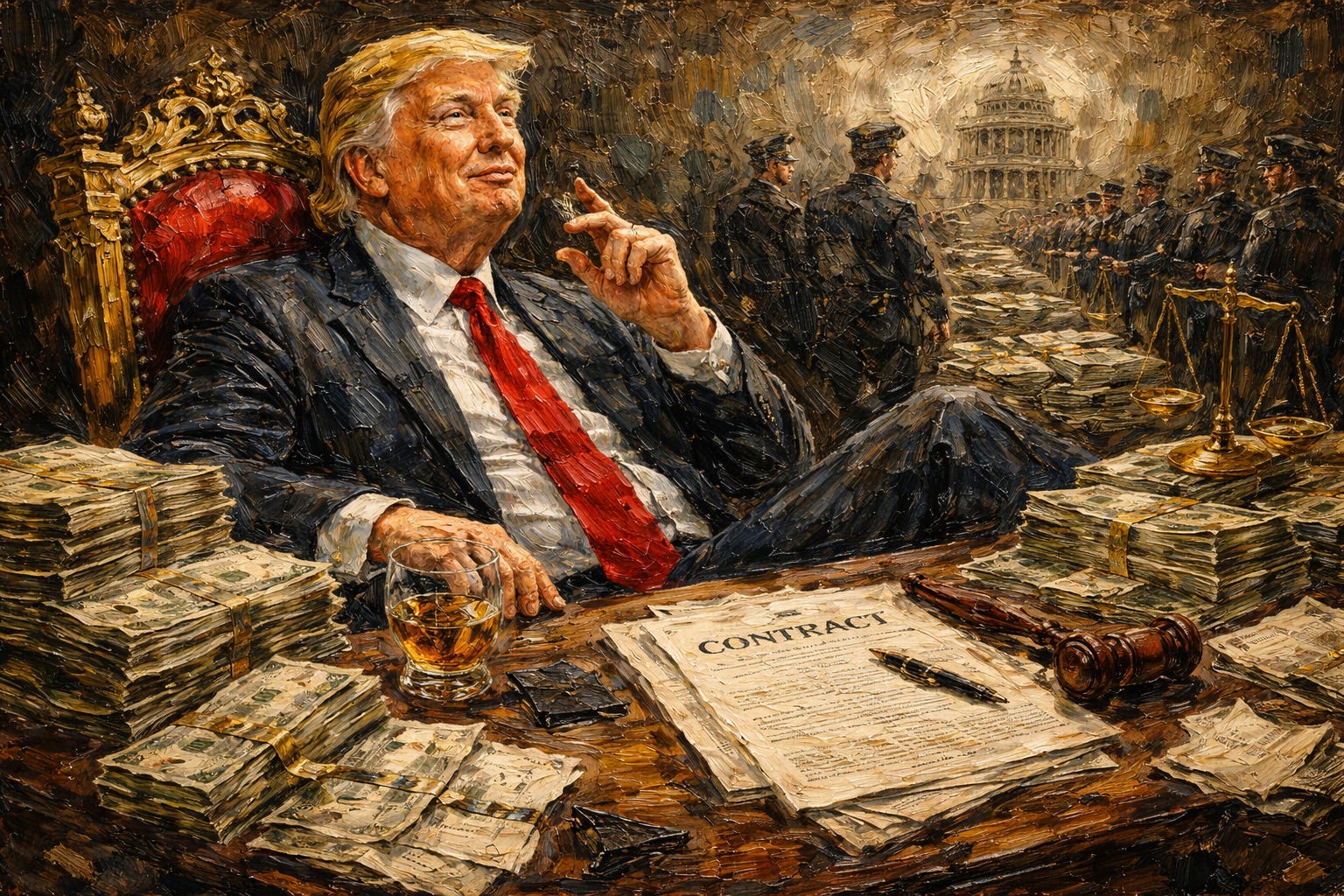
The Modus Operandi of Trump
Looking at the “style” of Trump and the limited repertoire of skills he employs to run his businesses, it’s made me ponder a repeating question.
What if Donald Trump governs the same way he’s always done business?
Not rhetorically. But practically.
When I look at his presidency through that lens, a lot of what feels chaotic starts to make a grim kind of sense. I realize this isn’t news and that others have already noted the pattern; however, bear with me as I’m not talking about the pattern as much as the outcome.
How He’s Always Operated
In his business life, Trump had a fairly consistent way of operating. He made deals loudly and confidently. He talked about them as victories. And then, when the time came to honor them, things got slippery. Contractors were paid late or not at all. Obligations were disputed. Lawsuits were filed, not necessarily to win, but to delay. Bankruptcy wasn’t treated as failure but as a reset. Accountability was optional. Time did most of the work.
That pattern didn’t disappear when he entered public life. It just scaled up.
How That Method Became Governance
Think about agreements. In Trump’s commercial world, contracts were leverage, not promises. Once the leverage faded, so did the obligation. That’s how you end up with unpaid builders and years of litigation. As president, treaties, alliances, and even laws seem to get the same treatment. NATO becomes a favor. Trade agreements are reopened. Congressional appropriations are treated as suggestions. Nothing feels settled for long. Nothing binds beyond the moment it’s useful.
Then there’s ambiguity. Trump’s contracts were often vague, not because of carelessness but because vagueness creates room. If terms aren’t clear, responsibility can always be argued away. In government, this shows up as policies announced and then contradicted, executive actions written broadly and enforced selectively, statements walked back and then repeated. Confusion isn’t accidental. It’s part of the environment.
Default fits right in. Trump defaulted on loans and settlements and wore it as toughness. Creditors were framed as foolish for expecting compliance. In government, norms are violated and then normalized. Oversight is ignored. Court orders are delayed. Pushback is treated as persecution. Compliance starts to look like weakness.
And then there’s delay. This may be the most important piece. Trump didn’t need to win quickly. He needed to last longer than the other side. Lawsuits dragged on. Opponents ran out of money or patience. In government, everything is litigated, appealed, postponed, or buried under the next manufactured crisis. Accountability isn’t defeated. It’s postponed until people stop demanding it.
When you put all of that together, you see the effect it has on people.
It wears them down.
When every rule feels conditional and every fact contested, attention scatters. Moral clarity dulls. People don’t give up because they’re convinced. They give up because they’re tired. Stability starts to feel more attractive than justice. Silence starts to feel easier than engagement.
That’s the danger. And that’s the message
Trump doesn’t need the country to agree with him. He needs it to stop insisting that anything be agreed upon at all. He needs exhaustion to do what persuasion can’t.
What This Moment Is Asking of You, of Us
So what do we do with that?
First, we name the pattern. This isn’t improvisation. It’s habit. Once you see delay as the method, you stop waiting for quick resolutions. Once you recognize ambiguity as deliberate, you stop chasing clarity and start demanding enforcement.
Second, we prepare for duration. This isn’t a single crisis that resolves neatly. It’s a long contest between institutional stamina and personal will. Knowing that changes how you pace yourself.
Third, we refuse to live entirely inside his frame. His power depends on pulling everyone into his tempo, his chaos, his endless emergencies. The counter isn’t louder outrage. It’s steadier presence. Repetition of truth. Consistency. A willingness to stay with the work even when it’s dull or frustrating.
And finally, we remember something simple and old.
Democracies don’t usually fall because they’re attacked. They falter when people decide the cost of defending them is too high.
This moment is asking something of us. Patience. Attention. Endurance. A willingness to stay engaged even when it’s draining and unsatisfying.
Trump’s style is built to make people give up.
The work now is to notice that, and to decide, quietly and deliberately, that we won’t. Not now. Not ever. Not until we are through this charge and again rise into the light.
Please Support the Work
Light Against Empire is free for all. If my words have value to you and you’re in a position to help, you can chip in with a monthly or yearly donation. Your support keeps the writing alive, the lights on, and the fire burning.


