


Corrective Friction, Gone
Let me start where this started for me, not with a theory, but with a moment.
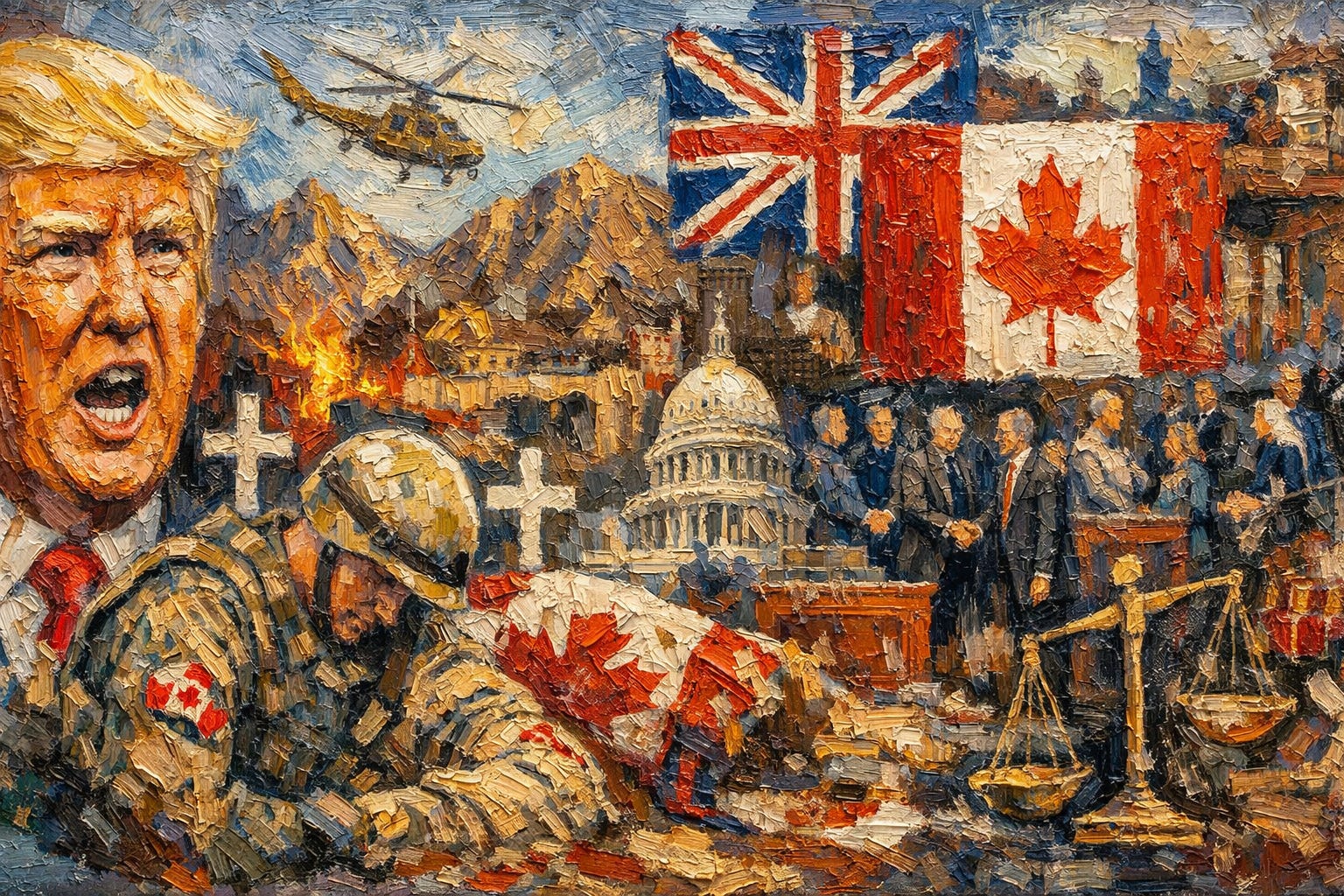
I was reading a post by Nick Cohen about Donald Trump insulting allied war dead, British, Canadian, and European soldiers who died in Afghanistan. I’ve heard Trump say cruel things before. We all have. That wasn’t new. What was new was the feeling that followed. Not outrage exactly. More like unease that lingered.
So I asked myself a question.
What exactly bothered me here?
Was it the insult itself? Of course.
Was it the historical ignorance? That didn’t help.
Was it the moral emptiness? That was familiar.
The discomfort came from something harder to name. The remarks didn’t feel sharpened for cruelty so much as allowed to drift there. Untethered. Unchecked.
Nick named the question that followed. Is something happening here that we’re refusing to talk about?
That question matters. But what kept me thinking was the next one.
Even if Nick is right, even if this is decline layered onto long standing pathology, why isn’t anything stopping it?
That’s where I want to begin.
Why the question itself feels forbidden
Let me ask the uncomfortable thing plainly, the way friends do over coffee.
Why does asking about fitness feel more dangerous than ignoring it?
Nick didn’t call Trump stupid. He didn’t diagnose him from a distance. His claim was narrower and more unsettling. He pointed to a visible pattern of disinhibition, incoherence, entitlement, and escalating aggression, then asked whether it was responsible to pretend this was all just personality.
The reaction to that question was revealing. Not argument. Not counter evidence. Just discomfort. Silence.
Why?
Because we’ve built strong taboos around discussing mental decline in public figures, and some of those taboos are honorable. We don’t want to stigmatize illness. We don’t want disability turned into a political weapon. We don’t want civic judgment replaced by armchair psychiatry.
All of that makes sense.
Until it doesn’t.
So here’s the first question that matters.
When does restraint turn into abdication?
If someone holds immense power and their behavior visibly degrades, is it kinder to avoid the question, or more dangerous?
Nick’s provocation wasn’t really about Trump. It was about whether a liberal democracy still knows how to talk about fitness without collapsing into cruelty or denial.
But I don’t want to linger here, because this hinge is only the door. The deeper problem comes after.
So let me ask the next question.
Even if we never mention decline again, even if every clinical inference is wrong, what is the system actually doing?
The disappearance of corrective friction
This is where my concern shifted from the man to the machinery.
Let’s set diagnosis aside. Assume Trump is exactly who he’s always been. Same impulses. Same bravado. Same contempt. Same confusion. Same hunger for dominance.
If that’s true, why does it feel more dangerous now?
Here’s my answer.
Because the system that used to slow people like this down has degraded to the point of near invisibility.
I want to talk about friction, not as metaphor, but as function. Friction is what turns impulse into delay. It’s the pause before action. The refusal. The raised eyebrow. The memo that never moves. The ally who says no. The institution that stalls.
Presidents were never saints. They were restrained.
So let me ask it this way.
What used to slow this down?
Advisors who delayed implementation.
Institutions that refused to translate impulse into policy.
Media that treated instability as danger rather than spectacle.
Parties that feared disgrace more than retaliation.
That friction didn’t cure bad leaders. It absorbed shock.
What feels different now is that impulses no longer encounter resistance. They encounter processing.
An outburst becomes a talking point.
A threat becomes a trial balloon.
A confusion becomes a headline cycle.
A cruelty becomes “just how he is.”
Instead of friction, we have throughput.
And that matters more than diagnosis.
Because a disinhibited leader is only catastrophic if nothing absorbs the force. What we’re watching is impulse moving through the system with very little loss of energy.
You can see this in small moments. Reporters sitting silently while colleagues are abused. Officials translating obvious nonsense into administratively usable language. Allies tiptoeing around behavior that once would’ve triggered pushback.
This isn’t about courage or cowardice. It’s about adaptation.
When a system stops interrupting, it starts accommodating.
So the question becomes less about what Trump says, and more about what happens after he says it.
Which leads to the next question.
If institutions no longer correct, who does?
The electorate that corrects for the wrong thing
At this point, someone usually says, don’t worry, the voters will fix it.
I understand why we reach for that. It preserves the idea that democracy heals itself.
But let’s look at how correction is supposed to work.
In a functioning republic, the electorate corrects in three ways.
First, by reacting to reality rather than narrative.
Second, by punishing instability or incompetence at the ballot box.
Third, by withdrawing legitimacy when leaders violate shared norms.
Now let’s ask whether those mechanisms are still intact.
Do people encounter events directly, or do they encounter prepackaged stories loaded with identity and emotion?
Do elections still function primarily as judgment, or as declarations of belonging?
And when norms are violated, does legitimacy drain away, or does loyalty harden?
These aren’t rhetorical questions. The answers matter.
What I see isn’t an absent electorate. It’s an electorate tuned to a different frequency.
Many voters aren’t correcting for stability or restraint anymore. They’re correcting for emotional alignment. For grievance. For dominance. For defiance.
That doesn’t make them irrational. It makes them responsive to a system that rewards those signals.
So the electorate hasn’t disappeared as a force. It’s still powerful. It’s just pushing in a direction that doesn’t slow danger.
Which raises the next uncomfortable question.
If voters are present but misaligned, why doesn’t someone else step in?
The incentives that reward silence
Here’s where explanations based on character start to fall apart.
It’s tempting to say people stay quiet because they’re afraid, weak, or corrupt. Sometimes that’s true. But it’s not enough.
The deeper reason resistance has thinned is that the incentives punish it.
Let’s talk mechanics again.
Resisting Trump carries immediate personal cost. Loss of position. Loss of access. Loss of funding. Loss of safety. Accommodation, by contrast, offers protection and relevance.
Parties don’t punish unfitness. They punish disloyalty.
Media doesn’t reward restraint. It rewards spectacle.
Law moves slowly by design. Damage moves quickly through narrative.
So here’s the hard question.
Why would a rational actor intervene in a system where resistance guarantees pain and accommodation offers survival?
Once incentives tilt that way, dysfunction doesn’t just persist. It stabilizes.
At that point, hoping someone will step in stops being a plan and starts being a prayer.
Which leaves one final place we tend to look for correction.
The public.
And here’s where I think we’ve missed something essential.
Exhaustion as design, not apathy
I want to talk about fatigue, but not in the shallow way it’s usually discussed.
This isn’t about people not caring. It’s about timing.
American campaigning now lasts years. Presidential campaigns begin long before anyone votes. House races never stop. Local contests overlap with national ones. Politics becomes a permanent state of mobilization.
By the time someone finally takes office, the public is wrung out.
So let me ask something honestly.
After years of argument, outrage, fear, hope, and mobilization, what do most people want when the election ends?
They want to exhale.
There’s a quiet psychological move that follows. We tell ourselves this is a representative government. Go represent. I’m done watching for a while.
We go recover.
The problem is that this is precisely when scrutiny should intensify.
Instead, attention collapses just as power begins to move. Oversight gives way to delegation. Vigilance gives way to exhaustion.
This isn’t apathy. It’s structural depletion.
The system consumes civic energy during campaigning, then allows governance to unfold in a quieter, less watched space.
That’s why normalization sticks. Not because people approve, but because they’re tired.
And once exhaustion sets in, even shocking behavior struggles to register as urgent.
So now let’s put all of this together.
Where this leaves us
A leader may be unfit.
Institutions that once slowed him now translate instead.
Incentives reward accommodation.
The electorate corrects for belonging rather than danger.
And the public enters governance exhausted, exactly when vigilance should begin.
None of these failures alone would doom a democracy.
Together, they describe a system that no longer reliably corrects itself.
That’s the thought I can’t shake.
Not that collapse is inevitable.
Not that repair is impossible.
But that repair no longer emerges automatically.
And if that’s true, then the most dangerous thing we can do is pretend time will fix this on its own.
Time, without resistance, never has.
Please Support the Work
Light Against Empire is free for all. If my words have value to you and you’re in a position to help, you can chip in with a monthly or yearly donation. Your support keeps the writing alive, the lights on, and the fire burning.


This stuff happens... And more horror will happen.. Until he is stopped... Congress.... If you're listening... 🤔.
I get that this is specifically directed at Trump. But, just as an experiment, I tried reading it as though it's directed at genocide-enablers and imperialists hell bent of bringing Operation Barbarossa to culmination. And it seems to still make perfect sense.