


I move through my days with the sense that something in the air’s changed. Conversations feel tighter. Silences linger longer than they used to. The language around us has grown sharper, more certain, more impatient with nuance or mercy. Fear travels quickly now, as if it’s memorized the country’s roads. It arrives in headlines, in raised voices, in the way people brace themselves before speaking honestly.
Fear makes itself useful. It promises order. It promises protection. It promises relief from the exhausting work of discernment. It tells us who belongs and who doesn’t, what to harden and what to discard, how to survive by narrowing the circle of our concern. It offers itself as the sensible choice, the adult choice, the necessary choice.
Love doesn’t compete well in that climate.
Love moves more slowly. It doesn’t announce itself with certainty or slogans. It doesn’t come armed with instructions. Love asks for patience when patience looks irresponsible. It asks for openness when closing feels safer. It prefers kitchens and sidewalks and the quiet space between two people who choose not to wound each other even when they could.
This is how fear begins to reign. Not all at once, but gradually, through speed and spectacle, through the steady pressure to choose hardness over tenderness, certainty over care. Fear organizes quickly. Love works by staying.
When I look at the political and cultural landscape right now, I don’t see a shortage of intelligence or outrage or urgency. I see a thinning of tenderness. I see a nation embarrassed by mercy. A culture that confuses cruelty with strength and decisiveness with wisdom. We know how to argue. We know how to condemn. We’ve become less practiced at the quieter work of remaining human under strain.
And yet, love persists.
Not as a banner.
As a gesture.
As restraint.
As the refusal to humiliate when humiliation’s available and even rewarded.
Love survives in small rooms. In ordinary bodies carrying ordinary grief. It survives because it doesn’t wait for permission. It survives because it’s stubborn in ways fear can’t fully conquer.
It’s here, in this unsettled moment, that the question finally rises for me. Not as a slogan, not as a command, but as something personal and demanding, something that asks about the future of my own soul rather than the fate of the nation.
What does love require of me now, when fear would be easier?
I don’t ask this from a place of innocence. I ask it with the news still flickering in my hands. I ask it knowing how efficient fear can be, how clearly it speaks, how convincingly it presents itself as wisdom. Fear tells me where to stand. Love asks me how to stand. Fear tells me who to protect. Love asks me who I might abandon in the process.
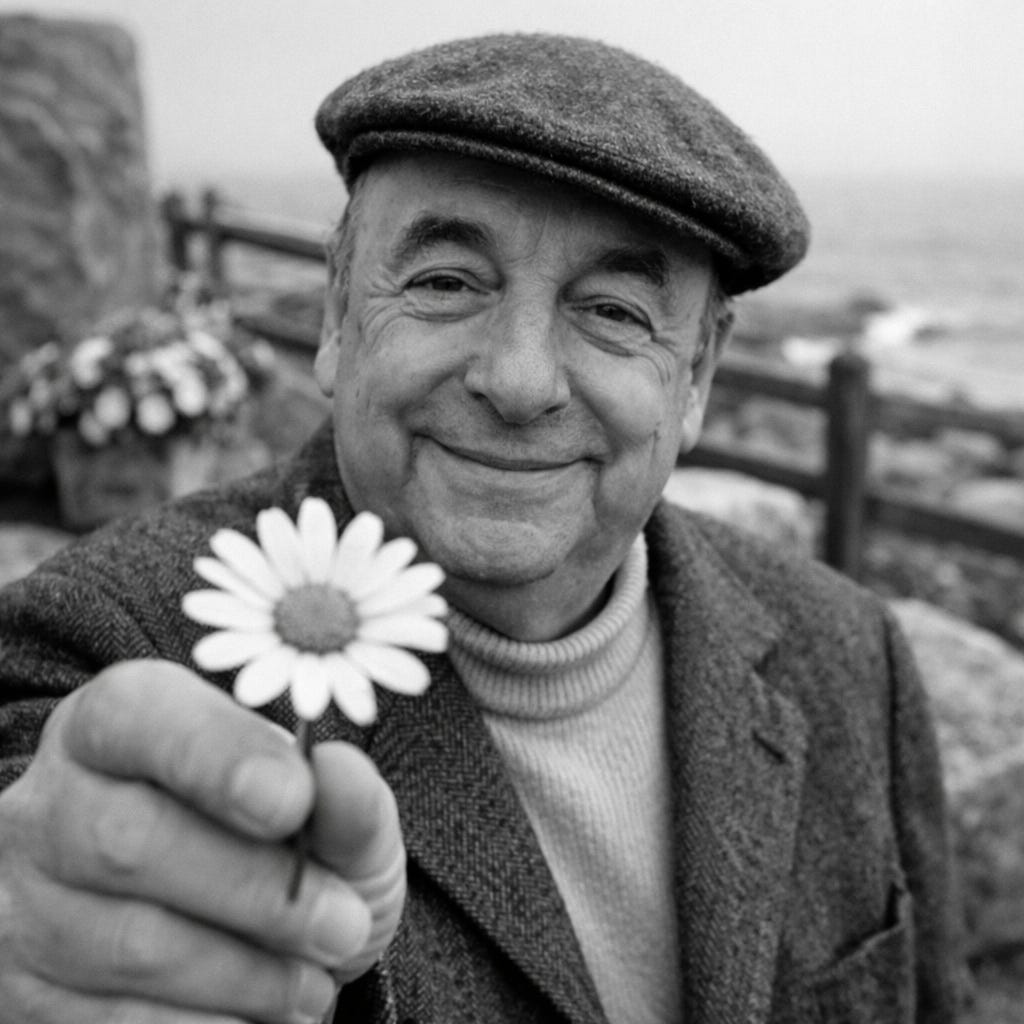
Neruda understood this tension. He wrote of love not as escape but as presence. Love lived in bread and hands and streets and the long patience of people who kept choosing each other under pressure. It wasn’t purity he trusted, but proximity. Not innocence, but fidelity to the human scale of things. Love, for him, was rooted in the ordinary and therefore harder to uproot.
That’s where this question keeps leading me. Away from performance and proclamation, toward the daily grammar of my life. Toward how I speak when disagreement sharpens into contempt. Toward how I meet the people who frighten me because they remind me of how easily fear could teach me to live differently.
Love doesn’t require that I pretend things are fine. It doesn’t ask me to excuse cruelty or disguise it with clever language. It doesn’t ask me to confuse compassion with surrender or silence with wisdom. Love doesn’t ask me to hand my conscience to anyone else for safekeeping.
But love does ask something harder.
It asks me to resist the relief that comes from dehumanizing. To refuse the ease of flattening people into enemies so I can feel clean. It asks me to remember that fear, left unattended, will make monsters of us all. It asks me to leave room for the possibility that even now, even here, something in us remains capable of change.
This isn’t decorative love. This is love with its sleeves rolled up. Love that knows anger and grief and still refuses to abandon dignity. Love that understands boundaries aren’t betrayals but the way compassion survives without destroying itself.
Fear tells me to withdraw. To narrow my concern. To care only for my own. Love asks something more precise. To remain porous without dissolving. To give without bleeding out. To choose my yes and my no with equal care.
Some days love looks very small. It looks like refusing to repeat a lie even when repetition would be easier. It looks like listening longer than I planned. It looks like grieving honestly instead of hiding behind irony. It looks like tending to the frightened places in myself so I don’t ask the world to do that work for me.
Authoritarian cultures try to domesticate love. They want it conditional. Measured. Distributed according to loyalty and usefulness. They want charity to serve power and compassion to obey borders drawn by fear. This question quietly refuses all of that. It keeps love rooted in the personal, where it can’t be easily commandeered.
What does love require of me now?
It asks me to think about the person I’ll be when this season’s passed. Not the version of myself who survived by shrinking, but the one who stayed awake. The one who kept their hands open even when it’d have been safer to clench them. The one who didn’t mistake hardness for strength.
I want to be able to say that fear didn’t decide who I was allowed to love. That despair didn’t write my ethics. That I didn’t outsource my compassion to the loudest voice in the room. I want to say I practiced mercy without illusion and courage without spectacle.
Love doesn’t promise to fix the world. It promises something quieter and more demanding. It promises to keep us human while the ground shifts beneath our feet.
So I return to the question, not once, but daily. In grocery stores. In conversations that tighten unexpectedly. In moments of silence when fear tries to sound reasonable. I ask it when I’m tired. I ask it when I’m angry. I ask it when I’m tempted to disappear into comfort.
What does love require of me now, when fear would be easier?
Sometimes the answer’s rest. Sometimes it’s refusal. Sometimes it’s forgiveness that comes slowly and without applause. Sometimes it’s simply staying. Staying present. Staying kind. Staying honest.
And sometimes, love is what remains when fear’s finished making its demands.
Keep the Flame Lit
This work is free for all because light should never be gated. If these words feel like a lantern in your hands, you can help keep it burning. Your donation makes sure the flame doesn’t go out.