

Warning! Political Satire Ahead! -Meanwhile in Judea: Rome Keeps Getting Nervous About the Wrong Messiahs
When in Doubt, Nail Someone to Something.

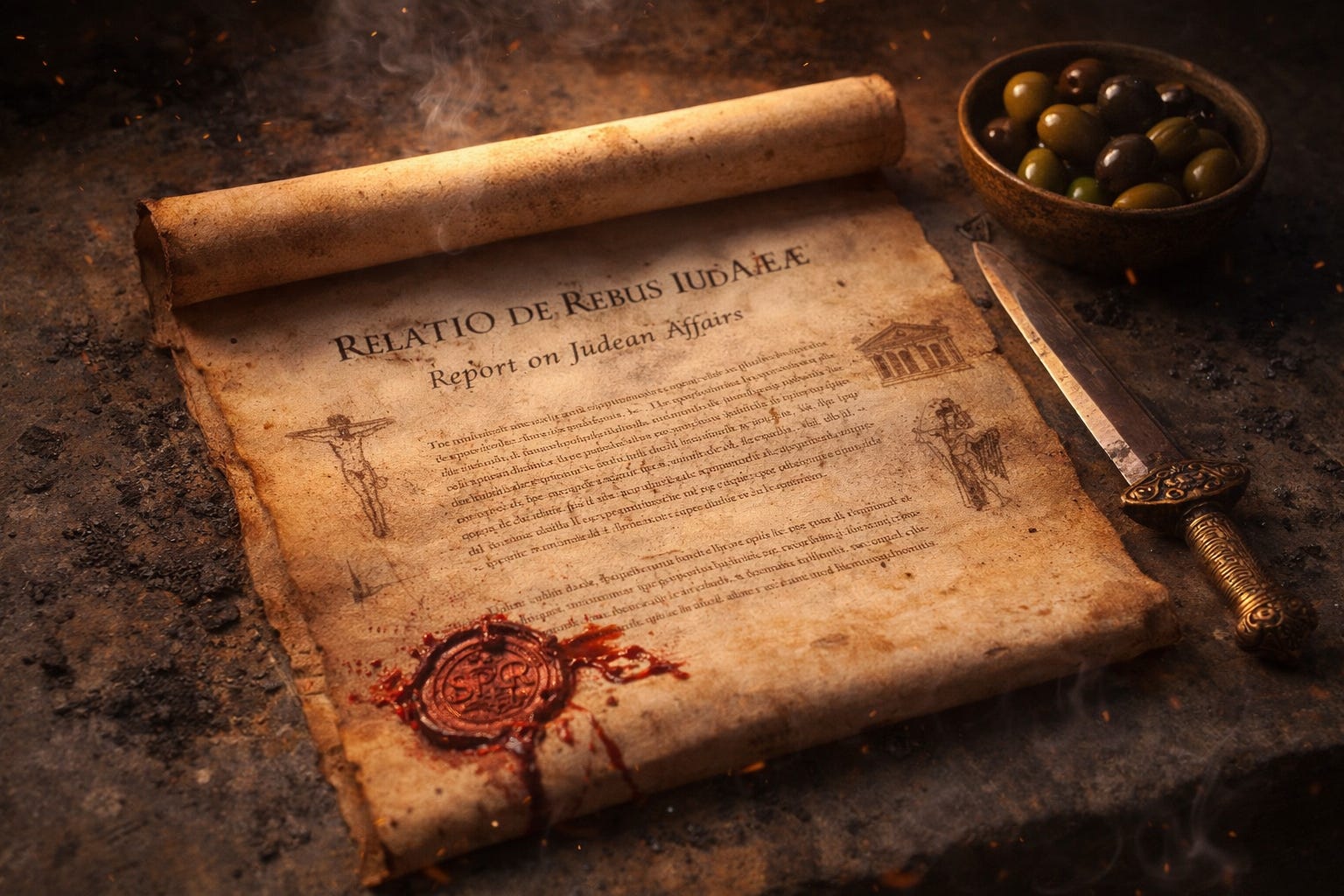
MEMORANDUM
To: Central Authority, Department of Internal Cultic Affairs, Rome
From: Centurion M. Secundus Publius, Judean Affairs Division
Subject: Q2 Threat Report – Subversive Religious Activity and Regional Uplift Risk, Province of Judea
Executive Summary
Judea remains operationally unstable, with elevated levels of prophecy, hunger, anti-tax sentiment, and divine rhetoric. Regional morale is mixed. Temple elites remain cooperative. The peasants remain uncooperative. A number of fringe religious figures are gaining influence, each with some variation of the usual message: the empire is corrupt, Rome is doomed, the kingdom of heaven is imminent, etc.
Of particular concern is the increase in self-proclaimed messiahs. While most lack organizational structure or military capacity, they continue to generate unrest. Public gatherings have increased by 37 percent during recent festivals, and scroll-based radicalism is rising across the Galilee.
We recommend full-spectrum preemptive crucifixion of all unauthorized teachers, suspected prophets, and charismatic wilderness dwellers until the spiritual climate stabilizes.
Threat Matrix: Individuals of Messianic Concern
Below is a summary of key figures currently generating instability, confusion, or spiritually inconvenient enthusiasm within the province. Assessments remain provisional, as messianic figures have a habit of evolving rapidly once crowds gather.
Jesus of Nazareth
Current assessment places this individual in the low but irritating category. Professionally identified as a carpenter, though he appears to have abandoned gainful employment in favor of itinerant teaching, healing, and parable delivery. Not armed. Not advocating violence. Disturbingly popular with the poor. Uses agricultural metaphors that imply moral equality. Has been overheard suggesting that mercy outranks law and that the powerful may be judged. While militarily negligible, he presents a persistent narrative risk. Recommendation remains continued monitoring, with strong consideration for a discreet, temple‑adjacent arrest should crowd sizes increase.
Simon bar Giora
Categorized as high threat. Openly armed, openly hostile, openly ambitious. Claims divine backing, burns Roman infrastructure, recruits aggressively, and displays a worrying comfort with bloodshed. His messaging is crude but effective, focusing on vengeance, land, and glory. Rome understands this type well. Active military suppression is underway. No theological nuance required.
John the Baptizer
Assessed as moderate threat with escalation potential. Operates primarily along riverbanks, immersing followers in water while shouting about repentance and impending judgment. Dietary habits include insects, which may be symbolic. Draws large crowds. Speaks harshly about both Roman authority and temple elites. Could pivot into full messianic status if imprisoned incorrectly. Recommend containment without martyr creation.
The Elijah Returns Network
Threat level currently unknown. Appears to be a loose collection of apocalyptic enthusiasts operating out of caves, hillsides, and poorly lit upper rooms. Distributes handwritten scrolls heavy on metaphor and end‑times language. No clear leader identified. Possibility remains that this is either an organized insurgent cell or simply a poetry collective. Further infiltration required.
General Observation:
The most disruptive figures continue to be those without weapons. Armed rebels behave predictably. Moral teachers do not. The former can be crushed. The latter tend to linger.
Many of these figures are operating within low-resource, high-impact models—meaning they’re poor, disorganized, and incredibly effective at storytelling. This poses a unique threat to imperial narratives!
Section One: The Messianic Dilemma
The core problem remains conceptual: Judea continues to produce messiahs faster than we can crucify them.
The traditional messiah model was thought to involve military leadership, Davidic lineage, and an unhealthy fixation on temple sovereignty. Current messiahs do not follow these parameters. They are humble. They are nonviolent. They quote scripture sideways. Some heal the sick. Others just sit under fig trees saying vaguely seditious things about Caesar.
This has complicated our classification system. Philosophers sound like rebels. Rebels claim divine appointment. Shepherds are prophesying. And one man in particular keeps referring to himself as “the Son of Man,” which is legally meaningless but somehow deeply threatening.
We remain unclear on which of these is the real threat—so we are recommending, for safety, that we treat all of them as hostile until proven crucified.
Section Two: Messaging and Optics
Crucifixion remains the most effective public deterrent, though overuse has diluted its symbolic power. We estimate that 1 in 4 Judean children now sees crucifixion as a common occupational hazard for relatives with unpopular opinions.
To counteract desensitization, we recommend rotating spectacle methods, including:
Temple excommunication with loud trumpets
Satirical coinage
“Exile by Temple Lottery” (prototype under development)
We also advise refreshing regional messaging to shift perceptions of occupation. Current terms like “military presence” and “tax enforcement” are testing poorly in synagogue-adjacent focus groups.
Suggested replacements:
“Spiritual Infrastructure Partnership”
“Sacred Custodial Arrangement”
“Shared Governance Under Divine Oversight”
Temple leadership has expressed willingness to denounce messiahs publicly in exchange for continued political autonomy, firstfruit stipends, and expanded parking.
Section Three: Memory Control and Martyr Management
The primary danger with messianic figures isn’t what they do while living. It’s what they become after they’re dead.
Posthumous martyrdom rates remain high. Once crucified, messiahs tend to multiply in significance. The phenomenon is theological in origin but memetic in effect. Public memory often detaches from reality within forty-eight hours of execution.
The recent teacher from Nazareth presents a particular risk in this regard. While his teachings are irritatingly gentle—”Blessed are the peacemakers,” “Turn the other cheek,” “Give Caesar what is Caesar’s”—they are gaining post-arrest resonance. He’s become something of a living parable, and people like parables more than they like governors.
We recommend coordinated post-crucifixion messaging strategies, including:
Discrediting with temple-approved scrolls
Highlighting carpenter background to delegitimize claims of divinity
Suggesting mental instability (“over-fasting,” “wilderness isolation,” etc.)
Emphasizing lack of formal rabbinic training
Section Four: Policy Recommendations
Crucify Early, Crucify Often
Do not wait for miracles or crowds. Detain and execute preemptively, especially during festivals.Outsource Blame
Utilize temple councils and local religious authorities to initiate trials. Appear to honor local law.Standardize Messiah Criteria
Create a public registry of “Recognized Religious Leaders” to frame all others as illegitimate.
Branding idea: “Certified Messiahs of Judea™”Enhance Regional Surveillance
Focus especially on hillsides, riverbanks, upper rooms, and wedding banquets. These tend to serve as flashpoints.Develop Anti-Resurrection Contingencies
Should rumors of post-mortem activity emerge, deploy immediate memory management protocols.
Suggested actions: Tomb sealing, disinformation scrolls, plausible deniability.
Section Five: Final Reflections
Judea remains a spiritual volcano disguised as a province. The people do not fear Rome—they tolerate it until the next miracle. They sing psalms of rebellion. They speak in prophecy. They trade in rumor. And they follow those who speak plainly about justice, even if those figures never pick up a sword.
We keep crucifying the wrong messiahs.
We keep leaving the actual rebels alone because they speak our language—power, conquest, spectacle.
The ones who trouble us most are the ones who speak of mercy.
Let this be clear: if there’s a teacher out there telling people that every human being carries divine worth, that the last shall be first, that the meek shall inherit anything, we must respond as if they’ve declared war on the empire.
Because they have.
Addendum: Logistics
Increase budget for wood procurement—demand for crosses remains high.
Consider standardizing “King of the Jews” signage for public consistency.
Review regional burial protocols in case of resurrection-related public relations crises.
Closing Note:
Rome maintains order through memory. And memory begins with spectacle.
Let the people see what happens to prophets. Let them see the silence that follows.
Let them forget the voice. But not the cross.
SPQR
Endorsed unanimously by the Senate, reluctantly by the People, and enthusiastically by the crucifixion detail.
Please Support the Work
Light Against Empire is free for all. If my words have value to you and you’re in a position to help, you can chip in with a monthly or yearly donation. Your support keeps the writing alive, the lights on, and the fire burning.


