

Walking Away from the World
America’s return to isolationism, and what it costs us to pretend it’s strength

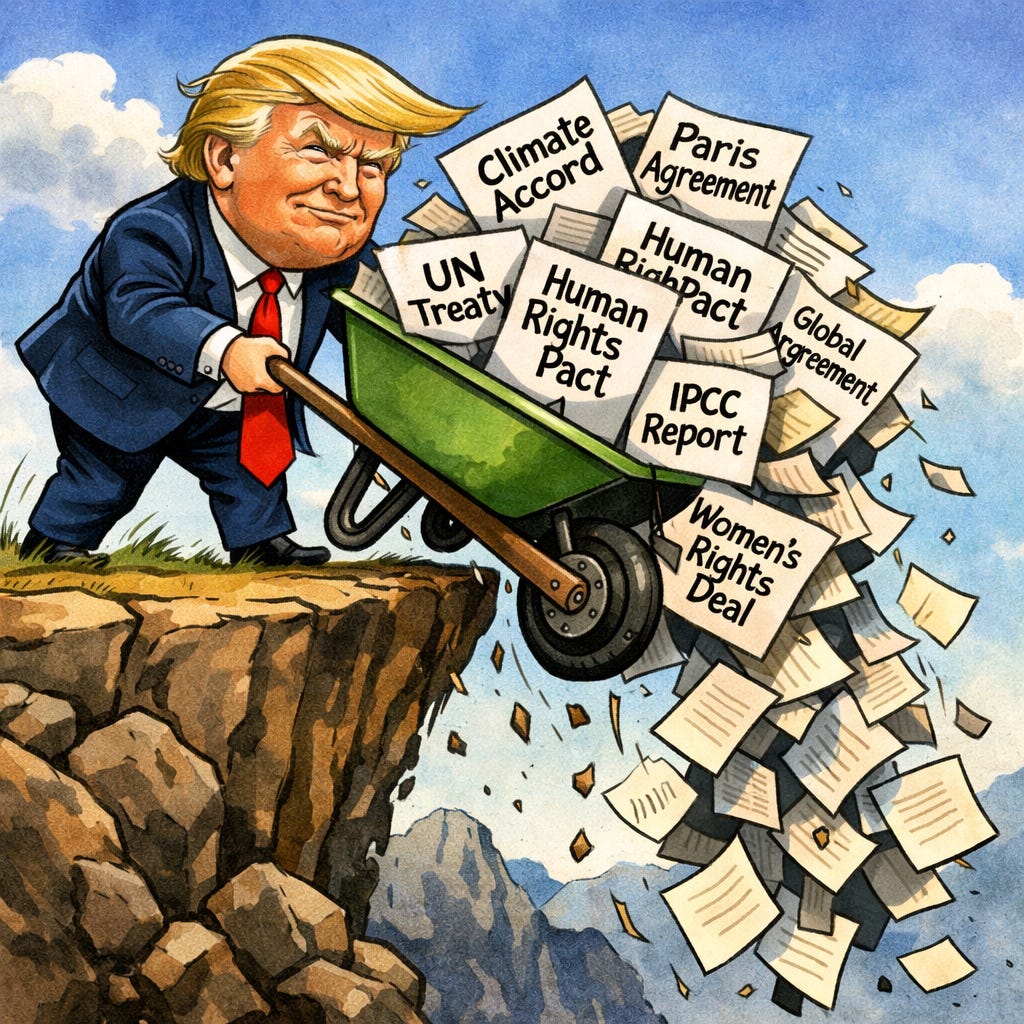
I’ve been trying to find the right way to name what this moment feels like without reaching for drama or abstraction. The facts alone are heavy enough.
In early January, the United States began withdrawing from sixty-six international organizations, conventions, and cooperative bodies. That includes the UN Framework Convention on Climate Change, the treaty that’s underpinned every major global climate agreement since the early nineteen nineties. It includes the Intergovernmental Panel on Climate Change, the body that gathers and evaluates climate science for the entire planet. It includes UN Women, population and migration coordination frameworks, renewable energy cooperation, biodiversity protection, and multiple forums where public health, displacement, and humanitarian response are coordinated.
On paper, this reads like foreign policy.
What it actually feels like is a declaration about who we think we are in the world, and who we think we owe anything to.
For most of my life, America carried a rough moral story about itself. It went something like this. Some problems are bigger than borders. You don’t solve them alone. You don’t pretend they belong to someone else just because they didn’t start near you. You show up, not because you’re flawless, but because absence creates its own harm.
That story was never clean. We violated it often. Sometimes deliberately. Still, we argued about how to live up to it, not whether it mattered at all.
What’s happening now feels like a decision to abandon the argument entirely.
This isn’t exhaustion. It isn’t recalibration. It isn’t a pause to reassess priorities. It’s a renunciation. A statement that shared human problems are no longer ours. That cooperation itself is suspect. That obligation is something to escape rather than manage.
The language used to justify this shift sounds tidy and reassuring. Sovereignty. Freedom. National interest. Each word lands cleanly on its own. Together, they promise control.
But control achieved through withdrawal is fragile. It depends on the world agreeing to absorb your absence.
Climate doesn’t. Disease doesn’t. Migration doesn’t. Markets don’t. Instability doesn’t.
None of these wait for permission before crossing borders. They move whether we participate or not. The real choice isn’t between engagement and safety. It’s between engagement and irrelevance.
Irrelevance carries consequences.
What unsettles me most isn’t just the loss of influence, though that will come. It’s the lesson being taught quietly, to ourselves and to others, that responsibility is optional. That suffering elsewhere is external. That coordination is weakness rather than discipline.
That posture doesn’t make a country safer. It makes it smaller.
There’s also a deeper truth here that needs to be said plainly. This isn’t only nationalism. It’s isolationism, and not the vague kind people use as a talking point. It’s a return to the pre–World War Two instinct that America should seal itself off from global responsibility, treat international cooperation as contamination, and imagine that oceans and borders provide moral insulation.
We know how that story ends. We’ve already lived it.
And we also know who that tradition has always appealed to. It’s never been a movement of broad democratic confidence. It’s always drawn strength from fear of entanglement, suspicion of outsiders, resentment of shared norms, and a belief that American power is diminished by accountability. It’s an America First reflex that predates Trump by generations, and it’s always found a home on the authoritarian edge of American politics.
That history isn’t incidental. It’s the spine of this moment.
There’s an illusion at work that stepping back restores control. That disengaging from complexity loosens its grip on you. I’ve seen this logic before, not just in governments, but in people. The belief that looking away dissolves obligation. That silence equals innocence.
It never does.
The world doesn’t stop pressing because you stop listening.
What makes this moment heavier is the timing. We’re living through problems that demand shared effort. Rising seas. Forced displacement. Public health threats. Resource strain. None of these bend to nationalism, no matter how forcefully it’s declared.
To walk away now isn’t independence. It’s avoidance.
And avoidance always comes due.
What’s most troubling is that this withdrawal is framed as virtue. As moral clarity. As if disengagement were strength rather than abdication. As if refusing the work of cooperation were a sign of seriousness.
But cooperation was never about moral purity. It was about discipline. The discipline of being answerable. Of hearing truths you didn’t ask for. Of having assumptions challenged by people who live with different consequences.
That discipline slows arrogance. It exposes blind spots. It keeps power from collapsing inward.
When a country leaves the spaces where shared problems are studied, argued over, and negotiated, it isn’t just abandoning tables and treaties. It’s stepping away from the practice of restraint.
What follows isn’t calm. It’s narrowing.
I don’t think most people want this posture, even if they can’t quite articulate why the news feels unsettling. At a human level, people understand that walking away doesn’t absolve you. It only delays the reckoning.
What remains for those of us watching this unfold isn’t panic. It’s clarity.
Clarity about what cooperation actually was. Not charity. Not sacrifice for its own sake. But mutual survival, imperfectly managed, through shared attention.
Clarity about what happens when a country decides obligation is an enemy.
And clarity about where responsibility goes when governments abandon it.
It doesn’t disappear. It relocates.
To states and cities. To scientists who keep working even when funding dries up. To aid workers who don’t stop caring because a flag changed posture. To ordinary people who still believe some problems don’t belong to one nation alone.
You can’t dissolve shared reality by memo.
You can only refuse to participate in it.
That refusal tells the world something important about who you think you are.
The question this moment asks isn’t whether America will remain powerful. It’s whether we still believe that living in a shared world requires showing up, even when it’s uncomfortable, even when it’s humbling, even when answers are incomplete.
That belief, once surrendered, is hard to recover.
Not because the world won’t wait.
But because it won’t stop moving while we’re gone.
Please Support the Work
Light Against Empire is free for all. If my words have value to you and you’re in a position to help, you can chip in with a monthly or yearly donation. Your support keeps the writing alive, the lights on, and the fire burning.

