


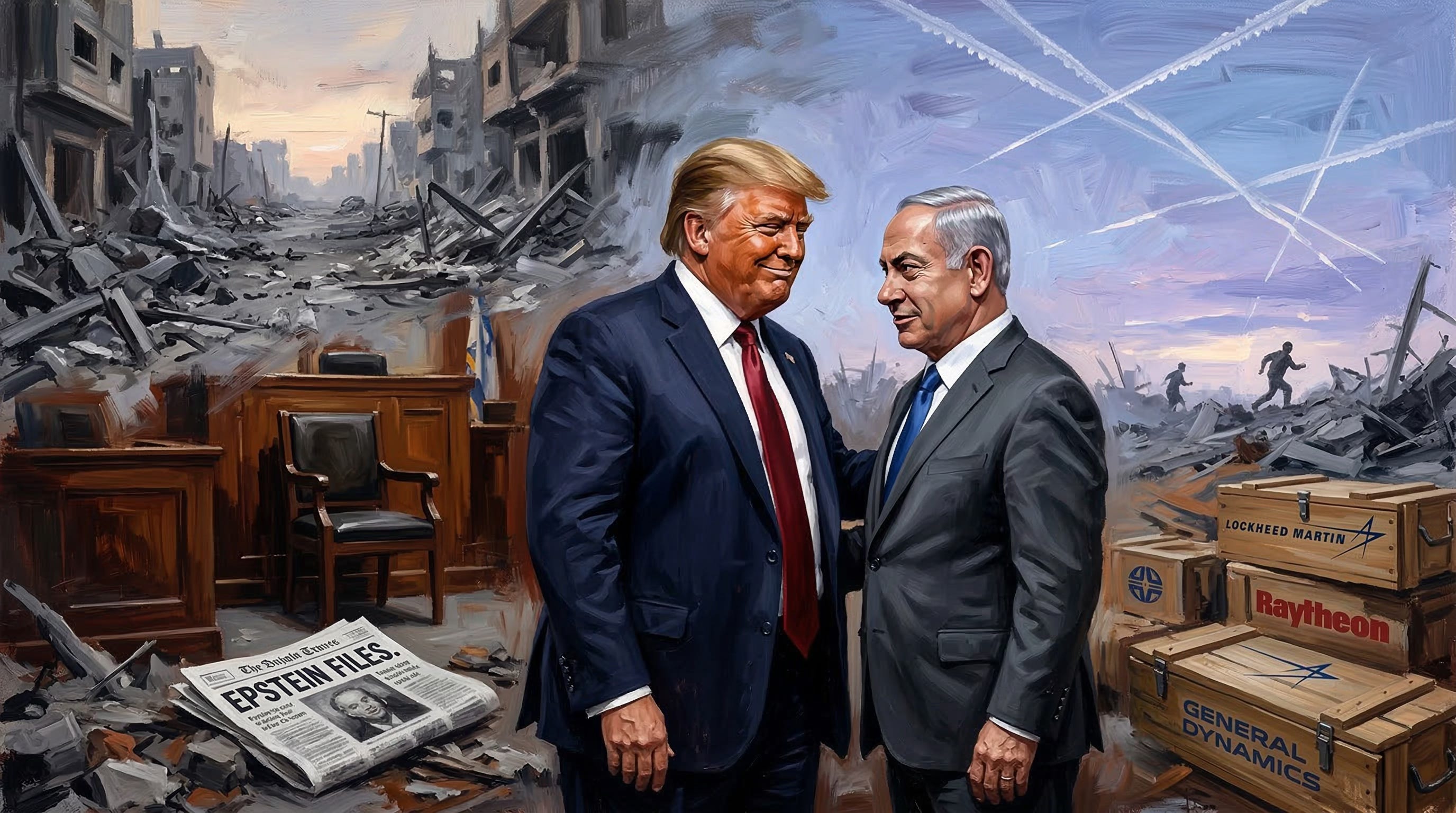
This is a companion piece to “Relax, its Just Another War” (attached at bottom)
Start with the children, because that’s where the accounting must start.
By the time the Iran war consumed the world’s attention in February 2026, more than 50,000 Palestinians were confirmed dead in Gaza. The actual number was almost certainly higher. Bodies were still under rubble that hadn’t been cleared. Hospitals that might have counted them had been bombed. Among the dead: Hind Rajab, six years old, killed in her family’s car while calling a Palestinian Red Crescent dispatcher for help, surrounded by the bodies of her relatives. The dispatcher kept the line open for hours after she went silent. The United Nations called it one of the fastest accumulations of civilian death in the post-World War II record. Entire family lines had been erased. Aid workers. Journalists. Doctors. Children who hadn’t learned to read yet.
Then the Iran war started. And Gaza left the front page.
That’s not an accident. Here’s why.
To understand what happened in Gaza, you must start not in Gaza but in an Israeli courthouse in 2023, and with a man who needed a war more than he needed almost anything else.
Benjamin Netanyahu was on trial. Three separate corruption cases, charges of bribery, fraud, and breach of trust, were grinding through the Israeli legal system. His governing coalition was the most far-right Israel had ever produced, held together by ministers who had publicly called for the annexation of the West Bank and described Palestinian civilians as legitimate military targets. The streets of Tel Aviv had been filling every Saturday for months with the largest protests in Israeli history, hundreds of thousands of people opposing his judicial overhaul, a plan critics said was designed to give a sitting prime minister the power to escape legal accountability. A quarter of Israeli military reservists had threatened to stop reporting for duty. His approval ratings were in collapse.
He was a man whose grip on power was loosening in ways that no amount of political maneuvering was going to stop. The legal machinery was patient. It would eventually reach its verdict.
Then October 7th happened.
Twelve hundred Israelis were killed in a single day. It was the deadliest day for Jewish people since the Holocaust. Hamas’s attack was real, its horror was real, and Israel’s right to respond was broadly recognized internationally. Nobody who looks honestly at October 7th can pretend it was a manufactured pretext. It was a massacre.
What happened afterward is where the questions live.
The military response that followed exceeded any proportional security objective within the first weeks and kept escalating for over two years. The death toll crossed 20,000, then 30,000, then 50,000. The majority were civilians. Gaza’s hospitals were struck. Its water infrastructure was destroyed. Its universities were rubble. The World Food Program described famine conditions. The International Criminal Court opened criminal investigations and issued arrest warrants for individuals, Netanyahu among them. Separately, the International Court of Justice, which hears cases against states rather than individuals, began proceedings under the Genocide Convention brought by South Africa. Both the man and the country he led were being held to account in two different courts under two different bodies of international law simultaneously. Dozens of countries filed supporting briefs. European governments moved toward recognizing Palestinian statehood. Arab American voter registration surged in Michigan and Minnesota. Democratic incumbents faced primaries over their votes on military aid. American public opinion, particularly among voters under forty, was shifting in ways that hadn’t cost politicians this kind of concrete electoral price since Vietnam.
Netanyahu’s corruption trial, meanwhile, was repeatedly disrupted and delayed by wartime emergency provisions.
Hold that fact a moment.
A man on trial for corruption, who needed the legal proceedings against him suspended, found himself leading a war that suspended them. He needed that war to keep running long enough for the political and legal terrain to change around him. And the war kept running.
This is where the second man enters.
Donald Trump in 2023 was facing 91 felony counts across four separate criminal indictments. The January 6th case. The classified documents case. The Georgia racketeering case. The New York business fraud case. He was the most legally exposed presidential candidate in American history, trying to return to the most powerful office on earth. He needed foreign policy wins. He needed to look decisive and indispensable on the world stage. He needed allies who understood the particular pressure of being a powerful man with the legal system closing in, and who would act accordingly.
Netanyahu was one of the few world leaders who understood that pressure from personal experience.
Their relationship predated October 7th by years. Trump had moved the US embassy to Jerusalem. He’d recognized Israeli sovereignty over the Golan Heights. He’d withdrawn from the Iran nuclear deal. He’d brokered the Abraham Accords. Each of these was a gift with limited American strategic justification and enormous personal value to Netanyahu. The relationship wasn’t standard diplomatic alliance. It was ideologically fused and personally reinforcing in ways that blurred the line between national interest and individual survival.
When Trump returned to office in January 2025, Netanyahu had an American partner who didn’t ask inconvenient questions about civilian casualties and who shared a specific interest in keeping Iran in the news and Gaza off it.
Watch what followed.
June 2025. The Twelve-Day War. A joint US-Israeli operation that struck Iran’s nuclear facilities and severely damaged its proxy network. It degraded Hezbollah. It weakened Hamas’s resupply lines. It hit the Houthis. Each Iranian-aligned force that had given Gaza any regional diplomatic leverage was methodically reduced. The strikes were framed as anti-proliferation operations. They were also the military preparation for what came next.
Late 2025 into early 2026. US Treasury Secretary Scott Bessent publicly acknowledged that Washington had engineered a dollar shortage in Iran, deliberately crashing the rial and stoking the protests that killed thousands of Iranians in January 2026. That acknowledgment came without apparent embarrassment. Economic warfare against a civilian population, designed to generate internal unrest, stated openly as policy.
February 6, 2026. Iran and the United States sat in Oman for indirect nuclear talks. Iran’s foreign minister called a deal within reach. A second round was scheduled in Geneva. Then on February 23rd, Netanyahu called Trump personally to tell him where Khamenei would be meeting his senior advisors and what time.
On February 28th, the bombs fell. Khamenei was killed. The Iran war started. And Gaza, the ICC proceedings, the genocide case, the shifting public opinion, the concrete electoral costs of supporting Israel’s conduct, all of it got swallowed by a regional war that reframed every subsequent Palestinian death as collateral in an existential conflict against Iran.
The ICC arrest warrants got quieter. The European governments that had been moving toward harder positions pulled back. The protest movement lost oxygen to the larger war. The Palestinian reckoning that had been building across three years of documented atrocity got administratively buried under new geography and new urgency.
Two men, each facing political death by different instruments, produced exactly the war that saved both. Netanyahu’s trial was suspended the same day the bombs fell. Israeli courts closed under emergency orders on February 28th, and as of this writing not a single hearing date has been rescheduled. Trump was a wartime president rather than a man whose name appeared in three million pages of sex trafficking documents. Israel was fighting for its existence against Iran rather than answering to international courts. The Epstein files vanished from the American news cycle the morning after the first strikes.
And there’s more to the Netanyahu legal story than suspension. Even before the war gave him a clean halt, February 2026 had been a graveyard of canceled hearings. The first week of that month: scrapped because Netanyahu flew to Washington for Iran talks with Trump. The third week: canceled when the presiding judge’s mother died. The final week: postponed for a state visit, followed by claims of unavailability for “security consultations” that were almost certainly final planning sessions for the attack itself. The trial had been made effectively impossible before the emergency orders made it officially so.
Then came the parallel maneuvers. In November 2025, Netanyahu formally requested a presidential pardon without admitting guilt. The Justice Ministry’s own review found the request “extremely problematic” and recommended against it. Netanyahu ignored the recommendation. On March 12, 2026, eleven days into the Iran war, he held his first press conference since the bombing began and called the trial an “absurd circus,” urging the Israeli president to “do the right thing.” Trump amplified the pressure directly, telling Axios he wanted Netanyahu to “focus on the war and not on the f*cking court case,” and calling the Israeli president who held pardon authority “disgraceful” for not acting. Meanwhile, Netanyahu’s coalition advanced legislation to repeal the fraud and breach of trust charges he faced entirely, charges that appeared in all three of his cases.
Foreign Policy reported on March 10th that the driving force behind the Iran war was, and had always been, Netanyahu, observing that if the conflict ended well, he might avoid prison and cling to power through Israel’s fall 2026 elections. Former Israeli Supreme Court President Aharon Barak, not a man given to hyperbole, warned that Israel was “sliding toward dictatorship,” describing a strategy of flooding democratic institutions with so many simultaneous crises that gatekeepers exhaust their capacity to respond.
Here’s the strongest counter to everything I’ve written, because it deserves its hearing before I set it aside.
Iran’s nuclear program wasn’t imaginary. October 7th was not staged. Hamas did what Hamas did, and Israel was genuinely attacked. The proxy network was real, patient, and had been firing into Israeli territory for years. There are military planners, intelligence officials, and foreign policy analysts who had been arguing for years that Iran’s regional architecture needed to be confronted and that the window for doing so was closing. Some of them aren’t cynics. Some aren’t profiteers. Some are people who looked at the map and reached an honest conclusion that force was the only remaining language.
Grant them that. Grant them the full threat, the honest fear, the military logic.
What they can’t grant back is the trial postponements. The targeting phone call. The pardon pressure running parallel to the bombing campaign. The timing of the Iran war against the timing of the Epstein files and the House Oversight Committee summons. The way each military escalation served both men’s personal survival with a precision that legitimate security interests alone can’t fully explain. The fact that the people dying in the largest numbers weren’t the people who posed the threat.
The ICC case rested on a specific legal argument: that the conduct of the war, the targeting of civilian infrastructure, the blocking of humanitarian aid, the scale of civilian death relative to any plausible military objective, met the threshold of the Genocide Convention. That case was built from evidence, not politics. What happened to it wasn’t a legal rebuttal. It was a regional war that made the question feel smaller than the new emergency.
That’s not how justice works. It’s how justice gets buried.
The shovels were American.
The United States vetoed ceasefire resolutions at the United Nations. Not once. Repeatedly. American weapons were in the strikes that killed the civilians the ICC was counting. American diplomatic cover was the reason Israel could say, at every international forum, that the world’s most powerful democracy stood behind its conduct. American taxpayers funded it. American politicians calculated their positions in real time against their donor bases and their district demographics and their own career interests, and most of them kept writing the checks.
The American public, in documented polling, opposed the scale of civilian casualties. Majorities, sometimes large ones, said the war had gone too far. Protests filled American campuses and city streets for months. And then the election came, and the voters who said they opposed it returned to office the people who funded it, because they were also the people managing their tax rates or their immigration concerns or their own particular fear, and the Palestinians in the rubble got weighed against those things and lost.
That weighing happened in millions of individual minds, in the privacy of a ballot box, across the most powerful democracy on earth. It’s not a comfortable thing to name. It’s the thing that needs naming.
There’s a question I can’t stop returning to. When a government kills people in your name, with your money, over your stated objections, on a legal theory that the world’s courts found credible enough to investigate, and you return that government to power anyway, what exactly is the word for your relationship to what they did?
Not ignorance. We had the images. We had the casualty counts. We had the ICC warrants. We had Hind Rajab’s name. Six years old, calling for help from a car surrounded by her dead family, a dispatcher keeping the line open for hours after she went silent because there was nothing else left to do. We had her name and we knew exactly what it meant and we went back to our lives.
Not helplessness. We had votes. We had the ability to make politicians pay costs they didn’t pay.
The word sits just out of reach because we’ve spent a long time building a vocabulary designed to keep it there. We call it complexity. We call it geopolitics. We call it the lesser of two evils. We call it the necessary cost of regional stability.
Two men, each running from accountability, found one war that covered both their tracks. The dead were the price of that cover. And the rest of us paid the bill without being asked, then looked away before the receipt arrived.
The receipt is still coming.
Light Against Empire is free for all. I write on American foreign policy, political accountability, and the lies of “Empire.” If my words have value to you and you’re in a position to help, you can chip in with a monthly or yearly donation. It takes time, energy, and resources to keep Light Against Empire running. Your support keeps the writing alive, the lights on, and the fire burning. Thanks!
Further Reading:


I hate all of these war mongers and the Epstein Class. They have made life so unnecessarily difficult for millions of people - and millions more will be suffering because they're trying to escape their heinous crimes