

Twin Cities Update: Sunday - 1/17/2026
A note for those trying to stay informed without losing their footing

I want to begin by saying this plainly, because tone matters right now.
I’m not writing as a journalist filing copy, and I’m not writing as a pundit trying to score points. I’m writing as someone paying close attention, listening to people who live here, reading court filings and official statements, and then sitting with how all of that lands in the body. Fear. Confusion. Anger. Disbelief. Sometimes all at once.
Since this is the first of what I intend to be regular updates (every couple days or daily depending on the situation), I want to rewind briefly and walk us through what’s happened in the Twin Cities since Monday, and then widen the lens just enough to name the pressures shaping what may come next.
This isn’t exhaustive. It’s an attempt to mark where we’re standing.
What has happened since Monday
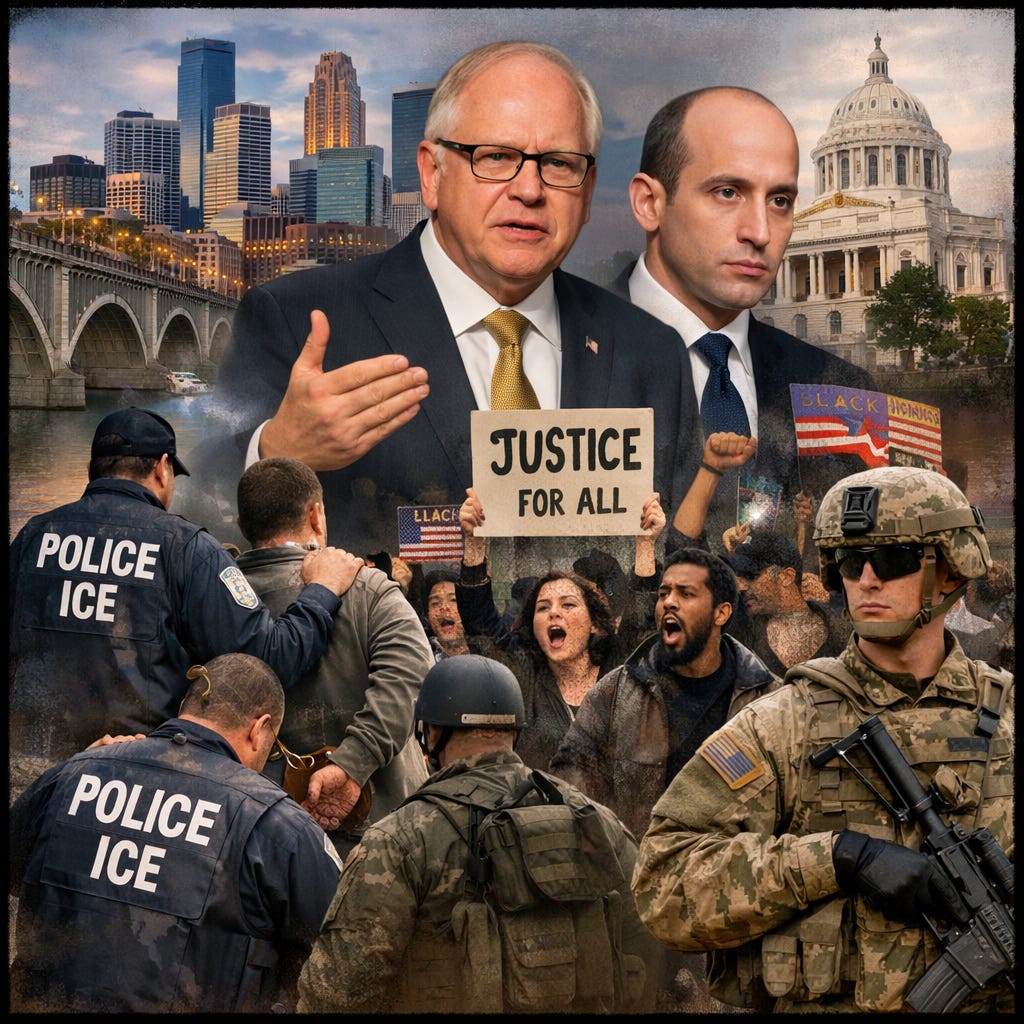
Most readers have seen the outlines by now. A federal immigration enforcement action in Minneapolis earlier this month resulted in the death of a woman, Renee Nicole Good, during a chaotic encounter involving ICE agents. That incident triggered protests, public outrage, and demands for accountability.
In the days that followed, enforcement activity intensified rather than cooled. Based on local reporting, video circulating from residents, statements by advocacy groups, and confirmations from city officials, agents deployed flash bang devices and chemical agents during subsequent operations. One incident involved a family vehicle carrying children, including an infant who reportedly lost consciousness and required medical attention.
I want to pause here and speak directly to you.
Even when facts are still being sorted, it is not hysteria to react strongly to images of children harmed during law enforcement actions. You don’t need a legal memo to know something has gone wrong when parents are fighting to keep a baby breathing. That response is human. It is sane.
At the same time, details matter. Investigations are ongoing. Federal agencies have issued statements defending their actions as lawful and necessary. Local officials have demanded answers. Civil litigation is beginning to form. This is how accountability is supposed to begin, slowly and imperfectly, through process.
The problem is that process moves at a speed that feels unreal when people are bleeding in the street.
The escalation that followed
What shifted this from a local crisis into something more consequential was not only what happened on the ground, but what followed rhetorically from Washington.
In the days after the Minneapolis incident, senior administration figures, including Stephen Miller, publicly framed resistance by Democratic governors and mayors as criminal obstruction rather than political disagreement. Statements suggested that state leaders opposing federal enforcement could themselves become subjects of investigation.
That shift matters more than any single quote.
In a functioning constitutional system, conflict between state and federal authority is expected. Governors push back. Courts referee. That friction is not a breakdown. It’s the design.
What alarms many observers is the replacement of “who has authority” with “who should be punished.” That change does not create new legal powers, but it does signal intent. And intent shapes behavior long before it shows up in indictments.
To be clear, no governor can be lawfully arrested for opposing federal policy, criticizing enforcement tactics, or carrying out the duties of office. Detention requires evidence of a crime, probable cause, judicial authorization, and a warrant or indictment. Rage does not substitute for law, no matter how loudly it is broadcast.
Still, language matters. When elected officials are repeatedly described as enemies or criminals, the ground beneath institutions begins to soften.
How this feels on the ground
Here’s the part that doesn’t show up in briefings.
People in Minneapolis and St. Paul are tired. Not performatively outraged. Not glued to cable news. Tired in the way you get when you’re deciding whether it’s safe to bring your kids to the park, attend a rally, or even say the wrong thing out loud.
I’ve read comments from residents who say openly that they no longer believe the system will protect them. That they feel abandoned. That they’re wondering whether calling in the military might actually restore order.
I understand where that thought comes from. When you feel hunted, you look for something bigger to stand between you and the threat.
But this is where we need to be careful with our hope.
The U.S. military is not a neutral referee standing above politics. It is a federal institution, answerable to civilian authority. Its involvement in domestic matters is tightly restricted for a reason. Once the military becomes the imagined solution to civil conflict, the republic is already in trouble.
The real checks on federal overreach are not uniforms with heavier weapons. They are courts, documentation, public scrutiny, and, critically, state and local officials acting together.
That last piece is the quiet center of gravity right now.
Why governors matter more than ever
If you take nothing else from this update, take this.
The most meaningful restraint on federal abuse at this moment does not come from Washington correcting itself. It comes from governors who refuse to be isolated.
A single governor can be targeted, vilified, and pressured. A group of governors acting together is far harder to break. Federalism stops being abstract when power is tested. It becomes practical.
We are already seeing signs of this. Public statements coordinated across states. Attorneys general comparing legal strategies. State leaders insisting on jurisdictional limits not as a partisan move, but as a constitutional obligation.
This work is slow. It doesn’t trend well. But it is how systems hold.
Adjacent pressures shaping the moment
Minnesota isn’t happening in isolation.
Nationally, immigration enforcement has become the symbolic engine of this administration’s second term. Campaign promises of mass deportation are colliding with logistics, legal constraints, and public resistance. When policy stalls, force becomes tempting.
At the same time, courts are strained, media is fragmented, and public trust is thin. Add election year pressure, and every confrontation becomes a test case.
Internationally, authoritarian governments are watching closely. So are domestic actors who benefit when Americans lose faith in democratic process altogether.
This is the context in which Minneapolis is unfolding. Not as an anomaly, but as a pressure point.
A word about fear and clarity
I want to speak to you directly again.
Fear spreads easily. Clarity does too.
It’s possible to name danger without surrendering to spectacle. It’s possible to grieve what’s happened without declaring the worst outcome inevitable. And it’s possible to resist federal overreach without imagining saviors in camouflage.
The system hasn’t vanished. It’s strained. It’s slow. It’s uneven. But it is still contested ground, not a settled outcome.
That distinction matters because it tells us where effort still counts.
What to Watch Next
If you’re trying to stay informed without burning out, here are the signals that actually matter over the next several days. These are not predictions. They’re pressure gauges.
First, court movement.
Pay attention to whether emergency injunctions are sought or granted in federal court, particularly around the use of force, jurisdictional authority, or access to records. Even denials matter, because they tell us how quickly courts are willing to engage.
Second, coordination among governors.
Watch for joint statements, shared legal filings, or multi state actions rather than isolated responses. Escalation becomes more likely when state leaders are picked off one by one. De escalation becomes possible when they act together.
Third, changes in federal posture.
Not speeches. Orders. Look for shifts in operational guidance, pauses in activity, or quietly revised rules of engagement. These usually surface through court documents, whistleblower accounts, or confirmation by local officials rather than press conferences.
Fourth, treatment of journalists and observers.
Restrictions on access, equipment seizures, or intimidation of press and legal observers are often early indicators of a hardening approach. They don’t always make headlines, but they matter.
Fifth, language creep.
When the vocabulary of enforcement starts replacing the vocabulary of governance, when disagreement is routinely labeled criminal, when officials stop talking about law and start talking about loyalty, that’s a sign the ground is shifting again.
None of these guarantee escalation. But taken together, they tell us whether restraint is holding or thinning.
Where this leaves us, today
As of this writing, investigations continue. Protests continue. Legal filings are taking shape. Federal rhetoric remains aggressive. State leaders are pushing back. Courts have not been bypassed, even as they are being tested.
Nothing about this is comfortable.
But discomfort is not the same thing as collapse.
I’m going to keep writing these updates not to inflame fear, but to keep a clear record of what’s happening, how it’s being framed, and how it feels to live inside it. Facts matter. So does the human cost of waiting for them.
If you’re reading this and feeling overwhelmed, you’re not failing. You’re paying attention.
Monday, I’ll narrow in on the legal terrain itself, what cases are moving, where delays are likely, and which signals are actually worth watching.
For now, stay grounded. Stay connected. And don’t let anyone tell you that caring carefully is weakness.
Please Support the Work
Light Against Empire is free for all. If my words have value to you and you’re in a position to help, you can chip in with a monthly or yearly donation. Your support keeps the writing alive, the lights on, and the fire burning.
Further Reading:


Thank you. This is affirming and helpful.