


“And thus I clothe my naked villainy.”
— Richard III
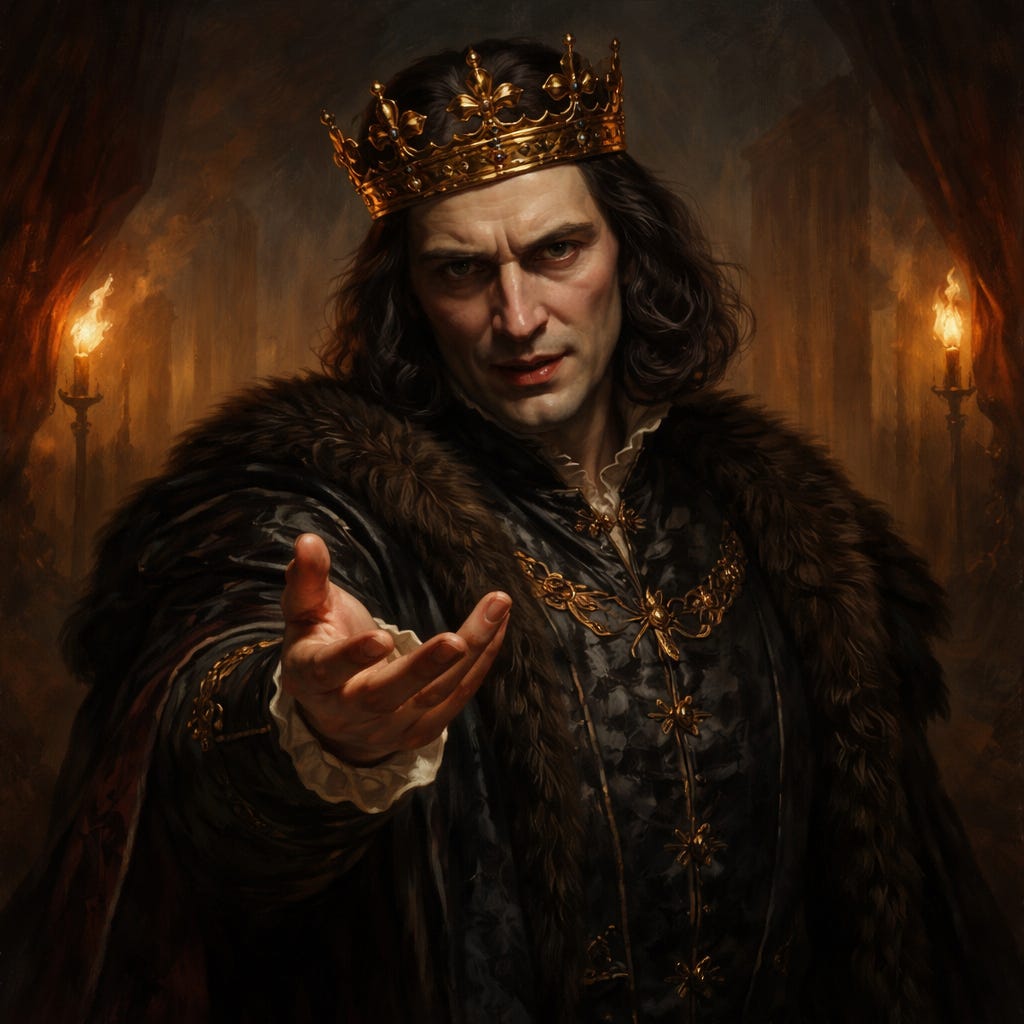
I woke with Richard this morning.
Not the man exactly, not the humpbacked caricature we get in the popular imagination, but the voice. The logic. The cold, glittering self-honesty of a person who’s decided that consent is optional and that legitimacy is just a costume you wear until you don’t need it anymore.
So I reread his opening soliloquy. I read it the way I read a warning label, the way you read a weather report when the sky’s already turned that wrong color. I read it once for what it says. Then again for what it admits. Then again for what it teaches about political seasons, and about the strange moment when a country thinks it’s survived the storm, while the next storm is already tightening its grip.
And because this kept working on me, I wanted to share with you, my friends, what I found there.
Richard names the winter, then celebrates its ending. He announces the war is over. He declares the air has warmed. He tells us the kingdom’s shifted from alarms to ceremonies, from armor to music, from clenched teeth to public relief.
And then, almost immediately, he confesses something that should freeze the blood.
He’s not built for this new season.
He can’t join the dance. He can’t melt into the ordinary pleasures of peace. He can’t live inside a world where power is shared, where attention isn’t monopolized, where the public story isn’t about him. So he does what some men always do when the world stops feeding their grievance.
He decides to become the storm.
This is the part that keeps snagging in my mind, and it’s why Richard’s rising unbidden in mine.
Because Richard doesn’t begin by saying, “I’m evil.” He begins by saying, “The country’s calming down, and I don’t fit in the calm.” He begins with the psychological truth that comes before the political crime.
He’s restless inside peace. He’s humiliated by normalcy. He experiences stability as a personal insult.
So he turns politics into therapy. He turns the public into his audience. He turns the institutions into props. He turns the law into something decorative, something you gesture at while you do what you planned to do anyway.
That’s a pattern, not a period piece.
And this is where I feel the eerie overlap with our moment, even if the costumes are different, even if the slogans are louder, even if the stage is lit by phones and cable panels instead of torches and tapestries.
When power decides it no longer needs permission, legitimacy is replaced by momentum, and consent is replaced by fatigue.
There’s a time in every national story when power still pretends it needs permission.
It flatters the public. It insists it’s serving the common good. It bows toward law, toward norms, toward precedent, toward the idea that people have a right to say no. Even the ambitious, even the cruel, even the corrupt, they still perform some reverence for legitimacy because they understand a basic rule.
If you want durable power, you must be seen to deserve it.
But then sometimes a different season arrives. A season when performance becomes impatience. When the costume begins to feel heavy. When the leader, and more importantly the movement around the leader, starts to treat legitimacy as an inconvenience.
That’s the season I think we’re in.
And I want to say this plainly, because the temptation’s always to over-dramatize or to understate, and I think both are forms of evasion.
When a political project begins to rename the world, to rewrite civic space, to flood institutions with personal branding, to demand loyalty as identity rather than agreement as consent, it’s not just trying to win elections. It’s trying to change what power means.
It’s trying to train people out of the habit of asking, “Do you have the right?”
And it’s trying to replace that question with a new one, quieter, deadlier, more resigned.
“Can you get away with it?”
This is what Richard understands before anyone else onstage does. He understands that the most vulnerable moment in a society isn’t always the moment of open war. It’s the moment after war, when people are grateful to stop bleeding, when fatigue makes them sentimental, when relief makes them careless, when the public hunger for normal starts to outrank the public duty of vigilance.
So let me correct a sentence I nearly wrote wrong, because the correction matters.
Richard opens in winter, but speaks from the first false warmth of summer.
That’s the trick. That’s the trap. He uses the language of peace to hide the beginning of predation. He uses the kingdom’s relief as his cover. He exploits the human desire to believe the worst is behind us.
And this is why I keep circling back to legitimacy and consent.
Because legitimacy isn’t a vibe. It isn’t a feeling. It isn’t a brand.
Legitimacy is the slow, public, accountable process by which power proves it has a right to act. It’s the visible chain of lawful authority and public consent that separates a government from a takeover.
And what I’ve watched, with the weary clarity of someone who spent decades inside the federal system, is how quickly that chain can be weakened without most people noticing.
Not always by one dramatic illegal act, though that happens too. More often by a thousand small degradations that make the next degradation easier.
A rule bent “just this once.” A process bypassed “because we don’t have time.” A norm mocked “because it’s outdated.” A watchdog defanged “because it’s partisan.” A civil servant purged “because loyalty matters.” A law treated as optional “because the leader has momentum.”
And then, one day, you look up and realize power’s no longer asking permission.
It’s simply moving.
And everyone around it is adjusting their behavior as if inevitability is the same thing as legitimacy.
This is where the Wars of the Roses echo becomes more than literary seasoning. That conflict wasn’t just swords and banners. It was a legitimacy crisis, a struggle over who had the right to rule, and what story the nation would accept as lawful. It was a long national argument about succession, authority, and the meaning of order.
What we’re living through has its own banners and factions, but the deeper question’s familiar.
Who gets to decide what’s real?
Who gets to decide what counts as lawful?
Who gets to decide what institutions are for?
Who gets to decide whether the public has standing to say no?
Richard answers that question in the most terrifying way, by treating the public as clay. By treating institutions as furniture. By treating morality as theater. By treating law as a stage direction.
And I think that’s why he haunts this moment. Not because our situation’s identical to his, but because the psychological architecture rhymes.
A leader who can’t tolerate limits.
A movement that confuses loyalty with truth.
A public sphere flooded until fatigue becomes compliance.
A class of officials who tell themselves they’re being “practical” while they surrender the moral ground that makes practicality possible.
This is the part I keep wanting to say to my friends, and it’s why I’m writing this at all.
Richard isn’t just a villain. He’s a diagnostic tool.
He shows us what it looks like when power turns inward, when it becomes personal, when it becomes mythic, when it decides that the only real constraint is whether anyone can stop it.
And he shows us something else that matters just as much.
He shows us that villainy rarely arrives naked. It arrives dressed.
Dressed in procedure. Dressed in patriotism. Dressed in “reform.” Dressed in “efficiency.” Dressed in “common sense.” Dressed in the exhausted public’s desire to move on.
And if you’re not paying attention, you’ll call it summer.
You’ll call it restoration.
You’ll call it normal.
Until the day you realize you’ve been living inside someone else’s script.
So I’ll end where we began, because sometimes the only honest ending is an echo that refuses to let us off the hook.
If Richard has anything to teach us in this season, it’s that when power decides it no longer needs permission, it doesn’t announce that decision as a crime. It announces it as destiny.
Villainy never arrives naked. It arrives dressed as necessity, confidence, and destiny, and by the time we recognize the costume, we’re already applauding the performance.
And thus I clothe my naked villainy.
Support the Work
Light Against Empire is a reader-supported publication and always free. To receive new posts and support my work, consider becoming a free or donation based subscriber.
Further Reading:


Thank you, Dino Alonso. Substack writer, Liberaldad, restacked this; I, then, it. Your writing is beautiful. I look forward to reading more.
You always leave me pondering reality.