

The Shelf Life of Power
A Brief History of Why Donald Trump Won’t Get the Ending He Desires

“Fame is a vapor, popularity an accident, riches take wings. Only character endures.”— Horace
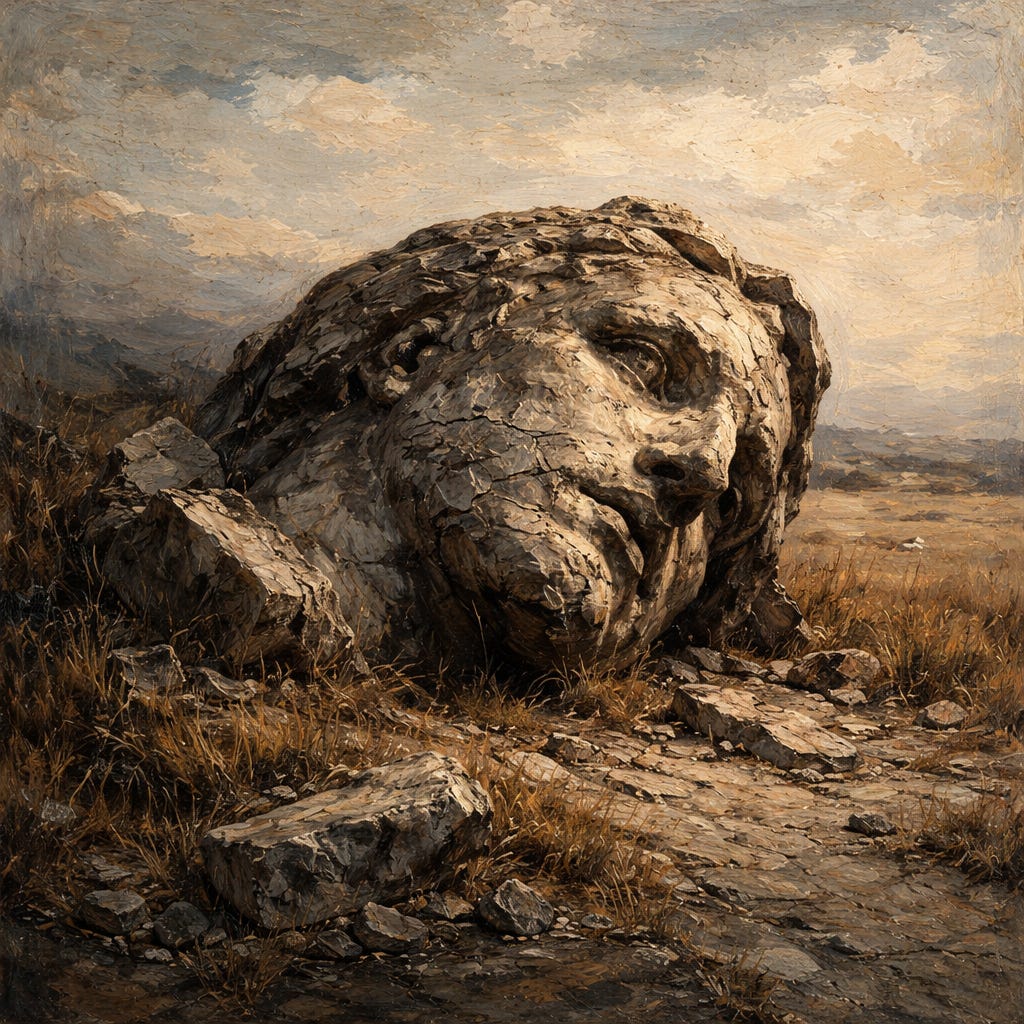
Power always believes it will last.
That belief is the tell.
It’s how you know it won’t.
The men most convinced of their permanence rarely arrive quietly. They rename what already has a name. They mark what was meant to outlive them. They insist on being seen everywhere at once, and they leave behind a familiar unease, the feeling that something temporary is trying to pass itself off as the world.
What people are feeling now isn’t confusion.
It isn’t fragility.
It’s recognition.
The tightening in the chest that comes when shared space starts shrinking. When public language bends toward a single will. When memory is nudged aside to make room for presence. When power stops governing and starts intruding.
That sensation is ancient.
And it never ends the way power expects.
Throughout history, kings and tyrants have shared the same fantasy. They don’t merely want to rule. They want to become. To fuse their identity with the land, the institutions, the memory of the people so completely that resistance feels unnatural, even immoral. They rename things. They overwrite symbols. They stamp their likeness where lineage once lived. They do this not because they’re strong, but because they’re terrified of impermanence.
Public space is the battleground of this fear.
When a ruler renames a civic institution, he isn’t adjusting signage. He’s attempting to displace memory. When he overwrites a moral institution, he isn’t reorganizing bureaucracy. He’s declaring that restraint itself is subordinate to his will. And when he threatens to carve his image into sacred ground, he isn’t indulging vanity alone. He’s chasing immortality by force.
That’s why these recent acts land with such psychic force.
The renaming of the Kennedy Center isn’t a petty insult or a branding exercise. The Kennedy Center exists as a mnemonic anchor. It reminds the country that public life can be animated by service, culture, and continuity rather than appetite. To rename it is to say that lineage is optional, that inheritance is disposable, that nothing stands above the present ego. This is a classic move. Roman emperors did it with forums and cities. Revolutionary strongmen did it with boulevards and theaters. They didn’t erase the past. They stepped on it, so everyone had to look at them instead.
The assault on the United States Institute of Peace is even more chilling. Peace institutions exist to slow power, to interpose deliberation between impulse and destruction. Renaming or hollowing such an institution isn’t symbolic. It’s declarative. It announces that there’ll be no counterweight, no moral brake, no vocabulary that says, “You aren’t the measure of all things.” Every autocrat learns this lesson early. Councils of mediation, ethical buffers, and peace bodies must be neutralized because they imply limits. And limits are intolerable to men who mistake domination for destiny.
Then there’s the threat to deface Mount Rushmore, which should be understood as the apex of the pattern, not an outlandish aside. Mount Rushmore isn’t just stone. It’s mythic terrain. It’s where the nation performs its origin story, however flawed that story may be. To insert one’s own face isn’t merely to join a lineage. It’s to declare oneself synonymous with the nation’s meaning. The engineers’ warnings that the structure may not survive such alteration matter profoundly. They sharpen the fear because they reveal the truth beneath the impulse. He’s willing to damage the monument itself to secure his reflection upon it. History’s littered with rulers who cracked temples, cities, and countries in an effort to preserve their image.
None of this is unprecedented.
In fact, it’s so familiar that history barely raises an eyebrow anymore.
Napoleon Bonaparte crowned himself emperor in a cathedral full of clergy. He placed the crown on his own head. He made the point unmistakable. Europe answered with exile, not once but twice. His name survived. His illusion did not.
Benito Mussolini plastered his image across Rome and declared himself the architect of a revived empire. He understood spectacle. He understood monuments. He misunderstood time. His final public appearance involved being dragged through the streets and hung upside down in a Milan square. His likeness ended where history thought it belonged.
Nicolae Ceaușescu renamed cities, bulldozed neighborhoods, and built a palace so massive it hollowed out a nation’s economy. Today, it hosts guided tours and wedding photos. He and his wife were executed on Christmas Day, their grand project reduced to a cautionary tale.
Saddam Hussein rebuilt Babylon with bricks stamped with his name, casting himself as a modern Nebuchadnezzar. Tourists now walk those ruins, reading plaques about delusion, the ancient city having outlived its would-be heir by millennia.
Even those who weren’t monsters, merely absolutists, discovered the same truth. Louis XIV declared, “I am the state.” The state endured. He didn’t. His excesses narrowed his legacy to a symbol of overreach rather than permanence.
This is what time does.
It doesn’t argue.
It doesn’t persuade.
It erodes.
Time breaks cyphers. It dulls slogans. It edits men down to scale. It turns once-terrifying figures into chapters, then paragraphs, then footnotes. Some tyrants dominate an entire lifetime. That doesn’t make them permanent. It only makes the waiting harder for those trapped inside their shadow.
This is the lie that must be refused.
The lie says that if a man dominates the landscape long enough, he defines the people who live in it. If his image fills enough space, it becomes destiny. If his voice is loud enough, it becomes the nation’s inner voice.
It never does.
Donald Trump isn’t inventing a new form of power. He’s reenacting the oldest one, with American materials. Renaming civic memory. Undermining moral restraint. Attempting to inscribe himself onto mythic ground. It feels total because these moves are designed to feel total. They aim at saturation, at forced presence, at the collapse of interior boundaries.
That’s why the anxiety spikes.
That’s why even the absurd feels dangerous.
That’s why the pressure feels personal.
But history also tells us how this ends.
The renamed buildings are renamed again.
The gutted institutions are restored or replaced.
The monuments are repaired, reinterpreted, or contextualized.
The face fades.
The cypher loses authority.
The world resumes its scale.
The most reliable fate of tyrannical monuments isn’t destruction but context. Statues are moved to parks of failure. Palaces become museums. Grand gestures are explained to schoolchildren in the past tense. Context is death to ego. It returns stolen air to the people who were forced to hold their breath.
Justice here isn’t swift.
It isn’t sentimental.
It doesn’t always spare the innocent from suffering.
But it does equalize.
It restores proportion.
It refuses the fantasy that one sad man can become the measure of a civilization.
Our identity, our meaning, our being isn’t defined by the callous, vain, and willful brutality of one man. It never has been. It never will be.
History doesn’t punish. It reduces.
Kings who demanded total presence end up in parentheses. Tyrants who insisted on immortality are reduced to “see also.” Men who tried to become the world are edited down until they fit the truth.
And when that happens, as it always does, people rediscover something they never actually lost.
Themselves.
The arc of justice is long, not because it hesitates, but because it waits. It waits for ego to exhaust itself. It waits for time to do what no institution can fully accomplish alone.
And then, quietly, without ceremony, it equalizes.
No man has ever succeeded in becoming the world.
Please Support the Work
This work is free for all because light should never be gated. If these words feel like a lantern in your hands, you can help keep it burning. Your support keeps the flame from going out. You can make a monthly or yearly donation below.
Donate and Keep the Light Burning
Further Reading:


