


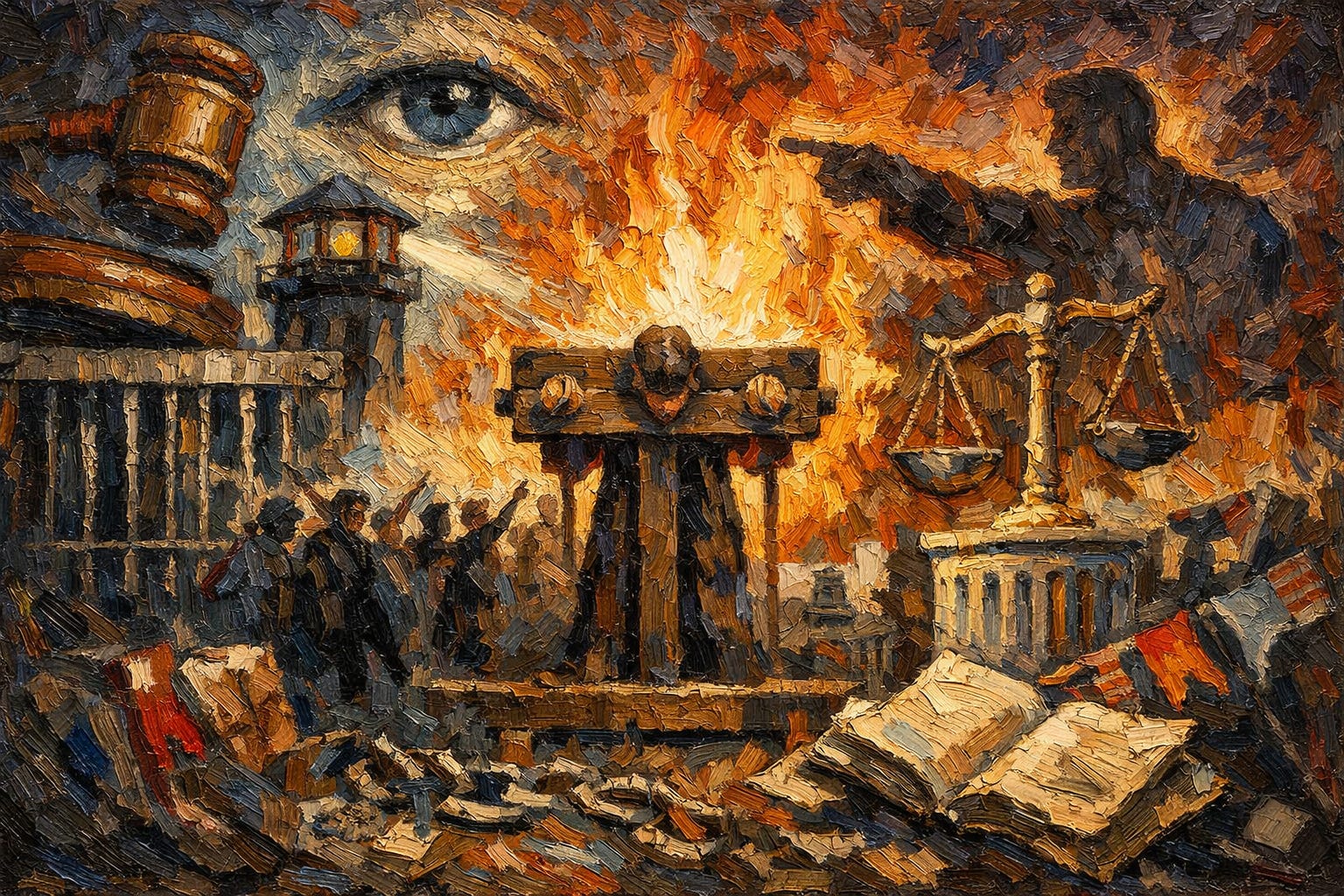
"Distrust all in whom the impulse to punish is powerful" — Friedrich Nietzsche
Opening
The Feeling of Being Right
There’s a particular relief that comes with certainty.
Not the calm kind that settles after reflection, but the sharp kind that snaps into place when blame is assigned. When a line is drawn. When someone is named as the reason things feel wrong. Disorder stops being diffuse. It gets a face.
That relief is powerful. It feels like clarity. It feels like moral seriousness. It feels like finally standing on solid ground after too much drift.
But it’s also deceptive.
In moments of stress, cultures don’t just look for solutions. They look for resolution. They want an ending. They want the discomfort to stop. Punishment offers that. It doesn’t fix the underlying fracture, but it closes the emotional loop. Something happened. Someone responded. The world feels momentarily coherent again.
That sensation is older than our politics. It runs beneath them.
Long before punishment became policy, it was posture. A way of reassuring ourselves that order still existed, that someone was watching, that deviation wouldn’t go unanswered. Moral certainty didn’t just guide behavior. It stabilized fear.
When shared meaning weakens, judgment rushes in to fill the gap.
This is the terrain we’re standing on now. Not a collapse of values, but a hardening of them. Not moral chaos, but moral compression. Everything must be decided quickly. Everything must be categorized. Everything must carry consequence.
Nuance feels indulgent. Process feels evasive. Restraint feels like complicity.
In that atmosphere, punishment doesn’t feel cruel. It feels responsible.
It feels like proof that someone still cares enough to draw a line. Enough to enforce it. Enough to say no, even when the cost is human.
That’s the feeling this essay is concerned with. Not anger. Not hatred. The feeling of being right, and the comfort that comes from watching someone else bear the weight of disorder.
This is not a story about a single movement or a single moment. It’s about inheritance under pressure. About what happens when a culture trained to equate moral order with visible enforcement loses faith in institutions but not in judgment.
When trust erodes, punishment steps forward.
It offers simplicity in place of complexity. Closure in place of understanding. Control in place of formation.
And for a while, it works.
The question isn’t why punishment exists. The question is why it has begun to feel like the only remaining proof that moral life still matters.
That’s where this essay begins.
From Moral Accounting to Moral Policing
There’s a difference between believing that moral order matters and believing that moral order must be seen.
Puritan culture never trusted what couldn’t be observed. Grace might be inward, but it had to leave tracks. Conduct mattered because it signaled alignment. Behavior mattered because it reassured the community that the moral universe was still intact. Silence was suspicious. Ambiguity was dangerous. Disorder wasn’t just uncomfortable, it was contagious.
This didn’t begin as cruelty. It began as fear.
A small, fragile society surrounded by wilderness, uncertainty, and threat needed rules that held fast. Moral accounting offered that stability. You could measure it. You could enforce it. You could reassure yourself that chaos hadn’t crept in while you weren’t looking.
But over time, accounting hardened into something else.
When moral life is treated as a ledger, someone must keep the books. When virtue is assumed to produce visible outcomes, someone must inspect them. When disorder is read as moral failure, someone must intervene.
That someone becomes the community itself.
What starts as shared responsibility slowly becomes shared surveillance. Not because people are eager to dominate, but because they’re trained to believe that unaddressed moral deviation invites collapse. If wrongdoing goes unanswered, the whole structure feels threatened. The response isn’t measured reflection. It’s enforcement.
Moral policing grows from the belief that restraint equals negligence.
This is the point where moral certainty stops being inward formation and starts becoming external control. The community no longer asks whether someone is growing toward wisdom. It asks whether they are compliant. Whether they conform. Whether they reassure.
The original concern wasn’t punishment for its own sake. It was preservation. A fragile order could not afford looseness. Tolerance felt like risk. Mercy felt like indulgence. Patience felt like weakness disguised as virtue.
That logic never disappeared. It only changed clothes.
As America secularized, moral language migrated. The theology thinned, but the structure remained. Right and wrong stayed sharp. Judgment stayed urgent. Accountability stayed visible. What changed was who held the authority to judge.
Over time, moral policing detached from churches and attached itself to culture, law, and eventually politics. The instinct didn’t vanish when faith loosened. It found new objects. New heresies. New sinners.
Once moral order is something that must be protected rather than cultivated, deviation stops being a question and becomes a threat. Correction isn’t enough. Display matters. Consequence matters. Someone has to be seen responding, or the order itself feels compromised.
That’s the shift from accounting to policing.
Accounting asks how we’re doing.
Policing asks who failed.
The first allows for growth. The second demands resolution.
Policing feels reassuring because it produces clarity. Someone is wrong. Someone is addressed. The boundary holds. The anxiety quiets, at least for a moment.
But the cost is hidden.
When moral life is organized around enforcement, it loses its capacity for humility. It stops asking how people become better and starts asking how quickly deviation can be corrected. Complexity becomes inconvenience. Context becomes excuse. Compassion becomes suspect.
The moral imagination narrows.
A society taught to fear disorder will always reach for control when trust erodes. A moral tradition built on visible righteousness will always struggle when meaning fractures.
That tightening feels like responsibility. It feels like seriousness.
It’s also the soil from which punitive culture grows.
Once moral order must be policed, punishment stops being a last resort. It becomes reassurance.
When Institutions Stop Mediating Judgment
Moral judgment doesn’t disappear when institutions weaken. It concentrates.
For a long time, American life relied on intermediaries to slow judgment down. Courts insisted on process. Churches translated moral impulse into formation. Journalism filtered outrage through verification. Even flawed institutions absorbed heat. They delayed consequence. They forced patience.
That mediation mattered more than we realized.
When institutions function, they give moral certainty somewhere to rest. They insist that being right is not enough. One must also be careful.
But when trust collapses, judgment doesn’t dissolve. It escapes.
The moral impulse that once moved through systems now moves directly through people. Individually. Unfiltered. Accelerated.
What disappears first is patience.
Rules feel like obstacles rather than safeguards. Due process feels like delay. Expertise feels like evasion. Authority feels suspect by default. Moral seriousness becomes performative because performance is all that’s left.
Judgment no longer asks permission.
This is where punishment begins to replace governance.
When institutions no longer command confidence, punishment proves that someone is still in control. It offers immediacy. Visibility. Emotional alignment. People don’t have to agree on policy or principle. They only have to agree on who deserves consequence.
That agreement feels like solidarity.
But it’s thin.
Institutions distribute responsibility. They absorb error. They allow correction without spectacle. When they fail, all of that weight falls back onto the public. Everyone becomes judge and witness at once.
Judgment loses proportion. It loses memory. It loses the ability to distinguish harm from offense, danger from deviation.
And punishment rushes forward to fill the vacuum.
Not because people become less moral, but because they become more anxious.
Punishment lightens that anxiety briefly. It offers action without repair. Theater instead of restoration.
And once that pattern sets in, governance begins to look weak by comparison.
Punishment feels honest.
That’s the danger point.
Grievance as Moral Fuel
Punishment needs energy. Grievance supplies it.
Grievance is moralized loss. Something rightful was taken. Something meaningful was denied. And the injury still counts.
In a culture shaped by moral accounting, grievance looks for recognition. It wants to be witnessed, affirmed, repaid.
When shared meaning weakens, grievance offers coherence. It explains confusion by naming a culprit. If I am aggrieved, I am righteous. If I am righteous, someone else must be wrong.
Grievance becomes identity.
Letting go feels like erasure. The injury must remain active or the self blurs.
Punishment keeps grievance alive while promising relief. Seeing someone punished doesn’t heal the wound, but it proves the wound mattered.
That’s why grievance pairs so easily with moral absolutism.
Grievance rarely asks for repair. Repair is slow. It requires trust and restraint. Grievance asks for consequence. It wants the scales to move.
Punishment offers spectacle.
It sanctifies grievance. It turns suffering into authority.
And because grievance is inwardly focused, it doesn’t ask whether punishment restores trust or understanding. It asks only whether the injury was acknowledged loudly enough.
Once grievance becomes moral fuel, punishment stops being corrective. It becomes compensatory.
Someone must pay so the loss counts.
The Carceral Imagination
Once punishment becomes moral reassurance, it reshapes how order is imagined.
The carceral imagination begins with the belief that control is seriousness. That boundaries only matter if they hurt. That mercy risks collapse.
The question shifts from how people are formed to how they are contained.
Law and order language thrives here because it promises clarity. It marks transgression and moves on.
The appeal isn’t efficiency. It’s reassurance.
This imagination separates inside from outside, compliant from dangerous, deserving from suspect. It turns fear into structure.
And once built, it expands.
Behavior becomes risk. Difference becomes threat. Nonconformity feels unsafe.
Proportionality collapses.
Punishment responds to anxiety, not harm. Fear demands more enforcement, more surveillance, more consequence.
Control feels like responsibility.
But control doesn’t teach wisdom. It manages risk.
Justice becomes containment. Order becomes suppression.
And once internalized, punishment no longer needs justification. Only opportunity.
Public Shaming as Civic Ritual
When moral formation breaks down, punishment looks for an audience.
Public shaming is ritual. It resolves discomfort now. Visibility matters more than correction.
Someone must be marked so the community can reassure itself that order still exists.
Shaming accelerates when consensus collapses. Without shared standards, punishment must perform loudly.
Proportionality disappears. Context is flattened. Complexity is dismissed.
Outrage signals belonging. Silence signals complicity.
The ritual repeats.
Forgiveness interrupts the ritual, so it’s treated with suspicion. It feels irresponsible in a culture hungry for closure.
Shaming offers certainty without patience.
But it doesn’t rebuild trust. It teaches people how to wound and when.
Moral life becomes defensive. Strategic. Brittle.
The ritual closes the circle.
The anxiety quiets.
The conditions remain.
Why Punishment Feels Like Truth
Punishment feels true because it simplifies the world.
It cuts through confusion. It assigns responsibility. It produces a visible outcome.
Something happened.
Someone answered.
That feels like meaning.
Punishment demonstrates seriousness. It ends the conversation. It locates disorder outside the self.
That relief is seductive.
Over time, firmness is mistaken for truth. Punishment stops responding to truth and begins producing it.
Restraint looks like denial. Mercy looks like distortion. Reflection looks like weakness.
Punishment ends the struggle to understand.
And in doing so, it hollows moral life.
A Closing Pivot
What Punishment Cannot Do
Punishment can draw a line, but it can’t teach us how to live with one another once it’s drawn.
It can stop behavior, but it can’t restore trust. It can satisfy grievance, but it can’t repair meaning. It can create the appearance of order, but it can’t cultivate moral adulthood.
That work requires patience, restraint, humility.
A society that relies on punishment as its primary moral language exhausts itself. Trust shrinks. Belonging tightens. Disagreement becomes threat.
When everything must be punished, nothing can be taught.
Punishment can restrain bodies. It cannot form conscience.
The deeper danger isn’t cruelty. It’s immaturity.
A culture that cannot hold complexity without immediate consequence remains trapped in reaction. It enforces rather than forms.
What was meant to cultivate character has narrowed into managing deviation.
The question ahead isn’t whether punishment will continue. It will.
The question is whether punishment will remain our primary moral tool, or whether we can recover the harder work of formation.
Because a culture that only knows how to punish eventually finds itself surrounded by people who no longer know how to trust, restrain themselves, or live together without force.
That’s the reckoning this moment points toward.
The next question is whether we are capable of meeting it.
Question for the Reader:
When punishment feels necessary, what fear is it actually answering, and what work does it allow you to avoid?
Recommended Reading:
Governing Through Crime
How punishment became a dominant way America explains social problems, exercises authority, and signals moral seriousness.
The Culture of Control
A clear account of how fear, insecurity, and political anxiety reshaped modern societies around surveillance, punishment, and control rather than formation.
Coming Next in The Puritan Spine
The next and final essay brings this series to its culmination.
After tracing how moral inheritance hardened into judgment, punishment, and control, the final movement turns to what remains unresolved. What happens when a culture built on moral seriousness loses the capacity for restraint. What adulthood might look like after centuries of certainty. What it would mean to recover formation instead of enforcement, conscience instead of spectacle.
This closing essay does not offer comfort. It offers reckoning.
It asks whether a society shaped by discipline can relearn humility, whether a people trained to judge can relearn patience, and whether a moral inheritance that once formed character can still do so without force.
This is not a return. It is an accounting.
And it is where The Puritan Spine comes fully into view.
Please Support the Work
Light Against Empire is free for all. If my words have value to you and you’re in a position to help, you can chip in with a monthly or yearly donation. Your support keeps the writing alive, the lights on, and the fire burning.
Further Reading:


your essay has definitely given me food for thought. we are hungry for retribution. we are hungry for punishment. I am hungry for punishment. I asked myself, would I rather vote for a future presidential candidate that promises to put every single one of these f****** in jail or would I rather vote for a presidential candidate that promises to provide universal health care? I am ashamed to say that I am leaning toward the punishers. what have we come to?