

The Opportunists’ Parade: The Shape of the Right: An Autopsy of American Conservatism-A Ten Part Series, Nr 8
When Power Wore a Red Tie

“The real hero is always a hero by mistake. He dreams of being an honest coward like everybody else.” — Italo Calvino
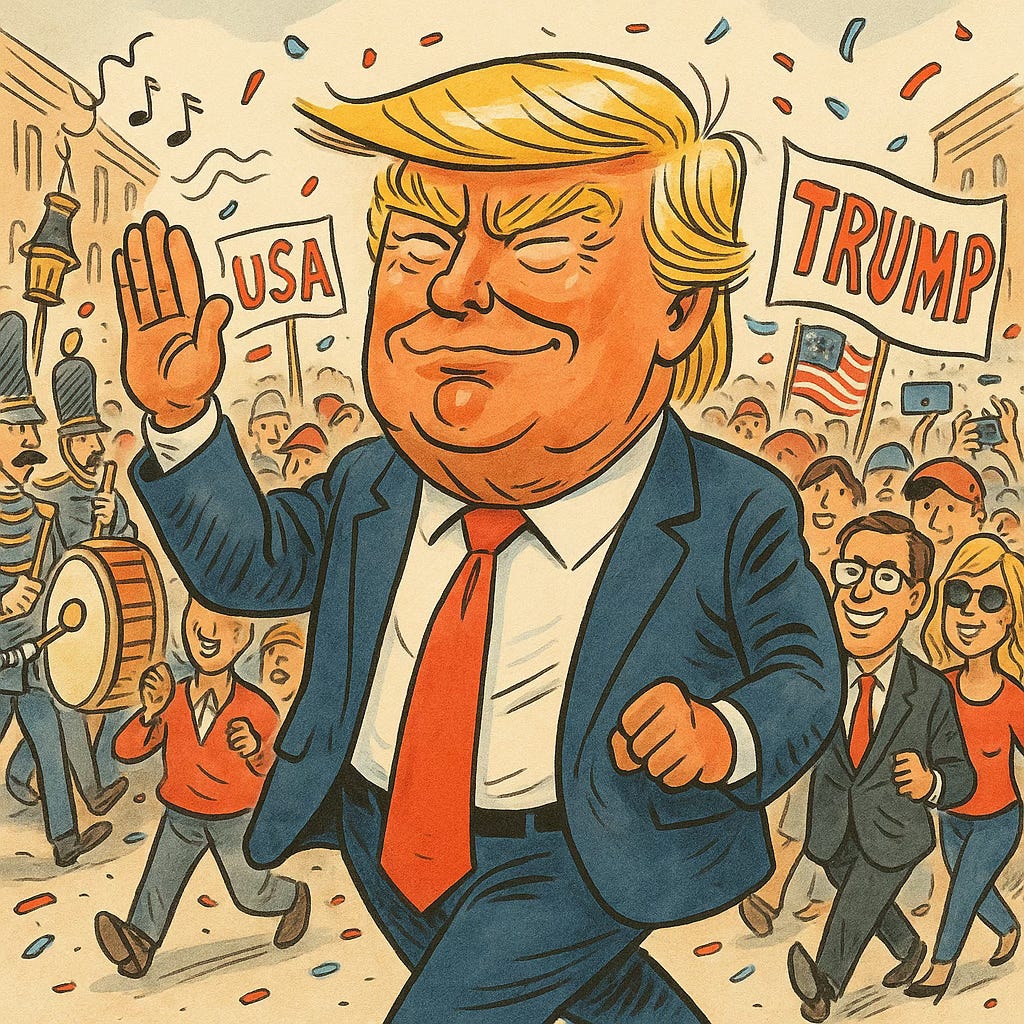
This essay is part of The Shape of the Right: An Autopsy of American Conservatism, a ten-part exploration of the ideas, myths, and moral compulsions that shaped the American Right. I’m not here to sneer or to support it, but to understand how a movement that began with sermons and self-discipline grew into a politics of grievance and spectacle. Each essay stands on its own, but together they form an autopsy, not of a party, but of a moral psychology that still thinks it’s the soul of the nation.
Standing at the Curb Again
I keep finding myself back at the curb of this parade route even though I keep telling myself I’ve got better things to do. I know it isn’t a parade in the usual sense. It’s the rolling spectacle that appears every season when ambition puts on a costume and calls itself the voice of the people. There’s always this little ceremony in my head when I arrive. I take a sip of my coffee, look down the street, and wonder what in the world I think I’ll learn by watching this circus again. Yet here I am. I think some part of me still believes that if I watch long enough I might see something honest slip through. Some unguarded moment when a face reveals its truth before the persona snaps back into place.
Every time the procession rolls by it looks more like a talent show for the morally flexible. I stand here studying a national mood the way a physician studies a rash, hoping it’s not contagious. Or maybe it already is and I’m only now realizing how far it’s spread. I’d like to think I’m immune, yet the fact that I return tells me I’m still drawn to the spectacle even as it disturbs me. A contradiction I keep trying to understand.
This parade’s grown over the years. It didn’t always have amplification or choreography. At first it was a ragged line of people walking down the street, shouting slogans and waving signs they’d written in thick marker the night before. Then someone brought a drumline. Then speakers. Then merch. Then livestreams. Then a full media caravan. It grew the way weeds grow, from neglect and inattention and the absence of anything healthier to occupy the soil. Now it stretches from one end of the block to the other, a rolling morality play for citizens who keep forgetting what morality looks like.
The Tie That Became a Flag
At the center of this parade is that red tie. I see it on nearly every float, swaying like the banner of some traveling kingdom. It’s thicker some years, thinner other years, sometimes glossy, sometimes dull, but always unmistakable. It’s strange how a strip of fabric became a national password. Wear it and the crowd relaxes. Wear it and the cameras lean forward. Wear it and you’re telling the world you belong to a certain tribe that mistakes grievance for identity.
I once believed clothing could reveal something about a person. Now I’m beginning to think clothing reveals only what a person wants to sell. The red tie doesn’t symbolize courage or discipline or any of the old virtues we once attributed to formal attire. It symbolizes marketing. It symbolizes a willingness to perform anger on command. It symbolizes a pledge to say the things polite society once avoided, not out of fear but out of decency.
Sometimes I wonder if the tie enchanted the crowd or if the crowd enchanted the tie. Maybe symbols become powerful only when a people lose their own.
The Grifters Step Forward and Smile Too Widely
The first float approaches. The Grifters Brigade. They arrive early because they never want to miss a camera. Their smiles are stretched so tight across their faces that I almost expect to hear them crack. Their wrists flick in constant waves, a rhythm practiced in front of mirrors. Mirrors that now probably answer back with compliments.
For a moment I try to imagine these people as they once were, before the spotlight rewired their inner circuitry. Maybe some of them once believed something. Maybe they once had ideals before the market taught them that sincerity pays in applause but not in cash. Maybe they discovered that rage performs better than reason and that a well timed insult can do more for their careers than a lifetime of principle.
The parade moves forward and I catch a glimpse of one grifter whose smile falters for half a second. A tiny fracture. A flash of something tired. Then it snaps back. And I feel a cold wave of recognition. Even the performers are trapped in the performance.
The Influencers Bring Their Ring Lights and Recite Their Lines
Behind them comes the Influencers Guild. Their ring lights bob above the crowd like artificial halos. They look like prophets for rent, ready to preach for anyone who offers sponsorship. Their voices lift in short inspirational bursts as if they’re allergic to sustained thought.
I often wonder what happens when they turn off the camera. I picture a quiet room, filled with equipment but not warmth, where they sit alone trying to remember who they were before every opinion had to be filmed. The panic behind their eyes tells me they’re running from irrelevance like it’s a predator. And maybe it is. In their universe, losing attention feels like losing oxygen.
I watch one influencer adjust her mic while speaking about authenticity. The irony hangs in the air like thick perfume.
The Populist Millionaires Try to Eat Diner Food
Now comes the float that always confounds me. The Populist Millionaires Alliance. They sit on hay bales that’ve been cleaned and fluffed to prevent actual dirt from touching their jeans. Jeans that, I’m fairly certain, cost more than my first car. They drink weak diner coffee as if they’re participating in a cultural exchange program.
They discovered their love of the working class when a pollster told them to. It shows. One of them takes a bite of a pancake so slowly that I start to wonder if he thinks the pancake might stage an uprising. His discomfort’s written across every muscle in his face. Yet he smiles through it like a student trying to impress the teacher in a class he never wanted to take.
The crowd laps it up because it confirms a fantasy. The fantasy that someone rich will rescue the poor without altering anything that created the poverty. A comforting illusion that asks nothing of anyone except applause.
The Marketplace of Conviction
I drift toward the merch booths. The air smells like fried food and cheap plastic. Every movement eventually becomes a retail event. Here the revolution comes with a QR code. Hats, shirts, coffee mugs, devotionals, freeze dried food, bumper stickers, bracelets, flags. The merch table hums with the energy of a shopping mall at holiday season.
Conviction feels cheaper when it can be bought in bulk. Maybe that’s why people buy it. Belonging feels tangible when you can put it on a hat. Understanding a system requires effort but wearing a slogan requires none. When the world feels chaotic, even a poorly printed T shirt can feel like something solid to hold.
A child tugs on her mother’s sleeve and asks what the words on a poster mean. The mother tells her she’ll understand when she grows up. I’m not so sure.
The Rhythm That Trains the Crowd to Chant
The drumbeat returns. Fear. Anger. Nostalgia. Repeat. It’s always the same rhythm. The same chants rise from the crowd with mechanical enthusiasm. I recognize them all. They used to shock me. Now they feel like nursery rhymes recited without comprehension.
Repetition’s powerful. It can turn noise into meaning and meaning into habit. It can lull a nation into confusing volume with truth. The chants wash over me until I feel my own thoughts thinning. Spectacle can do that. It can make even the thinking mind drift toward the easy current.
I grip my coffee cup tighter just to remind myself I’m still awake.
The Empty Float Glides By and Reveals the Truth
Then it comes. The float that stops me cold every year. The empty one. No decorations. No performers. Just a flat wooden platform rolling slowly down the street. And the crowd cheers for it with the same enthusiasm they gave the others.
Something in me tightens. It’s so simple. So honest. So completely symbolic of everything I fear. The applause continues. Loud. Proud. Unquestioning. They cheer the emptiness because the expectation to cheer’s become automatic. The float represents nothing, yet it receives everything.
That’s the moment when I understand the danger. The danger’s not the performers. It’s the audience that’s learned to clap even when there’s nothing on stage.
The Crowd and Its Willing Surrender
The crowd grows louder. Children sit on shoulders. Cameras flash. Confetti falls even though nothing’s happened to merit celebration. The atmosphere feels strangely devotional even as it feels dangerously hollow.
I look around and realize many people aren’t cheering for ideas. They’re cheering for a feeling. They’re cheering for belonging. They’re cheering for the relief of not having to think. It’s easier to chant than to question. Easier to applaud than to understand.
And I feel a quiet fear. Not terror. Something colder. A recognition that public apathy’s become a political resource.
Walking Away Before the Parade Ends Me
I turn away. I tell myself I’ve seen enough. The parade will return next year. The floats will change names but the choreography will remain the same. The red tie will still be a passport to power. The grifters will still smile too widely. The influencers will still perform sincerity in fifteen second clips. The millionaires will still pretend to enjoy diner food. And somewhere near the end an empty float will still collect applause.
As I walk home, I think about the people who never join this parade. The quiet ones who carry principles without needing a spotlight. The ones who understand citizenship as a practice rather than an aesthetic. The ones who feel no enchantment when the red tie swings into view. They’re not glamorous, but they’re the only reason I haven’t given up on the country.
The Meaning Hidden in the Wooden Platform
I keep thinking about that empty float. It haunts me because it’s the truest symbol in the entire parade. It’s the altar of a movement that worships volume over substance. It’s the proof that people will celebrate nothing if nothing comes packaged with enough noise.
One day maybe the float’ll pass with no applause. One day maybe the crowd’ll stay home. One day maybe the country’ll remember that a republic doesn’t survive on spectacle but on responsibility. I don’t expect it soon, but hope’s stubborn. It refuses to die even when evidence thins.
What the Parade Accidentally Taught Me
As I turn onto my street, the last fragments of music fade behind me. The drumbeat weakens. The cheers dissolve into distant static. The parade’s over for now, and I realize I haven’t wasted my time. Watching it again’s taught me something I didn’t want to admit.
The danger’s not the opportunists. Opportunists have always existed. The danger’s a people who become comfortable with applause. A people who find comfort in noise. A people who mistake the emptiness of a wooden float for meaning simply because it arrives wrapped in spectacle.
And I can’t help asking myself one last question. If the crowd can cheer for nothing, what else might they accept.
I don’t know the answer, but I walk home with the quiet resolve to stay awake long enough to find out.
Support the Work
I’ve opened this newsletter to all readers because these words aren’t meant for a paywall—they’re meant for the moment we’re living through. But writing takes time, energy, and tools. If you find value in this work and want to help me keep it alive, consider becoming a paid supporter.
Further Reading:


" As I walk home, I think about the people who never join this parade. The quiet ones who carry principles without needing a spotlight. The ones who understand citizenship as a practice rather than an aesthetic. The ones who feel no enchantment when the red tie swings into view. They’re not glamorous, but they’re the only reason I haven’t given up on the country."
Thank you for keeping Hope alive !
I really do believe that day will come ( sooner rather than later) when people in the crowd will stop at the empty float and ask themselves:
WTF ??
All I can see is the title page?