


"I live my life in widening circles that move out over the things of the world." — Rainer Maria Rilke
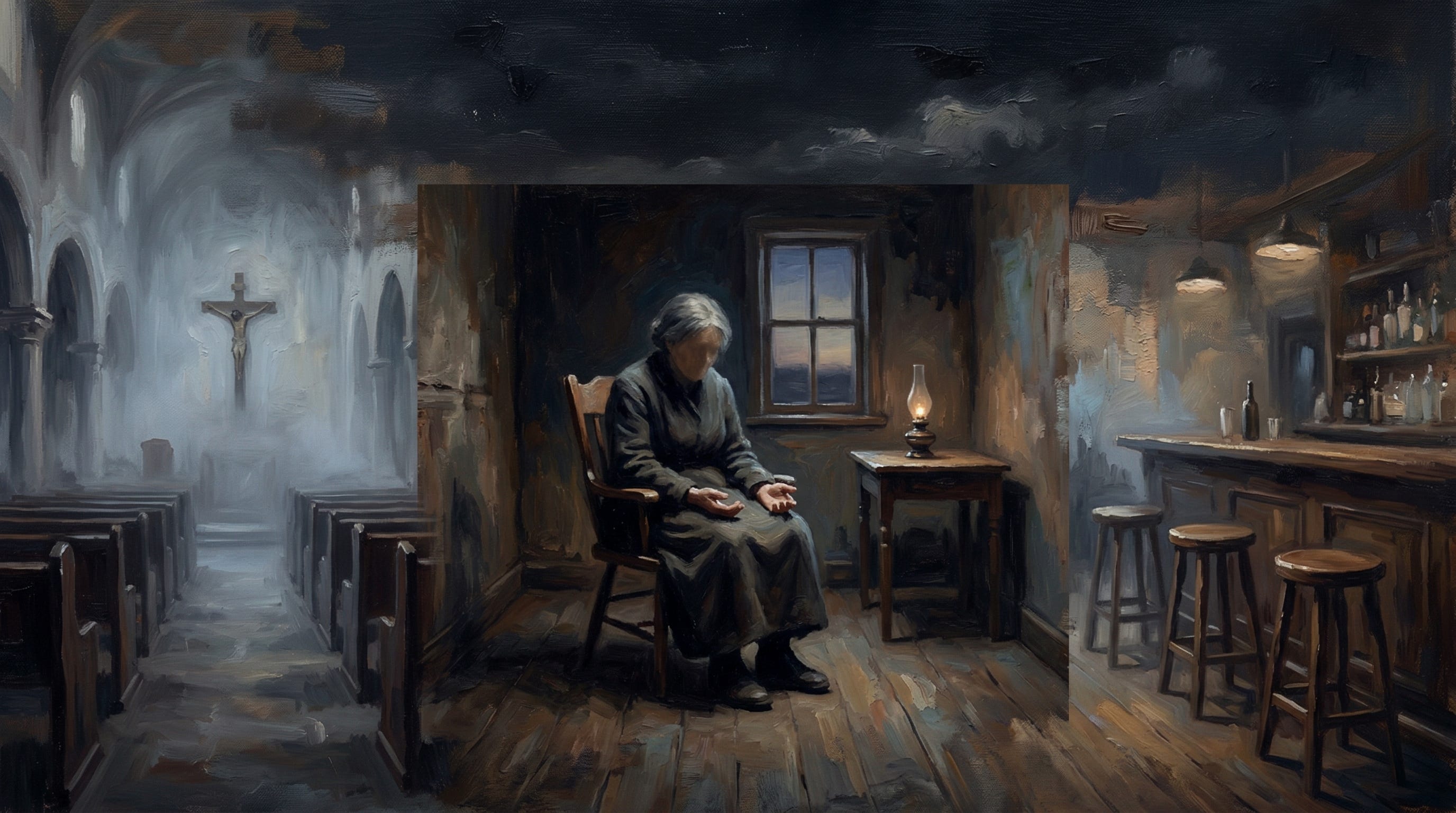
The American Legion bar is the civilian cathedral for the military mind. The same people occupy the same stools with the quiet authority of pew holders at Sunday mass. The bartender presides from behind the rail, confessor and oracle in equal measure, reading the room the way a good chaplain reads a congregation. Officers drift in and out checking the temperature of their flock. The place doesn’t feel happy exactly. It feels safe. And I sat there long enough to understand that those aren’t the same thing, that safety without honesty is just a more comfortable cage, and that I’d spent a significant portion of my life building and then vacating exactly these kinds of structures, each one promising connection, each one delivering belonging of a kind, the kind that requires you to check most of yourself at the door.
My life has been about the lessons of leaving. The Catholic Church first, in my early teens, when the doctrines began to feel like walls rather than windows. Then the bright, seductive world of 1970s spirituality, channelers and spirit guides and the palpable evidence of the afterlife, which I’ll return to in a moment because it deserves more than a sentence. Then a Protestant church in the 1980s. That one I entered not from conviction but from need, which is the most honest thing I can say about it. I knew something of what I was walking back into. I went anyway, because the need doesn’t negotiate with what you know, and because there’s a particular loneliness in having left one shelter without yet understanding that you’re capable of standing in the open. And finally the Legion, after twenty years of military service left me standing in civilian life looking for something that could hold what the military had held, and finding only an imitation of it, a costume worn in the shape of the real thing.
The need for belonging doesn’t care what you know. It doesn’t negotiate with your skepticism. It simply persists, and it’ll accept almost any vessel that presents itself, because the need itself, and this is what took me decades to understand, is the one thing that never betrays you. Not the church. Not the channeler. Not the post, with its bar and its officers and its careful simulation of mission. The need is faithful even when everything built to answer it is fraudulent.
But I want to tell you about the channeler, because that story contains everything.
It was the early 1970s. The room was dim enough that you could see the outline of the man but not much more. He sat in a chair, body occasionally seized by spastic movements meant to signal a spirit taking physical hold, and from that chair he channeled a Native American chief, wise and gently humorous, who addressed people directly, calling them out for their value, locating something in each person that felt specific and true. When he turned his attention to my mother and told her that her son had been a great chief in a former life, I felt the words land in her before they landed in me. I watched something in her face open with a pleasure that was entirely about love for me and nothing else. I was perhaps fifteen. That was the hook. Not my vanity but hers. Not my need to be special but her need for me to be.
A year or two later, older and quieter in my conviction, I sat in another dim room and heard a different channeler say the same words to a different mother about a different child. The rose colored glasses didn’t fade. They shattered. And what I understood in that shattering I’ve spent the rest of my life learning to say plainly: we’re most completely captured not when someone flatters us, but when they flatter us through the people we love. Every institution worth its salt knows this. The church knew it. The Legion knew it. The dim room knew it. You’re never just a member. You’re a son, a father, a veteran, a believer, and leaving means dragging all of those identities toward a door that was never built wide enough for all of them.
Every room I’ve ever left was full of people doing exactly what I was doing when I walked in. Looking for cover. Not cover from enemies or hardship or the specific difficulties of a life, but cover from the exposure of being fully known and still accepted. We dress it differently depending on the room. We call it faith, or fellowship, or patriotism, or enlightenment. But underneath every banner and every doctrine and every dimly lit room is the same animal need. We’re afraid. Not just of dying, though that too, but of the smaller deaths that arrive daily. The social death of being seen without your costume and found wanting. The spiritual death of admitting that the map you’ve been following was drawn by someone who needed you dependent. The moral death of admitting you stayed longer than you should have, and that the room changed you in ways you’re still accounting for.
We’re all, every one of us, negotiating the distance between who we actually are and who the room requires us to be. And we’ll pay almost any price to avoid closing that distance, because closing it means standing in the open with no banner between you and the next person, nothing to hide behind, nothing to hide behind them either. Just two human beings attempting to see each other clearly across a space that’s never been as wide as we’ve made it.
I’m not a young man anymore and I no longer have the patience for the banner or the bar stool or the dim room. But I haven’t lost my patience for the need that drove me into all of them. That need isn’t weakness. It isn’t gullibility. It’s the most human thing about us, more human than our politics or our doctrine or our tribe, because it precedes all of those things and will outlast them. The person on the other side of whatever divide you’re contemplating right now walked into their room for the same reason you walked into yours. They’re warm inside it, as you were warm inside yours. They’re afraid of what leaving costs, as you were afraid, as I was afraid, every single time.
You can’t argue someone out of a room they entered through need. You can only stand outside it, in the open, and refuse to pretend you were never inside one yourself.
In the end, our soul is the only sanctuary we can afford.
Light Against Empire is free for all. I write on American foreign policy, political accountability, and the lies of “Empire.” If my words have value to you and you’re in a position to help, you can chip in with a monthly or yearly donation. It takes time, energy, and resources to keep Light Against Empire running. Your support keeps the writing alive, the lights on, and the fire burning. Thanks!
Further Reading:


