


There was an America I carried like a tune learned by ear,
not from a radio or a flag,
but from small rooms and ordinary days.
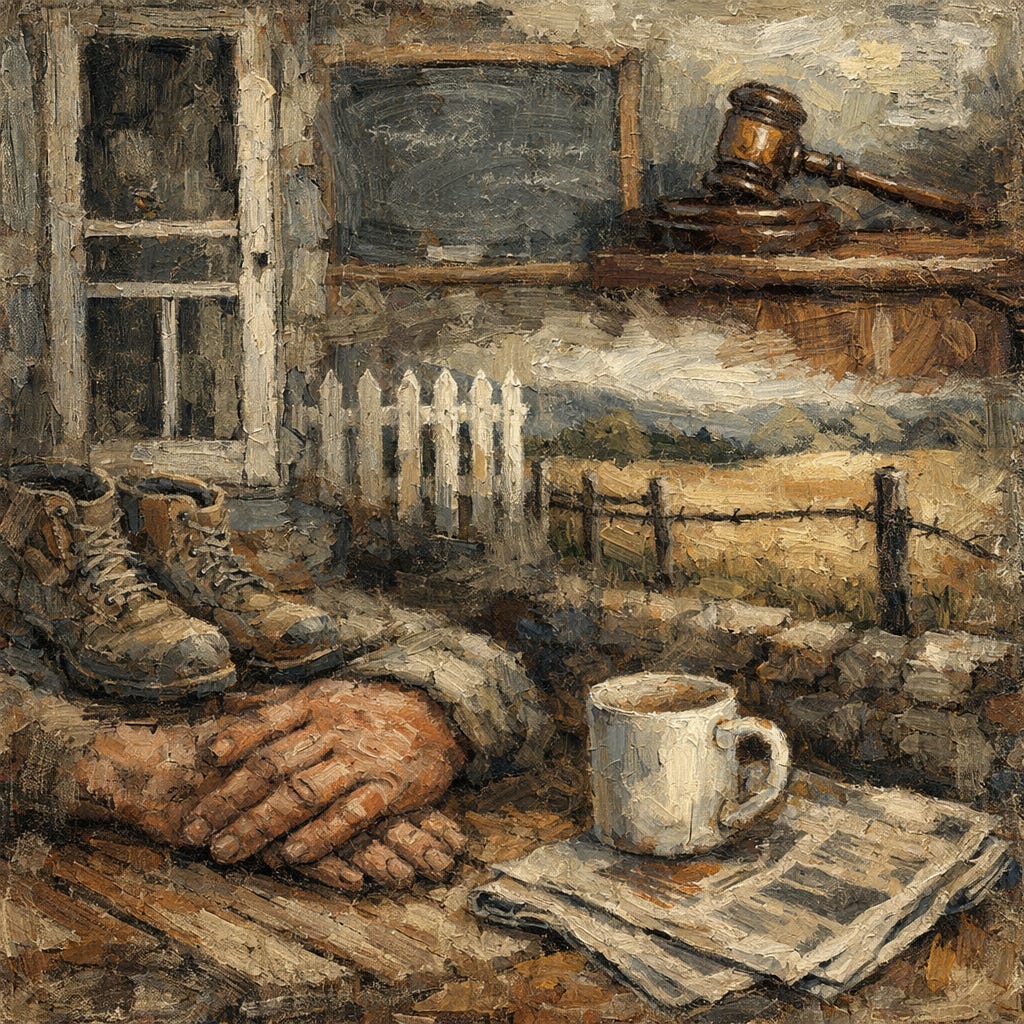
It lived in the weight of a screen door closing slow,
in the courtesy of a stranger holding it open,
in the way voices lowered when something serious entered the room.
It did not pretend to be perfect.
It did not need to.
It tried, most days, to be decent.
Only later did I understand
that I mistook decency for permanence.
It showed itself in work done without applause,
hands roughened by effort,
rules kept not because someone was watching
but because breaking them felt like a kind of theft.
You did not cut the line.
You did not pocket what was not yours.
You did not laugh when someone weaker took the blow.
That America never announced itself.
It did not speak of virtue.
It lived in habits, passed hand to hand like tools,
used until the handles wore smooth.
I remember classrooms where disagreement stayed human,
where truth mattered enough to slow the tongue.
Courts that moved carefully,
not to shield power but to keep it from running wild.
The law felt like a fence leaned on together,
not a weapon swung for advantage.
None of this was heroic.
That is what made it real.
And maybe that is why it was easy to lose.
It spoke softly while louder things arrived.
It trusted that what had always held
would go on holding without care.
It assumed shame would still work,
that lies would still hesitate,
that cruelty would still feel like crossing a line
you could not step back over.
I think now of fields left unworked,
stones lifted once and set back careless,
drainage neglected until the water had nowhere to go.
You do not see the damage all at once.
First the ground softens underfoot.
Then it gives.
What we have now is louder,
more certain,
quick to accuse and quicker to excuse itself.
It borrows the old language but drains it of care.
Calls strength what once meant restraint.
Calls winning what once meant cheating.
And the hardest truth is this.
It did not arrive as a thief in the night.
We made room for it,
one small letting go at a time.
Still, I will not say that America was a lie.
It was a practice.
Fragile, unfinished, dependent on memory and upkeep.
Like any craft, it asked something of the hands that held it.
I do not know if we can recover it whole.
But I believe pieces remain.
In the way some people still lower their voices.
In work done well when no one is watching.
In the refusal to turn away,
even when turning away would be easier.
What was lost was not innocence.
It was attention.
And if there is any hope left,
it lives there.