

The Great Grievance Machine: The Shape of the Right: An Autopsy of American Conservatism-A Ten Part Series, Nr 7
How Resentment Replaced Reason in American Conservatism

“If you want to know what a man fears, watch what he hates.” — Anonymous
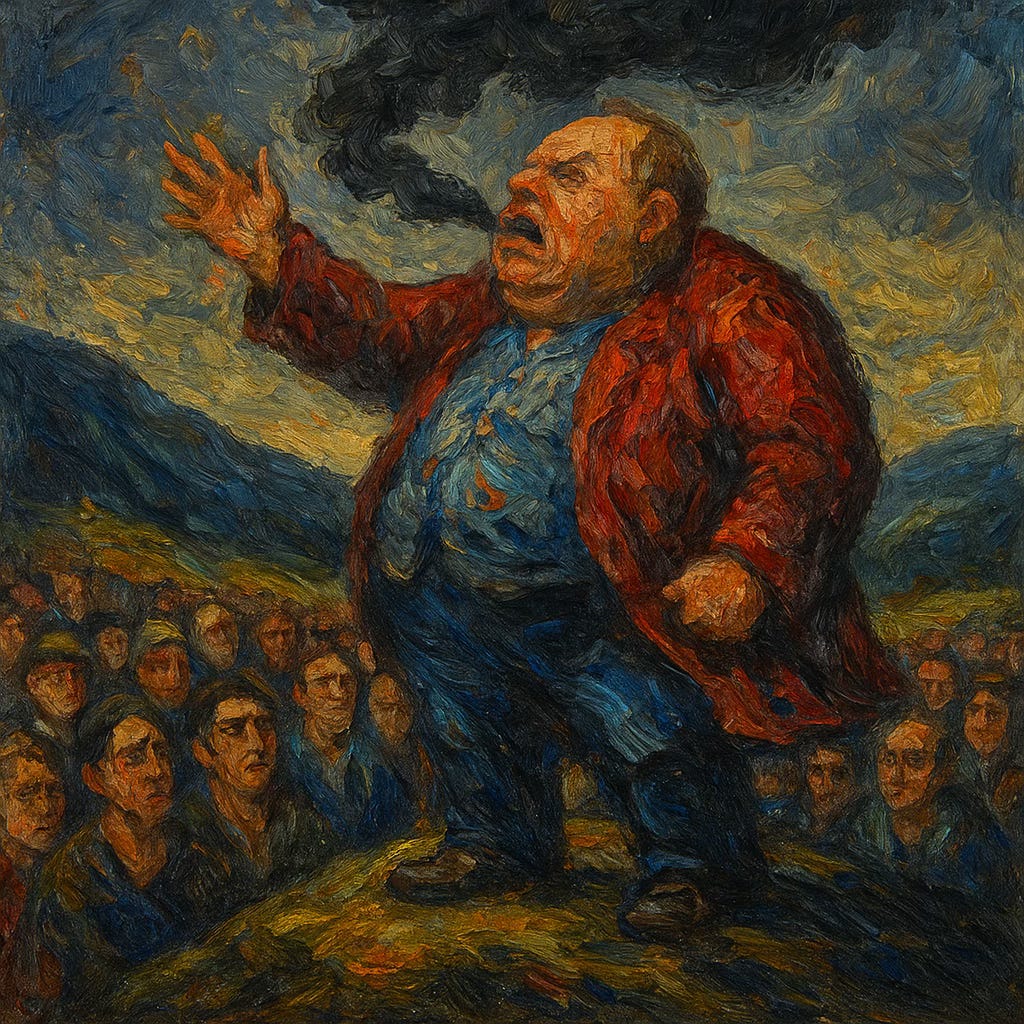
This essay is part of The Shape of the Right: An Autopsy of American Conservatism, a ten-part exploration of the ideas, myths, and moral compulsions that shaped the American Right. I’m not here to sneer or to support it, but to understand how a movement that began with sermons and self-discipline grew into a politics of grievance and spectacle. Each essay stands on its own, but together they form an autopsy, not of a party, but of a moral psychology that still thinks it’s the soul of the nation.
The Opening
Sometimes I gotta wonder when the country I grew up in quietly enrolled itself in a graduate seminar on creative resentment. I look around and see a nation that once prided itself on rugged independence and personal responsibility, yet half the time we’re now behaving like a society that discovered resentment the way ancient chemists discovered fire. We hold it up. We marvel at its glow. We pretend it’s light even while it burns us from the inside out.
And I keep asking myself the same question. When did conservatism stop being a movement and start being a feeling. Not a worldview. Not a philosophy. Not a program. A feeling. A mood that sits in the chest like a sour aftertaste, the emotional equivalent of weak diner coffee at two in the morning while a trucker in the next booth rants about something he saw on television. Some days I feel like I’m watching a political project turn into a national temperament, one that keeps trying to convince the rest of us that outrage is patriotism and irritation is a civic virtue.
I ask myself how we arrived here, because the truth is that grievance isn’t a political argument at all. It’s a psychological event that’s been dressed up in red, white, and polyester. And we’re all now expected to clap as if we’ve been given a national anthem instead of a national anxiety disorder.
And if I sound confused, I am. Because I grew up thinking conservatism meant a respect for institutions and traditions, not an endless audition for who can be the angriest person in the room.
Let me walk through how I arrived at this suspicion.
On Mood
There’s a strange thing that happens when a political identity becomes a mood. Mood doesn’t care about evidence. Mood doesn’t care about outcomes. Mood has no memory, no horizon, no plan. Mood simply wants to feel itself. It wants to be recognized. It wants to swell like a storm cloud that never quite breaks.
I sometimes sit with my coffee in the morning and watch the news, and I can feel the nation vibrating with a low frequency hum of irritation. It’s as if millions of people wake up each day eager to find out what will offend them before lunch. And I mean that literally. I sometimes imagine a national breakfast table covered in toast, bacon, eggs, and a large pitcher of fresh resentment poured daily.
The strange thing is that moods spread faster than ideas. And in this case, the mood has outpaced the movement that once claimed to steward it. Conservatism, at least the version that now dominates our politics, is no longer a set of principles about the role of government or the importance of community. It’s the emotional equivalent of a car alarm that refuses to shut off.
And like all moods, it stops being chosen. It starts being inhabited. It becomes a part of the weather system of a person’s life. It becomes the emotional climate of communities, congregations, and entire regions. And because mood longs for confirmation, it begins to remake the world in its image.
Sometimes I wonder if we’re living inside the psychological afterlife of a country that never learned to handle decline with grace. Because resentment is rarely about what’s happening. It’s almost always about what we fear is happening behind it.
On Memory
I keep hearing conservatives talk about wanting their country back, and every time I hear it, I want to sit gently across from them and ask which country they mean. Because nostalgia is the perfect breeding ground for grievance. It sanctifies the past, simplifies the present, and provides a perfect narrative for why anger feels justified.
In their telling, the past was a place of orderly certainty, a time when people knew their place, when society was stable, when families were whole, when the world made sense. The fact that this past exists only in the imagination doesn’t matter. Memory isn’t a historian. It’s a painter who keeps adding light to the spots we want to remember and shadow to the ones we prefer to forget.
And here’s the danger. When nostalgia becomes political currency, grievance becomes its interest rate. And that interest compounds daily.
I sometimes think the nation’s been sold a fairy tale about what it used to be, and that fairy tale has become a map people keep trying to follow, even when the roads no longer exist. So they get angry. They feel cheated. They sense betrayal. And they begin to believe the only explanation for why the country doesn’t look like their memory is because someone must have stolen it.
Which brings me to the next point.
On the Diner Booth
I wish I were joking when I say that half of the political imagination of modern conservatism seems to be located in a diner off a rural interstate. The cultural myth is always the same. A reporter goes to hear the wisdom of salt of the earth people while they drink coffee in a cracked vinyl booth and complain about how everything’s gone to hell.
But the truth is that these diners have become something else in the national psyche. They’ve become confessional booths. They’ve become grievance revival tents. They’ve become places where outrage is nourished, where resentment is passed like communion, where the emotional life of the movement is cultivated and then broadcast to the nation.
What interests me is that these grievances rarely articulate what’s actually wrong. They articulate what it feels like to be wronged.
It’s not policy. It’s posture. It’s not principle. It’s mood. It’s not suffering. It’s the belief that one ought not have to suffer.
I once overheard a conversation in a diner not far from where I live. A man was complaining about immigrants, although he didn’t know any. Another insisted the government was coming for his freedom, although he couldn’t specify which one. A woman said schools were indoctrinating children, although she had no children in school.
And I sat there thinking that I’d stumbled into a rehearsal for a play about resentment. Each person was performing a line they didn’t write, but that they’d memorized with great emotional devotion.
What would it mean to live in a country where the national mood is written by talk radio hosts and social media misanthropes who’ve monetized indignation. What does it do to the soul to wake up each morning and be guided by whatever narrative tells you to be angry next.
On Outrage
Here’s the part that troubles me most. Outrage has become a substitute for civic participation. People no longer need to volunteer, vote, compromise, or engage. They only need to be angry in the right direction. They only need to feel the correct resentment. They only need to brand themselves with the correct grievances.
Outrage is cheap. Outrage is portable. Outrage lets people feel engaged without being involved. And in its own way, outrage feels noble. It feels purposeful. It convinces people they’re fighting a great battle when they haven’t left their driveway.
But I think something darker has happened. Outrage has become a badge that signals membership in a tribe. And once outrage becomes identity, it becomes untouchable. It becomes sacred. It becomes the way people understand themselves.
Which is why I sometimes think we’re watching the rise of a new national religion, one built not on faith but on fury. And it raises a question I keep asking myself. What happens when a movement realizes anger is easier to sell than ideas. What happens when a political identity discovers that grievance is more intoxicating than governance.
Here’s what happens. Governance collapses and grievance grows. The nation becomes louder and less capable of reflection. People become angrier and less clear about what their anger is for.
And in that confusion, something else grows. Fear.
On Fear
If I’m being honest, I don’t think conservatism today is primarily about what its adherents say they dislike. It’s about what they fear will happen to them if the world continues changing without their permission.
Fear is a powerful teacher. It teaches people to cling to certainty. It teaches them to distrust complexity. It teaches them that outsiders are threats, that strangers are enemies, that change is suspect, and that difference is dangerous.
Fear is the quiet architect of resentment. It builds the emotional scaffolding for anger. It fuels the furnace of grievance. And when fear is widespread enough, it becomes a kind of atmospheric condition. It becomes the weather of the culture.
I sometimes wonder if the country is processing a deep unspoken terror about the future. Economic instability, demographic change, cultural transformation, technological upheaval, and a political system that no longer functions have created the perfect storm for fear to masquerade as ideology.
And when fear isn’t acknowledged, it finds expression in anger. Anger is simply fear wearing a leather jacket and pretending to be tough.
On What Comes Next
I’m not naïve. I don’t think a nation this invested in grievance will suddenly wake up one morning and decide that gratitude is a more pleasant emotional habit. We’ve built entire industries that depend on keeping the public furious. There are people whose careers require national bitterness to remain at a steady boil.
But I’m also not hopeless. Because moods don’t last forever. They can’t. They burn out. They collapse under their own intensity. They reveal their emptiness in time.
And I sense, quietly, that some Americans are beginning to recognize how exhausted they feel. They’re noticing that grievance hasn’t improved their lives, fixed their communities, saved their families, or strengthened their character. They’re noticing that being angry all the time is actually a kind of grief. It’s a loss disguised as fire.
If this essay has a point, it’s this. A movement that makes resentment its core identity will eventually become emotionally unlivable for the people who follow it. Because resentment isn’t nourishment. It’s noise. It isn’t purpose. It’s coping. It isn’t patriotism. It’s projection.
And I think more and more people are beginning to realize that patriotism built on grievance is just loneliness that’s been painted to look heroic.
I keep telling myself this because I want to believe it’s true. And because I want to believe there’s still a path back to a politics that doesn’t depend on the emotional exploitation of millions of people.
If we’re honest with ourselves, the Great Grievance Machine can’t survive forever. It feeds on fear, and fear always demands more than any society can give. It devours joy. It devours hope. It devours the ability to imagine a shared future.
And I can’t help thinking that the way out isn’t to tell people to stop being angry. The way out is to remind them that they deserve more from their politics than anger can ever provide.
In the end, resentment is a poverty of the spirit. And a nation that wants to survive must find a way to cultivate something richer.
Because outrage may feel like belonging, but it’s not community. And resentment may feel like conviction, but it’s not courage. And grievance may feel like identity, but it’s not destiny.
If you’d like to support this work:
Light Against Empire is free for all. If my words have value to you and you’re in a position to help, you can chip in with a monthly or yearly donation. Your support keeps the writing alive, the lights on, and the fire burning.
Dino’s Homily and Poetry Shop here
Light Against Empire - The Podcast here
Further Reading:


