


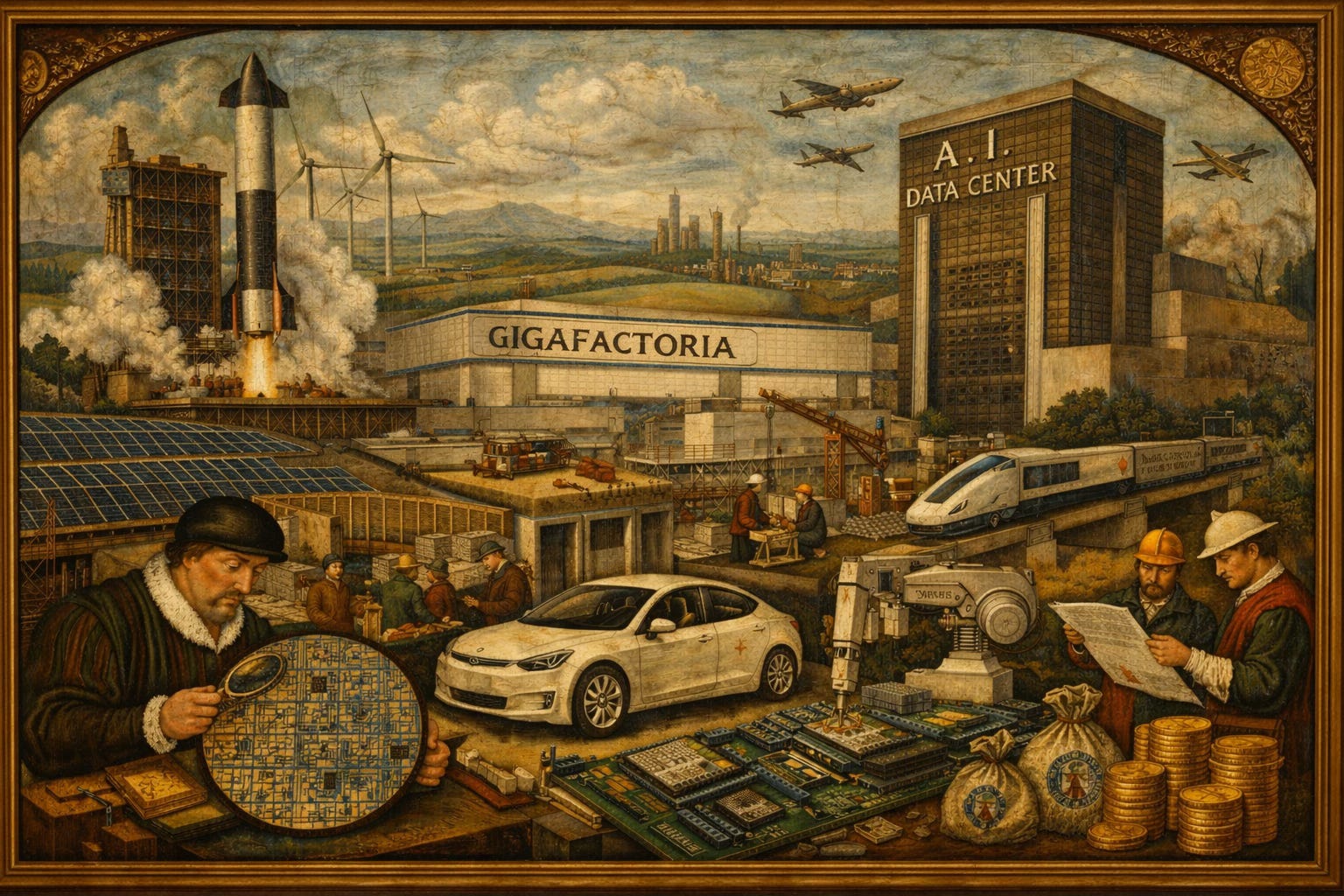
“In the councils of government, we must guard against the acquisition of unwarranted influence… by the military-industrial complex.” — Dwight D. Eisenhower
If you were to lift a drone over America in early 2026 and let it drift from coast to coast, you’d see two different countries unfolding at once.
In one frame, semiconductor plants rise from desert soil in Arizona. Battery megasites reshape farmland outside Savannah. AI data centers expand across northern Virginia in quiet, humming rows. Billions in concrete and steel. Crews working around the clock. Federal backing that signals this will be finished.
In the other frame, you’d see a bridge outside Pittsburgh still wrapped in scaffolding. A rail extension in Los Angeles pushed back again. A water system replacement in Jackson re bid for the third time. A highway expansion in Nashville that was supposed to relieve daily congestion now delayed well into the next decade.
It looks like a construction story.
It isn’t.
It’s a story about what we choose to build first.
And that’s always a story about power.
A republic, at its healthiest, maintains the conditions of ordinary life before it pursues grand projection. An empire prioritizes strategic dominance and assumes the rest will follow.
We’re drifting from the first posture toward the second.
Industrial policy isn’t wrong. Strategic competition isn’t imaginary. The question isn’t whether to build the fortress. The question is whether we’ve allowed the fortress to crowd out the village.
The Gravity of Federal Concentration
If we’re honest about what’s driving the distortion, two forces sit at the center.
First, federal subsidy concentration.
The CHIPS and Science Act authorized more than $50 billion in semiconductor incentives. The Inflation Reduction Act directed hundreds of billions toward energy and manufacturing credits over the next decade. These aren’t marginal programs. They’re capital anchors. They signal where labor, materials, and long term contracts will flow.
When tens of billions of dollars are directed toward semiconductor fabrication, battery manufacturing, and AI infrastructure, those projects don’t merely enter the market. They reshape it. They carry policy certainty, long term capital, and political urgency. Contractors know those projects will be funded. Lenders know they’re protected. Wages adjust accordingly.
Second, skilled labor scarcity.
According to Associated Builders and Contractors, the construction industry needs more than half a million additional workers beyond normal hiring just to meet current demand. That gap didn’t appear overnight. Apprenticeship pipelines lagged for years. Retirements accelerated. Vocational tracks were deprioritized.
When hundreds of thousands of skilled positions sit unfilled nationwide, any surge in demand doesn’t create new labor overnight. It reallocates existing labor.
So what happens when you combine concentrated federal money with a limited workforce?
You create gravity wells.
A semiconductor expansion outside Phoenix doesn’t just hire electricians. It pulls them from surrounding counties. A battery plant in Georgia doesn’t simply create jobs. It outbids smaller municipal projects across the region. A data center cluster in northern Virginia doesn’t merely add infrastructure. It locks in long term contracts for crews that might otherwise have been repairing local roads or upgrading water systems.
Nobody intends harm.
But the math is unforgiving.
A mayor in Ohio trying to replace aging water lines can’t compete with a federally backed megasite offering higher wages and years of guaranteed work. A small city in California planning a transit upgrade can’t match the financial certainty attached to a national strategic project.
So bids don’t come in. Or they come in high. Or they collapse midway when subcontractors leave for more stable contracts.
The fortress absorbs. The village waits.
A Human Face
I spoke recently with a municipal project manager in a Midwestern city. He’d spent two years planning a wastewater system upgrade. The engineering was complete. The funding was approved. It was ready.
Then the bids arrived.
They were nearly twenty percent over projection. Some contractors declined entirely, explaining that their crews were committed to a manufacturing facility two counties away.
He wasn’t angry. He understood why workers would choose higher pay and longer term stability.
But he said something that stuck with me.
“We did everything right,” he told me. “And we still can’t get it built.”
That sentence captures the quiet shift.
When local competence is no longer enough to secure execution, something structural has changed.
Tariffs and the Squeeze
Trade policy amplifies the strain.
Tariffs on steel, aluminum, and copper are framed as necessary tools of sovereignty. And perhaps they are in certain contexts. But when those cost increases cascade into municipal budgets without adjustment, local projects feel the squeeze immediately.
Construction runs on feasibility. A city plans a library or transit expansion based on projected material costs. If those inputs spike sharply, the project doesn’t adapt smoothly. It stalls. It returns to committee. It waits for additional bonding authority. Permits expire. Momentum fades.
Multiply that dynamic across Sacramento, Milwaukee, Charlotte, Albuquerque, and rural Maine.
The impact isn’t spectacular. It’s cumulative.
And cumulative strain rarely announces itself as crisis. It simply lowers the baseline of expectation.
Housing and the Everyday Economy
The housing market reveals the same pattern.
In Boise, Tampa, Denver, and parts of Texas, entry level construction has slowed under the combined weight of material volatility and labor scarcity. Builders face crews that are booked months in advance by megasites. Suppliers issue short lived quotes that complicate budgeting. Margins compress.
So developers delay. Or they shift toward higher end units where risk can be absorbed.
Young families searching for modest homes don’t see subsidy concentration. They see prices that keep moving upward.
And when housing tightens, mobility tightens. When mobility tightens, opportunity narrows.
Again, this isn’t theatrical decline. It’s incremental narrowing.
Empire Logic
Let me ask the uncomfortable question.
Why does this pattern feel familiar?
Because empires historically centralize resources around strategic imperatives. They elevate sectors deemed critical to survival. They justify concentration as necessary strength. The outer territories, the smaller cities, the everyday maintenance of civic life, become secondary to the grand project.
Not abandoned. Just delayed. Deferred. Quietly subordinated.
Here’s the philosophical tension.
A republic distributes attention. It accepts inefficiency in exchange for diffusion. Power moves outward through states, counties, and towns. The measure of success isn’t spectacle but stability.
An imperial mindset concentrates attention. It channels resources toward visible demonstrations of strength. The measure of success becomes scale, speed, and global leverage.
Strategic competition with China didn’t create this impulse. It accelerated it.
The current administration has made a clear calculation. Economic sovereignty first. Domestic supply chains first. Technological dominance first.
There’s logic there.
But here’s the moral tension.
If the visible symbols of national strength multiply while the lived experience of ordinary citizens erodes, legitimacy doesn’t grow. It weakens.
People don’t measure strength by semiconductor output. They measure it by the reliability of water, transit, housing, and roads.
Ask and Answer
Should we abandon industrial strategy?
No. Dependence on foreign supply chains in critical sectors is dangerous.
Should we ignore skilled labor shortages?
No. Without serious expansion of apprenticeship and vocational training, we’re simply redistributing scarcity.
Should we scrap trade tools entirely?
No.
But we must calibrate them.
The problem isn’t building the fortress.
The problem is building it without equal urgency for the village.
Correction
What would balance look like?
First, pairing subsidy concentration with proportional investment in local infrastructure, not as an afterthought but as parallel priority.
Second, treating skilled labor scarcity as a national emergency, funding apprenticeships at scale, restoring vocational dignity, and aligning workforce development with both megasites and municipal needs.
Third, designing trade policy with municipal impact in mind, so that strategic tariffs don’t inadvertently suffocate everyday projects.
These aren’t partisan corrections. They’re structural ones.
Because this isn’t fundamentally about construction.
It’s about civic trust.
Gallup has shown in recent years that trust in federal government hovers near historic lows, often below twenty five percent saying they trust Washington to do what is right most of the time. When citizens watch cranes rise over corporate campuses while their own bridges remain wrapped in caution tape, that distrust doesn’t soften.
It hardens.
They begin to suspect that national ambition has outrun local care.
And when that suspicion takes root, the greater good becomes harder to defend.
A Lopsided Renaissance
Yes, America is building.
Yes, strategic industries are expanding.
Yes, high wage hubs are forming.
But if we define success solely by fortress metrics, we’ll miss the erosion happening at ground level.
The republic depends on daily dignity. On streets that function. On water that flows. On homes that can be afforded. On transit that connects rather than frustrates.
If those begin to feel secondary to grand industrial strategy, then we haven’t strengthened the nation. We’ve narrowed our definition of what strength means.
So I return to the question.
If we win the strategic contest of the century but allow the texture of ordinary life to fray, what happens next?
Civic trust isn’t lost in dramatic collapse. It drains slowly. A delayed bridge here. A stalled housing project there. A water line that should have been replaced five years ago.
People don’t revolt over one inconvenience.
They disengage over many.
A republic can survive strategic rivalry. It can survive economic cycles. What it can’t survive indefinitely is the quiet belief that government builds magnificently for the powerful and reluctantly for everyone else.
A republic builds outward from its people.
An empire builds outward from its perimeter.
Right now, our cranes tell one story.
Our stalled local projects tell another.
The future depends on which story citizens believe is truly theirs.
Please Support the Work
Light Against Empire is free for all. If my words have value to you and you’re in a position to help, you can chip in with a monthly or yearly donation. Your support keeps the writing alive, the lights on, and the fire burning.
Further Reading:


