


There’s a particular kind of laughter that should worry you.
Not the laughter that escapes when something human slips its mask. Not the laughter that surprises you. I mean the other kind. The practiced laugh. The communal laugh. The laugh that says, I know I’m supposed to find this funny, so let’s all agree that it is.
It’s the kind of laughter that appears most reliably when decisions stall and judgment gets awkward.
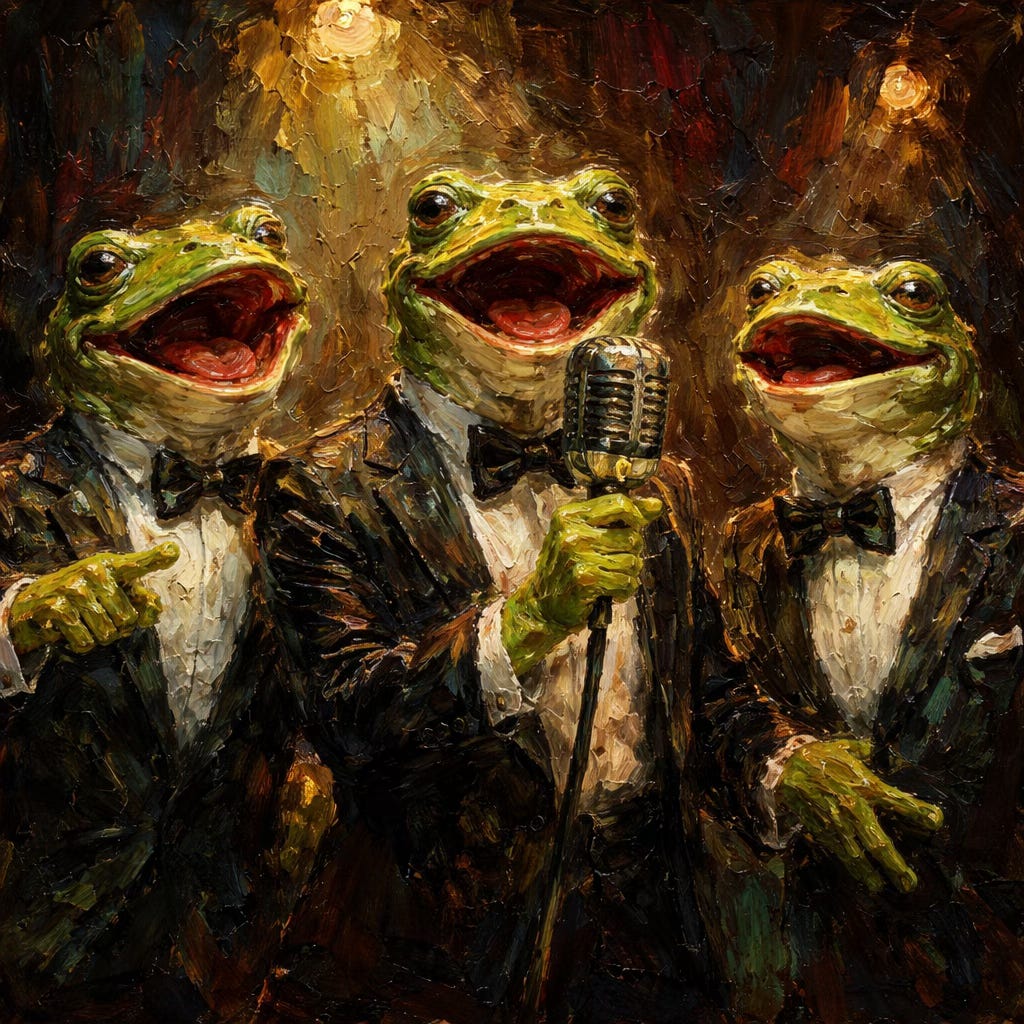
That’s the sound drifting out of Athens in The Frogs.
It’s also the sound echoing through civic life now.
The frogs croak.
The crowd laughs.
The city decays.
Everyone keeps time.
A Descent That Should’ve Ended the Joke
In The Frogs, Dionysus does something quietly humiliating for a civilization that once took itself seriously. He goes to the underworld to retrieve a poet.
Not a general. Not a lawgiver. Not a reformer. A poet.
Athens has no shortage of voices. What it lacks is gravity. People speak constantly, but nothing carries weight. Everything floats. Everything dissolves into reaction, commentary, and cleverness.
So Dionysus goes below, hoping the dead can supply what the living no longer seem able to produce.
That alone should’ve stopped the laughter.
A culture that must exhume wisdom because it can’t recognize it among the living is already unstable. A culture that turns that crisis into entertainment has crossed into something stranger.
Aristophanes doesn’t offer a funeral. He offers a show.
The jokes land.
The songs stick.
The frogs chant nonsense with perfect rhythm.
The audience roars.
When the Joke Stops Doing Its Job
Humor isn’t the problem. It never is.
The problem begins when humor stops sharpening judgment and starts replacing it.
Comedy should puncture pretension. Satire should wound lies. Irony should give truth enough distance to survive contact with power.
Here, those tools turn inward. The joke no longer points at decay. It curls back on itself. Cleverness becomes the achievement.
The frogs are funny. Catchy. Relentless.
They fill the space where discernment once lived.
That happens when a culture rewards noise more than clarity.
When everything is funny, nothing can be weighed.
When everything is ironic, nothing must be defended.
When everything is performance, nothing has consequence.
Seriousness doesn’t get defeated. It gets embarrassed into silence.
When Earnestness Becomes Unfashionable
One of the quiet tragedies in The Frogs is how unfashionable wisdom has become.
The poets arguing below are not debating taste. They are asking whether Athens still has patience for meaning, restraint, and moral pressure.
They already suspect the answer.
Serious speech sounds inflated. Moral language feels theatrical. Anyone who speaks plainly risks being treated as naive, humorless, or dull.
So the clowns step forward. Not because they are wiser, but because they are rewarded.
And the laughter keeps coming.
The Chorus That Will Not Leave
The frogs are a chorus. They chant. They repeat. They set the mood. They decide nothing.
In theory, that makes them harmless.
In practice, they take over.
The chorus grows louder. The chorus becomes the event. The question itself gets buried under rhythm and reaction. Applause replaces judgment. Familiar sounds replace thought.
The chorus does not need to decide anything. It only needs to keep singing.
The audience knows the tune now. The jokes no longer surprise. They comfort. They reassure. They fill the silence where something heavier used to sit.
The frogs croak.
The chorus swells.
The audience laughs again.
Somewhere offstage, a decision waits.
It is never quite made.
And the singing continues.
Further Reading:


