


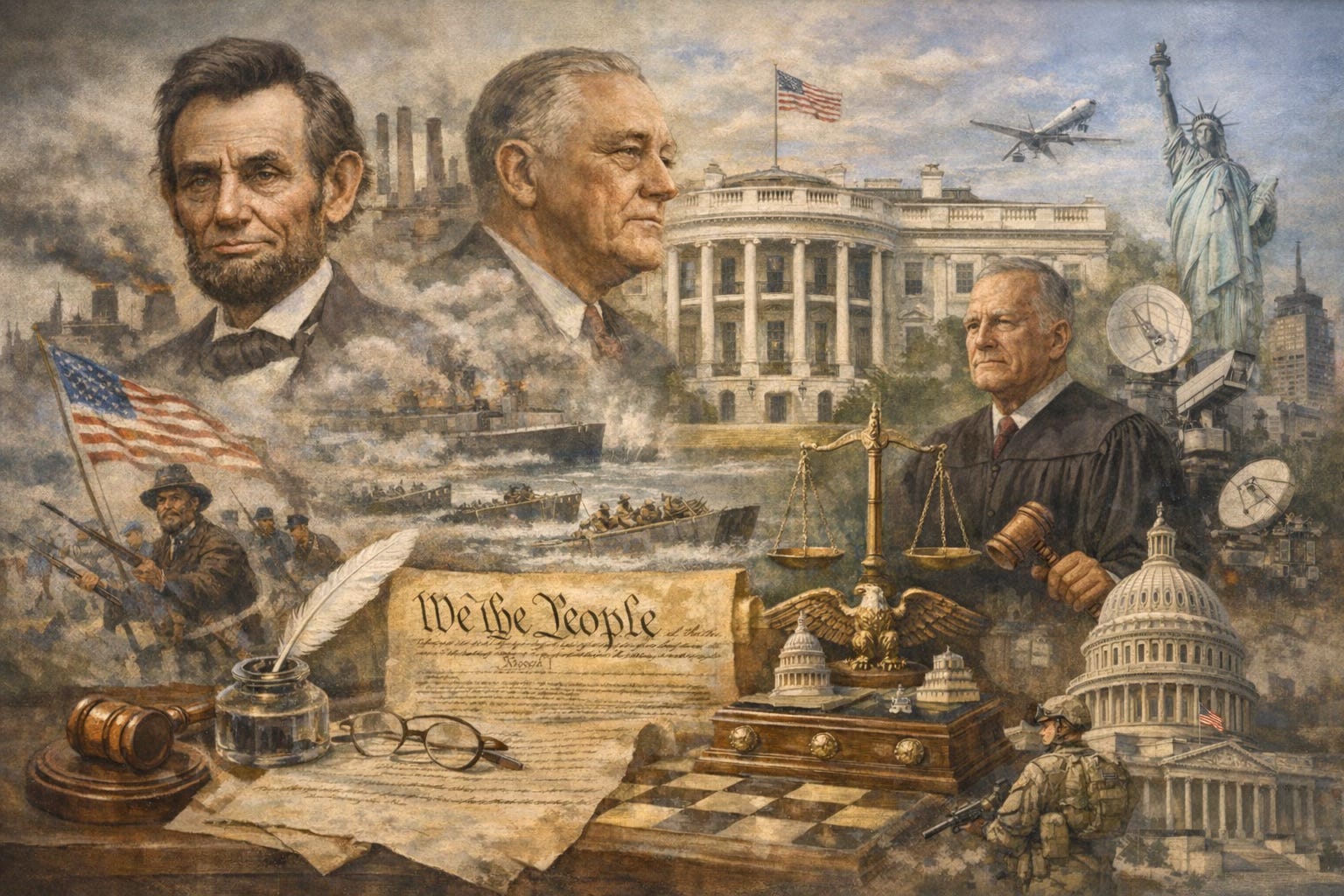
“The accumulation of all powers, legislative, executive, and judiciary, in the same hands… may justly be pronounced the very definition of tyranny.” — James Madison, Federalist No. 47
Where We Left Off
In the previous essay we examined the founders’ deep concern about faction, the tendency of groups to gather around passion, interest, or grievance and then attempt to impose their will upon the whole republic. The Constitution did not attempt to remove faction from public life because the founders believed such a task impossible in a free society. Liberty itself gives rise to competing interests.
Instead, they built a structure meant to contain it.
Representation, competing institutions, and a large republic were intended to scatter power widely enough that no single faction could easily seize control of the machinery of government. Ambition would confront ambition. Interests would restrain other interests. The system would compel negotiation rather than domination.
James Madison captured this logic clearly when he wrote that government must be arranged so that “ambition counteracts ambition.” The Constitution therefore distributes authority among competing institutions, not because the founders expected perfect virtue, but because they expected human ambition.
But this arrangement only works so long as authority remains divided.
When political pressure begins drawing power into a single office, the friction the founders believed essential to liberty begins to weaken. It is at that moment the question of executive power becomes unavoidable.
Present Anxiety
Many of us now sense that the presidency has grown into something larger than the Constitution originally contemplated. Some of us fear the office commands too much authority in war, surveillance, regulation, and emergency action. Others among us argue the nation requires an even stronger presidency so it may act swiftly when danger arises.
Both impulses grow from the same unease.
The presidency feels powerful because it is powerful. Yet the Constitution never intended it to stand alone.
The Elasticity of Article II
When the framers wrote Article II, they devoted far fewer words to the presidency than to Congress. The legislative branch occupies the longest portion of the Constitution. The executive occupies one of the briefest.
That contrast was deliberate.
Law making authority was meant to be detailed and expansive. Executive authority was meant to be narrower and dependent upon the other branches.
Even so, the presidency contains a certain flexibility. Some measure of flexibility is unavoidable. A nation may face events faster than its legislature can gather or deliberate. In such moments the executive must act.
The founders understood this necessity.
That is why the president serves as commander in chief, why the office is charged with executing the laws, and why diplomacy largely resides within executive hands.
Alexander Hamilton spoke directly to this question in Federalist No. 70, arguing that the executive must possess what he called energy. Government required a magistrate capable of decisive action when uncertainty or danger appeared.
But energy was never meant to exist without restraint.
Congress declares war.
Congress raises and appropriates revenue.
Congress writes the laws the president must execute.
The courts judge whether executive action accords with the Constitution.
The presidency was meant to possess vigor, yet remain within a system of balance.
Crisis and the Expansion of Authority
The history of the United States reveals a recurring pattern. Executive authority often grows during moments of national crisis.
During the Civil War, Abraham Lincoln suspended habeas corpus and exercised extensive wartime authority to preserve the Union. These actions provoked serious debate in their own time. Yet they demonstrated that extraordinary authority might be exercised when the survival of the republic appeared at stake.
During the Great Depression and the Second World War, Franklin Roosevelt oversaw the growth of federal administration on a scale previously unknown. Agencies expanded. Economic management moved increasingly within executive departments. Wartime leadership further enlarged the influence of the presidency.
After the attacks of September 11, 2001, presidents gained broader surveillance powers, extended counterterrorism authority, and a prolonged military posture abroad.
Each episode possessed its own justification. Many occurred during moments of genuine national danger.
Yet the structural pattern remains visible.
Crisis invites expansion.
Expansion establishes precedent.
Precedent gradually becomes part of the ordinary structure of government.
The presidency seldom transforms through a single dramatic act. It changes through accumulation.
The Modern Presidency
The founders could not have imagined the scale of the modern executive branch.
Today the presidency stands at the center of a vast administrative structure composed of federal agencies, regulatory bodies, intelligence services, and military commands. Through these institutions the executive influences public health, financial regulation, environmental policy, immigration enforcement, and national defense.
Modern presidents also possess procedural instruments that allow them to guide policy directly.
Executive orders direct administrative action within the departments of government.
National emergency declarations activate statutory authorities written into federal law.
Regulatory interpretation within executive agencies shapes how legislation operates in practice.
Most of these mechanisms were created by Congress across many decades. Yet taken together they give the presidency a reach far beyond what existed in the eighteenth century.
The Slow Accumulation of Power
Power, once exercised, rarely retreats easily to its earlier limits.
Presidents act decisively during crisis because the nation demands action. Congress often tolerates expansion because opposing decisive action carries political danger. Courts frequently hesitate when national security or executive judgment is invoked.
When the crisis passes, the authorities created in urgency often remain.
The transformation rarely appears dramatic in the moment.
Precedent accumulates.
Emergency powers become ordinary administrative tools. Military authority extends beyond formal declarations of war. Executive directives influence policy areas once shaped primarily through legislation.
Each step appears modest when viewed alone. Over time they create a different understanding of presidential authority.
This process does not arise solely from presidential ambition. It grows from institutional incentives.
Congress sometimes prefers criticizing executive action rather than assuming responsibility for difficult decisions. Courts often defer in areas framed as national security. And we ourselves often demand swift resolution when fear or uncertainty spreads.
The presidency becomes the office that absorbs those expectations.
The Human Reality of Unchecked Power
The danger lies not only in the character of the officeholder. It lies in the structure that encourages concentration.
Unchecked power seldom harms itself first.
It erodes the boundaries around it.
The first loss is often legislative responsibility. When Congress yields authority to declare war, regulate commerce, or define statutory limits, it weakens its own constitutional role.
The next loss is clarity.
When authority expands through precedent rather than statute, we as citizens can struggle to determine where power truly resides. Responsibility grows indistinct. Accountability becomes difficult to identify.
The final loss is restraint itself.
Presidents inherit the authorities created by earlier administrations. What once appeared extraordinary gradually becomes routine.
Some leaders exercise such tools with caution. Others do not.
The structure itself cannot distinguish between the two.
Why the System Tilts
The framers expected ambition to exist within every branch of government. Their answer was not the elimination of ambition but the arrangement of competing powers.
Power checking power.
This balance only survives when each branch defends its share of authority.
The presidency does not become dominant only because presidents seek greater authority. It grows dominant when the other branches gradually abandon their responsibilities.
When Congress declines to legislate.
When courts decline to review.
When we demand speed rather than deliberation.
A republic rarely loses its equilibrium through a single dramatic event. Authority shifts slowly toward the office most capable of acting alone.
The Public’s Role
Public expectation plays its part as well.
We often reward leaders who appear decisive during uncertainty. Modern media magnifies displays of command and urgency. The slower work of legislation and compromise attracts less attention.
Gradually we begin expecting the president to solve problems the Constitution assigned to Congress.
Members of Congress respond to the same incentives. Difficult votes are avoided. Responsibility drifts toward executive action.
Executive expansion therefore reflects not only presidential ambition but also our own civic habits.
A political culture that values decisiveness above deliberation will steadily concentrate authority in the office most capable of immediate action.
The Discipline of Restraint
None of this suggests the presidency should be weakened into helplessness. A nation requires an executive capable of decisive leadership. Government unable to act during danger invites instability.
The question is not whether the president should possess authority.
The question is whether that authority remains anchored to the constitutional structure that gives it legitimacy.
A strong presidency can exist within restraint. Indeed, restraint preserves the credibility of executive action.
When presidents respect statutory limits, seek congressional authorization for major decisions, and operate openly within the law, the office retains public confidence.
When those limits fade, confidence fades with them.
Conclusion
Victory in politics does not remove the necessity of restraint.
Authority exercised without limits may produce immediate advantage. Yet it creates precedents that endure long after the moment has passed.
Those precedents will eventually fall into other hands.
The presidency will always appear powerful. The founders intended it to possess energy, decisiveness, and the capacity to act when the nation requires leadership.
Yet they also intended that energy to remain within a constitutional order no single office could dominate.
When that order weakens, the presidency expands to fill the space.
And when that expansion becomes ordinary, the balance that preserves the republic begins to erode.
The strength of the presidency has never rested in its freedom from restraint.
It rests in its willingness to remain bound by the Constitution that gives it life.
What’s Up Next
Essay IV: The Courts and the Quiet Power of Interpretation
The Constitution speaks through its text, but its meaning often emerges through interpretation. In the next essay we turn to the judiciary, the branch least visible in daily politics yet capable of reshaping the republic through its judgments. Courts do not command armies or write legislation, yet their interpretations can expand or restrain the authority of both Congress and the presidency. We will examine how judicial review, precedent, and institutional caution shape the boundaries of American government, and how the quiet authority of the courts can steady the constitutional order or gradually redirect it.
Light Against Empire is free for all. If my words have value to you and you’re in a position to help, you can chip in with a monthly or yearly donation. It takes time, energy, and resources to keep Light Against Empire running. Your support keeps the writing alive, the lights on, and the fire burning. Thanks!
Further reading:


