

The Democratic Perimeter Update for 2/4/2026
Tracking where democratic norms, federal power, and allied stability are being tested by autocratic pressure at home and abroad.

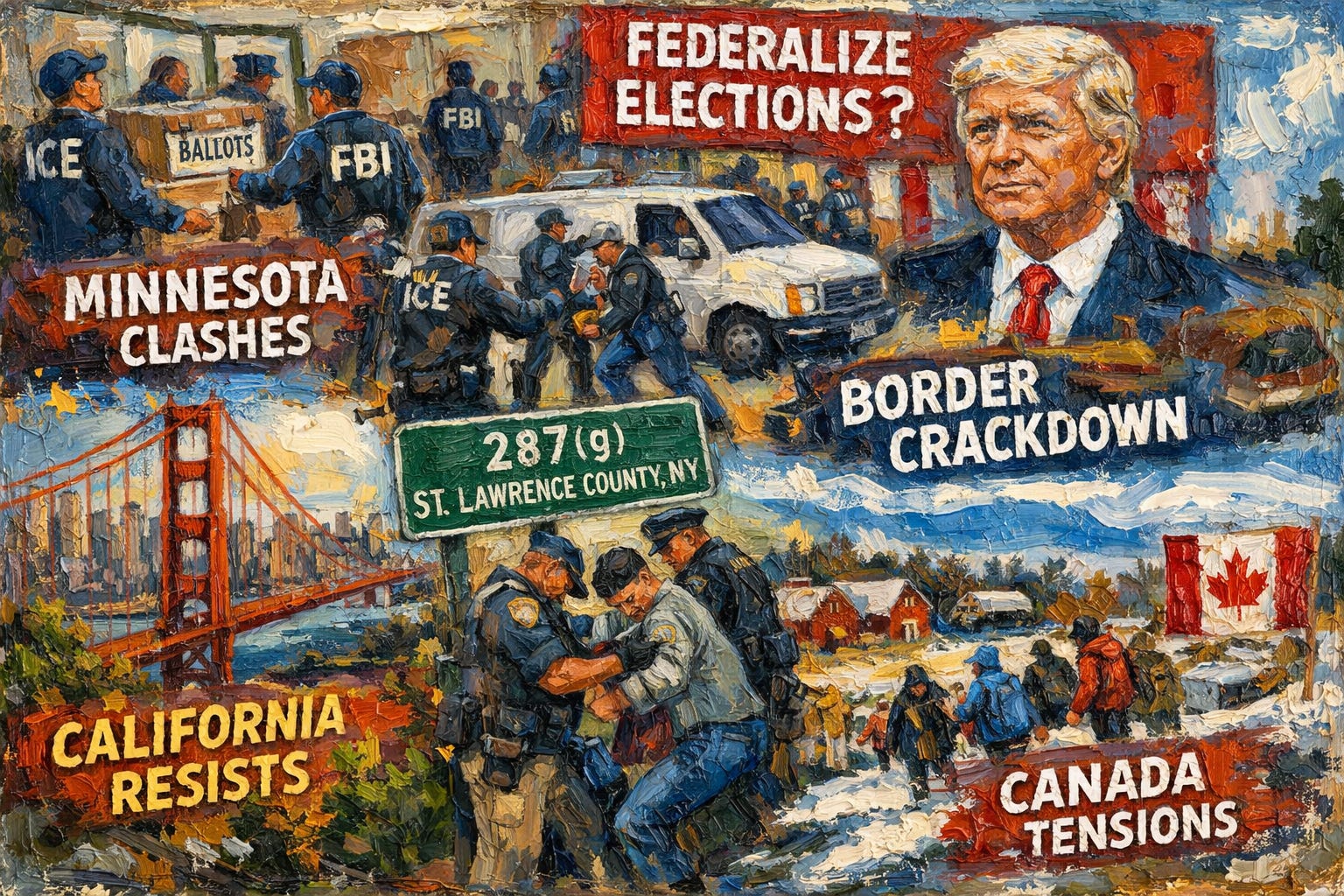
Opening Orientation
Over the last 96 hours, the perimeter didn’t drift outward so much as it thickened. The same pressure points kept getting pressed, and the system’s responses kept showing their shape.
What matters right now isn’t the headline. It’s the repetition. Federal force. Local resistance. Demands for accountability. Then procedural language meant to drain heat without changing behavior.
The question isn’t whether conflict is present anymore. It’s whether anyone with power still feels obligated to explain themselves to the public, or whether authority itself is being repositioned as justification enough.
Federal
The federal government moved quickly to stop fiscal hemorrhaging while leaving the underlying conflict intact.
A spending package ended the partial shutdown, but the most contested elements centered on Homeland Security funding and enforcement accountability. The resolution didn’t resolve the dispute. It postponed it, buying time without settling direction.
Operationally, the most telling move wasn’t rhetorical. It was mechanical. Immigration officers in Minneapolis were ordered to use body worn cameras, with discussion of broader expansion tied to funding. That shift reflects an unspoken admission that credibility, not capacity, has become the liability.
Alongside enforcement maneuvers, another signal emerged that belongs squarely inside the perimeter. The president renewed assertions that elections should be federalized, framed as a corrective to alleged irregularities and presented as a partisan imperative.
This matters because it marks a conceptual expansion of federal authority from enforcement into democratic infrastructure itself. Where immigration operations assert control over physical space, federalization of elections asserts control over civic structure. The implication isn’t oversight or standards setting. It’s displacement, a suggestion that state administered processes are inadequate and must be replaced or subordinated.
That assertion now sits beside concrete federal activity. Federal law enforcement recently entered a major county election office to seize materials tied to past elections, with senior intelligence leadership present and running a parallel election related inquiry outside the traditional Justice Department lane. Regardless of legal justification, the image matters. It places federal law enforcement and intelligence posture directly inside election administration space at the same moment federal takeover rhetoric is escalating.
The Constitution places election administration primarily with the states, with Congress holding limited authority over timing and standards. Even within the president’s own party, the call for federalization has triggered constitutional objections. Feasibility isn’t the only issue. The willingness to press federal authority into voting infrastructure signals a governing posture that no longer treats local autonomy as a boundary, but as a problem to be solved.
Taken together, these moves suggest a federal logic that prioritizes compliance first and explanation later, whether the subject’s enforcement activity or the mechanics of voting itself.
State and Federal Tension
The standoff’s clarified into a familiar shape.
States and cities are asserting moral and practical limits. The federal government’s asserting jurisdiction while attempting to manage optics without reducing force. When both sides control narrative this tightly, the next arena’s almost always legal.
What’s changed is the scope. The tension isn’t confined to law enforcement actions in the street anymore. It now reaches elections, local governance, and the internal machinery of civil life.
The perimeter isn’t advancing through announcements. It’s advancing through normalization.
California
California continues to operate on two parallel tracks.
Publicly, state leadership emphasizes competence under pressure, projecting the image of a state capable of managing crime and immigration without federal spectacle. Beneath that, the legal strategy’s sharpening. Lawsuits and legislative efforts are being aimed directly at constitutional violations and personal liability for federal agents.
This posture’s being reinforced legislatively. Multiple bills are now moving through the state legislature designed to limit or condition federal immigration activity, signaling that resistance isn’t episodic but systematic.
This is how states attempt to alter federal behavior when they can’t alter federal authority. They change the cost structure.
California officials have also been among the most explicit in rejecting federal intrusion into election administration, reinforcing that resistance isn’t limited to enforcement tactics but extends to democratic process itself.
Minnesota
Minnesota remains the front edge of the domestic perimeter because the conflict there isn’t abstract anymore. It has names, funerals, legal ambiguity, and consequences for ordinary life.
In the last 24 hours, the federal posture crossed another line. Immigration agents in Minneapolis drew their weapons and arrested activists who were following their vehicles during an enforcement operation. Individuals were ordered out of cars at gunpoint, forced to the ground, handcuffed, and detained. This didn’t occur at a mass rally or organized protest site. It unfolded on public streets as civilians tracked the movement of federal convoys.
The presence of drawn firearms in this context matters. It marks the moment enforcement bleeds fully into armed confrontation in everyday civic space.
This incident landed on top of an already volatile environment shaped by earlier fatal shootings involving federal officers. Those deaths transformed enforcement from policy debate into lived trauma, triggering sustained demonstrations and deepening public fear.
That fear’s now moving through schools, workplaces, and neighborhoods. School districts have reported heightened anxiety and security concerns. Workers are staying home. Businesses are losing revenue. Daily routines are being altered around the expectation of federal presence. When normal life contracts around enforcement activity, it signals an occupying atmosphere rather than targeted action.
At the same time, citizen led monitoring networks are expanding. Some are driven by genuine alarm. Some by escalation culture. All of them place untrained civilians into proximity with armed agents. That combination doesn’t require malice to end in tragedy.
Federal leadership’s responded by tightening guidance around engagement, directing officers to avoid interaction with those attempting to provoke or document operations. At the same time, enforcement tactics have shifted toward quieter home based arrests, changing the terrain of confrontation without reducing risk.
The conflict’s also moved decisively into the legal realm. A federal grand jury’s reportedly examining whether state or local officials obstructed immigration enforcement, pulling Minnesota’s governance itself into the enforcement dispute. Separately, questions have emerged around due process after individuals were re detained following judicial findings that earlier claims against them were unsupported.
Here, the perimeter question sharpens. Can people witness, record, teach, work, and govern without being treated as interference. Or has everyday civic life itself become suspect.
New York Local Federal Escalation via 287(g)
A quieter but deeply consequential development’s emerged in upstate New York.
St. Lawrence County, a largely rural county in the far northern part of the state along the Canadian border, voted to authorize its sheriff’s department to enter into a 287(g) agreement with federal immigration authorities.
Section 287(g) of the Immigration and Nationality Act allows the federal government to deputize local law enforcement officers to perform certain federal immigration enforcement functions after training and supervision by ICE. In practice, this means local jail personnel can question individuals about immigration status, access federal immigration databases, issue immigration detainers, and hold people for federal pickup even when no criminal conviction exists.
Although the county amended the agreement to adopt a jail enforcement model, limiting activity to individuals already in custody, the practical effect remains significant. It embeds federal immigration enforcement inside local policing infrastructure and collapses the distinction between civil immigration matters and criminal law enforcement.
Historically, 287(g) programs have been associated with serious civil rights abuses. These include racial and ethnic profiling, extended detention without warrants, cooperation based on civil rather than criminal violations, and the erosion of community trust in local law enforcement. Even when formally limited to jails, the program incentivizes arrests for minor offenses and creates pressure to treat immigration status as suspicion in itself.
This move creates immediate state federal friction. New York State leadership’s advanced legislation aimed at prohibiting local agencies from entering such agreements, setting up a direct conflict between state policy and county level alignment with federal enforcement. If enforced, that conflict would move quickly into court.
More broadly, this vote gives the federal government a powerful tool. Rather than relying solely on federal agents, it can scale enforcement horizontally by turning willing counties into force multipliers. If this model spreads across ideologically aligned counties in red states or red regions of blue states, federal immigration enforcement could be effectively nationalized without new legislation, using local sheriffs as distributed nodes of federal authority.
That’s the deeper perimeter issue. Section 287(g) allows federal power to bypass resistant states by recruiting local jurisdictions directly. It fractures state cohesion, politicizes policing, and turns ordinary county governance into an extension of federal enforcement strategy.
If widely adopted, it would normalize immigration enforcement as a routine function of local law enforcement nationwide, eroding long standing boundaries between civil administration, criminal justice, and federal authority.
Maine
Maine appears to be entering a later phase of the same cycle.
Enhanced operations have tapered, and official messaging emphasizes conclusion and de escalation. But the aftershock’s begun. Legal challenges, civil complaints, and public scrutiny are emerging around conduct during the surge.
When operations end and litigation begins, it usually means the perimeter hasn’t vanished. It’s shifted from street to courtroom.
Canada
Canada continues to be treated less as a partner and more as a pressure surface.
Recent friction extends beyond trade volume into regulatory disputes and industrial coercion. Conflicts over aircraft certification have expanded into a broader contest over whether safety and regulatory systems can be pressed into political service.
The unresolved tariff threats tied to Canada’s posture toward China remain part of this pattern. Even when action’s delayed, the conditioning remains. Independent movement carries consequences.
Greenland
Greenland now functions as an alliance stress test rather than a rhetorical curiosity.
Alliance planning’s moved from discussion to early operational consideration, with indications that planning can proceed even without full consensus. That shift signals that the issue’s no longer being treated as theater. It’s being treated as a real contingency.
Public sentiment inside Greenland’s clarified as well. Resistance to joining the United States remains strong, making any future proposal look less like partnership and more like pressure.
Europe
European governments are absorbing two signals at once. Arctic instability and American unpredictability.
The Greenland posture’s forcing allied institutions to think in terms of contingency rather than assumption. When alliances begin planning missions to stabilize internal disputes, cohesion itself’s become the concern.
No Material Change
There wasn’t durable de escalation across the perimeter.
There’s no sign that federal enforcement posture in Minnesota’s voluntarily shrinking, even as scrutiny intensifies.
What appeared instead were tactical adjustments, procedural fixes, and messaging shifts. The temperature’s being managed. It isn’t being lowered.
What to Watch Next
Upcoming DHS funding deadlines and renewed congressional brinkmanship around enforcement accountability.
Whether body worn camera use becomes a national standard or remains a localized concession tied to public outrage.
Legal movement in Minnesota, including grand jury activity, civil rights inquiries, and state level strategies that could harden into coordinated resistance.
In New York, whether state legislation blocking 287(g) enforcement advances, and whether additional counties attempt similar agreements.
In Maine, whether post surge legal action becomes a template for other states once operations recede.
The evolution of the push to federalize elections. Any further use of federal law enforcement or intelligence posture inside state election systems would represent a significant shift in the federal state balance and move the perimeter directly into democratic participation itself.
Alliance language following upcoming NATO defense discussions, especially any framing that treats Arctic tension as an active operational concern.
Where This Leaves Us
Here’s the honest read.
We’re living in a period where the state’s trying to retain power while shedding explanation. It still demands compliance. It still expects deference. It simply doesn’t want to be watched closely.
The perimeter isn’t only about arrests or protests. It’s about whether the public’s allowed to witness, record, teach, vote, and govern without being treated as an obstacle to order.
That’s where we are today.
Please Support the Work
Light Against Empire is free for all. If my words have value to you and you’re in a position to help, you can chip in with a monthly or yearly donation. Your support keeps the writing alive, the lights on, and the fire burning.
Further Reading:


Thanks once again for these clear-sighted and clear-minded daily updates, Dino. The absence of panic, along with the refusal to minimize the dangers, are admirable - and absolutely necessary.
I applaud your depth of related knowledge. Minneapolis is quite a flashpoint, with an amazing number of demonstrators, and grassroots organization in response to what has impacted them so highly, with their hospitals, schools, businesses, and thousands of terrified families of color. I think this pushes the matter to getting back to state powers, and we should consider, from the grassroots, moving up to local, then state, then maybe federal. So first Minneapolis, for example. I just published an article on the idea of greater organization for that city, to begin with, and then perhaps the state to follow. God bless. https://markgmeyers.substack.com/p/how-to-start-a-city