

The Democratic Perimeter Update for 2/2/2026
Tracking where democratic norms, federal power, and allied stability are being tested by autocratic pressure at home and abroad.

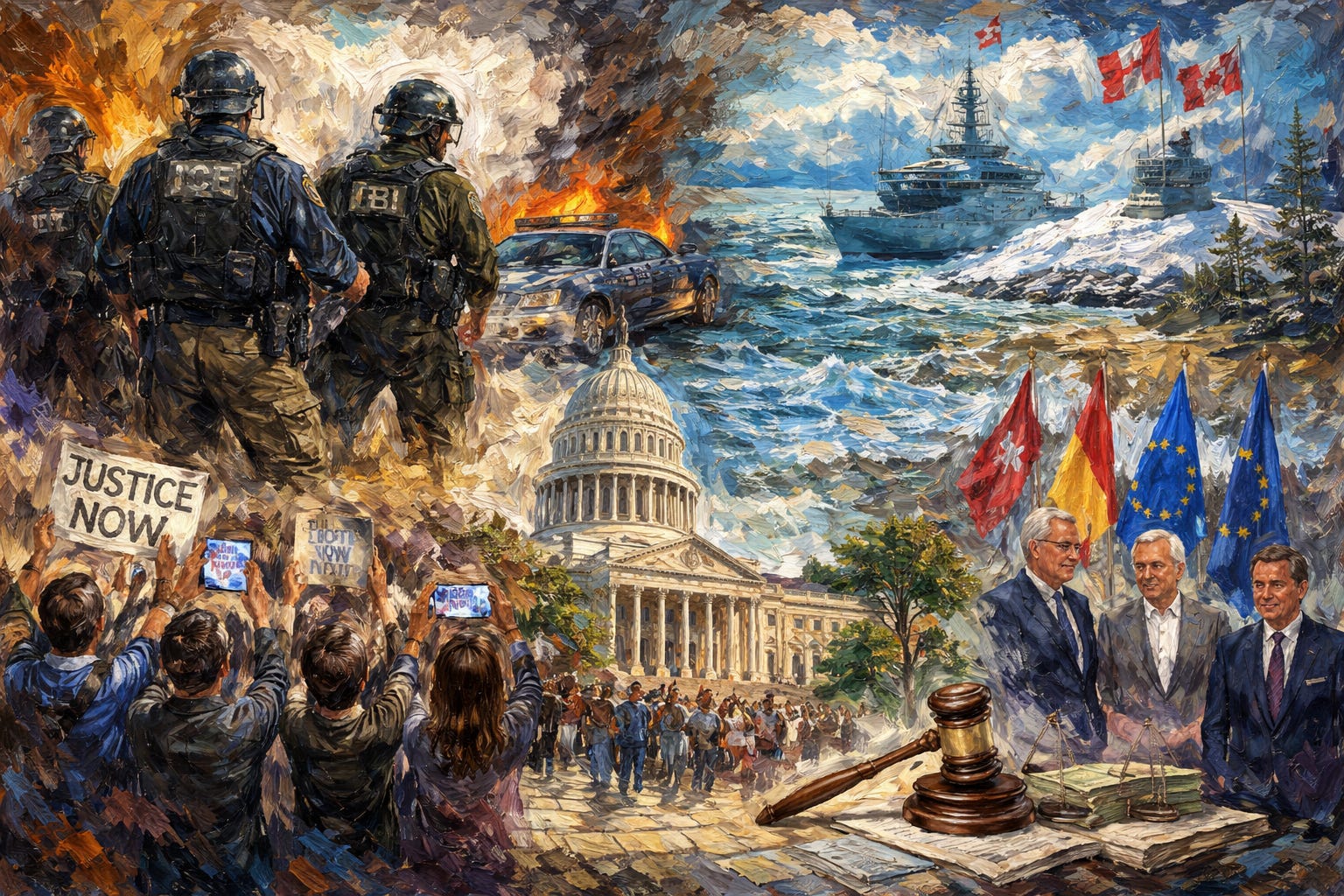
Opening Orientation
The last 48 hours weren’t defined by a single headline. They were defined by a pattern repeating itself in different rooms of the same house.
Federal enforcement continues to widen.
A funding fight is now fused to that widening.
States are trying to draw lines while courts hesitate to draw them with them.
Allies abroad aren’t reacting to American volatility as an episode anymore. They’re treating it as a climate.
This perimeter isn’t news. It’s pressure. And the pressure didn’t break over the weekend. It settled in.
Federal
Over the weekend, the partial shutdown posture hardened. The fight itself didn’t change much. What changed was its proximity to lived reality.
Homeland security funding isn’t an abstract line item argued over in fluorescent rooms anymore. It’s now visibly tethered to what people are watching unfold in their streets and to what lawmakers are being forced to answer for out loud.
That matters because it locks the federal story into a loop that’s getting harder to pretend is temporary.
First, enforcement produces an incident.
Then, an incident produces public anger.
Public anger produces funding resistance.
Funding resistance becomes the justification for escalation, messaging discipline, and procedural hardball.
This is how a policy disagreement quietly mutates into a legitimacy problem. And then into a control problem.
State and Federal Tension
Minnesota
Minnesota continues to carry the sharpest edge of the perimeter, and over the last 48 hours that edge sharpened along three tracks, accountability, the courts, and community posture.
Accountability and naming
After days of public pressure, two federal agents connected to the fatal shooting of Alex Pretti were formally identified. Both were placed on leave while a civil rights investigation opened.
That step didn’t cool anything. It clarified something. Silence had become untenable. Identification wasn’t optional anymore. The public learned, again, that even basic transparency has to be dragged into the light.
Courts and restraint
A federal judge declined to halt Operation Metro Surge. The operation remains active while litigation continues.
Translated plainly, the state didn’t get immediate relief, and the street reality remains the street reality. The law’s moving. The boots aren’t pausing to wait for it.
Community posture
What stands out isn’t protest alone. It’s continuity.
Mutual aid networks remain active. Legal observers remain present. Civic coordination isn’t episodic anymore. It’s become the default posture rather than a spike of reaction.
Then a separate case cut through the noise with a different register. A federal judge ordered the release of a five year old child and his father from ICE detention, using language that went well past sterile procedure and into moral rebuke. The release deadline’s now set.
So Minnesota’s carrying three signals at once.
Federal force remains in place.
State attempts to restrain it haven’t yet succeeded.
Individual cases are producing judicial language that reads less like paperwork and more like warning.
That combination’s volatile. It produces despair for some and resolve for others. Both reactions are rational.
California
California’s posture hasn’t changed in shape, but it’s changed in texture.
The state’s created a formal mechanism for the public to submit photos and video documenting alleged unlawful conduct by federal agents. This isn’t framed as protest support. It’s framed as record building. Evidence as civic defense.
At the same time, Sacramento continues advancing legislation designed to widen civil liability and professional consequence for federal agents tied to enforcement abuses and recent killings.
The signal’s deliberate. California isn’t waiting for a single decisive ruling. It’s building a record dense enough that the future has fewer places to hide.
Maine
Maine remains a quieter front, which is precisely why it matters.
Federal officials say large scale enhanced operations have ended after high level conversations. On paper, that sounds like de escalation. On the ground, the residue remains.
A South Portland man’s announced plans to sue after ICE agents allegedly threatened him with arrest while he observed them from a distance. The theme’s familiar now. The line between observing and interfering keeps stretching until it catches ordinary people standing still.
Attorneys in the state continue raising alarms about warrant practice, entry practice, and constitutional drift. Maine’s signal isn’t mass arrests. It’s normalization.
Specifically, the normalization of treating the witness as the problem.
Canada
Canada’s posture over the last 48 hours has been measured and revealing.
Senior officials publicly distinguished Canadian enforcement norms from what’s unfolding in Minnesota, choosing careful language rather than confrontation. That restraint itself’s a signal.
At the same time, trade and steel protection measures continue moving through their timelines. Economic friction remains a parallel track that never pauses, even when political attention shifts elsewhere.
Canada’s managing two boundaries at once. Cultural distance on enforcement practices, and economic exposure that still demands constant calibration.
Greenland
Greenland remains unresolved, but the temperature shifted.
The conversation’s moved from overt rhetoric into structured technical talks framed around Arctic security. Denmark’s reiterated sovereignty, and symbolic statecraft’s returned, including an upcoming royal visit meant to communicate continuity rather than anxiety.
This isn’t a normal foreign policy file. It’s being treated like a loyalty test wrapped in diplomacy. Europe understands that. It’s responding accordingly.
Process can mean progress. It can also mean delay. The distinction hasn’t revealed itself yet.
Europe
Europe’s posture’s clarifying, not panicking.
Leaders continue to insist on alliance continuity while speaking more openly about reduced trust and the need for stronger independent defense capacity. The message isn’t rupture. It’s preparation.
German officials have emphasized that alignment with the United States remains closer than alignment with China, while acknowledging tension and pointing to diversification as a hedge against volatility.
Allies don’t make these adjustments for weather they expect to pass quickly. They make them when unpredictability’s become structural.
No Material Change
Over the last 48 hours:
There’s no sign that federal enforcement posture in Minnesota’s voluntarily shrinking, even as scrutiny intensifies.
There’s no sign that the funding fight’s separating from enforcement politics. The two remain fused.
There’s no sign that Greenland rhetoric’s disappeared. It’s simply moved into procedural form, which can mean diplomacy or deferral.
The pressure’s redistributed. It hasn’t dissipated.
What to Watch Next
Legal Escalation
Whether Minnesota renews injunction efforts, and whether any court treats civic harm as immediate harm rather than theoretical injury.
Federal and State Friction
Whether California’s evidence pipeline converts quickly into coordinated filings, subpoenas, or new local protections.
Use of Force Posture
Whether federal agencies revise crowd and observer engagement rules, or whether opacity hardens as policy.
Administrative Pressure
Shutdown negotiations and any attempt to reattach enforcement funding in ways designed to force acquiescence rather than consent.
Allied Response
Whether Greenland talks result in expanded United States presence under existing agreements without touching sovereignty.
Narrative Drift
The continued effort to redefine witnessing as interference and fear as order. Maine remains a quiet bellwether.
What Is Not Happening
There’s still no credible sign of federal rhetorical restraint that treats accountability as a first principle rather than a concession extracted by outrage.
Where This Leaves Us at 7AM This Morning
The perimeter’s holding, but it’s holding the way a door holds when someone keeps leaning their weight into it.
Minnesota’s showing what surge looks like when it turns inward, courts hesitate, and the public organizes anyway.
California’s treating documentation as self defense, not symbolism.
Maine’s showing how easily the witness becomes the suspect.
Canada’s measuring distance while managing exposure.
Europe’s shifting from reassurance to readiness.
This is the moment when a country finds out whether it still believes power must explain itself, or whether it’s decided that power only needs to prevail.
Please Support the Work
Light Against Empire is free for all. If my words have value to you and you’re in a position to help, you can chip in with a monthly or yearly donation. Your support keeps the writing alive, the lights on, and the fire burning.
Further Reading:


