

The Democratic Perimeter - 1/28/2026
Tracking where democratic norms, federal power, and allied stability are being tested by autocratic pressure at home and abroad.

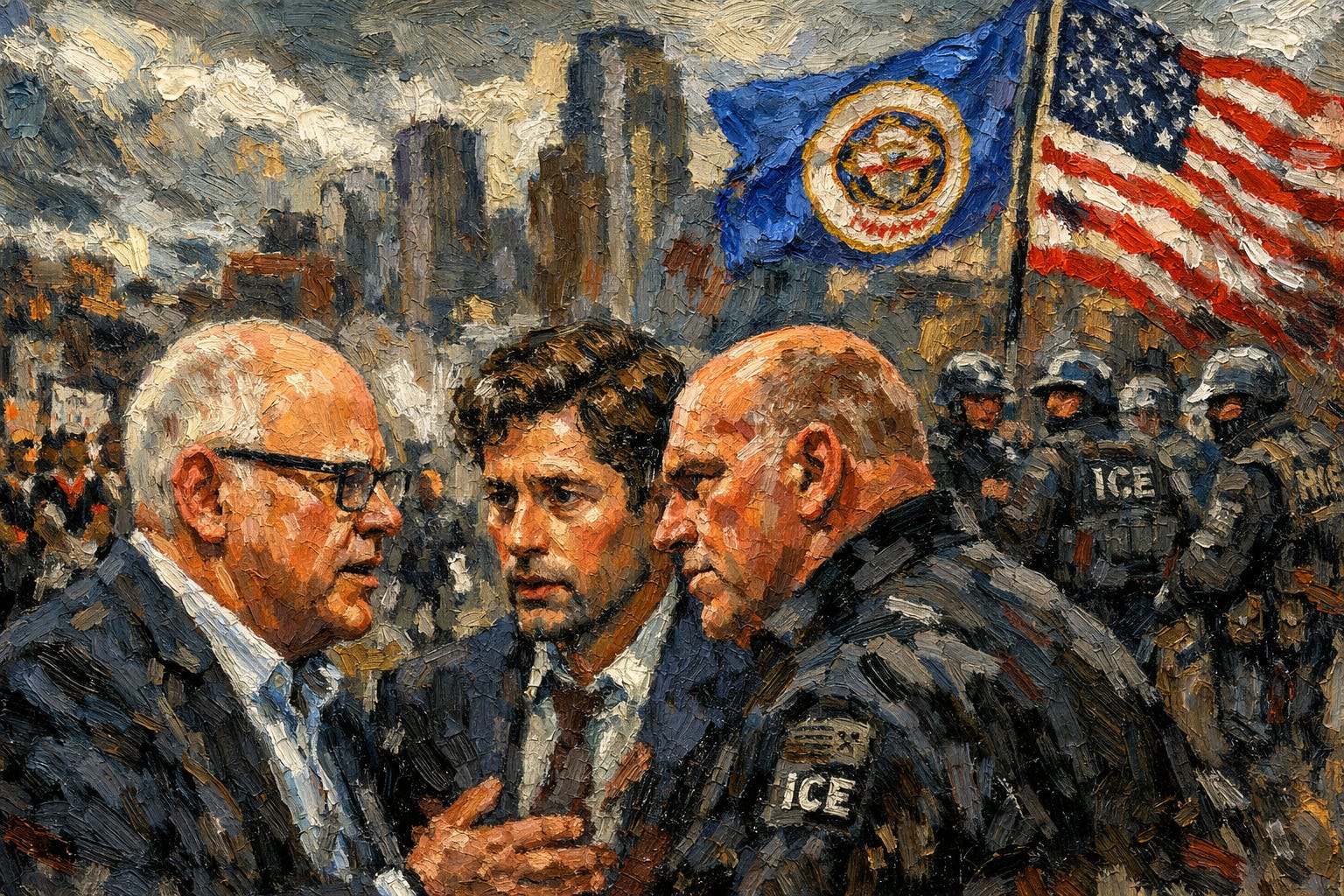
Opening Orientation
Over the last 24 hours, pressure continues to concentrate around federal immigration enforcement, state resistance, and the legal boundaries of force. What began as localized outrage in Minnesota is now pulling multiple states, Congress, and the courts into open confrontation. The perimeter is not collapsing, but it is being tested simultaneously across legal, political, and narrative fronts.
Federal Government
On Capitol Hill, negotiations over Department of Homeland Security funding have become increasingly brittle. Senate leadership is openly discussing the possibility of a partial government shutdown if enforcement accountability measures are not addressed.
House Democrats escalated pressure on DHS leadership, issuing a public ultimatum demanding the removal of Secretary Kristi Noem. While impeachment proceedings have not formally begun, the threat is no longer abstract.
At the legal level, Illinois enacted legislation allowing state-level civil lawsuits against federal immigration agents for civil rights violations. Multiple Democratic-led states, including California and New York, announced parallel efforts. The federal government has signaled it will challenge these laws under the Supremacy Clause, setting up a direct constitutional conflict likely to reach the Supreme Court.
State–Federal Tension
Minnesota
Minnesota remains the central flashpoint in the current federal–state confrontation.
The fatal shooting of Alex Pretti by federal immigration agents and the ongoing federal refusal to grant full access to state investigators continue to drive public outrage and institutional friction. In a significant operational shift reported in the last 24 hours, President Trump dispatched his “border czar,” Tom Homan, to Minneapolis to take command of immigration enforcement operations and manage the widening backlash. Homan’s arrival was framed by the White House as a step toward de-escalating tensions after intense criticism of federal tactics earlier in the month. Governor and the Minneapolis mayor have already met with Homan, with Minnesota leaders describing the talks as “productive” but insisting federal operations must be reduced and constrained to respect local authority.
Homan’s assignment coincides with the removal of Border Patrol Commander Gregory Bovino from frontline oversight and signals the administration’s attempt to recalibrate engagement, though the scale and presence of federal agents remain contested. Reports indicate some DHS personnel will depart as Homan takes over, even as broader enforcement activities continue.
Federal rhetoric has softened slightly since the shootings, with the president calling the Pretti death “very sad” and voicing support for an “honest” investigation while emphasizing Homan’s role. Despite that, Minnesota officials, including Governor Tim Walz and Minneapolis Mayor Jacob Frey, have publicly called for an immediate pullback of federal forces and sharply criticized the prior leadership of the operation, underscoring that state law enforcement will not assist in enforcing federal immigration law under the current conditions.
Organized protests and demonstrations remain active across Minneapolis, and local resistance has hardened in response to both the shootings and the federal posture. The situation continues to highlight deep fractures in institutional cooperation and raises urgent questions about the balance of federal authority, civil rights protections, and state sovereignty within the broader democratic perimeter.
California
California officials reaffirmed their position that state law enforcement will not participate in or materially support federal immigration actions that bypass state oversight. The posture remains unchanged but hardened.
State leadership has publicly aligned itself with emerging multi-state legal strategies aimed at federal accountability, signaling that California intends to be a plaintiff or coordinating jurisdiction if litigation escalates.
Maine
No new enforcement actions reported in the last 24 hours. However, state officials continue to monitor federal activity closely following earlier legal disputes over detention authority and compliance demands.
Maine remains quiet operationally but is positioned as a potential secondary front should federal enforcement redeploy northward.
Other States With Federal–State Enforcement Tensions
Virginia
The governor has moved to reduce state cooperation with ICE, drawing criticism from local political actors on both sides and situating the state at the leading edge of expanded federal immigration enforcement debates beyond the Upper Midwest.
Colorado (Denver)
Although not yet a site of major federal deployments, Denver and Colorado officials are preparing legal responses and policy tools in anticipation of expanded ICE activity, indicating a broader geographic spread of tension and potential clashes.
Note
There is sustained and increasingly organized resistance by states coordinated through multistate attorney general coalitions and joint litigation, and persistent local resistance via sanctuary jurisdictions. These function as de-facto coalitions pushing back on federal policy. However, there is yet no single formal compact signed by multiple states dedicated strictly to opposing federal immigration enforcement at this time.
Canada
Canadian officials issued renewed statements emphasizing concern over cross-border spillover effects from aggressive U.S. enforcement policy. While no formal diplomatic escalation occurred in the last 24 hours, Canadian media coverage has sharpened, framing U.S. actions as destabilizing to bilateral norms.
No changes to border posture reported.
Greenland
No material developments in the last 24 hours. Danish and Greenlandic officials continue to signal watchfulness regarding U.S. strategic posture, but no new actions or statements have been recorded.
Europe
European political reaction continues to evolve at the rhetorical level. Several EU parliamentarians referenced the Minnesota situation in broader debates about democratic backsliding and the use of force by central governments.
No formal EU action has been initiated, but the issue is increasingly cited as part of a wider concern about alliance norms and internal U.S. stability.
What to Watch Next
Whether federal authorities concede limited cooperation with Minnesota investigators or continue to block state access
Expansion of state-level civil liability statutes targeting federal agents
Congressional movement from rhetoric to procedural action, including funding leverage or impeachment filings
Signs of federal redeployment or escalation into additional states
Judicial intervention to clarify or freeze state–federal authority boundaries
Where This Leaves Us Today at 730AM
The perimeter is under sustained, multi-vector stress. Federal authority is asserting itself through enforcement and legal resistance, while states are responding not with symbolic protest but with litigation, legislation, and refusal to cooperate.
What is notable today is not collapse, but friction, friction that is no longer confined to the margins. The system is still operating, but it is doing so loudly, adversarially, and without shared assumptions. That is the condition to watch.
Please Support the Work
Light Against Empire is free for all. If my words have value to you and you’re in a position to help, you can chip in with a monthly or yearly donation. Your support keeps the writing alive, the lights on, and the fire burning.


