

The Democratic Perimeter - 1/20/2026
Tracking where democratic norms, federal power, and allied stability are being tested by autocratic pressure at home and abroad.

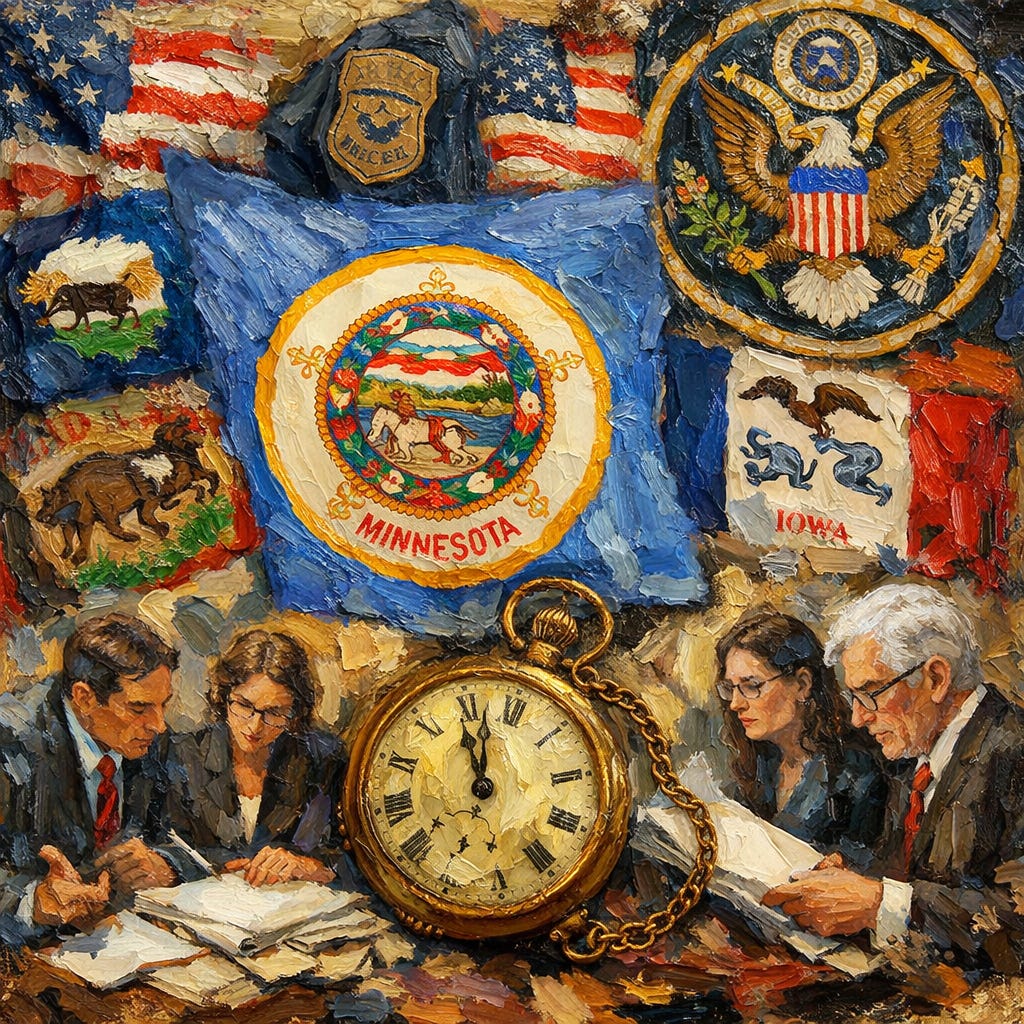
Opening Orientation
I want to begin where I always do, because while some things have shifted on paper, the underlying feeling hasn’t moved much at all.
I’m not writing this as a journalist filing copy or as a commentator trying to win an argument. I’m writing as someone paying close attention. Reading court filings. Watching how authority gets framed. Noticing how quickly language hardens. And then noticing how all of that lands in the body politic as well as the individual American, the tight chest, the vigilance, the quiet recalculation before ordinary decisions.
Since the last update, a few things have changed that matter. Not because they resolve anything, but because they show where pressure is building and where restraint is still holding.
This is my attempt to mark that terrain.
State and Federal Tension
What feels different today is not just the intensity, but the direction of federal attention.
In Minnesota, the Justice Department is now signaling an appeal of the federal court order that placed limits on how immigration agents may treat protesters and legal observers. That alone is not surprising. What matters is the framing. The posture is shifting from disagreement with a ruling toward testing how far federal authority can push back against state level resistance.
I want to be clear about why this matters beyond Minnesota.
When the federal government tightens its posture in one state, it is rarely just about that state. It is about precedent. About whether resistance can be isolated. About whether constitutional boundaries are treated as durable limits or temporary obstacles.
What’s being contested here is not protest as an event, but protest as a protected civic act. Observation as oversight. Presence as lawful participation rather than provocation.
That contest does not stay neatly contained.
Minnesota
Most of what is happening in Minnesota today is continuation rather than rupture, but the continuation itself is consequential.
The court order limiting federal conduct toward protesters and observers remains in effect. That order does not settle responsibility for violence, and it does not halt federal operations. What it does do is assert that constitutional standards still apply even when tension is high.
The federal response, signaling appeal and investigation rather than accommodation, tells us where the next phase will likely unfold. Not in the streets, but in filings, arguments, and procedural moves that shape what future enforcement looks like.
There is also ongoing civil litigation moving quietly alongside the federal case. That lane rarely attracts attention in real time, but it is often where records surface and accountability slowly forms.
If I had to name the core truth here, it’s this. Minnesota is becoming a test case for whether protest remains protected when it becomes inconvenient.
Canada
Today, Canada is notable mostly for what it has not yet done.
There is no new federal policy move tied directly to the Greenland dispute or the tariff pressure. The public posture remains one of support for Danish and Greenlandic sovereignty and concern about escalation, but without a new retaliatory step attached.
That absence is not indifference. It reads more like restraint, at least for now. A choice to hold position while watching how far the United States pushes its leverage.
In moments like this, waiting is also a form of signal.
Greenland
Greenland remains the sharpest pressure point in the broader picture.
What changed today is not a single announcement, but the insistence of tone. The administration is speaking about Greenland in absolute terms, as if the outcome is inevitable rather than contested. That kind of language is not casual. It is meant to narrow the range of acceptable responses from allies.
By tying territorial pressure to tariffs and trade consequences, the administration is turning economic tools into instruments of political coercion. That shifts this from a diplomatic disagreement into something more structurally destabilizing.
Greenland itself remains caught in the middle, its status discussed loudly elsewhere while its people and institutions are treated as secondary.
That dynamic is not accidental.
Europe
Europe’s posture today feels firmer and less deferential than earlier in this cycle.
Several European leaders are now speaking openly about resisting tariff pressure and refusing to treat territorial questions as bargaining chips. The conversation is moving away from quiet diplomacy and toward explicit resistance, including discussion of countermeasures that go beyond normal trade disputes.
There is also an added layer of complication. Outside actors are attempting to exploit the fracture rhetorically, questioning Denmark’s claim to Greenland in ways that add noise and opportunism to an already volatile situation.
At the same time, the UK breaking publicly with the administration over these threats signals that this is no longer contained within back channels. The disagreement is now visible.
Visibility changes the stakes.
No Material Change
It’s important to name what did not happen today.
There are still no US forces deployed into Greenland.
There is still no Canadian policy escalation tied directly to the Greenland dispute.
In Minnesota, the most significant movements remain legal and procedural rather than operational.
None of this means the situation is safe. It means restraint is still holding, at least in form.
That distinction matters.
What to Watch Next
If you’re trying to stay informed without burning out, these are the signals I’m watching.
First, legal escalation. Appeals, emergency filings, or efforts to narrow existing court orders will tell us how aggressively federal authority is pressing back against judicial limits.
Second, federal and state friction. Pay attention to whether resistance by governors or local officials is framed as disagreement or as criminal interference. That shift usually arrives before more concrete action.
Third, use of force posture. Preparation language is not deployment, but watch closely for any movement from alert to action, whether domestically or framed as Arctic security.
Fourth, administrative pressure. Tariffs used as leverage in territorial disputes are not routine. If that tool becomes normalized, it changes the entire field.
Fifth, allied response. Watch whether Europe moves from planning to action, and whether Canada continues to hold restraint or begins coordinating more openly with European partners.
Finally, keep noticing what is not happening. Absence is not reassurance, but it is information.
Where This Leaves Us Today
As of now, courts are engaged. Federal rhetoric remains aggressive. State resistance is holding, but under pressure. International tensions around Greenland are sharpening, but have not tipped into open rupture.
Nothing about this feels comfortable.
But discomfort is not collapse.
I’ll continue these updates not to inflame fear, but to keep a clear record of what is happening, how it is being framed, and how it is landing in real lives. Attention, applied carefully, still matters.
If you’re reading this and feeling overwhelmed, you’re not failing. You’re paying attention.
I’ll keep watching.
Contact me at: dinoalonsocreates@gmail.com
Thank you again Dino. I am exhausted and grateful for your words. Susan