


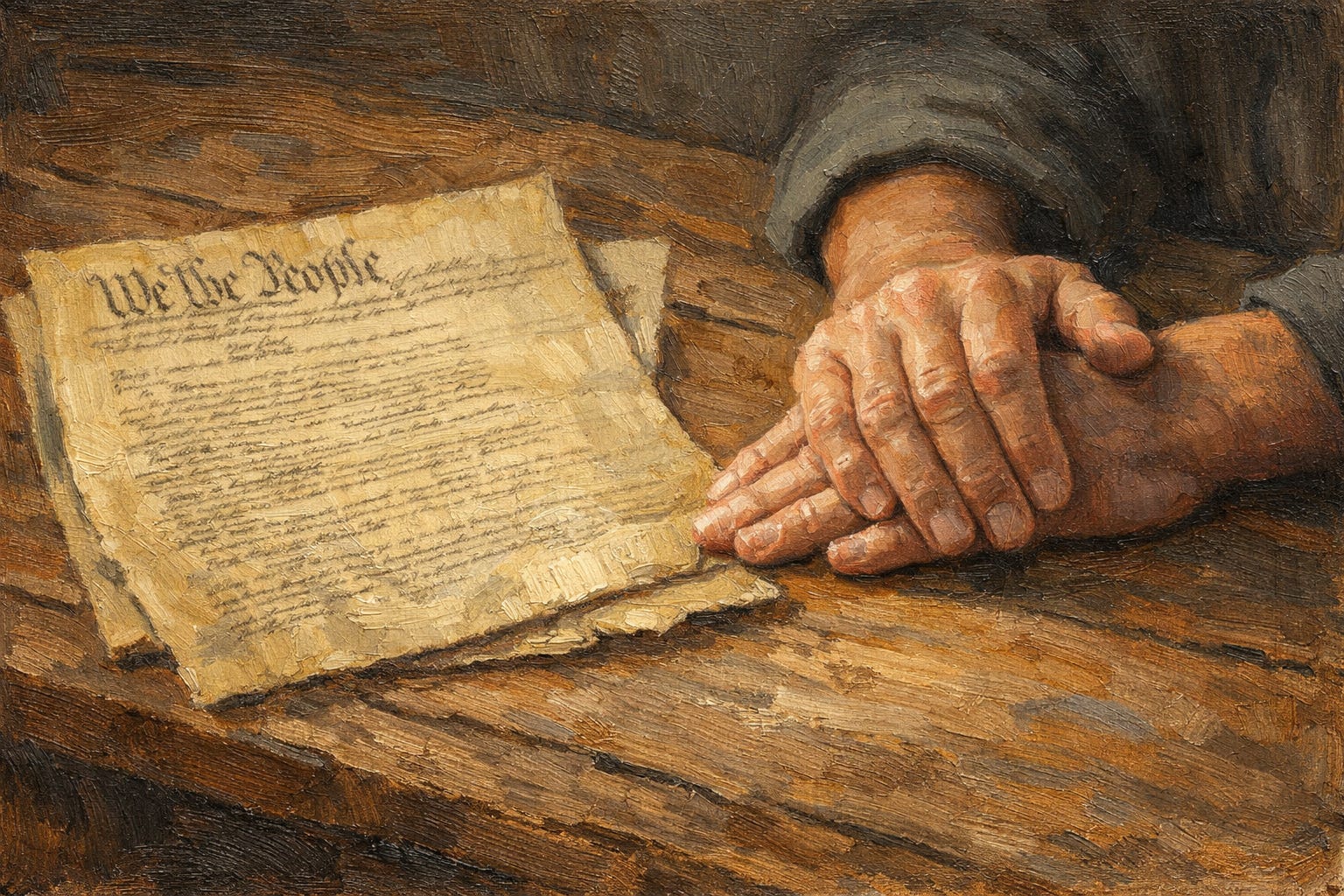
We are living through a season of strain.
Not the first in our history. Not the most severe. But real enough that many of us feel it in our conversations, in our communities, in the tightening language of our politics. We sense pressure in the system we inherited. We argue about what it means. We disagree about who bears responsibility. We wonder whether what we’re witnessing is adaptation, erosion, or something more lasting.
This series begins with that unease.
My family’s roots in this country reach back before the Revolution. That history doesn’t make me superior. It makes me accountable. We’ve been here long enough to know that this Republic survives contradiction. We’ve also been here long enough to know that survival has always required discipline.
The American experiment has always held two truths at once. It gave the world language of liberty while denying liberty to many. It aspired to equality while protecting hierarchy. We inherit both the promise and the damage. To love this country honestly is to refuse amnesia without surrendering belief.
I believe in the founding documents, even when I’m unsparing about the founders themselves. I believe in ordered liberty. I believe in divided power. I believe in the stubborn conviction that a people can govern themselves without a monarch. I don’t believe those achievements excuse our violence or our exclusions. They demand that we confront them.
This won’t be a lament for a golden age that never existed. Nor will it be a running indictment of one party or another. It won’t be a civics lesson disguised as commentary. It will be a steady examination of a constitutional system under pressure.
We’ll ask careful questions.
Was this anticipated?
Was this guarded against?
Is this tension part of the design, or a sign that we’re neglecting it?
We’ll distinguish between friction and fracture. The Constitution was built to manage ambition, not eliminate it. Conflict alone doesn’t signal collapse. But when restraint gives way to contempt, when power treats limits as inconveniences, when citizens lose confidence that the rules apply evenly, the strain isn’t theoretical.
And when strain stops being theoretical, it lands somewhere.
It lands in families uncertain whether their rights will hold.
It lands in communities unsure whether their voices carry weight.
It lands in neighbors who no longer trust one another’s good faith.
A republic doesn’t exist to preserve institutions for their own sake. It exists to secure the dignity of the people who live beneath them. When we speak of separation of powers, of federalism, of courts and legislatures, we’re speaking of structures meant to protect human beings. If those structures weaken, it isn’t parchment that suffers first. It’s people.
That’s where our concern must begin.
We’ll speak plainly about executive reach, legislative paralysis, judicial expansion, and cultural corrosion. We won’t exaggerate. We won’t minimize. We won’t treat every controversy as a constitutional crisis. But neither will we pretend that boundary testing carries no cost. As I’ve often stated: a system neglected long enough doesn’t quietly repair itself.
This Republic was never designed to run on autopilot. It assumes a citizenry capable of restraint, patience, and loss. It assumes that those who win elections won’t treat victory as permission without limit. It assumes that those who lose won’t treat defeat as proof of illegitimacy. Law can restrain power. It can’t manufacture character.
That truth unsettles us because it places responsibility back where it belongs.
On us.
We built this system. We amended it. We neglected parts of it. We’ve tolerated conduct that earlier generations treated more cautiously. We can’t demand institutional maturity while excusing personal recklessness. A grown republic requires grown citizens.
This doesn’t mean perfection. It does mean seriousness.
We shouldn’t imagine that pressure resolves itself. Systems under strain either strengthen through discipline or weaken through indifference. History offers examples of both. What it doesn’t offer is inevitability.
The American experiment has endured civil war, economic collapse, corruption, and reform. It has expanded its promise and betrayed it. It has been cruel and courageous in the same generation. We’ve survived darker chapters than this. We haven’t survived without cost.
This series will attempt to look at our present moment with clear eyes and steady hands. We’ll trace the design of the system. We’ll identify where it bends and where it breaks. We’ll ask what belongs to law and what belongs to culture. We’ll remember that outrage is easy and stewardship is hard.
Above all, we’ll speak in the first person plural.
We.
Not because we agree on everything. Not because we share the same fears. But because this Republic, in all its flaw and promise, belongs to all of us. To abandon that pronoun is to concede more than we intend.
I love this country enough to be disappointed in it. I love it enough to say when we’re shrinking it. And I love it enough to believe that strain, honestly faced, can become strength.
This isn’t the end of the experiment.
But it’s a test of whether we’re still willing to grow with it.
Up Next
A Republic Under Strain
What Pressure Reveals About Us
We feel it before we can define it. Trust feels thinner. The language of politics sharper. Some say the system’s broken. Others call it turbulence. Most of us sense pressure.
The first essay in The American System Under Pressure begins there.
What does strain mean in a constitutional republic? Was this system built for comfort or for conflict? When institutions bend, who feels it first?
This opening piece sets the moral and structural register for the series and centers the people who live beneath the architecture of law.
Production Note
Three articles will be released in the span of one week starting this coming Saturday, Feb. 21st then once a week thereafter.
Light Against Empire is free for all. If my words have value to you and you’re in a position to help, you can chip in with a monthly or yearly donation. Your support keeps the writing alive, the lights on, and the fire burning.
Further Reading:


