


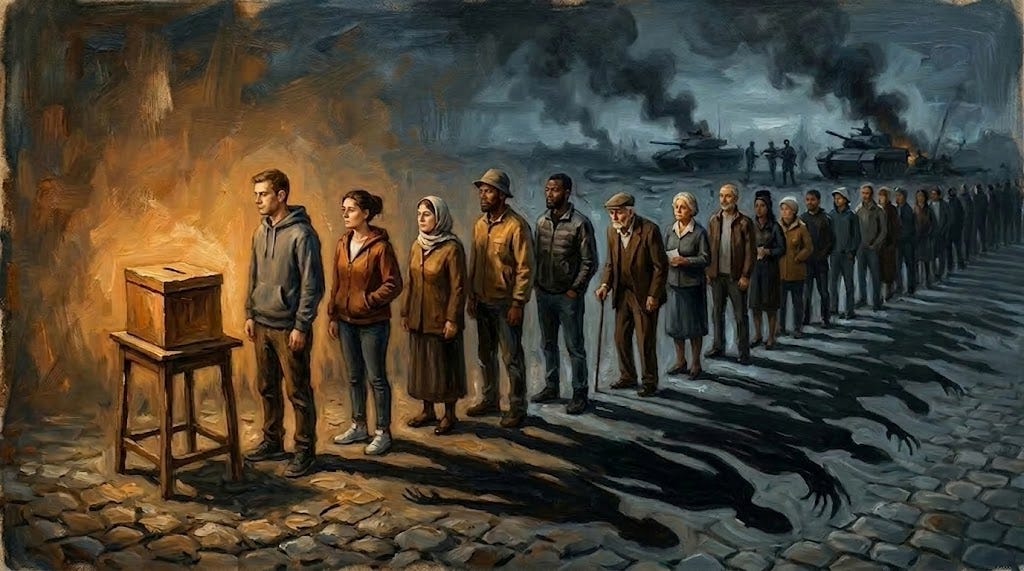
I wanted to believe this one was different.
The nuclear threat was documented. The International Atomic Energy Agency had spent years filing increasingly alarmed reports. Iran’s proxy network, Hezbollah threading rockets into northern Israel, the Houthis closing Red Sea shipping lanes, Iraqi militias picking off American personnel in ones and twos, was real, patient, and methodical. Ali Khamenei had spent thirty-five years building a regional architecture designed to make Iran untouchable by making everywhere else unstable. The case for action existed. I could see it. I gave it its due.
Then the bombs fell on February 28, 2026, and within forty-eight hours I recognized every single thing I was watching. Not from analysis. From memory.
I’d seen this before. We all had. That’s the problem. The problem with memory, though, is that most Americans have decided it’s optional. So let me use mine.
There’s a factory that builds American wars, and it’s been running without interruption since 1950. The product changes. The branding changes. The factory does not.
Korea was sold as a police action with defined UN objectives. It ended in a stalemate at roughly the same geographic line where it started, 36,000 Americans dead, and no peace treaty. That document still doesn’t exist seventy-five years later. Vietnam was sold as a firewall against communism, a necessary domino theory made real. The Pentagon Papers, leaked in 1971, proved the government had known for years the war was unwinnable and prosecuted it anyway, feeding body counts into a bureaucratic machine that needed the war more than it needed the truth. The Gulf of Tonkin incident, the trigger that opened the floodgates of full American involvement, was, in any honest accounting, fabricated. Fifty-eight thousand Americans died downstream of a lie told on a Tuesday in August 1964.
Iraq in 2003 brought the weapons of mass destruction that weren’t there, the al-Qaeda links that didn’t exist, and a PR campaign so polished that a seasoned secretary of state sat before the United Nations Security Council and presented satellite photographs as proof of a threat his own staff had doubts about. The Downing Street Memo, a classified British intelligence document that surfaced in 2005, recorded that Washington had decided on war and was “fixing intelligence around the policy.” Not the other way around. Afghanistan ran for twenty years, ate through trillions of dollars and thousands of lives, and ended with the Taliban back in Kabul, in possession of American military equipment, looking at cameras. The Afghanistan Papers, the government’s own internal interviews obtained by the Washington Post in 2019, showed officials privately admitting they had no idea what winning looked like while publicly insisting progress was being made.
Each of these wars came wrapped in urgency. Each had a villain we could picture. Each had a moment of national feeling, a rally, a resolution. Each one eventually revealed, at whatever cost, that the public justification and the actual machinery behind the decision were two different things operating in two different rooms.
Iran walked through the same door wearing the same coat. The only thing missing was the pretense of surprise.
Watch the sequence carefully, because the sequence is the argument.
On February 6, 2026, Iran and the United States sat down in Oman for indirect nuclear negotiations. Iran’s foreign minister described a “historic” agreement as within reach. A second round of talks was scheduled in Geneva. Diplomacy, for the first time in years, had real momentum. Then on February 24, two days before the bombs fell, Trump stood at the State of the Union and accused Iran of reviving its nuclear weapons program. American intelligence reports at the time assessed that long-range Iranian ballistic missiles capable of threatening the US were at minimum nine years away from development. The Pentagon later admitted Iran had moved much of its enriched uranium before the strikes even began. The Defense Intelligence Agency, in what the administration called a “political leak,” assessed the strikes set Iran’s nuclear program back by months, not years. The CIA director, a political appointee, then said the damage would take years to repair.
Two intelligence assessments. Directly contradictory. The more alarming one coming from the person whose job depends on the president’s confidence. Students of Colin Powell’s 2003 UN presentation will feel a familiar chill.
The war cost $11 billion in its first six days. Not over its lifetime. In its first six days. Lockheed Martin, RTX, Northrop Grumman: the weapons systems consumed across twenty distinct categories are their products, their contracts, their shareholder value. Defense contractor stocks moved accordingly the morning the bombs fell, as they always do, because the market understands the factory’s business model better than most voters care to.
Congress was notified shortly before the strikes, not consulted before them. The distinction matters constitutionally and was apparently irrelevant practically. A war powers resolution died in the Senate 53-47, along party lines, with one Democratic defection. The House rejected its version 219-212. Analysts noted the administration was treating old Iraq and Afghanistan AUMFs, authorizations passed in the aftermath of September 11, as blank checks for any military action any future president chose to take. As one legal scholar put it, Congress has ceded so much authority over war that it no longer knows how to reclaim it.
Trump said the conflict would last four to five weeks. Then he said he was prepared to go “far longer than that.” He said he’d know the war was over when he felt it “in his bones.” Fifteen days in, he’d bombed Kharg Island, through which most of Iran’s crude exports pass, and was openly threatening the island’s oil infrastructure if Tehran interfered with Hormuz shipping. The Strait was already effectively closed. At least sixteen oil tankers had been attacked. Gas prices hit a twenty-two-month high. The IEA released a record 400 million barrels of crude to stabilize global supply.
Four to five weeks. Right.
Now the part that the careful and credentialed are reluctant to say plainly, so I’ll say it plainly.
The day the House Oversight Committee called for Donald Trump to testify about his documented connections to Jeffrey Epstein, the bombs fell on Tehran.
That’s not an allegation. That’s a sequence of events.
In January 2026, the DOJ released over three million pages of Epstein-related documents under a transparency act Trump himself signed into law, in what now reads as a catastrophic miscalculation. The files implicated figures across governments and industries, reached into the British royal family, caused arrests, resignations, and international scandal. Documents in the release included a woman’s FBI statement describing assault by both Epstein and Trump when she was between the ages of thirteen and fifteen. Another account placed underage girls at a Trump golf course. The administration redacted names it was legally prohibited from redacting. It released roughly half the estimated total pages. Senator Merkley, whose bill created the transparency act, called the release a violation of its own law.
Google searches for “Epstein files” collapsed the day the war started. A poll of 1,272 likely voters, conducted March 6 through 8, found 52% believed Trump was at least partly motivated to attack Iran to distract from the Epstein scandal. Among independents, 52%. Among Democrats, 81%. Among Republicans, 26%. One in four members of his own base looked at the timing and drew the same conclusion.
Republican Congressman Thomas Massie, not a man given to Democratic talking points, called the strikes “acts of war unauthorized by Congress” and stated directly they were a distraction from the files. “Bombing a country on the other side of the globe,” he wrote, “won’t make the Epstein files go away.”
A former Israeli diplomat and strategic analyst told Al Jazeera that Trump’s approval ratings were the worst of his presidency, that the economic signs were darkening, and that the Epstein exposure was the most politically dangerous thing he’d faced. “He really needs a distraction in the form of a war,” the analyst said. “And if you look at searches on Google for the Epstein files, they’ve plummeted since this started.”
While the cameras pointed at Tehran, something else was disappearing from view. Gaza, which had been approaching a genuine international reckoning, with ICC proceedings building, global protest sustained, and public opinion in Western countries shifting in ways that were starting to cost politicians their seats, got absorbed into a wider regional war narrative that reframes every Palestinian death as collateral in an existential conflict. Netanyahu, facing elections potentially as early as June, called Trump personally to tell him where Khamenei would be meeting his advisors. The Israeli prime minister supplied targeting intelligence for the assassination of a sitting head of state to the American president. Two leaders, each in serious domestic political trouble, each needing a larger fire burning, produced exactly the larger fire they needed. That story has its own full telling and it’ll come. For now, note the timing. Note the beneficiaries. The factory’s always known how to run this play too.
Here’s where the honest case for this war lives, and it deserves a hearing before I dismantle it.
Iran’s nuclear program wasn’t imaginary. Its proxy violence wasn’t imaginary. Khamenei’s regime had spent decades making clear its intentions toward Israel, toward American influence in the region, toward any Arab government that moved toward normalization. The Twelve-Day War of June 2025 wasn’t manufactured. The protests Iran suppressed violently in January 2026, killing thousands of its own citizens, were real. There are serious people, not all of them cynics or profiteers, who believed military action was necessary and had believed it for years before the first bomb fell.
Grant them everything. Grant them the full threat assessment, the honest strategic rationale, the belief that diplomacy had run its course.
What they can’t grant back is this: the American public was owed a congressional debate and didn’t get one. It was owed coherent intelligence and got two contradictory assessments from a politicized process. It was owed stated goals with measurable endpoints and got “I’ll know it’s over when I feel it in my bones.” It was owed transparency about what it was paying for, $11 billion in six days on a trajectory of one to two billion dollars daily, and got press briefings.
The threat may have been real. The process was the same broken factory it’s always been.
As of this writing, at least 1,444 people are confirmed dead. The youngest was eight months old.
Which brings me to you. To us.
I’m not going to call us stupid. That’s too easy and it’s not true. Something harder is true.
We’re fluent in this now. We recognize the pattern while it’s happening. Fifty-two percent of likely voters looked at the Epstein timeline and the bombing timeline and reached their own conclusion without any journalist telling them what to think. Massie named it on day one. Merkley named it on day one. The Google search data named it in the aggregate behavior of millions of ordinary people who knew, on some level they couldn’t quite articulate, that something had just been switched off.
We saw it. We knew.
And the war powers resolution died 53-47.
That’s the number I can’t get out of my head. Not the casualty count, not the dollar figure, not the intelligence contradictions. Fifty-three senators, representing millions of people who in documented polling believed this war was at least partly a distraction from a child sex trafficking scandal, voted to let it continue without debate, without authorization, without an articulated endgame. No open oversight hearings were held. No public accounting was demanded. The Republican majority didn’t need the public’s permission, and the public didn’t make them pay for not asking.
We’ve passed through the phase where we’re deceived. We’re in a different phase now. We watch the mechanism operate, describe it accurately, commission polls about it, and then return the people who run it back to their offices with reliable regularity. We’ve decided, collectively and in practice if not in stated preference, that the cost of sustained political resistance is higher than the cost of the war. We’ve been making that calculation since Korea.
The factory that builds American wars doesn’t run on government appropriations alone. It runs on our willingness to be temporarily outraged and then permanently tired. It runs on the next news cycle and the one after that, our own exhaustion weaponized against us with a precision that by now should be called what it is: expertise.
At some point the question stops being “why do they keep doing this to us” and becomes something we’re less comfortable asking.
Why do we keep letting them?
The Iran war isn’t a failure of government. It’s a report card on us. The grade isn’t stupidity. It’s something closer to trained hope, the belief renewed every few years at a ballot box that this time the machine will behave differently. It never does. We keep believing it will. The people who run the factory have always known that. They built the factory around it.
Relax. We’ve seen this before. We’ll see it again.
Light Against Empire is free for all. I write on American foreign policy, political accountability, and the lies of “Empire.” If my words have value to you and you’re in a position to help, you can chip in with a monthly or yearly donation. It takes time, energy, and resources to keep Light Against Empire running. Your support keeps the writing alive, the lights on, and the fire burning. Thanks!
Further Reading:


How compelling the analysis, and how bitter the conclusion! …and enlightening!
Thank you Dino for your analysis. I know your words can be trusted.