


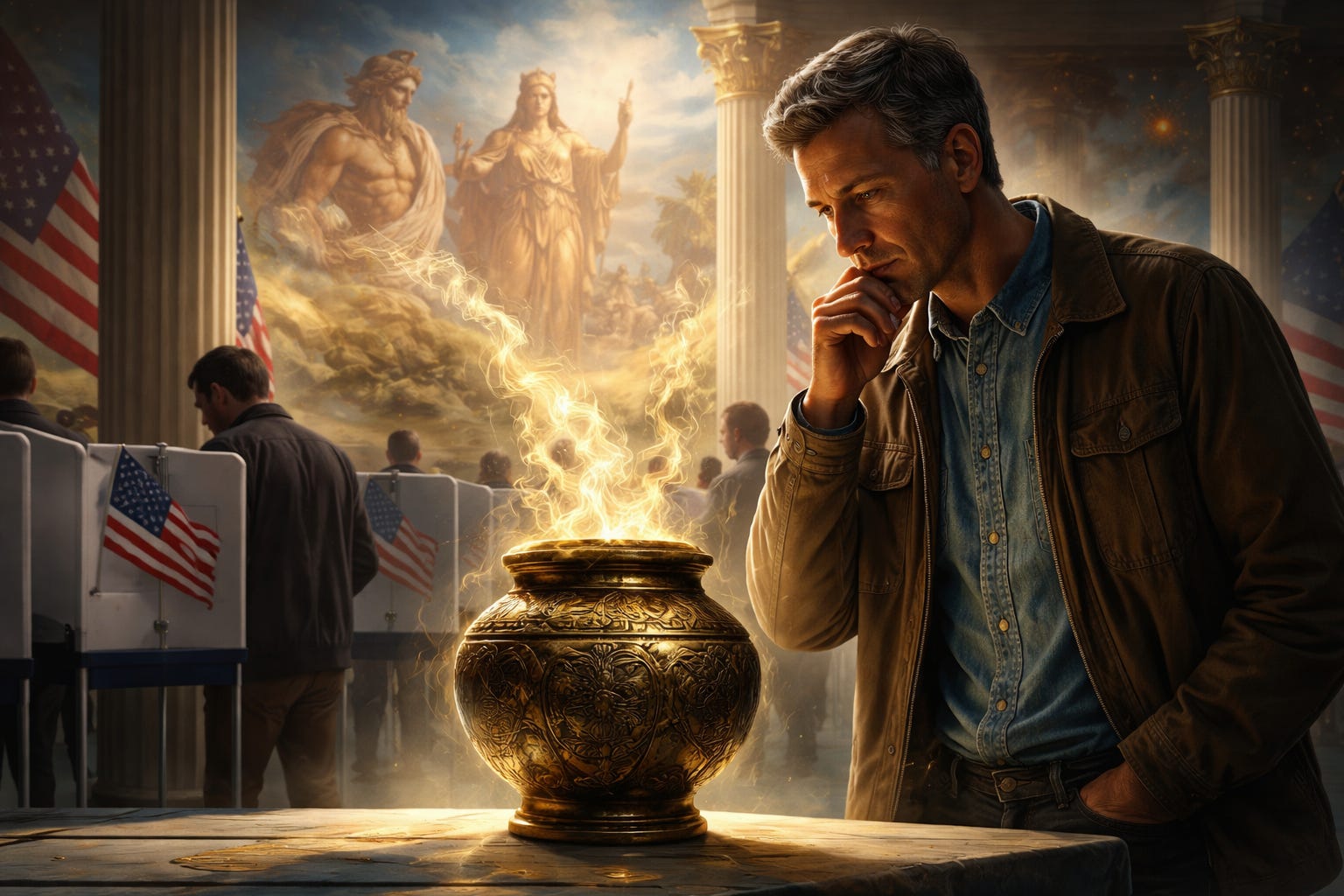
“Hope did not escape the jar. It waited to see if anyone would come looking for it.”
We’re staring at the jar again.
Everyone knows what escaped from it. Everyone’s got an opinion about what crawled out first. Some swear it was cruelty. Others insist it was arrogance. A few claim it was simply ambition wearing louder clothing.
Whatever the order, the contents are now running loose across the public square, shouting into microphones and arguing on television panels.
And here we are.
Staring at the jar.
Wondering whether there’s still anything inside worth reaching for.
Let’s begin with two facts that are about as subtle as a marching band in a library.
First, a very large number of Americans now view the current administration as rapacious, vindictive, self aggrandizing, and unusually relaxed about the old fashioned concept of human rights. Its interpretation of national prerogative often resembles the behavior of someone who’s just discovered the lock on the liquor cabinet was decorative and that international diplomacy can apparently be conducted with the tone of a late night argument in a sports bar.
Second, for many of those same Americans the administration represents something deeper than a bad government.
It represents the contents of Pandora’s box.
Rage.
Contempt.
Vengeance.
Vanity.
Cruelty.
Opportunism.
And the unsettling realization that the guardrails of a republic sometimes turn out to be made of plywood and crossed fingers.
Those perceptions are now circulating widely through the American bloodstream.
Because they exist, the next midterm elections have acquired a gravity midterms almost never possess.
Most midterms revolve around turnout models, suburban drift, and whether voters are irritated about inflation, gasoline prices, or the mysterious cost of eggs. Political consultants stare at spreadsheets with the intensity of medieval astronomers. Candidates practice smiling as if they genuinely enjoy county fairs and ribbon cuttings.
That’s not the emotional atmosphere this time.
For many citizens the coming elections feel less like routine maintenance and more like an emergency brake.
They see the ballot as the remaining lever of correction. Not the only one, of course. Democracies still contain other instruments of repair. Courts still exist. Legislatures still exist. Civil society still exists. A determined grandmother with a clipboard has saved more local democracies than most textbooks will ever admit.
But elections remain the largest lever placed directly in the hands of ordinary citizens.
Which brings us to Pandora.
The ancient Greeks had a remarkable talent for telling stories that feel disturbingly current. Their myths weren’t bedtime stories. They were warnings disguised as entertainment.
Pandora received a sealed jar from the gods. Inside it lived every misery humanity would one day encounter. Curiosity did what curiosity always does.
She opened it.
Out flew sickness, envy, cruelty, resentment, greed, violence, ambition, and several other emotions now commonly observed on political talk shows.
But something remained inside the jar.
Hope.
The Greek word was elpis. It didn’t mean cheerful optimism or motivational posters involving sunrises over mountain ridges. It meant the expectation that the future could still be shaped.
Hope remained inside.
Scholars have argued about that detail for centuries. Some think the gods left hope trapped as a final cruelty. Others think it remained available if humanity chose to reach for it.
Either way the myth carries a lesson.
When darker forces escape into the world, the survival of a society depends on whether citizens still believe their actions matter.
Which brings us back to the ballot box.
Democracies possess their own version of Pandora’s jar. It sits quietly in school gyms, courthouse basements, church halls, and county election offices that smell faintly of toner, paper, and civic obligation.
The ballot box.
Most years it behaves like an ordinary administrative device. Voters arrive, check their names, fill in a few circles, and leave with a sticker that implies democracy has just completed a cheerful arts and crafts project.
Ballots get counted.
Someone wins.
Someone loses.
Life continues.
But occasionally the ballot box becomes something else.
Occasionally it becomes mythic.
That’s where the country now appears to be drifting.
Across the United States a powerful narrative has taken hold. For millions of Americans the next midterm election has become the container of hope itself. It’s the moment when the forces they believe escaped Pandora’s jar might finally meet resistance.
If the administration they fear is restrained or replaced, the system will have corrected itself.
That’s the hope.
But there’s another possibility now circulating quietly beneath the public conversation.
What happens if the election doesn’t behave as expected?
What happens if the machinery of elections becomes contested territory?
What happens if results are delayed, disputed, or simply dismissed by those currently holding power?
These questions no longer belong only to political theorists or anxious graduate students. They now appear in ordinary conversations between neighbors, coworkers, and people standing awkwardly together in grocery store checkout lines.
The fear isn’t merely that one side might lose.
The fear is that the ritual itself might fracture.
And here the situation becomes almost darkly comedic.
The American republic was constructed specifically to prevent that outcome. The founders didn’t assume the country would be governed by angels. They’d spent far too much time around ambitious men to indulge that fantasy.
Instead they built a system designed to survive ambition, ego, corruption, and the occasional flamboyant narcissist who believed the entire government existed to narrate his personal greatness.
Checks.
Balances.
Courts.
Federalism.
Regular elections.
It was a remarkably durable design.
But even the most sophisticated political machinery depends on one ingredient that doesn’t appear anywhere in the Constitution.
Participation.
The system assumes citizens will keep showing up.
They’ll vote even when they’re tired.
They’ll vote even when candidates disappoint them.
They’ll vote even when politics resembles a traveling circus run by amateur jugglers, three rival prophets of doom, and one extremely angry goat.
In other words, the system assumes citizens will resist the most dangerous temptation in politics.
The temptation to opt out.
Authoritarian movements rarely succeed because they persuade everyone. That’s the dramatic version taught in history books. In reality they succeed through exhaustion.
They flood the public square with chaos.
They normalize behavior that once would’ve ended careers.
They make truth negotiable and outrage routine.
Eventually large numbers of citizens begin to feel a quiet corrosion in their civic spirit.
Why bother?
Why bother voting?
Why bother protesting?
Why bother defending institutions that appear already broken?
Why bother caring about the America of the founders when the present version sometimes resembles a reality show filmed inside a constitutional convention?
That quiet sentence has ended more republics than any invading army.
Why bother.
History is full of republics that didn’t fall with a bang. They faded. Citizens withdrew from public life. Politics became something ugly that happened somewhere else, to someone else, by someone else.
And power, once abandoned by the public, never stays empty for long.
And here the satire becomes unavoidable.
American politics has grown so theatrical that both sides now behave as if the republic will certainly end the moment the other party wins the next election.
One side shouts that democracy will die if their opponents remain in power.
The other side shouts that democracy will die if their opponents gain power.
Cable news shouts.
Social media shouts.
Everyone shouts.
Everyone predicts the apocalypse.
It begins to resemble two doomsday prophets arguing over who gets to set the alarm clock.
Meanwhile the most dangerous possibility slips quietly past the noise.
Citizens grow so tired of the shouting that they disengage altogether.
Which would be the final historical punchline.
After centuries of constitutional argument, revolution, civil war, civil rights movements, and millions of citizens participating in the experiment of self government, the American republic wouldn’t end solely through tyranny.
It would end through civic exhaustion.
Pandora’s jar wouldn’t need opening again.
We’d close it ourselves.
So the real test of the coming midterm elections isn’t simply who wins.
The deeper test is whether citizens continue believing participation matters even under conditions of fear and uncertainty.
Because hope in a democracy doesn’t arrive automatically.
Hope is manufactured through civic behavior.
You vote.
You organize.
You speak.
You refuse the seduction of despair.
The founders didn’t design a system that guarantees wise leaders or virtuous rulers. They designed one that allows citizens to correct mistakes.
That distinction matters.
A republic survives when its people treat the ballot box not as a magical device that fixes everything, but as a ritual that preserves the possibility of correction.
Pandora’s myth leaves us with an uncomfortable truth.
The darker forces of politics will always escape into the world. Human ambition guarantees that. Every generation produces individuals who believe power exists primarily to enlarge their own reflection in the mirror of history.
What determines the fate of a democracy is how citizens respond.
With vigilance.
With stubborn participation.
Or with withdrawal.
If the coming elections proceed normally, the republic will experience the familiar mixture of disappointment and celebration that accompanies democratic change.
If the elections are manipulated, contested, or ignored, the test will become far more severe.
At that moment Americans will face the choice hidden inside Pandora’s jar.
Whether hope remains something we keep alive through action.
Or something we leave sealed inside while we quietly walk away.
The ballot box, like Pandora’s jar, is a container filled with uncertainty.
But the greatest danger isn’t what may emerge when it opens.
The greatest danger is deciding it’s no longer worth opening the jar at all.
Please Support the Work
Light Against Empire is free for all. If my words have value to you and you’re in a position to help, you can chip in with a monthly or yearly donation. Your support keeps the writing alive, the lights on, and the fire burning.
Further Reading: