


“The wrong we do does not attract the punishment it deserves, it attracts the wrong we deserve.”— Simone Weil
Introduction
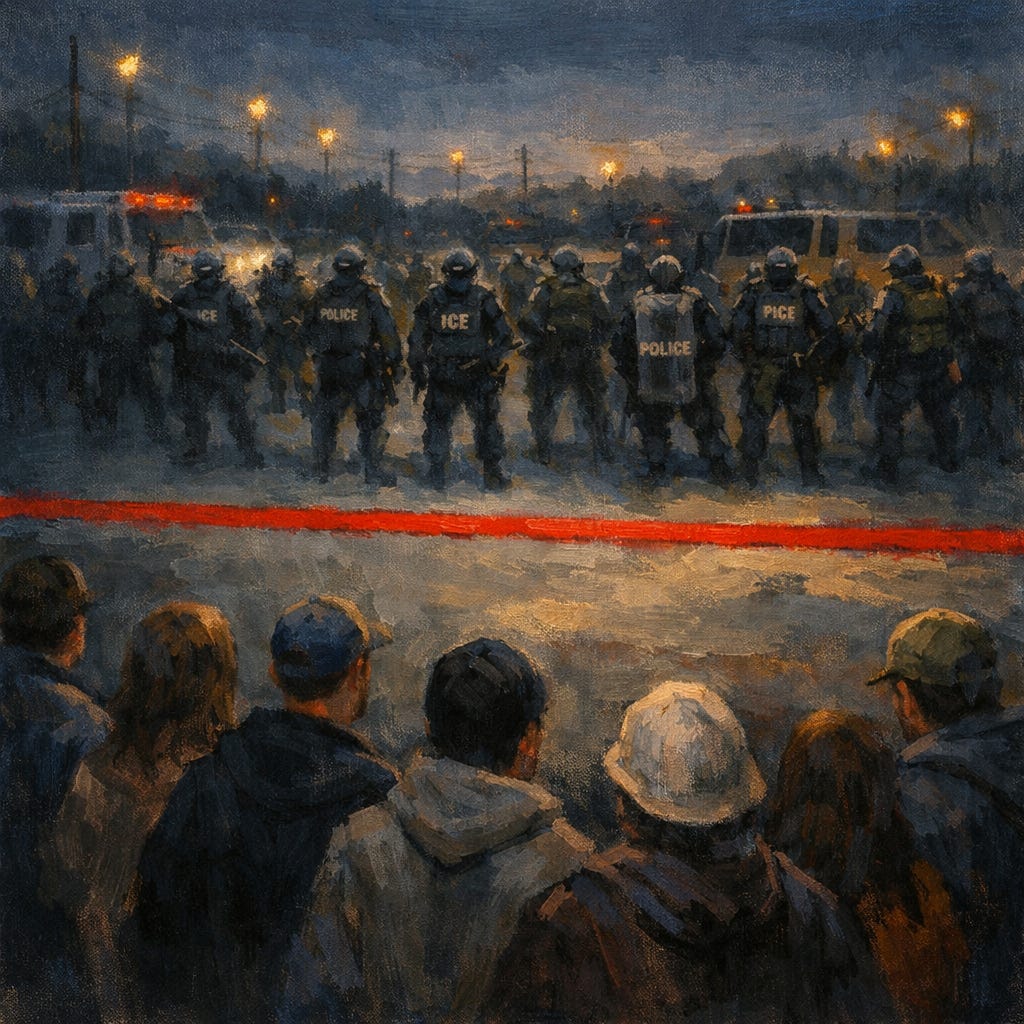
There are moments in a republic’s life when escalation feels righteous, even inevitable. When outrage sharpens into certainty and restraint begins to sound like cowardice. This is not one of those moments.
This is not a how-to document. It does not offer tactics, shortcuts, or instructions for action. It is long and dense by design, because the conditions it examines are complex, and because clarity earned slowly lasts longer than certainty arrived at quickly. What it offers instead is orientation, a way of understanding where we are, what still holds, and what is at risk of being lost if judgment gives way to impulse.
I am not asking for silence. I am not asking for patience dressed up as surrender. I am asking for civic calm as discipline. Calm as a chosen posture, not a mood. Calm as the refusal to hand the future to the loudest impulse in the room.
History is unambiguous on one point. When political conflict turns into civil violence, democracies do not survive in recognizable form. They do not become more honest. They do not become more just. They become brittle. Authority hardens. Fear spreads faster than reason. Emergency measures linger long after the emergency has passed. People stop arguing about policy and begin arguing about survival. And survival arguments have a way of crowning whoever promises order, regardless of the cost.
This is not a moral scolding. It is a pattern.
Civil violence does not merely accompany democratic collapse. It accelerates it. It gives concentrated power what it lacks in open societies, justification. Justification to suspend rights. Justification to federalize force. Justification to collapse dissent into threat. Justification to turn politics into a problem of control rather than consent.
Once citizens begin meeting one another as armed adversaries, the center of gravity moves upward, not outward. The state does not weaken. It consolidates. Even those who oppose it begin pleading for stability. And stability, once recast as security, rarely loosens its grip.
This is why the distinction between resistance and retaliation matters more than any single grievance. Retaliation trades legitimacy for adrenaline. It shrinks the circle of who can safely participate in public life. It hands the initiative to whoever is most willing to escalate rather than whoever is capable of governing.
Anger is not the problem. Anger can clarify injustice. Anger can mobilize conscience. The danger is anger without discipline. Undirected anger, especially when paired with weapons, dissolves the very conditions that make justice possible.
Every generation that has watched a democracy fracture learns this lesson too late. Street violence does not remain symbolic. It does not stay contained. It does not stop where intentions begin. It multiplies, misfires, and hardens into cycles no one fully controls. The dead stop being metaphors. Institutions stop mediating. Politics becomes memory soaked with blood.
Still, honesty requires naming the question many people carry quietly. What happens if every peaceful avenue is closed. What if courts fail. What if elections are sabotaged. What if law itself becomes a costume worn by power.
That question deserves a serious answer, not slogans.
There are moments in history when armed resistance emerges as a last resort against total domination. Those moments are tragic, not triumphant. They arrive only after civic mechanisms are crushed, not merely strained. Even then, they leave societies scarred, mistrustful, and burdened by losses that echo for generations. Armed conflict is not evidence of moral clarity. It is evidence of catastrophic failure upstream.
The purpose of this essay is not to deny extremity or romanticize restraint. It is to prevent despair from being mistaken for destiny.
We are not there.
What still exists, fragile but real, is a framework of resistance that does not require neighbors to become enemies. A set of structures, institutions, and civic practices that slow overreach, expose abuse, and preserve space for renewal. Central among them is federalism, not as abstraction, but as lived reality. States that still govern. Courts that still bind. Communities that still choose cooperation over collapse.
Federalism is not salvation. It is foundation. It redistributes power downward and outward. It creates friction. It frustrates impulse. It buys time. It keeps political conflict political.
But foundations alone do not hold a society together. What fills the space federalism preserves matters just as much as the structure itself. Civic coordination across states. Civil society that translates resistance into lived norms. Moral clarity that speaks across borders and identities. A disciplined refusal to meet provocation with chaos.
This is an essay about resistance that aims to save a democracy rather than scorch it. About the difference between courage and recklessness. About how movements endure without losing their soul. About where ordinary citizens fit, not as heroes, but as stewards of a shared civic life.
The question before us is not whether we are angry enough. Many of us are. The question is whether we are disciplined enough to resist without destroying the thing we claim to defend.
What follows is not a manual. It is a map. A way of seeing the terrain clearly before deciding how to move across it.
Threshold
Civic Calm as Discipline
There are moments in a republic’s life when escalation feels like clarity. When outrage sharpens into certainty and restraint is mistaken for weakness. Those moments are dangerous precisely because they feel honest. This is one of them.
I’m not asking for quiet. I’m not asking people to lower their voices while the ground shifts beneath them. I’m asking for civic calm as discipline. Calm chosen deliberately. Calm that refuses to confuse intensity with wisdom or reaction with resolve.
Democratic breakdown rarely announces itself with a single unmistakable act. It arrives through accumulation. Through pressure that builds faster than judgment. Through a thousand small decisions made under stress, each one understandable on its own, each one narrowing the range of outcomes that remain possible. Civic calm is what keeps that narrowing from turning into collapse.
This isn’t an appeal to patience as delay or politeness as virtue. It’s an appeal to self command. To the ability of a society to remain governable while it argues with itself. Calm is what allows disagreement to stay political rather than personal, public rather than tribal, moral rather than existential.
When calm is lost, everything accelerates. Fear shortens the horizon. People stop asking what will preserve a shared future and start asking what will secure their side. At that point, even well intentioned actions can end up feeding the very forces they oppose. History is crowded with movements that believed urgency justified escalation, only to discover too late that escalation answered a different master.
Civic calm doesn’t deny anger. Anger is often earned. It signals injury and injustice. But anger without discipline is easily captured. It can be redirected, amplified, and turned into fuel for outcomes no one intended. Calm interrupts that process. It slows the loop between provocation and response.
In moments like this, calm becomes a public good. It protects participation. It keeps institutions from sliding into permanent emergency posture. It preserves the possibility that tomorrow’s arguments will still be arguments rather than ultimatums. Without calm, even truth loses its footing, because it can no longer move safely through public space.
This is why restraint matters before strategy. Why boundaries matter before tactics. Before we decide how to resist, we have to decide what we refuse to become. A society that can’t govern its own reactions will eventually accept governance imposed upon it.
Civic calm isn’t the absence of action. It’s the condition that makes action intelligible. It’s how a democracy keeps its footing while standing at the edge of choices that cannot be undone.
That threshold is where we are now.
The Escalation Trap
How Democracies Slide from Conflict to Collapse
Democracies rarely fracture because people stop caring. More often, they fracture because caring turns into urgency, and urgency turns into permission. Permission to rush judgment. Permission to treat opponents as threats. Permission to act first and explain later.
Political conflict itself is not the danger. It is the ordinary condition of a free society. The danger arrives when conflict stops being mediated by shared rules and starts being experienced as an existential test. When disagreement feels like it threatens survival, every tool begins to look justified.
This is how escalation begins. Not with a plan, but with a feeling.
Fear shortens time. It narrows imagination. People stop asking what might preserve a shared future and start asking what will prevent immediate loss. That shift matters more than any single event. Once politics is framed as survival, restraint starts to feel irresponsible, and escalation starts to feel like clarity.
As this happens, the language of public life changes. Opponents are no longer wrong, they are dangerous. Institutions are no longer flawed, they are compromised. Delay is no longer prudence, it is betrayal. Each step feels rational inside the moment that produces it. Taken together, those steps steadily shrink the space where democratic life can still function.
Escalation feeds on itself because it rewards speed over judgment. The fastest response sets the tone. The most extreme reaction defines the frame. Those who hesitate are accused of complicity. Those who urge restraint are dismissed as naive or detached from reality. This dynamic does not favor wisdom. It favors momentum.
Democracies depend on friction. On pauses. On processes that slow decision making so bad choices can be questioned before they harden into irreversible acts. Escalation treats friction as an enemy. It seeks to bypass it, discredit it, or break it entirely. In doing so, it removes the very mechanisms meant to keep conflict from turning destructive.
This is why escalation often feels productive while quietly doing the opposite. It creates the sensation of movement without direction. It generates action without accountability. People feel engaged, even righteous, while the structure holding disagreement together weakens beneath them.
The most dangerous feature of escalation is that it feels earned. It carries the emotional logic of self defense. People tell themselves they are responding, not initiating. That they are acting because they must, not because they want to. This belief makes escalation harder to interrupt, because questioning it can sound like denying the reality of harm.
History, however, shows a consistent pattern. Once escalation becomes the dominant logic, democratic outcomes become harder, not easier, to achieve. Negotiation collapses. Trust erodes. Institutions retreat into defensive posture. Power migrates toward whoever promises to restore order, regardless of how that order is defined.
This is the trap. Escalation does not resolve conflict. It changes its nature. It turns political struggle into a contest of endurance and force, where legitimacy fades and control takes its place. At that point, democracy is no longer shaping its future. It is reacting to its own unraveling.
Understanding this trap is not an academic exercise. It is a warning. If we fail to recognize how escalation works, we will mistake speed for strength and intensity for effectiveness. We will believe we are defending democratic life while steadily stripping away the conditions that make it possible.
That is how societies fall into collapse without ever choosing it outright.
What Violence Gives Power
Permission, Consolidation, and Emergency Logic
Civil violence doesn’t weaken centralized power. It strengthens it. This is one of the hardest truths to accept, especially for people who believe force is being used in defense of something precious. But history is consistent on this point. Violence doesn’t scatter authority. It gathers it.
The moment violence enters civic life, power gains permission. Not moral permission, but operational permission. Permission to declare emergencies. Permission to suspend ordinary rules. Permission to expand enforcement authority and compress oversight. What couldn’t be justified under normal conditions becomes necessary under extraordinary ones, and extraordinary conditions have a way of becoming permanent.
Emergency logic doesn’t need to be invented. It’s already built into modern states. Laws anticipate crises. Institutions are designed to respond to threat. Civil violence activates these systems automatically. Once activated, they rarely return fully to their original shape.
This is why violence is such a gift to concentrated power. It resolves ambiguity. It collapses debate into command. It reframes political disagreement as a security problem. When people are afraid, they don’t ask who is right. They ask who is in charge.
As this shift occurs, distinctions that once mattered begin to blur. Protest and threat merge. Dissent and disorder are spoken of in the same breath. Criticism is recast as destabilization. Even peaceful opposition is forced to operate under the shadow of violence it didn’t commit. The state no longer has to persuade. It only has to manage risk.
Consolidation follows quickly. Authority that was once distributed is pulled inward. Oversight weakens in the name of speed. Decision making moves away from public processes and into closed rooms justified by urgency. Those who question this shift are accused of endangering safety rather than defending principle.
The most insidious part of this process is that it often feels reasonable to people who oppose the abuse of power. Faced with chaos, many begin to say they dislike the methods but understand the necessity. Order becomes the dominant political value, and anything that promises to restore it gains legitimacy by default.
This is how violence reshapes the moral landscape. It lowers expectations. It changes what people are willing to accept. Measures that once would have sparked outrage are tolerated as temporary fixes. Surveillance expands. Enforcement grows harsher. Rights are narrowed in the name of stability. Each step is justified as an exception. Taken together, they form a new normal.
Civil violence also allows power to claim neutrality. Once armed conflict appears in the public sphere, the state positions itself as the referee rather than the participant. It presents repression as balance. Force as restoration. This framing obscures responsibility and makes accountability harder to demand.
Perhaps most damaging of all, violence divides the public itself. Some people demand harsher control. Others demand retaliation. In that divide, centralized power presents itself as the only actor capable of containing both. The choice is framed as order or collapse, with democracy quietly removed from the menu.
This is why violence isn’t just morally costly. It’s politically clarifying in the worst possible way. It simplifies a complex civic struggle into a binary where power thrives. It strips resistance of its legitimacy and hands authority the one thing it needs most, justification to act without consent.
Once that permission is granted, it’s rarely revoked.
The Collapse of Coalition
Why Violence Shrinks the Civic Circle
Democracy doesn’t survive on conviction alone. It survives on participation. On the willingness of people with different fears, priorities, and limits to remain in the same public space long enough to argue, negotiate, and compromise. That arrangement is fragile, and it depends on one condition more than any other. Safety.
Civil violence destroys that condition almost immediately.
When violence enters civic life, the first thing it does is narrow who can afford to participate. People with children step back. People whose livelihoods depend on public trust step back. People who’re uncertain, undecided, or simply worn down step back. What remains isn’t the public. It’s a smaller, harder group bound more by identity than persuasion.
This is how coalitions collapse. Not because people suddenly agree with power, but because the cost of engagement rises beyond what many can carry. Fear doesn’t radicalize most citizens. It immobilizes them. They retreat into private life and leave the public square to those most willing to absorb risk. That shift changes the character of resistance itself.
Broad movements rely on moral safety as much as physical safety. People need to believe they can stand near a cause without being absorbed into its most extreme expressions. Violence erases that boundary. It collapses distinction. To be nearby is to be implicated. Silence becomes self protection rather than indifference.
As this happens, resistance begins to look factional rather than civic. It feels like one group fighting another, not a society defending shared norms. Moderates fade from view. Institutions hesitate. Allies grow cautious. What once felt like a common concern is reframed as someone else’s conflict.
Violence also hardens identity. Once harm’s occurred, people organize around grievance rather than principle. Loyalty replaces argument. Internal disagreement becomes suspect. Movements that once depended on persuasion begin policing their own edges. The room for pluralism shrinks from within.
This isn’t a failure of character. It’s a predictable human response to threat. When danger rises, people seek certainty. They close ranks. They simplify the world into us and them. But democracy can’t operate inside that logic. It requires a public that can tolerate difference without treating it as betrayal.
Coalitions are how democracies protect themselves. They draw in people who don’t share ideology but share concern. They make it possible for institutions to act without appearing partisan. They create legitimacy through breadth rather than intensity. Violence dissolves that breadth.
The cruel irony is that violent resistance often believes it’s clarifying the stakes. In reality, it’s clarifying exclusions. It tells millions of people that participation now carries risks they didn’t agree to shoulder. Faced with that choice, many will choose withdrawal over engagement, not because they lack conviction, but because they’ve got lives to protect.
When that happens, centralized power benefits again. Opposition fragments. Public pressure thins. What remains can be isolated, surveilled, and dismissed as extreme. The coalition that once made restraint politically possible no longer exists.
Democracy doesn’t fail when the most committed lose heart. It fails when the broad middle decides public life’s no longer safe enough to enter.
That’s the quiet work violence does. It doesn’t defeat democracy outright. It empties it out.
Naming the Unspoken Question
When People Ask What Happens If Everything Fails
There’s a question that surfaces in moments like this, often quietly, sometimes with discomfort, and almost always with fear beneath it. What happens if none of this works. What happens if courts fail. What happens if elections are subverted. What happens if the law itself becomes theater rather than restraint.
People don’t ask this because they hunger for violence. Most ask because they’re trying to understand the limits of endurance. They want to know when patience turns into complicity and restraint starts to feel like surrender. That question deserves seriousness, not dismissal.
But seriousness requires precision.
Not every failure is collapse. Not every injustice is catastrophe. Democracies are imperfect by design. They absorb delay, contradiction, and even abuse because the alternative is permanent crisis. The fact that institutions strain does not mean they’ve ceased to function. The fact that outcomes disappoint does not mean civic pathways have closed.
The danger lies in confusing frustration with finality.
Last-resort thinking only becomes relevant when peaceful civic mechanisms aren’t merely weakened, but comprehensively destroyed. When courts no longer operate at all. When elections no longer exist in any meaningful sense. When public life is reduced entirely to coercion. That threshold is far higher than most people assume, and mistaking proximity for arrival is one of the fastest ways to bring about the very conditions people fear.
There’s also a moral distinction that often goes unnamed. There’s a difference between resisting injustice and declaring the civic experiment void. One seeks repair. The other assumes nothing remains worth preserving. Once that assumption takes hold, behavior changes long before reality requires it.
History shows that societies often abandon restraint too early, not too late. They act on anticipated collapse rather than actual closure. In doing so, they help manufacture the collapse they claim to be preventing. Fear turns into prophecy.
This is why the last-resort question must be held, not answered in haste. It isn’t a plan. It’s a warning signal. It tells us what must be protected so that such choices never become unavoidable.
Treating last-resort scenarios as near-term options does not prepare a democracy for survival. It weakens the discipline required to keep survival possible. It encourages people to rehearse endings rather than sustain civic life.
None of this denies extremity. It names it accurately. Armed resistance isn’t the next step after disappointment. It’s the final step after civic life has been extinguished. Confusing those two states collapses the distance between them.
Naming this question honestly is an act of responsibility. It keeps fear from slipping into strategy. It reminds us that the goal isn’t to prove how far we’re willing to go, but to ensure we never have to go there at all.
That clarity matters, because once a society convinces itself there’s nothing left to lose, it often discovers too late that there was.
Armed Resistance as Tragedy
What History Actually Shows
When armed resistance appears in a society’s story, it’s often described later as inevitable. Necessary. Even noble. That language usually arrives after the damage has been absorbed and the alternatives have faded from memory. History, read more carefully, tells a harder story.
Armed resistance doesn’t appear because people suddenly discover courage. It appears because civic life has already broken down. Courts no longer bind. Elections no longer arbitrate. Public disagreement no longer has a place to land. Force steps in where politics has collapsed, not where it’s merely strained.
That distinction matters.
In nearly every case where violence becomes central, it follows a long period of erosion that went unnoticed, minimized, or accepted as temporary. Institutions weakened gradually. Norms bent, then slipped. Participation thinned. Coalitions fractured. By the time weapons entered the picture, the democratic fabric had already torn in multiple places.
Even then, armed resistance rarely delivers what people hope it will. It doesn’t restore trust. It doesn’t rebuild legitimacy. It doesn’t return societies to the moment before things went wrong. It replaces one form of coercion with another and leaves ordinary people trapped between forces that speak the language of necessity rather than consent.
This isn’t a judgment about motives. Many who take up arms do so believing they’re defending life, dignity, or survival itself. But outcomes aren’t shaped by intention alone. Armed conflict rearranges moral reality. It trains people to see opponents as targets. It rewards loyalty over truth. It favors secrecy, speed, and obedience, all traits democratic life can’t survive without being reshaped beyond recognition.
After the fighting, the costs don’t disappear.
Societies that pass through armed conflict inherit wounds that resist healing. Violence leaves behind distrust that seeps into institutions. It teaches future leaders that force works. It normalizes emergency thinking. Even when the fighting stops, the habits it creates linger. Politics hardens. Compromise is treated as weakness. Memory fixes itself around grievance.
Legitimacy suffers most of all. Armed resistance often claims to act on behalf of the people, yet the conditions of conflict make genuine consent impossible to measure. Dissent is silenced or suspected. Disagreement is treated as threat. What emerges may be a new order, but it’s rarely democratic in any meaningful sense.
None of this denies that armed resistance has occurred in the face of genuine tyranny. It names what that moment represents. It marks the failure of everything that came before. It isn’t a strategy to be chosen lightly or spoken of casually. It’s the sound of a society running out of options it once had.
That’s why treating armed conflict as an answer to political frustration is so dangerous. It collapses tragedy into aspiration. It skips over the long chain of losses that make violence possible. It turns the endpoint of democratic breakdown into something to anticipate rather than something to prevent.
History doesn’t show armed resistance as the fulfillment of democratic struggle. It shows it as the record of missed chances, delayed courage, and abandoned restraint. By the time force takes center stage, the question is no longer how to save democracy, but what kind of order will replace it.
That’s not a future to hurry toward. It’s a warning written into the record by every society that arrived there believing it had no other choice.
The Cost Carried Forward
Moral Injury and the Long Shadow of Violence
Violence doesn’t end when the fighting stops. It settles into people. It moves forward through memory, habit, and fear. Long after laws are rewritten and borders are adjusted, the damage remains active, shaping how a society understands trust, authority, and one another.
This is the cost most often ignored when violence is discussed in civic terms.
Armed conflict injures more than bodies. It injures moral judgment. People are asked to do things that once would have been unthinkable, then asked to live with those choices afterward. Lines crossed under pressure don’t uncross easily. They remain as shame, silence, or hardened justification. None of those outcomes support democratic life.
Moral injury reshapes a society’s relationship with truth. Actions taken in fear or desperation demand explanation, and explanation can slowly slide into distortion. Stories are edited to make survival bearable. Responsibility is blurred. Harm is minimized. Over time, a shared account of what happened and why begins to fracture. Without that shared account, accountability becomes fragile.
Violence also reshapes identity. People who live through internal conflict learn to read the world as hostile by default. Trust becomes conditional. Disagreement feels dangerous. Politics turns into threat assessment rather than collective judgment. Even after peace, the posture of war lingers.
These effects don’t disappear with a single generation. Children inherit them through silence as much as story. Through what’s spoken and what’s avoided. Through habits of caution, suspicion, and withdrawal that come to feel ordinary without ever being examined. A society may claim it has healed while quietly passing forward the injuries that keep it brittle.
Institutions carry these scars as well. Courts shaped by conflict grow cautious or punitive. Law enforcement trained under emergency logic struggles to return to restraint. Political leadership absorbs the lesson that force settles disputes faster than persuasion. Even when democratic forms reappear, their character has shifted.
This is why societies emerging from internal violence often struggle not just with rebuilding, but with believing in rebuilding. Cynicism takes hold. Appeals to common purpose sound hollow. Calls for restraint feel disconnected from lived experience. Violence teaches people that power decides outcomes, and unteaching that lesson takes time and patience few are eager to grant.
None of this is abstract. It appears wherever societies resume elections without trust, reopen courts without confidence, and return to public life with fear still sitting close to the surface. The structures may exist, but the faith that animates them is thin.
This is the inheritance violence leaves behind.
Understanding this cost matters because it reframes what restraint protects. Choosing nonviolent resistance isn’t only about limiting immediate harm. It’s about refusing to pass forward a civic wound that will outlast the crisis that produced it.
Violence doesn’t just endanger democracy in the present. It burdens the future.
And that burden is carried by people who had no voice in the choices that created it.
Resistance Without Retaliation
Every society under strain reaches a moment when a choice can’t be deferred. Not a choice between comfort and sacrifice, but between boundaries and drift. Between deciding what it won’t do and discovering too late what it’s become.
This is where the line has to be drawn.
Resistance isn’t retaliation. Resistance aims to preserve a shared civic life while confronting abuse of power. Retaliation seeks release. It answers harm with harm and treats escalation as proof of seriousness. In moments of anger, the two can look similar. In their consequences, they aren’t.
Retaliation collapses time. It demands action now, with little regard for what that action forecloses later. Resistance works on longer horizons. It measures success not by how much force is displayed, but by how much civic space remains afterward.
Drawing this line isn’t moral posturing. It’s a strategic and ethical necessity. Once retaliation is accepted, restraint begins to look optional. Provocation starts to feel like invitation. Impulse is recast as courage. From there, movements stop choosing their direction. Momentum chooses for them.
This is why boundaries matter before tactics. Without them, tools become temptations. People begin to ask not whether an action strengthens democratic life, but whether it feels equal to the injury they carry. Judgment gives way to release.
Refusing retaliation doesn’t mean accepting harm indefinitely. It means choosing forms of resistance that don’t turn political struggle into personal combat. It means refusing to mirror the logic of coercion, even when coercion is used against you. It means holding legitimacy, not dominance, as the measure of success.
This refusal also protects others. It keeps participation open to those who can’t risk escalation. It keeps disagreement possible without fear. It keeps public life from becoming a test of endurance rather than a place of decision.
Most of all, drawing this line keeps the future open. Retaliation hardens outcomes. It locks people into roles they didn’t choose. Resistance that holds its boundary leaves room for accountability, repair, and return.
There’ll always be voices that say this line is naive. That refusing retaliation is weakness dressed up as principle. History suggests the opposite. Societies that lose their boundaries rarely regain them intact. Those that hold them, even imperfectly, preserve something worth arguing over.
This isn’t a claim of purity. It’s a claim of responsibility.
How we resist teaches others what kind of society we believe can still exist. When resistance refuses retaliation, it says the goal isn’t to defeat fellow citizens, but to keep civic life from tearing itself apart.
That’s the line. Once crossed, it’s rarely drawn again.
Why Discipline Comes First
What Must Be Preserved Before Anything Else
Before any strategy is chosen, something more basic has to be settled. Before tools, plans, or responses, a society has to decide what it intends to keep intact while everything else is under strain.
That decision comes before action. It comes before momentum. It comes before certainty.
Discipline isn’t delay. It’s orientation. It’s the choice to remain governable while confronting what threatens governance itself. It’s how a democracy holds its standards when pressure invites it to abandon them.
Without discipline, resistance becomes reactive. It chases the latest outrage. It answers provocation on terms set by others. It mistakes motion for progress and intensity for effectiveness. Discipline restores judgment. It allows a society to choose actions that preserve civic life rather than drain it.
This is why discipline has to come first. It protects legitimacy. It keeps participation possible. It holds open the space where disagreement can still occur without fear. Once that space collapses, every argument becomes secondary to force.
Calm, restraint, and boundary aren’t luxuries reserved for safer times. They’re the conditions that prevent danger from turning into destiny. They keep conflict political rather than personal. They keep power visible rather than unchecked. They allow resistance to remain intelligible to people who haven’t yet chosen a side.
Part I has been about drawing that boundary clearly. About naming what can’t be done without destroying what remains worth defending. About recognizing that how we respond shapes what survives.
Nothing here asks for passivity. It asks for clarity. It asks for patience that acts rather than waits. It asks for refusal, refusal to hand the future to the shortest fuse in the room.
Discipline doesn’t answer every question. It doesn’t guarantee success. What it does is preserve the possibility of success by keeping civic life intact long enough for resistance to matter.
The future isn’t decided yet. That’s the point. But it will be shaped by choices made under pressure, not by intentions claimed afterward.
If discipline holds, something remains to protect without becoming what we fear. If it fails, the argument ends before it can even be heard.
That’s why discipline comes first.
CODA
Moments like this tempt us to believe that force is clarity.
It isn’t.
Force shortens memory. It narrows judgment. It trades legitimacy for speed, then names the trade necessity.
Discipline does the opposite. It holds a boundary when pressure insists none remain. It keeps conflict political and refuses to let fear decide who we become.
Violence promises resolution. What it delivers is inheritance, wounds carried forward, habits learned too well, trust made thin.
Restraint feels unsatisfying because it works on timelines we can’t command. It protects what can still be repaired, not what can be seized.
Democracy survives only where people decide there are things they will not do, even when doing them feels justified.
That decision is rarely dramatic. It doesn’t look like courage.
It looks like refusal.
And sometimes, refusal is the last form of care a society has left.
Up Next, Part II
If discipline holds the line, what comes next is orientation.
Part II turns from refusal to structure. From what we will not do to what still works. It examines how nonviolent resistance actually operates when it’s trying to preserve a democracy rather than burn one down. Federalism as lived reality. Civic coordination. Institutions that still matter. The places where ordinary citizens still have leverage, even when national politics feels unreachable.
This isn’t about heroics. It’s about staying governable. About using the space discipline preserves before it closes.
Part II asks a different question.
Given where we are, how do we resist without destroying the ground we’re standing on?
Please Support the Work
Light Against Empire is free for all. If my words have value to you and you’re in a position to help, you can chip in with a monthly or yearly donation. Your support keeps the writing alive, the lights on, and the fire burning.
Further Reading:


