


“To govern is to attend to the arrangements of a society.”— Michael Oakeshott
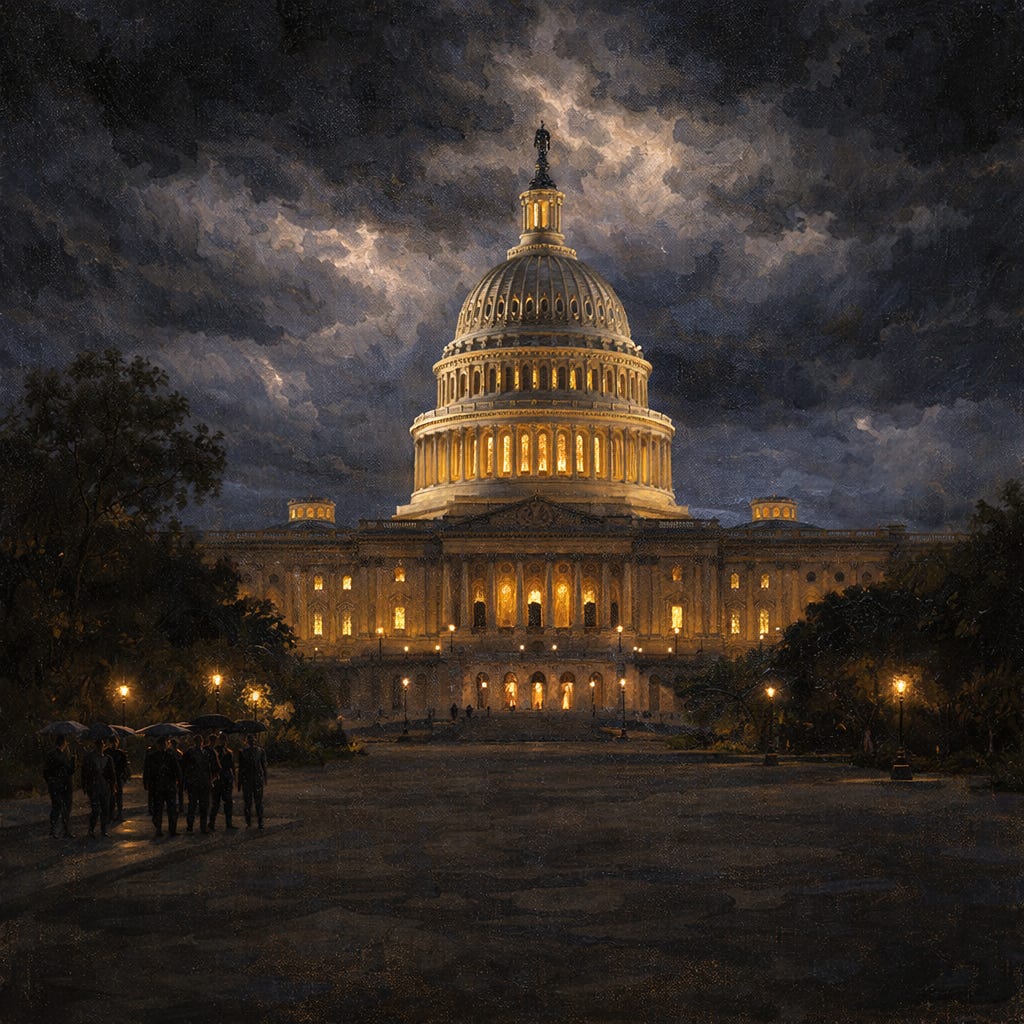
Part II Orientation
How Resistance Actually Holds
Part I was about lines.
Where they are. Why they matter. Why crossing them doesn’t preserve a democracy but finishes breaking it.
Part II begins somewhere quieter.
If restraint is the boundary, the next question isn’t dramatic. It’s practical.
What does resistance look like when it refuses violence, refuses panic, and refuses the false clarity of collapse?
The answer is rarely found in moments. It’s found in conditions.
Democracies don’t endure pressure because people feel inspired. They endure because power is slowed, divided, contested, recorded, and kept operating inside limits it didn’t choose. They endure because ordinary systems continue ordinary work even when national leadership turns erratic or coercive.
Part II is about those systems.
Not as theory. As lived reality.
Federalism. Coordination across states. Civil society. Legitimacy. Truth keeping. Mutual care. Ordinary participation. Time. Endurance. None of these feel like resistance if you’re expecting confrontation. All of them are resistance when the aim is to keep collapse from becoming irreversible.
This part doesn’t offer a plan. It offers orientation.
It doesn’t ask readers to do more than they can sustain. It asks them to recognize where they already stand, and why that ground still matters. It shifts attention from heroic acts to durable ones, from intensity to continuity.
That shift is intentional.
Authoritarian pressure feeds on exhaustion and impatience. It benefits when people believe only extreme measures count. Part II pushes back against that narrowing by showing how power is constrained not by spectacle, but by structure and persistence.
This is where resistance becomes legible to institutions. Where legitimacy is protected rather than spent. Where people remain inside their roles instead of abandoning them. Where civic life bends without breaking.
None of this guarantees success. It guarantees something more basic.
It keeps the future from closing too quickly.
Part II isn’t about winning.
It’s about holding.
Holding space.
Holding standards.
Holding one another steady long enough for correction to remain possible.
That’s the work this part takes up.
And it’s harder than it looks.
From Refusal to Orientation
What Discipline Makes Possible
Part I drew a boundary. It named what we won’t do, even under pressure. That boundary matters, but it isn’t the work itself. It’s the condition that makes the work possible.
Discipline doesn’t tell us what to build. It keeps us from tearing up the ground we’re standing on while we decide how to move. It turns refusal into orientation. It gives resistance shape instead of leaving it trapped in reaction.
Once retaliation is taken off the table, the question changes. It’s no longer how far we’re willing to go. It becomes where power still has to ask, where authority still depends on consent, and where civic life continues to function in ordinary ways. That shift is quiet, but it’s decisive.
Nonviolent resistance isn’t a single act or defining moment. It’s a system of pressure, delay, exposure, and care that unfolds over time. It works not by overwhelming power, but by complicating it. By forcing it to justify itself again and again. By slowing it down until its contradictions become visible to people who might otherwise turn away.
This kind of resistance depends on structure, not adrenaline or ideological purity. Structure is what allows people with different fears and commitments to remain in the same effort without turning against one another. It’s what keeps resistance from becoming spectacle or sliding into despair.
Orientation begins with a simple recognition. Power doesn’t reside in one place. It moves through institutions, laws, habits, professions, and routines. That means resistance can’t be centralized either. It has to be distributed, patient, and rooted in daily life.
This is where discipline shows its worth. It allows people to think in systems rather than moments. To ask not what feels satisfying today, but what preserves legitimacy tomorrow. To remain governable while challenging governance that has lost its bearings.
From here on, the work is less dramatic than many expect. It involves state authority used carefully. Courts that still bind. Elections that still matter. Institutions that still carry norms forward. Communities that choose care over collapse.
None of this guarantees success. But it keeps failure from becoming final.
Part II is about that ground. About how nonviolent resistance actually functions when it’s trying to preserve a democracy rather than burn one down. About the forms of pressure that remain when discipline holds. About where ordinary people still fit, not as heroes, but as stewards of a shared civic life.
The work ahead isn’t glamorous. It doesn’t reward speed or spectacle. It rewards clarity, patience, and coordination. It asks people to stay present long after the moment has passed.
That may not feel like power.
But it’s how power is made answerable.
Federalism as Lived Reality
Power That Still Has to Ask
Federalism is often treated as a constitutional idea. In moments like this, it’s better understood as a daily condition. It’s the way power encounters limits not on paper, but in practice. It’s how authority is forced to ask rather than simply declare.
In the American system, a great deal of power doesn’t flow from a single center. It’s spread across states, courts, agencies, professions, and local governments that operate close to people’s lives. That dispersion matters when national leadership becomes erratic or coercive, because it introduces friction into decisions that would otherwise move quickly and without challenge.
States control elections. They manage voter rolls, certify results, and run the machinery that turns participation into outcomes. They oversee courts that still bind people in real time. They set enforcement priorities. They govern education systems, health programs, licensing, and large portions of daily regulation. None of this is abstract. It shapes what people experience every day.
This is how federalism resists impulse. It forces power to move through layers. It slows directives down. It exposes them to scrutiny, delay, and contradiction. In doing so, it keeps authority visible. Power that has to justify itself repeatedly has fewer places to hide.
Federalism also creates choice. When one jurisdiction overreaches, others can refuse, reinterpret, or delay. That refusal doesn’t need to be dramatic to be effective. Often it’s administrative. Sometimes it’s procedural. Sometimes it’s nothing more than insisting that rules be followed exactly as written. These moves rarely generate headlines, but they shape outcomes.
This form of resistance doesn’t depend on protest cycles or constant mobilization. It’s embedded. A governor doesn’t need permission to act within state authority. A legislature doesn’t need a viral moment to pass a law. A court ruling still carries force regardless of attention. Federalism works even when the spotlight moves on.
It also preserves time. By slowing action, it prevents errors from becoming irreversible. It creates space for challenges to be filed, coalitions to form, and public understanding to catch up with decisions already underway. Time is one of the most overlooked resources in democratic resistance.
Federalism doesn’t guarantee virtue. It can be used for harm as easily as for restraint. But when power concentrates at the top, dispersion becomes protection. Not because it resolves the crisis, but because it keeps the crisis from closing every exit at once.
This is why centralized systems often move quickly to weaken or sideline states. Preemption. Funding threats. Legal pressure. Public humiliation of local officials. These are not signs of confidence. They’re signs that dispersion is creating friction.
Federalism isn’t a finish line. It doesn’t tell a society what it should become. What it does is hold ground. It keeps the civic structure uneven enough that domination remains difficult. It forces authority to contend with reality rather than command it outright.
In moments of strain, that unevenness isn’t a flaw. It’s a safeguard.
Federalism doesn’t defeat power. It makes power work harder.
And in times like this, making power work harder matters more than winning quickly.
Federalism’s Limits
Why Structure Alone Isn’t Enough
Federalism can slow harm. It can block overreach. It can force power to justify itself rather than act by impulse. What it can’t do on its own is resolve a crisis of legitimacy.
That limit has to be named plainly, because misunderstanding it leads to false comfort.
Federalism is structural resistance. It works through jurisdiction, procedure, and authority. It resists by creating friction, delay, and exposure. Those are real protections. But structure doesn’t generate meaning. It doesn’t rebuild trust. It doesn’t explain why restraint matters to people far from courtrooms and capitols.
A state can block a policy without persuading anyone. A court can halt an action without restoring confidence. A governor can refuse cooperation without creating a shared account of what’s being defended. Federalism can hold a line while the public drifts further apart.
This is where structure reaches its edge.
When federalism is treated as sufficient, it risks normalizing fragmentation. States begin to feel like islands of survival rather than parts of a shared civic project. People stop asking what holds them together and start asking only where they’re safest. Over time, resistance shifts from collective defense to jurisdictional shelter.
That shift carries real costs. National accountability weakens. Moral clarity becomes localized. Abuses are blocked in some places while becoming routine in others. The result isn’t resolution, but uneven endurance.
There’s also a political risk. When federalism becomes the primary answer to democratic strain, expectations drop. People begin to assume national dysfunction is permanent and that containment is the best that can be hoped for. Delay replaces repair. Survival replaces renewal.
None of this means federalism has failed. It means it was never meant to do this work alone.
Federalism is strongest when it operates as part of a broader effort. It buys time, but it doesn’t tell us how to use it. It preserves space, but it doesn’t fill it. Without coordination, culture, and legitimacy, structural resistance hardens into a holding pattern.
That’s why federalism has to be paired with forces that work across borders rather than within them. Shared action. Shared language. Shared standards that remind people they’re still part of the same civic experiment, even when power is uneven.
Structure can keep a democracy from collapsing quickly. It can’t, by itself, give people a reason to believe the democracy is still worth holding together.
Federalism holds the door open.
What walks through it determines what survives.
Civic Coordination Across States
When Resistance Becomes a Network
Federalism holds ground. Coordination gives that ground direction.
When states act alone, even principled resistance can appear parochial. A single governor’s refusal looks like defiance. A single court ruling looks like obstruction. A single legislature’s action looks partisan. Isolation makes resistance easier to dismiss, easier to pressure, and easier to mischaracterize.
Coordination changes that frame.
When states move in concert, resistance stops looking like a collection of local disputes and starts looking like a shared civic stance. Aligned action signals that something systemic is being contested, not merely a policy preference. It reframes resistance as continuity rather than rebellion.
This doesn’t require uniformity. It requires alignment.
Coordination works through pattern rather than spectacle. Similar laws passed across multiple states. Parallel legal challenges grounded in the same reasoning. Joint statements that use common language. Mutual aid agreements that protect elections, public services, or legal defense across jurisdictions. None of this needs attention to matter. Its force lies in repetition.
Aligned action also spreads risk. When one state acts alone, it absorbs the full weight of retaliation. When many act together, pressure diffuses. Legal threats lose focus. Funding leverage becomes harder to aim. Public narratives become more difficult to control. Coordination doesn’t remove danger, but it prevents isolation.
There’s a deeper function at work. Coordination restores scale.
Authoritarian pressure feeds on fragmentation. It thrives when resistance looks scattered and disconnected. Civic coordination counters that by reminding the public that they’re still part of a shared political life, even when national leadership is contested. It keeps the idea of a common civic project visible across borders.
This kind of coordination isn’t command driven. It doesn’t rely on a central authority or a single voice. In fact, it works best without one. Shared intent holds it together. States keep their authority. Institutions keep their independence. What changes is the awareness that actions belong to something larger than any single jurisdiction.
Coordination also strengthens legitimacy. When resistance is synchronized, it becomes easier for courts, institutions, and the public to recognize it as defense of norms rather than a struggle for advantage. Patterns communicate steadiness. They suggest continuity rather than crisis.
None of this is fast. Coordination takes patience. It requires communication across difference. It asks leaders to think beyond local timelines. That slowness is part of its strength. It resists impulse by design.
Civic coordination doesn’t replace federalism. It extends it. It turns dispersion into coherence without erasing independence. It makes resistance durable enough to outlast a single confrontation.
When resistance becomes a network, power has to respond differently. It can still pressure, still threaten, still distort. What it can’t easily do is claim the challenge is isolated or fleeting.
That shift matters.
Because legitimacy grows where alignment holds, and alignment is what keeps a strained democracy from forgetting that it’s still one.
Institutions That Translate Resistance into Daily Life
Civil Society as the Second Line
Federalism can slow harm. Coordination can align response. But neither reaches people where they actually live. That work belongs to civil society.
Civil society is where resistance leaves theory and enters daily life. It sits between the state and the individual, carrying norms through practice rather than decree. When it holds, pressure is absorbed instead of released all at once.
Universities do this when they defend academic standards rather than bend to ideological loyalty. Labor organizations do it when they protect workers without turning every dispute into performance. Faith communities do it when they root moral language in responsibility rather than dominance. Professional associations do it when they uphold ethics even when silence would be easier.
None of this looks dramatic. That’s why it matters.
Civil society turns resistance into habit. It translates shared commitments into ordinary expectations. It allows people to act with integrity inside their roles rather than imagining resistance as something reserved for streets or headlines.
This layer matters because it keeps participation wide. Not everyone can protest. Not everyone can litigate. Not everyone can relocate to a safer jurisdiction. But almost everyone belongs to some institution, some profession, some community that carries standards forward. Civil society gives people places to stand without demanding heroics.
It also slows escalation. Institutions that enforce standards create friction against impulse. They give people language for refusal that doesn’t sound like defiance. They offer cover for conscience. When civil society holds, fewer conflicts jump from disagreement straight into confrontation.
Civil society preserves continuity as well. Movements rise and fall. Elections cycle. Institutions endure. They carry memory. They teach what conduct is acceptable long after the moment that tested it has passed. In periods of strain, that continuity matters more than enthusiasm.
This doesn’t mean civil society is immune to pressure. It can be pushed, polarized, and weakened. But when it resists capture, it does so quietly, through standards, accreditation, contracts, ethics rules, and shared expectations that are difficult to dismantle without exposing intent.
That quiet resistance often lasts longer than public defiance. It doesn’t invite emergency response. It doesn’t reward spectacle. It forces power to confront limits without handing it an excuse to declare crisis.
Civil society is also where legitimacy is renewed. When people see institutions behave responsibly under strain, trust doesn’t need to be argued for. It’s observed. That observation spreads through communities and professions, rebuilding confidence without proclamation.
This is why civil society functions as a second line. It doesn’t replace law. It reinforces it. It doesn’t substitute for politics. It keeps politics human.
Without this layer, resistance thins and fractures. With it, resistance becomes livable.
And when resistance is livable, it lasts.
Legitimacy as Power
Why Nonviolence Pulls Institutions Inward
Legitimacy isn’t a mood or a moral pose. It’s a working force.
It shapes who institutions listen to, who courts are willing to protect, who allies choose to stand beside, and who the public believes deserves a hearing. In periods of strain, legitimacy becomes one of the few forms of power that can still move across division without tearing it wider.
Nonviolent resistance works because it preserves legitimacy under pressure.
Institutions are cautious by design. Courts, regulators, professional bodies, and much of the press respond less to volume than to credibility. They move when their own standing feels implicated. Legitimacy creates that condition. It frames resistance as defense of shared norms rather than a struggle for dominance.
Violence does the opposite. It drains legitimacy quickly. Once harm enters the picture, institutions retreat. They narrow their scope. They protect themselves. Even those sympathetic to the cause pull back, not because their beliefs have changed, but because proximity begins to carry risk.
That’s why nonviolence draws institutions inward. It gives them room to act.
A court can rule without fear of escalation. An official can refuse cooperation without appearing reckless. A professional body can enforce standards without inviting retaliation. A journalist can document abuse without being accused of incitement. These actions become possible when resistance looks responsible rather than volatile.
Legitimacy also widens participation. People are far more willing to stand near a cause when they don’t fear being absorbed into its most extreme expressions. Nonviolence keeps that door open. It allows people who can’t risk everything to still take part. That breadth matters more than intensity.
It also shapes time. Institutions don’t shift all at once. They respond to patterns, not moments. Nonviolent resistance sustains those patterns. It shows steadiness under strain. It signals that the goal isn’t disruption for its own sake, but continuity of civic life.
Over time, that steadiness compounds. Each lawful refusal, each upheld standard, each documented abuse adds weight. Gradually, power that once acted freely begins to hesitate. Not because it’s been overwhelmed, but because it’s been exposed.
Legitimacy doesn’t make resistance easy. It makes it durable.
It demands restraint when release would feel better. It asks people to accept slower feedback. It requires confidence that credibility accumulates even when results aren’t immediate. That patience isn’t passive. It’s deliberate.
Many movements fail by treating legitimacy as ornament rather than substance. They spend it early for attention or emotional relief. Once it’s spent, it’s difficult to recover. Institutions remember volatility long after slogans disappear.
Nonviolence protects legitimacy by refusing shortcuts. It keeps resistance readable to systems that still matter. It invites institutions to choose alignment without pushing them into siege posture.
That invitation doesn’t guarantee acceptance. But without it, refusal becomes far more likely.
In moments like this, legitimacy isn’t an accessory to resistance.
It’s the leverage that allows resistance to keep working when everything else begins to give way.
Information, Truth, and Narrative Stability
Keeping Reality Coherent
Resistance fails when reality can’t hold together.
That failure rarely arrives as censorship alone. It arrives as confusion. As saturation. As contradiction piled so high that people stop trying to tell what’s true from what’s merely loud. When reality fractures this way, power doesn’t need to persuade. It only needs to exhaust.
This is why information stability matters.
Democracies depend on shared reference points. Not agreement on everything, but a common understanding of what happened, what is happening, and what rules still exist. When those reference points erode, disagreement stops being productive and starts becoming corrosive. People argue past one another because they’re no longer standing on the same ground.
Authoritarian pressure exploits this weakness deliberately. It floods the field. It blurs fact with speculation. It treats contradiction as evidence that nothing can be known with confidence. In that environment, truth doesn’t need to be disproven. It only needs to be buried under noise.
Nonviolent resistance responds by doing less, not more. It slows circulation rather than amplifying it. It values accuracy over immediacy. It favors documentation over declaration. It understands that credibility grows through consistency, not volume.
This is where journalists, researchers, archivists, librarians, and ordinary witnesses matter more than commentators chasing attention. Their work doesn’t excite. It endures. They verify claims. They preserve records. They establish timelines. They make accountability possible later, even when it’s inconvenient now.
Truth also needs anchoring at the local level. Town meetings. School boards. Court filings. Professional reviews. Small, unglamorous processes where facts are entered into the record and can’t be erased by the next cycle of outrage. These spaces hold reality steady when national discourse begins to drift.
Resistance weakens when it treats every claim as urgent and every moment as decisive. That posture rewards distortion. It trains people to react instead of assess. Over time, it produces cynicism rather than clarity.
Narrative stability doesn’t mean controlling the story. It means refusing to let the story dissolve.
That refusal takes discipline. It means not sharing what can’t be confirmed. It means correcting allies as well as opponents. It means accepting that some truths move slowly because they’re being carried carefully.
This kind of restraint doesn’t feel powerful. It doesn’t gather applause. But it creates something more durable. It preserves a world where facts still matter and where institutions can still act on them.
When reality holds, legitimacy has somewhere to land. Courts can rule. Investigations can proceed. Memory can form. Without coherence, even principled resistance loses its footing.
Truth doesn’t need to shout. It needs to remain intact.
Keeping it that way isn’t secondary work. It’s resistance at its most basic.
Because once reality collapses, everything else follows.
Mutual Aid and Community Protection
Care as Civic Infrastructure
Resistance that can’t meet basic human needs doesn’t last.
People don’t remain engaged when their lives become unmanageable. They don’t defend systems that leave them exposed under strain. Fear and desperation don’t produce civic resolve. They produce withdrawal, resentment, and fracture. Mutual aid exists to interrupt that slide.
This isn’t charity. It’s stabilization.
Mutual aid is how communities support one another when formal systems are uneven or stretched thin. Food distribution. Childcare networks. Legal defense funds. Transportation for medical care or voting access. Shared resources that allow people to keep participating without sacrificing survival. These efforts don’t replace institutions. They keep people connected to them.
That distinction matters.
When aid presents itself as replacement, it signals breakdown. When it functions as reinforcement, it signals continuity. Mutual aid works best when it supports civic participation rather than pulling people out of public life. It buys time, dignity, and breathing room so fear doesn’t become the organizing principle.
Community protection follows the same logic. It isn’t about confrontation. It’s about presence. Neighbors watching out for one another. Calm information sharing. Making sure vulnerable people aren’t isolated or singled out. These actions lower panic by reducing isolation and uncertainty.
Care also blunts radicalization.
When people feel supported, they’re less likely to be pulled toward extreme responses. Despair makes violence feel tempting because it promises release. Mutual aid offers something steadier. It says you’re not alone, and you don’t need to destroy everything to matter.
This work rarely announces itself as political. That’s part of its strength.
Mutual aid builds legitimacy where statements can’t. It shows values through action. It demonstrates that resistance isn’t only about stopping harm, but about sustaining life together while harm is being challenged. People trust what they can see holding.
It also creates crosscutting ties. Aid networks often bring together people who don’t share ideology but do share need. Those connections rebuild social fabric without demanding agreement first. They remind people that civic life isn’t only about argument, but about care in the meantime.
None of this is dramatic. It doesn’t scale cleanly. It requires patience, coordination, and humility. It asks for consistency rather than spectacle. That’s why it endures.
Mutual aid doesn’t resolve political crises. It keeps them from turning into human disasters. It preserves the conditions under which nonviolent resistance can continue without sliding into despair or rage.
Care isn’t a distraction from resistance.
It’s one of the ways resistance stays human.
And resistance that forgets how to care won’t hold for long.
The Role of the Ordinary Citizen
Participation Without Heroics
Most democratic work is done by people who never feel like they’re doing anything important.
They aren’t leading marches. They aren’t writing manifestos. They aren’t courting attention. They’re showing up where they already are and refusing to abandon the standards that keep public life workable.
That kind of participation rarely looks like resistance. It looks like staying.
Ordinary citizens matter because democracies don’t collapse only from pressure at the top. They erode when people decide their presence no longer matters. When disengagement feels safer than involvement. When withdrawal becomes the quiet norm.
Nonviolent resistance depends on pushing back against that drift.
Not by asking for more courage than people can carry, but by asking for consistency. Voting when voting still matters. Serving on boards and committees no one praises. Taking notes at local meetings. Insisting on due process at work. Speaking plainly when rules are bent and choosing refusal when silence would be easier.
None of this looks dramatic. That’s why it holds.
Democracy is sustained by routines, not by moments. By people who return even when outcomes disappoint. By those who keep records, follow procedure, and keep asking questions long after the room has grown tired of hearing them.
This kind of participation spreads risk rather than concentrating it. When many people act within their roles, no single person carries the full burden. Pressure diffuses. Retaliation becomes harder to aim. Legitimacy thickens through repetition.
Ordinary participation also keeps resistance readable. Institutions respond more readily to steady presence than to bursts of outrage. Courts notice patterns. Boards respond to persistence. Records accumulate. None of that happens without people willing to stay put.
There’s a moral dimension here that’s easy to miss. Participation without heroics protects people from burnout and despair. It doesn’t ask them to become symbols. It asks them to remain citizens.
That matters because movements fail as often from exhaustion as from repression. When resistance depends on intensity, it burns people out quickly. When it depends on steadiness, it lasts.
No one has to do everything. Everyone has to do something that fits their life and their limits. That balance keeps participation honest rather than performative.
The strength of nonviolent resistance lies in its ability to be carried by ordinary people without breaking them. When citizenship becomes sustainable, democracy gains time.
And time, as much as courage, is what keeps a future possible.
Time, Patience, and Endurance
Why This Takes Longer Than We Want
One of the hardest realities to accept in periods of strain is that effective resistance rarely moves at the speed of outrage.
Democratic systems weren’t built for rapid correction. They were built to slow harm, absorb disagreement, and prevent mistakes that can’t be undone. That design can feel unbearable when pressure is constant and consequences feel close at hand. But the slowness isn’t a defect. It’s part of what keeps damage from becoming permanent.
Impatience is understandable. It’s also risky.
When people decide that if something doesn’t work quickly, it isn’t working at all, they start reaching for actions that feel decisive rather than those that hold. Duration gets mistaken for failure. Endurance gets mislabeled as passivity. Escalation starts to look like seriousness. That confusion weakens resistance from within.
Nonviolent resistance works across time rather than against it.
It builds pressure gradually. It exposes contradictions through repetition rather than shock. Each refusal, each upheld standard, each preserved record may feel small on its own. Taken together, they change the conditions under which power operates.
This is why patience matters. Not as waiting, but as persistence.
Endurance means staying present after the moment passes. It means returning when attention fades. It means continuing the work when there’s no immediate reward and no clear signal that anything has shifted. That kind of steadiness is difficult to maintain, which is why it carries weight.
Power often overreaches not in response to confrontation, but in response to sustained friction. When pressure doesn’t dissipate, when legitimacy doesn’t collapse, and when resistance remains orderly, authority begins to slip. Decisions get rushed. Justifications conflict. Intent shows itself. None of that follows a schedule.
Endurance also protects people.
Movements that demand constant intensity exhaust their participants. They narrow who can stay involved. Over time, they thin themselves out. Resistance that respects human limits lasts longer and reaches wider, not because it asks less of people, but because it asks what can be given without breaking them.
Patience preserves judgment as well. It keeps setbacks from being mistaken for endings. It leaves room for correction, learning, and adjustment. It holds the future open rather than forcing conclusions too early.
This isn’t comfort. It’s orientation.
Nonviolent resistance isn’t a rush toward resolution. It’s the effort to keep civic life intact long enough for correction to occur. That requires time. It requires people willing to stay when leaving would feel easier.
Endurance isn’t dramatic. It rarely feels powerful in the moment. But over time, it shapes outcomes more reliably than urgency ever has.
If democracy survives periods like this, it won’t be because someone moved fastest.
It will be because enough people stayed.
Holding the Line Without Losing Ourselves
What This Form of Resistance Is For
By now, it should be clear that what’s being described here isn’t a tactic. It’s a posture.
Federalism, coordination, civil society, legitimacy, truth keeping, mutual aid, ordinary participation, patience. These aren’t tools to be picked up one at a time. They’re conditions that overlap and reinforce one another. Together, they make nonviolent resistance possible without turning it into performance or despair.
They answer a single question.
How people resist without becoming what they oppose.
That question matters more than it first appears. Democratic collapse doesn’t happen only when power concentrates. It also happens when resistance sheds restraint and begins to mirror the logic it claims to reject. When urgency justifies cruelty. When fear licenses shortcuts. When damage along the way is excused as necessary.
This form of resistance refuses that trade.
It accepts limits. It works through institutions rather than around them. It chooses steadiness over spectacle. It treats legitimacy as something to be guarded, not spent. It understands that means shape outcomes long before outcomes arrive.
That doesn’t make it soft. It makes it serious.
Serious resistance isn’t only about stopping a particular abuse or outlasting a particular administration. It’s about preserving a civic life capable of repair. A public culture where disagreement doesn’t automatically turn into domination. A system that can still correct itself without tearing apart the people living inside it.
This is why violence isn’t a shortcut here. It’s a rupture.
Once resistance abandons restraint, it narrows who can participate. It pushes institutions into self protection. It fractures legitimacy. It speeds up the very dynamics it claims to resist. Even when it begins in desperation, it ends by giving away ground that’s difficult to recover.
Nonviolent resistance isn’t chosen because it’s pure. It’s chosen because it keeps more doors open for longer.
It allows people to stay inside their roles. It keeps institutions engaged rather than cornered. It sustains participation without demanding sacrifices only a few can afford. It holds a shared civic world together even while that world is under strain.
This is what it means to hold the line without losing ourselves.
Not to freeze. Not to retreat. But to refuse escalation that would hollow out the very thing being defended.
Part III moves into more difficult territory. It looks directly at moments when peaceful resistance breaks down, when institutions fail, and when choices narrow. It does so not to glorify rupture, but to understand it clearly, so it isn’t stumbled into blindly.
For now, what matters is this.
Resistance isn’t only about pressure. It’s about preservation.
And the form of resistance that preserves the most is the one that leaves the widest future behind it.
Where This Leaves Us Now
Orientation, Not Resolution
Part II doesn’t resolve anything. That’s deliberate.
What it offers is orientation. A way of seeing where resistance actually lives when dramatic options feel tempting and simple answers feel thin. It names the ground that still exists beneath the noise and asks the reader to notice where power is slowed, shared, checked, and quietly resisted in ordinary life.
Nothing here promises relief. It promises coherence.
Federalism holds space. Coordination gives that space shape. Civil society keeps it livable. Legitimacy protects it. Truth keeps it intact. Care sustains it. Ordinary participation carries it forward. Time gives it weight. None of these on their own end a crisis. Together, they keep collapse from becoming unavoidable.
That matters because confusion often pushes people toward extremes not out of conviction, but out of fatigue. When options feel narrowed, escalation begins to look like clarity. Violence starts to feel decisive. Breakdown starts to feel honest.
This section exists to resist that narrowing.
It insists that restraint isn’t denial, patience isn’t surrender, and nonviolence isn’t avoidance. It treats them as disciplines suited to holding a shared civic life together under strain.
That framing is the work.
If Part I was about why certain lines must not be crossed, and Part II about how resistance functions without crossing them, then what remains is the edge. The place where institutions falter, coordination thins, and restraint is tested by conditions that don’t wait for ideal timing.
That’s the territory Part III enters.
Not to praise rupture. Not to offer instruction for violence. But to examine, without romance or panic, how societies reach those moments, what signals appear beforehand, and what is lost when peaceful resistance gives way to something else.
For now, this is enough.
There is still room to act without becoming unrecognizable.
There are still ways to resist without destroying what we’re trying to protect.
There is still time to choose opposition that leaves something worth inheriting.
Part II ends here because endurance doesn’t need a crescendo.
It needs clarity.
And clarity is what allows people to continue when nothing feels settled yet.
Coda
What Still Holds
Nothing in this part promises rescue.
What it offers is a view of what still holds when certainty thins and shortcuts begin to look attractive. It shows that resistance doesn’t live only in moments of refusal, but in habits of restraint that keep the ground from giving way all at once.
Power presses hardest when people are led to believe they have only two choices. Submission or rupture. Silence or violence. Obedience or chaos. That narrowing isn’t accidental. It’s how control speeds up.
Part II exists to widen the frame again.
It reminds us that some forms of opposition don’t announce themselves, but still matter. That there is strength in remaining inside the work rather than abandoning it. That preservation isn’t passivity, and patience isn’t surrender.
What holds isn’t any single institution or strategy. It’s the accumulation of limits. The refusal to abandon standards. The decision to keep reality intact. The choice to care for one another without turning care into display.
This kind of resistance doesn’t feel heroic. It feels repetitive. Sometimes it feels dull. Often it feels unseen.
That’s why it lasts.
When systems bend without breaking, when people stay without hardening, when legitimacy isn’t traded for speed, something important remains. Not triumph. Possibility.
Part II closes without resolution because resolution isn’t the measure here.
What matters is whether the civic fabric still exists when pressure eases.
Whether there’s something left to repair.
Whether we have kept enough of ourselves intact to recognize the moment when repair becomes possible again.
That’s the quiet work.
And for now, it’s enough.
What Comes Next in Part III
Part II has been about what still works, and where lawful resistance still holds. It has argued that legitimacy, restraint, coordination, and care remain real sources of power as long as they’re practiced and defended.
Part III turns to what happens when those conditions begin to thin. Not everywhere. Not all at once. Quietly, unevenly, and without notice. It looks at how legitimacy erodes, how coercion replaces consent, and how ordinary civic tools lose their reach.
This is not a call to escalation. It’s an effort to name the point at which endurance, not success, becomes the moral task. Part III asks what responsibility looks like when the scaffolding weakens, and whether we can recognize that moment before misreading it carries a permanent cost.
Please Support the Work
Light Against Empire is free for all. If my words have value to you and you’re in a position to help, you can chip in with a monthly or yearly donation. Your support keeps the writing alive, the lights on, and the fire burning.
Further Reading:


