


“What was done cannot be undone, but it can be prevented from happening again.”— Primo Levi
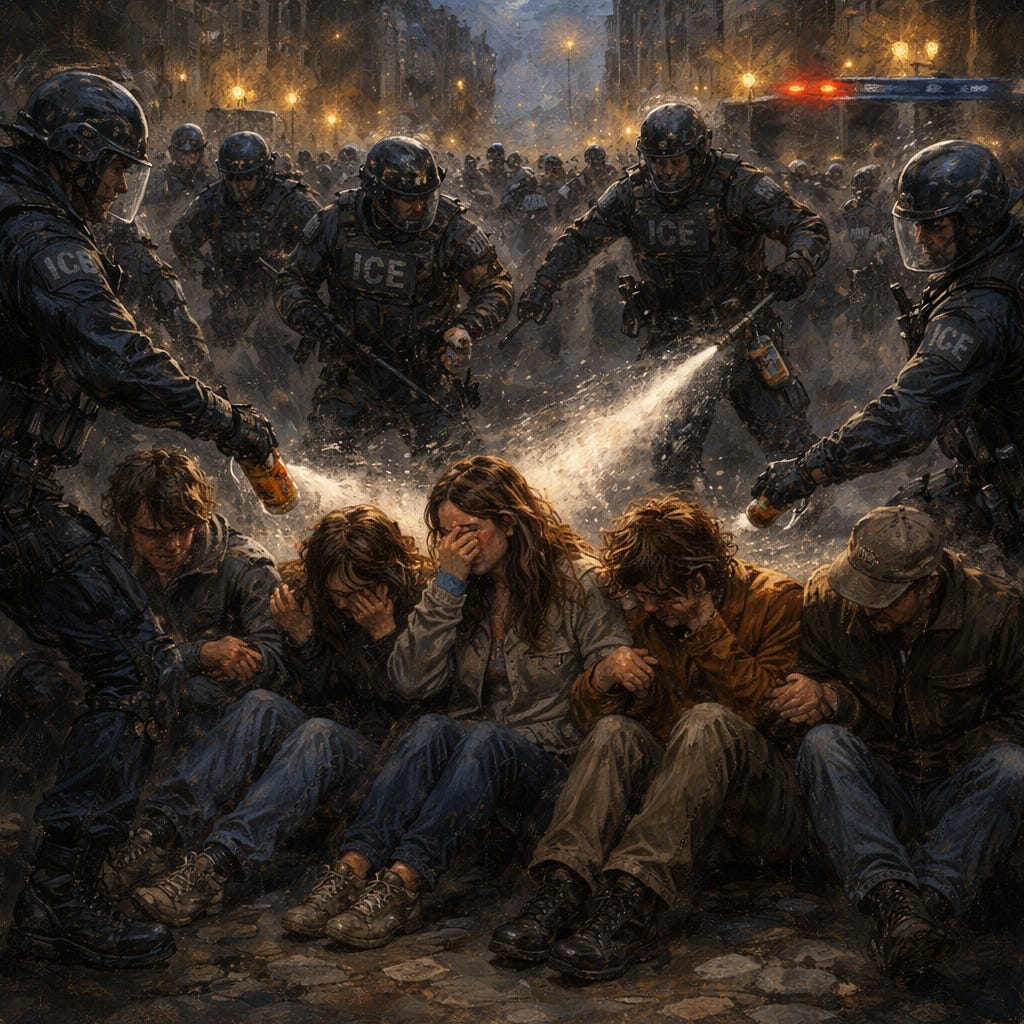
Orientation
Why This Part Exists at All
This part exists because refusing violence isn’t the same thing as refusing to think clearly about failure.
Parts I and II argued for restraint, structure, and endurance. They made the case that nonviolent resistance isn’t moral theater, but the only form of opposition that preserves legitimacy, participation, and the possibility of repair.
Part III begins where that framework is tested.
Not because violence is inevitable. Not because collapse is prewritten. But because systems fail in ways that aren’t announced, and people often cross irreversible thresholds without recognizing them as such.
Naming those thresholds isn’t an invitation to cross them.
It’s a way to strip away romance, panic, and false clarity before they do their damage.
This section doesn’t offer instruction. It doesn’t rehearse tactics. It doesn’t treat rupture as cleansing or courageous. It examines what changes when peaceful resistance stops working, not as a decision, but as a condition shaped by institutional breakdown, selective enforcement, and the narrowing of lawful options.
The purpose here is diagnostic.
To understand how escalation actually unfolds.
To see what is lost before it’s fully gone.
To recognize limits that don’t announce themselves.
Most societies don’t slide into internal conflict because restraint suddenly disappears. They slide because restraint becomes harder to sustain while alternatives begin to feel unavoidable. That feeling is often mistaken for reality.
This part is meant to interrupt that mistake.
It looks at how legitimacy collapses unevenly. How participation narrows. How institutions withdraw rather than confront. How violence, once introduced, reshapes who can stand where, and at what cost. The focus stays on consequence rather than justification, on inheritance rather than outcome.
Nothing here is meant to prepare anyone for confrontation.
It’s meant to prepare the reader to recognize when the ground is shifting, and to understand why holding the line matters long before it appears to fail.
If Parts I and II asked how to remain inside democratic resistance without losing ourselves, Part III asks a harder question.
What happens when that effort breaks down, and what responsibility remains even then?
This part doesn’t answer that question with certainty.
It answers it with clarity.
And clarity, at the edge, is the difference between choosing and drifting.
That’s why this part exists.
When Nonviolence Fails Structurally
Not as Choice, but as Condition
Nonviolent resistance rarely fails because people abandon it.
More often, it fails because the conditions that allow it to work begin to give way.
That distinction matters. Discussions of escalation often assume a moral turning point. A moment when restraint is rejected and force is chosen. A conscious crossing of a line. In practice, the breakdown of nonviolence is usually structural rather than intentional.
Institutions stop responding.
Processes stop binding.
Rules remain written but no longer constrain action.
None of this requires anyone to change their stated beliefs.
Courts can continue to exist while their rulings are ignored or enforced selectively. Elections can still be held while their outcomes no longer limit power. Laws can remain on the books while their application depends on affiliation rather than obligation. In these conditions, nonviolent resistance doesn’t lose its moral standing. It loses its leverage.
That loss is incremental.
At first, enforcement becomes delayed. Then exceptions multiply. Then compliance becomes conditional. Each step is framed as temporary. Each step is justified as necessary. Together, they alter what resistance can realistically achieve without anyone declaring a break.
This is how peaceful resistance begins to fail without anyone choosing violence.
The danger here isn’t frustration alone. It’s misreading the cause.
When structural failure is mistaken for insufficient resolve, people are pushed toward escalation as if effort were the missing element. More pressure. More disruption. More intensity. When that still doesn’t produce results, the logic hardens. If nothing else works, force starts to feel like the only honest option left.
But the problem was never effort.
It was capacity.
Nonviolent resistance depends on institutions that still respond to legitimacy. It relies on enforcement mechanisms that remain tied to rules rather than loyalty. It assumes that refusal produces consequence. When those assumptions stop holding, the ground shifts beneath the entire framework.
That doesn’t mean nonviolence was naive.
It means it was conditional.
Every democratic system carries a threshold below which peaceful resistance can operate and beyond which it begins to lose traction. That threshold isn’t announced. It isn’t marked by a single event. It’s crossed through accumulation.
Ignored rulings.
Unanswered oversight.
Selective prosecution.
Unpunished violations.
Each weakens the feedback loop that nonviolent resistance requires.
Understanding this matters because it reframes responsibility.
When nonviolence falters under structural breakdown, the cause isn’t moral failure among citizens. It’s institutional withdrawal. Power stops answering to restraint not because restraint failed, but because the mechanisms that translated restraint into consequence were hollowed out.
Naming that difference doesn’t justify escalation.
It clarifies what’s actually breaking.
Part III begins here because this is the moment most often misunderstood. The moment when people sense that something essential has shifted but can’t yet name it. The moment when escalation starts to feel less like a choice and more like gravity.
Seeing that moment clearly doesn’t make it safe.
But it does make it visible.
And visibility is the only thing that keeps drift from being mistaken for destiny.
The Illusion of the “Last Resort”
How Violence Gets Framed as Inevitable
Violence rarely enters a society as a decision.
It enters as a story.
More specifically, it enters as the story of the last resort. The claim that every other option has been tried, that restraint has been exhausted, that no alternatives remain. By the time this story settles in, violence doesn’t feel chosen. It feels imposed.
That feeling carries force. It also misleads.
The language of last resort implies a clean progression. First dialogue. Then protest. Then law. Then resistance. Then, finally, force. But this sequence almost never exists. What exists instead is a slow narrowing of imagination.
Options don’t vanish all at once. They’re discounted. Deferred. Treated as pointless. Labeled naive. Over time, restraint begins to sound unserious, even dishonest. Escalation starts to feel like the only candid response left.
This is how inevitability gets constructed.
The last resort story shifts responsibility. It moves agency away from those escalating and places it onto circumstance itself. No one chooses violence. Violence simply arrives because nothing else could work. Once framed this way, hesitation looks like denial rather than judgment.
But inevitability isn’t a condition. It’s an argument.
And it’s often made early, not late.
Groups that escalate rarely wait until every nonviolent avenue is closed. They escalate when patience thins, when legitimacy moves slowly, when outcomes don’t match urgency. The last resort story then cleans up that impatience by recasting it as necessity.
This matters because once violence is framed as unavoidable, deliberation collapses.
Questions about consequence start to sound like stalling. Concerns about legitimacy begin to feel indulgent. Warnings about loss get dismissed as fear. The story does its work by shrinking the range of acceptable thought.
It also hides how escalation actually unfolds.
There is rarely a single turning point. There are thresholds. Small steps that feel reversible. Acts described as symbolic. Responses framed as defensive. Each step is justified by the one before it. Each step lowers resistance to the next.
By the time violence feels unavoidable, it has already been normalized.
The danger of the last resort narrative isn’t only that it excuses violence. It’s that it conceals how many moments of choice still existed along the way. It turns accumulation into fate.
Part III refuses that disguise.
Not to deny desperation. Not to minimize injustice. But to keep responsibility visible. Violence doesn’t arrive as destiny. It arrives when enough people accept the claim that nothing else counts anymore.
That claim spreads quickly. It rewards certainty over judgment. It offers emotional clarity at the cost of future possibility.
Seeing this pattern clearly doesn’t prescribe action.
It identifies which stories deserve suspicion.
Because once the language of last resort takes hold, the ground has already begun to move.
And noticing that movement early is one of the few ways it’s ever been slowed.
What Changes the Moment Violence Enters
Legitimacy, Institutions, and the Closing of Doors
The most consequential shift that occurs when violence enters isn’t tactical. It’s relational.
The moment violence becomes plausible, the civic field reorganizes. Institutions recalibrate. Neutral actors pull back. Standards tighten unevenly. What had been a contested public space begins to behave like a risk environment.
This happens quickly.
Institutions don’t wait for violence to occur. They respond to its likelihood. Courts narrow what they’ll hear. Agencies reduce discretion. Professionals become cautious about association. Even those sympathetic to resistance begin to step back, not because their views have changed, but because the cost of proximity rises.
Legitimacy begins to drain before the first act is carried out.
This is one of the hardest realities to accept. Violence doesn’t only confront power. It closes doors that restraint had kept open. Once escalation enters the picture, institutions shift from judgment to self protection. They stop weighing claims and start managing exposure.
That shift isn’t neutral.
Those already holding power adapt more easily to constrained environments than those challenging it. They control enforcement, resources, and narrative channels. When institutions pull inward, imbalance widens. The field becomes harder to contest, not easier.
Participation narrows at the same time.
People who could engage under nonviolent conditions begin to step aside. Not from fear alone, but from calculation. Parents. Professionals. local officials. Community leaders. Once risk crosses a threshold, staying involved no longer feels responsible. Resistance that once included many becomes the burden of a few.
That narrowing alters outcomes.
Broad participation gives legitimacy weight. Narrow participation concentrates it. The loss isn’t only numerical. It’s qualitative. Voices that anchor resistance in everyday life fade. What remains is more intense, but less representative.
Violence also simplifies narratives in ways that favor authority.
Complex failures get reduced to order versus disorder. Structural breakdown gets reframed as threat. Demands for accountability get recast as instability. Once violence enters the frame, power no longer needs to argue. It only needs to restore calm.
This is how escalation strengthens the dynamics it claims to oppose.
None of this suggests institutions are virtuous. It suggests they’re cautious. They respond to risk before they respond to justice. When violence becomes plausible, that caution hardens into withdrawal.
The harm isn’t only that doors close.
It’s that they close unevenly.
Some actors retain access. Others lose it entirely. Legitimacy fragments. Authority consolidates. The space for lawful contest contracts, often for longer than expected.
This is why legitimacy mattered so much in Part II. Not as moral signaling, but as operating ground. Once that ground gives way, recovery becomes far harder than escalation ever seemed.
Violence doesn’t simply add force to a struggle.
It rearranges who can stand where.
And once that rearrangement occurs, many of the paths back are no longer available.
Fragmentation as the Real Danger
Civil Conflict Rarely Looks Like Civil War
When people imagine internal conflict, they tend to imagine fronts.
Two sides. Clear lines. A beginning that can be dated and an ending that can be named. That picture is powerful, and it’s largely wrong.
Most modern internal conflict doesn’t arrive as civil war. It arrives as fragmentation.
Authority breaks unevenly. Rules apply in some places and not in others. Enforcement depends on who you are and where you stand. Daily life continues, but under assumptions that shift without settling. There is no declaration. There is no unified battlefield. There is only drift.
Fragmentation is harder to recognize because it feels familiar.
Schools still open. Courts still operate. Elections may still be held. But outcomes lose consistency. Decisions lose coherence. Trust thins quietly. People begin adjusting behavior not according to law, but according to expectation. What matters is no longer what applies to everyone, but what will be tolerated here, today.
This is how civic life comes apart without dramatic rupture.
Power becomes local and informal. Authority moves downward and sideways. Rules become negotiable. Protection becomes personal. The guiding question changes from what binds us all to what keeps me safe right now.
That change reshapes how people relate to one another.
Neighbors stop assuming shared standards. Institutions stop assuming compliance. Disagreement stops moving through common procedures and starts being managed through avoidance or dominance. The space between people fills with calculation.
When violence appears in this environment, it doesn’t unify conflict. It multiplies it.
Instead of clarifying sides, it creates pockets of instability. Isolated incidents. Retaliatory acts. Selective enforcement. Each one deepens mistrust without resolving anything. Each one provides justification for further withdrawal.
This is why fragmentation is more dangerous than confrontation.
In a fragmented setting, there is no center strong enough to absorb shock. There is no shared authority capable of enforcing limits evenly. There is no common account robust enough to restore trust. What exists instead is a patchwork of realities that don’t quite align.
That patchwork hardens over time.
People learn which rules still apply and which don’t. They learn where to speak and where to stay quiet. They learn which institutions still function and which are symbolic. Survival replaces participation. Adaptation replaces judgment.
None of this requires widespread violence.
It requires inconsistency.
And once fragmentation takes hold, repair becomes far harder than resistance ever was. It’s easier to keep a system intact under pressure than to piece it back together after coherence is lost.
This is the real danger at the edge.
Not open conflict, but the quiet collapse of shared ground.
Not war, but a civic landscape where nothing binds evenly and no one feels fully protected.
Fragmentation doesn’t announce itself as failure.
It presents itself as normal life, slowly adjusted.
And by the time it’s recognized for what it is, much of what made repair possible has already slipped away.
The Moral Injury of Escalation
What Violence Does to the People Who Carry It
Violence doesn’t only alter outcomes.
It alters the people who commit it, support it, or live alongside it.
That alteration often begins before the first act occurs.
As escalation becomes thinkable, moral language shifts. Acts that once felt unallowable begin to feel necessary. Harm gets reframed as response. Damage gets described as cost. The inner work of justification starts quietly, well before anything public happens.
This is where moral injury forms.
Moral injury isn’t guilt. It’s fracture. It’s the break that occurs when people act against the standards they once relied on to know who they were. Unlike shame, which seeks repair, moral injury often seeks dulling. Judgment becomes painful, so it gets muted.
Escalation speeds this process.
Once violence is treated as justified, restraint starts to look like betrayal. Doubt becomes suspect. Hesitation reads as weakness. The moral field narrows until loyalty becomes the primary measure of worth. In that environment, harm doesn’t feel tragic. It feels required.
That narrowing doesn’t end when violence pauses.
People carry it forward. The thresholds lowered under pressure don’t rise back easily. What once shocked begins to feel ordinary. This is why societies that pass through violent periods struggle afterward not only with rebuilding institutions, but with restoring moral trust.
The damage isn’t evenly distributed.
Those closest to the violence carry the heaviest burden. Not only those who act, but those who watch, who endorse, who remain silent out of fear. Moral injury spreads sideways. It reshapes communities, not just individuals.
This is one of the costs rarely counted when escalation is discussed in abstract terms.
Violence promises clarity. It seldom delivers it. What it delivers instead is simplification. Complex realities collapse into friend and enemy. Responsibility gives way to alignment. Judgment is replaced by the demand to choose sides.
That replacement can feel stabilizing at first.
Over time, it corrodes the inner life.
People who’ve learned to justify harm struggle to return to ordinary civic engagement. Disagreement feels threatening. Compromise feels dishonest. The patience required for shared governance feels unbearable. What was once exceptional becomes baseline.
This is why escalation damages more than institutions. It damages the moral capacity required to rebuild them.
Restraint isn’t only about protecting systems. It’s about protecting people from becoming unrecognizable to themselves. From carrying injuries that don’t resolve when the crisis passes.
Part III names this cost not to condemn, but to clarify.
Violence always asks more than it admits.
And one of the things it takes, quietly and persistently, is the moral coherence of the people who believed they had no other choice.
The Point of No Return
When Repair Becomes Almost Impossible
There’s rarely a single moment when a society moves from strain into rupture.
What exists instead are thresholds.
They’re crossed quietly. Step by step. Often without agreement or announcement. Each move feels manageable. Each decision is framed as temporary. Only later does it become clear that something essential has slipped beyond reach.
The point of no return isn’t a date. It’s a condition.
It emerges when repair stops meaning the restoration of shared rules and starts meaning damage control. When legitimacy can no longer be rebuilt across difference because difference itself has hardened into identities that no longer recognize a common frame.
Certain changes tend to gather around this point.
Institutions lose the ability to enforce limits evenly.
Violence, once exceptional, becomes expected.
Participation narrows to those willing to live with constant risk.
Memory fractures, leaving no agreed account of what happened or why.
None of these changes announces itself as final. Each one presents as adjustment.
That’s why the point of no return is so often missed.
People assume repair can always come later, once things settle. They confuse endurance with pause. But some losses don’t wait. Once key thresholds are crossed, time doesn’t heal. It deepens separation.
The most damaging loss is legitimacy.
When legitimacy collapses beyond recovery, even good faith efforts to rebuild institutions struggle to take hold. Enforcement feels suspect. Compromise reads as surrender. Appeals to shared norms sound hollow because the norms themselves are no longer shared.
At that stage, survival replaces continuity as the guiding aim.
People organize around protection rather than participation. Authority becomes transactional. Trust becomes conditional. The idea of a shared future shrinks until it feels abstract or implausible.
This doesn’t mean daily life stops.
It means civic life thins.
Markets function. Services operate unevenly. People adjust. But the capacity for collective correction fades. The society can continue, but it can’t easily change itself without adding further damage.
This is the moment restraint was trying to avoid.
Not because restraint is virtuous in itself, but because once repair becomes nearly impossible, choices narrow sharply. What remains are tradeoffs between harms, rather than paths toward restoration.
Part III names this point not to claim it’s been reached, but to make it visible.
Seeing thresholds clearly is one of the few ways they’ve ever been avoided.
Because once a society passes them without noticing, there’s no clean return.
Only endurance under loss.
And the work that follows is no longer about holding together what exists, but about living with what has been broken.
Responsibility Before Rupture
What Still Belongs to Us While Choice Remains
The purpose of naming limits isn’t to declare defeat.
It’s to clarify responsibility while choice still exists.
Much of the danger described in this part comes from a quiet erosion of agency. People begin speaking as if forces are acting upon them rather than through them. Systems strain. Pressure rises. Options narrow. Gradually, responsibility feels dispersed, abstract, or already gone.
That feeling is understandable.
It’s also risky.
Even under severe strain, societies don’t slip into rupture by accident. They arrive there through accumulated decisions, omissions, silences, and justifications. Responsibility doesn’t disappear under pressure. It becomes harder to see and easier to avoid.
This section exists to bring it back into focus.
Responsibility before rupture doesn’t ask for heroics. It doesn’t demand sacrifice beyond reason. It doesn’t require certainty about outcomes. It asks something quieter and more demanding.
It asks whether people continue to act as if legitimacy still matters before it erodes. Whether shared standards are defended before they fragment. Whether the temptation to excuse what once would’ve been refused is resisted simply because refusal has become inconvenient.
This work rarely feels satisfying.
It happens inside institutions that still function, even imperfectly. Inside professions that still carry norms. Inside communities that argue rather than withdraw. Inside citizens who continue to participate even when participation feels slow, procedural, and unrewarding.
None of this halts collapse on its own.
But it delays it. It complicates it. It preserves pathways that close once escalation hardens.
Responsibility also means declining certain shortcuts.
Declining the language of inevitability.
Declining the urge to pre justify harm.
Declining the belief that moral cost can be deferred.
These refusals don’t resolve conflict. They prevent it from closing prematurely.
There’s a common assumption, especially under strain, that responsibility ends where effectiveness begins. That once outcomes matter more than process, earlier standards can be set aside for now. History points the other way.
When responsibility collapses first, outcomes follow.
The most durable forms of resistance have rarely been loud. They’ve been steady. They’ve relied on refusal rather than reaction. They’ve been carried by people who understood that holding the line early prevents far harsher choices later.
That doesn’t make the work easier.
Responsibility before rupture often feels lonely. It draws little notice. It offers no closure. It asks people to live with uncertainty while continuing to act as if the future still counts.
That’s exactly why it matters.
Once rupture arrives, responsibility changes shape. Choice contracts. Judgment turns survival focused. What remains is endurance rather than direction.
Part III names this moment because it’s the last one where restraint is still fully voluntary.
The last one where legitimacy can still be defended rather than grieved.
The last one where people can still say, without self deception, that they chose to hold rather than to break.
That choice doesn’t guarantee success.
But it does shape what kind of society exists on the other side of strain.
And that shaping is still ours, for as long as the line hasn’t yet been crossed.
What Endures When Things Don’t
Continuity Without Illusion
One of the quieter dangers at this stage is the belief that endurance depends on optimism.
It doesn’t.
Endurance isn’t confidence that things will turn out well. It’s the decision to keep acting as if standards still matter when outcomes remain uncertain. It’s continuity without reassurance.
History suggests that societies under strain don’t hold together because people believed everything would be fixed. They hold because enough people kept doing ordinary, principled work long after reward disappeared.
Courts that continued issuing careful opinions even as enforcement weakened.
Journalists who kept reporting without expecting impact.
Public servants who applied rules evenly despite personal cost.
Citizens who stayed engaged without believing engagement would be decisive.
None of this stopped collapse on its own.
But it preserved memory, method, and expectation.
That preservation matters more than it seems at the time.
When systems eventually recover, they don’t rebuild from slogans. They rebuild from remnants. From records that weren’t falsified. From norms that weren’t fully abandoned. From practices that survived quietly inside pressure.
This is the difference between collapse that erases and strain that scars.
What endures isn’t volume. It’s fidelity.
Fidelity to process.
Fidelity to language.
Fidelity to restraint when restraint no longer looks efficient.
These commitments rarely feel powerful in the moment. They feel small. They feel isolating. They often feel futile.
They’re not.
They’re the difference between a future that can still be argued with and one that can only be endured.
This is why Part III refuses spectacle. The work that lasts doesn’t announce itself. It looks like people continuing to show up for systems that disappoint them, maintaining standards others discard, and refusing to turn exhaustion into permission.
Endurance here isn’t about saving everything.
It’s about saving enough.
Enough record to remember what happened.
Enough norm to rebuild trust later.
Enough coherence to recognize repair when it becomes possible again.
This isn’t consolation.
It’s discipline.
And it’s one of the few forms of resistance that continues to function even when legitimacy thins and outcomes stay unclear.
Things don’t have to resolve for continuity to matter.
They only have to continue.
And what continues, quietly and consistently, shapes what becomes possible when pressure finally lifts.
Choosing the Line Before It’s Forced
Why Early Judgment Matters More Than Late Courage
Most societies don’t fail because people lack bravery.
They fail because people delay judgment.
There’s a common belief that courage is only required at the edge, when conditions are unmistakable and choices are stark. But by the time a line is obvious, it’s usually too late to choose it freely. What remains then isn’t judgment. It’s reaction.
This is the quiet trap that runs through every stage described in Part III.
People wait for clarity before acting. They wait for permission before refusing. They wait for consensus before drawing limits. Each delay feels reasonable. Each one is defended as patience or caution. Together, they shrink the space where real choice still exists.
Early judgment feels premature.
Late courage feels heroic.
History suggests the opposite.
Judgment exercised early preserves room to act. Courage exercised late usually takes place inside conditions already shaped by others. By the time confrontation feels unavoidable, most of the meaningful choices have already been made, simply not by those who imagine themselves choosing.
This is why restraint matters long before it’s tested.
Restraint practiced early isn’t passivity. It’s boundary keeping. It’s the refusal to treat what shouldn’t be normal as acceptable. It’s the insistence that standards still apply before enforcement thins and language hardens.
Once escalation takes hold, judgment changes form.
Decisions speed up. Information narrows. Loyalty crowds out deliberation. The pressure to act overwhelms the ability to assess. In those conditions, courage often means absorbing risk rather than shaping direction.
That kind of courage is real.
It’s also costly.
Part III keeps returning to early moments because that’s where responsibility still carries weight. Where refusal still changes the field. Where rejecting certain stories prevents others from becoming dominant.
Choosing the line early doesn’t guarantee success.
But it does preserve integrity.
It allows people to say, later on, that they didn’t drift. That they didn’t confuse inevitability with permission. That they acted while action still mattered.
This is the final contrast Part III offers.
Not between violence and peace.
Not between action and inaction.
But between judgment exercised while choice remains, and courage demanded only after choice has collapsed.
One preserves a future that can still be argued over.
The other survives inside whatever future arrives.
The difference between them isn’t bravery.
It’s timing.
And timing, in moments like these, is often the last form of freedom a society has.
What This Part Is For
Orientation Without Permission
This part isn’t here to prepare anyone for collapse.
It’s here to prevent confusion if strain deepens.
Everything in Part III has been descriptive rather than directive for a reason. The aim hasn’t been to map action, but to clarify conditions. Not to tell people what to do, but to help them recognize what’s happening while choice still exists.
That difference matters.
When pressure rises, people often start looking for permission. Permission to escalate. Permission to disengage. Permission to hand judgment over to urgency. This part refuses that transfer.
It doesn’t offer absolution.
It doesn’t supply urgency.
It doesn’t provide a script.
What it offers instead is orientation.
Orientation makes it possible to locate oneself without rushing forward. It allows people to see when stories are moving faster than events require. It keeps judgment active even when clarity remains incomplete.
That’s the purpose.
Part III exists to slow the moment when reaction overtakes thought. To interrupt the slide from recognition into inevitability. To keep language from doing the work of escalation before events ever do.
Nothing here assumes collapse is coming.
But everything here assumes confusion is costly.
Confusion about how violence enters.
Confusion about what legitimacy costs once it thins.
Confusion about what’s lost long before anything looks broken.
This part tries to remove that confusion without replacing it with certainty.
It also rejects the idea that responsibility only appears at the edge.
Responsibility matters earlier than that. It shows up in how pressure gets interpreted. In which stories are accepted. In which lines are treated as nonnegotiable while crossing still feels optional.
That’s where agency actually resides.
By the time rupture feels unavoidable, most agency has already been spent. What remains is endurance and adjustment. Those may be necessary. They aren’t the same as choice.
Part III ends here because its task is limited.
It doesn’t predict how events will unfold.
It doesn’t assign roles.
It doesn’t promise resolution.
It offers a way to remain oriented inside strain without surrendering judgment or accelerating harm.
If Parts I and II were about how democratic resistance functions while systems still answer, Part III has been about what changes when those answers grow thin.
Not to induce despair.
To prevent drift.
Because drift is how thresholds get crossed without being noticed.
And noticing, early and without drama, remains one of the few forms of restraint still fully within our hands.
What We Leave Behind
Inheritance Is Formed Long Before Outcomes
Every period of strain leaves something behind.
Not only laws or precedents, but habits. Assumptions. Ways of speaking, judging, and deciding that persist after the moment passes. Long after events fade, what remains is how people learned to treat one another while pressure was high.
That inheritance forms early.
It takes shape in the choices people make while restraint still feels optional. In what they excuse. In what they normalize. In what they refuse to carry forward even when refusal carries cost.
This is one of the quieter truths of civic life.
Outcomes shift. Structures bend. Power changes hands. But inheritance endures. It shows up later in how institutions are rebuilt or avoided. In whether disagreement feels workable or threatening. In whether trust can be extended without fear.
This is why Part III has insisted on attention before rupture.
Not because history can be directed, but because inheritance can be shaped. People may not control how a period ends. They do shape what it teaches.
Violence teaches quickly.
It teaches that force resolves uncertainty. That loyalty outranks judgment. That harm can be justified by fear. These lessons don’t disappear when violence subsides. They settle in. They travel forward.
Restraint teaches more slowly.
It teaches that limits still matter when enforcement weakens. That legitimacy carries weight even when it’s contested. That judgment exercised early prevents harsher reckonings later. These lessons are quieter, but they last.
Inheritance isn’t dramatic.
It’s cumulative.
It’s built from thousands of ordinary decisions made without witnesses or applause. From people who kept standards intact even when outcomes disappointed them. From those who refused to turn exhaustion into permission.
This doesn’t guarantee repair.
But it determines what kind of repair remains possible.
A society that inherits habits of restraint can argue again. It can disagree without immediate threat. It can rebuild shared ground rather than rely on imposed quiet.
A society that inherits habits of escalation struggles to do even that.
This is the final responsibility Part III names.
Not to secure victory.
Not to predict survival.
But to leave behind something other than damage.
Whatever comes next will draw from what exists now. From the language people use. From the limits they hold. From the lines they choose not to cross while crossing still feels optional.
That’s the work that remains even when outcomes stay unclear.
And it’s the work that decides whether the future inherits a civic life that can be repaired, or only one that can be endured.
Holding the Center
What It Means to Refuse the Slide
There’s a pull, at the end of any long reckoning, to look for resolution.
To want an answer that tells us where this leads, how it ends, or who prevails. But Part III hasn’t been about resolution. It’s been about refusal.
Refusal of drift.
Refusal of inevitability.
Refusal of the quiet trades that exchange judgment for certainty.
Holding the center doesn’t mean moderation in the shallow sense. It doesn’t mean splitting differences or softening conviction. It means holding to shared ground when pressure pushes people toward extremes that simplify at the cost of truth.
The center isn’t where things feel calm.
It’s where standards still apply.
It’s where legitimacy is defended even when it’s inconvenient. Where language stays precise even when slogans would be easier. Where restraint is practiced not because it’s rewarded, but because abandoning it would cost more than it first appears.
This kind of holding isn’t dramatic.
It doesn’t announce itself as resistance. It doesn’t produce moments that feel decisive. It looks like people continuing to speak carefully when others shout, continuing to judge when others rush, continuing to insist that process still matters when process feels slow.
That insistence is fragile.
It’s also consequential.
Because once the center gives way, everything else reorganizes around force. Once shared ground disappears, disagreement starts to feel like threat. Once restraint is dismissed as weakness, escalation becomes the default language.
Part III has traced how that slide takes shape.
Not to heighten fear.
To make it harder to wander into it without noticing.
Holding the center is the work of people who understand that breakdown rarely arrives as a single blow. It arrives through concessions that feel reasonable on their own. It arrives when pressure is mistaken for permission.
Refusing that slide doesn’t require confidence about what comes next.
It requires steadiness in the present.
Steadiness with limits.
Steadiness with judgment.
Steadiness with the understanding that how we act under strain becomes what we pass on.
This isn’t a promise.
It’s a posture.
A way of standing that keeps open the possibility of repair even when repair feels distant. A way of living inside strain without speeding harm or surrendering responsibility.
Part III ends here because this is where the argument comes to rest.
Not in prediction.
Not in instruction.
But in a refusal to let pressure decide in advance who we become.
What comes next will unfold as it will.
What we carry forward is still, for now, ours to choose.
And that choice, made quietly and again and again, is the last thing that stands between strain and surrender.
Coda
What Remains Ours
History doesn’t usually ask for declarations.
It asks for habits.
Not the habits we claim in calm moments, but the ones we keep when pressure presses hard and no one is watching. The ones that decide whether judgment survives inconvenience, whether restraint survives frustration, whether legitimacy survives disappointment.
Nothing in this part promises safety.
It promises responsibility.
Responsibility to notice when language runs ahead of events.
Responsibility to resist the stories that hurry us toward harm.
Responsibility to hold standards before they become impossible to recover.
This is not the work of certainty.
It’s the work of care.
Care for shared ground. Care for limits that protect even when they aren’t enforced. Care for a future that will inherit whatever we normalize now.
What comes next will unfold beyond anyone’s control.
But how we meet this moment, how we speak, how we judge, how we refuse, will travel forward whether we intend it to or not.
That’s the quiet truth beneath all of this.
Outcomes pass.
Inheritance remains.
And what we leave behind will say more about us than anything we hoped would happen.
Please Support the Work
Light Against Empire is free for all. If my words have value to you and you’re in a position to help, you can chip in with a monthly or yearly donation. Your support keeps the writing alive, the lights on, and the fire burning.
Sources:
Civil Disobedience — Henry David Thoreau
Hind Swaraj (Indian Home Rule) — Mahatma Gandhi
Letter from Birmingham Jail — Martin Luther King Jr.
On Violence — Hannah Arendt
The Power of the Powerless — Václav Havel
The Federalist Papers — James Madison
We the People — Bruce Ackerman
Constitutional Faith — Sanford Levinson
Taking the Constitution Away from the Courts — Mark Tushnet
The Drowned and the Saved — Primo Levi
On Tyranny — Timothy Snyder
The Rebel — Albert Camus
Ordinary Vices — Judith Shklar
The Wretched of the Earth — Frantz Fanon
Guerrilla Warfare — Che Guevara
On Guerrilla Warfare — Mao Zedong
Mini-Manual of the Urban Guerrilla — Carlos Marighella
Why Civil Resistance Works — Erica Chenoweth
From Dictatorship to Democracy — Gene Sharp
Achilles in Vietnam — Jonathan Shay
The Iliad, or the Poem of Force — Simone Weil
Further Reading:

