


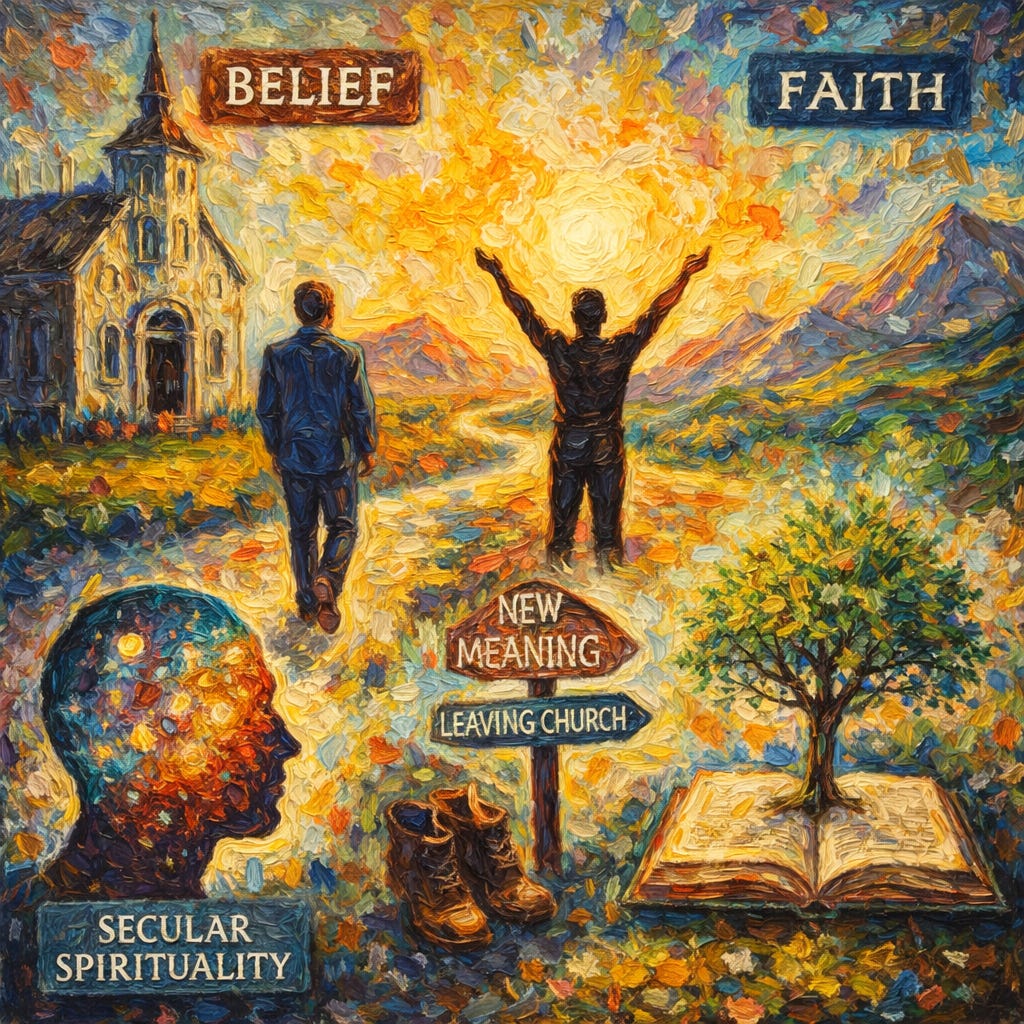
This essay is part of Life After Leaving Church, a series focused on practical ways to rebuild meaning, structure, and care after stepping away from organized religion.
After you leave church, something subtle often happens to time.
Nothing dramatic breaks. Your days still fill up. Your calendar may even look busy. But the week begins to feel flatter. The days blur together. Weekends lose their distinction. Holidays arrive with activity but without a center.
Many people don’t notice this right away. They just feel less steady. More scattered. Oddly tired, even when nothing obvious is wrong. They assume it’s stress, or distraction, or simply getting older. Rarely do they connect it to the quiet loss of rhythm.
This matters because when time loses its shape, meaning has a harder time landing.
Without rhythm, reflection floats. Attention weakens. Life becomes a sequence of tasks rather than something you inhabit. When this goes unnamed, people often respond by either filling every moment or drifting through them. Neither brings steadiness.
Church shaped time.
Not only through services or seasons, but through return. A predictable moment in the week when life paused, gathered itself, and took itself seriously. That rhythm held people even when belief wavered. It worked on the body before it worked on the mind.
When that structure disappears, time does not collapse.
It thins.
Thin time is harder to live inside. It offers little resistance. Days slide past without weight. You are free, but not oriented.
Church understood something here, even when it misunderstood many other things.
It did not only tell people what to believe. It told them when to return. Weekly. Seasonally. Again and again. That repetition created steadiness. It gave life a spine.
You could see this in ordinary ways. Sunday mornings that held rhythm, seriousness, and shared pause all at once. Seasons that returned each year whether you were ready or not. Moments of crisis that automatically moved into a shared space, rather than being absorbed alone.
After leaving, many people assume freedom will naturally replace that rhythm. They expect that having full control over their time will feel expansive. Sometimes it does, at first.
But freedom alone does not create rhythm.
Freedom creates choice.
Rhythm requires commitment.
Without some chosen structure, freedom often becomes fragmentation. Days fill up, but nothing gathers them. Time is spent, but rarely held. Life becomes reactive rather than oriented.
This isn’t a personal failure. It’s a human pattern.
Productivity tools don’t solve this problem. They manage tasks, not meaning. They track output, not return. They can make a week efficient without making it coherent.
What church did to time was quieter and more durable. It created predictable pauses. It marked transitions. It made room for seriousness without requiring constant effort.
You don’t need belief to need that.
You need rhythm.
At this stage, many people try to rebuild structure too quickly. They design elaborate routines. They adopt new practices with intensity. They schedule their way toward steadiness. When that effort collapses, they conclude that structure itself is the problem.
It isn’t.
The problem is scale.
I know this because I made this mistake myself. I tried to build a full structure before I understood what I needed from it. What finally helped was choosing something small enough to keep.
You don’t need a schedule.
You need an anchor.
One.
A single, chosen return point in the week that doesn’t negotiate with urgency. A moment that belongs to you, not productivity, not performance, not explanation.
This is not a replacement for church. It is a function church once served.
A weekly anchor can take many forms.
A long walk at the same time each week.
A quiet hour with a book that asks something of you.
A shared meal that is not rushed.
A reflective pause where you review how you lived the week.
A deliberate moment of silence where nothing is expected.
What matters is not what you choose. What matters is that you return.
Consistency matters more than intensity. Simplicity matters more than symbolism. Sincerity matters more than outcome.
If the anchor feels dramatic or ambitious, it is probably too heavy to carry. The goal is not to impress yourself. It is to steady yourself.
There is dignity in small repetition.
When you return to the same moment week after week, something begins to settle. Time thickens. The days around that anchor orient themselves. You stop drifting without realizing it.
This isn’t discipline in the moral sense. It’s care.
Structure is often mistaken for restriction. In practice, it is a form of respect. You are telling your life that it deserves a shape. You are telling yourself that not everything is negotiable.
That message lands quietly, but it lands.
Small rhythms restore dignity because they say, this matters enough to return to.
They also reduce anxiety. Predictability gives the nervous system something to trust. Repetition creates safety. When you know there is a place in the week where you will stop, reflect, or simply be present, everything else feels less frantic.
You don’t need to explain this to anyone. You don’t need to justify it. You don’t need to frame it as spiritual or productive.
You only need to keep the appointment.
Over time, this single anchor becomes the place where other practices gather. Reflection becomes easier. Moral clarity sharpens. Emotional life finds a container. None of that needs to be forced.
Rhythm comes first.
Meaning follows.
You are not rebuilding a religious life here. You are restoring the conditions that allow a serious life to breathe.
If your weeks feel thin, this is a place to begin.
Not by filling them.
By shaping them.
Practice
This week, set aside one quiet hour.
Don’t use it to argue with yourself or solve anything.
Use it only to practice what this essay addresses.
You may write, walk, or sit in silence. Choose one.
During that time, engage the prompts below privately, without explanation or judgment.
Where does my week currently feel most scattered or thin
When would a small, predictable return point feel supportive rather than burdensome
What single weekly anchor could I realistically keep without negotiation
You aren’t designing a system here. You’re choosing one place to return.
When the hour ends, close the exercise deliberately. Put the notes away. Take a breath. Return to your life.
You don’t need to add anything else yet.
Practice is meant to support living, not replace it.
In the next essay, we’ll look at how to practice ritual without belief, and why ritual still matters even when doctrine doesn’t.
Please Support the Work
Light Against Empire is free for all. If my words have value to you and you’re in a position to help, you can chip in with a monthly or yearly donation. Your support keeps the writing alive, the lights on, and the fire burning.


I have changed church affiliation many times in my life. Now I am in a church where everyone matters, no one is excluded, differences are celebrated. We do not have a doctrine instead we have a covenant with each other:
Love is the doctrine, the quest for truth is our sacrament and service is our prayer.
To dwell together in peace,
To seek knowledge in freedom...so all may come to their understanding of the Divine
This church community does not depend on how you perceive God or whether you name the Divine. It is the building of Beloved Community that moves us. We focus on spiritual growth that is alive and ever changing.
I have found a home that follows Jesus.... That concept I bring from my Christian background.
We do not profess to be Christians but call our community the church of the Sermon on the Mount.
I left the " Christian" churches because they missed the whole point of Jesus's message.
Some people have been so damaged by a severe church experience....we are a place of healing...I believe that is the way of The Cosmic Christ.
I pray for all who seek spiritual community to find a "church" that accepts you as you are.. .wouldn't Jesus?
I left the church for a long time. I did stuff. I tried other churches. I didn't do stuff. I relaxed on Sunday mornings. I didn't miss it. And then I did. Now I attend again because it helps put more meaning into my life. Yes, it had meaning before. But I found a church where they work for social justice and they take real action to help others, to welcome friendships with other faith communities, to act as One People... because we are.
I'm still agnostic. Does that sound strange? An agnostic who goes to church. Well, it's because I still have the same questions. Does a deity really exist? Does that deity care about me? Why is there suffering in the world? Don't tell me it gives us opportunities to help others. Many more are suffering than we can possibly help. I have questions that I'll never be able to answer, so I have to let them go.
But I find a steadiness there. I find a community. I find people to care about... people who care about me. For me, it isn't about blind faith. I still have questions. But my church offers purpose in one facet of my life, while other activities offer purpose in other facets.
Find your purpose and your happiness wherever you can. In church or out of church.