

How Democracies Are Gutted, and How Fast It Can Happen
A comparative analysis of modern autocrats and an estimate of America’s democratic half-life

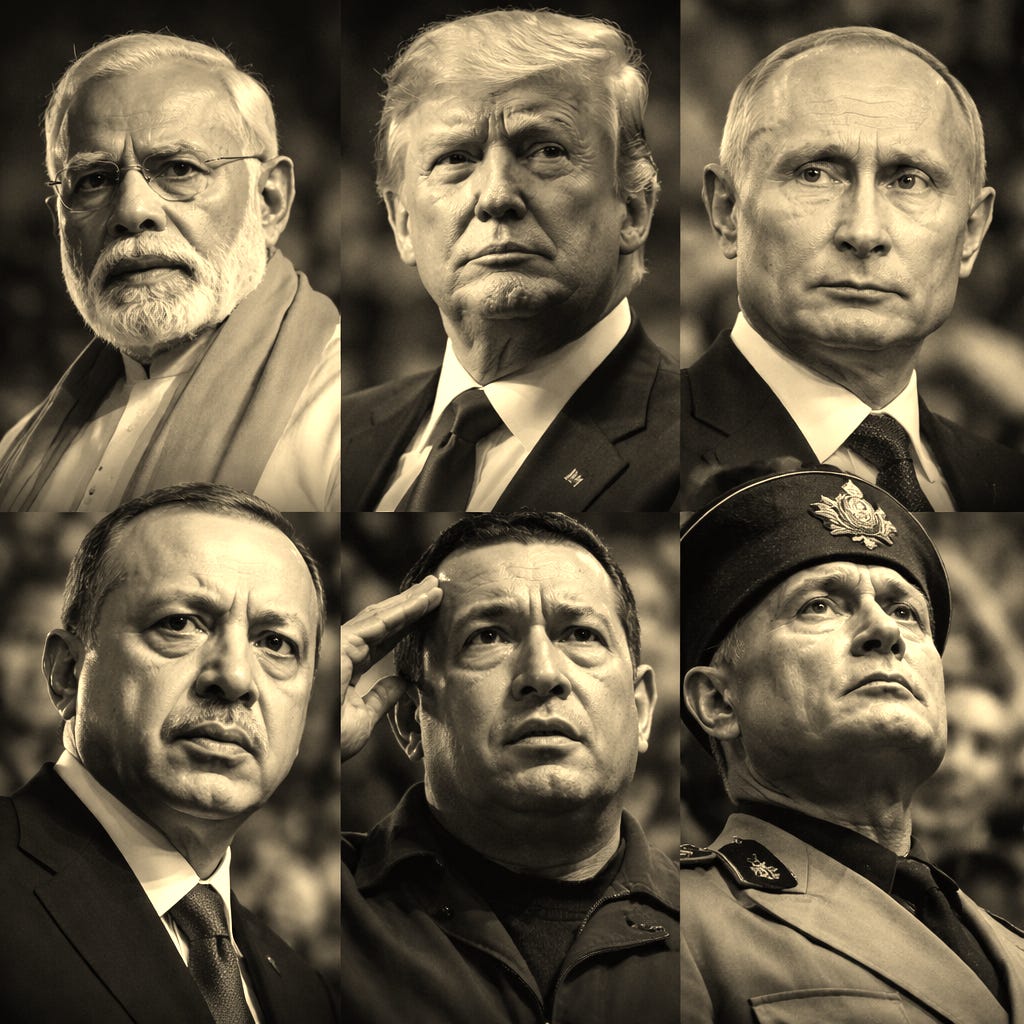
I keep walking around this same uneasy thought, not because it’s a bit of drama, but because it keeps rising to top of mind no matter how much I’d like to be done with it.
Before I go any further, I should say this plainly. What follows isn’t a definitive theory of democratic collapse. It’s a comparison. An estimation. Me lining up a handful of modern cases that keep echoing one another and trying to get a feel for their timelines. The subject deserves a fuller treatment than this. But waiting for perfect certainty before acknowledging a pattern has never struck me as wisdom. It’s usually just another way of not looking.
What I keep noticing, and what keeps bothering me, is that democracies don’t usually fall because people stop believing in them. They fall because belief becomes a substitute for active defense. Because faith in institutions replaces the harder, messier work of holding them together.
What unsettles me most about modern democratic collapse is how ordinary it looks while it’s happening. No armies. No proclamations. No single moment you can circle on a calendar and say, that’s when it ended. Instead, it arrives through statutes, appointments, budget lines, regulatory capture, and a steady wearing down of public attention. The language of law remains. The rituals of participation persist. What disappears is civic consequence from these government actions.
And when consequence disappears, power stops listening.
I’m often told not to compare. That America is different. That our institutions are older, stronger, exceptional. I understand the comfort in that claim. But comparison is how patterns reveal themselves, and patterns are usually what loosen denial’s grip.
So I’m not asking whether democracy can fail. History settled that question long ago. What I keep asking instead is simpler, and colder.
How does it fail now?
And how long does it usually take?
Viktor Orbán and the Architecture of Legal Capture
When I started looking for a modern case that could actually teach me something, not the loudest or most theatrical, but the one that explained the mechanics, I kept circling back to Hungary.
Not because it was extreme.
Because it was careful.
Orbán didn’t overthrow the system. That detail matters more the longer I sit with it. He moved into it. Returning to power in 2010 with a constitutional supermajority, he used the machinery of democracy to make sure democracy could no longer restrain him. The constitution was rewritten. Courts were restructured. Oversight bodies were packed. Media ownership drifted, almost politely, into the hands of loyal oligarchs. Elections continued. Opposition parties still existed. International observers still arrived.
Everything looked familiar.
What vanished wasn’t voting.
It was uncertainty.
What struck me as I traced the timeline wasn’t just what happened, but how long it took. Not because Orbán lacked ambition, but because he ran into resistance early on. Independent media still mattered. Courts still pushed back. The European Union applied friction. He moved incrementally because he had to.
From electoral victory to full electoral autocracy, it took roughly ten to fifteen years, depending on where you start the clock.
Hungary shows me what democratic hollowing looks like when institutions still fight back. It’s the baseline case I keep measuring everything else against. And once I see it clearly, I start noticing how often later autocrats are working with fewer constraints and moving much faster.
Recep Tayyip Erdoğan and the Politics of Permanent Emergency
Here the timeline starts to compress.
Erdoğan’s early years weren’t openly autocratic. They were framed as reformist, even stabilizing. But once crisis governance took hold, especially after the failed coup attempt in 2016, emergency powers stopped behaving like temporary measures. Purges were justified as security. Courts were subordinated in the name of order. Journalists became suspects. Dissent became disloyalty.
Elections continued. Parliament convened. The vocabulary of democracy stayed intact. But emergency became the governing logic.
As I lined Turkey up next to Hungary, the difference became hard to ignore. Where Orbán hollowed out institutions slowly under law, Erdoğan hollowed them out quickly under fear. The ambition wasn’t greater. The justification was simply more useful.
From reformist governance to entrenched electoral autocracy, the process took roughly seven to ten years, give or take.
Once emergency becomes permanent, democratic erosion doesn’t just continue. It accelerates.
Vladimir Putin and the Illusion of Participation
Russia forced me to confront a different kind of discomfort.
Putin didn’t abolish elections. He removed risk from them. Media was brought under state control. Oligarchs were disciplined into loyalty. Opposition figures were allowed to exist until they became effective. Then they were marginalized, exiled, or erased.
Participation remained, but it changed character. Voting no longer influenced outcomes. It legitimized them.
As I compared Russia to Turkey and Hungary, a third method emerged. Orbán relied on law. Erdoğan relied on fear. Putin relied on inevitability.
From competitive elections to a fully managed democracy, the shift took roughly eight to ten years.
What unsettles me most about Russia isn’t repression. It’s resignation. Democracies don’t fall when opposition disappears. They fall when opposition becomes performative, when participation itself stabilizes power by draining it of meaning.
Narendra Modi and Majoritarian Hollowing
India complicates the picture in ways I find especially troubling.
Under Modi, institutions haven’t been abolished. They’ve been pressured. Media hasn’t been nationalized. It’s been intimidated and consolidated. Courts still rule, but selectively. Civil society still operates, but under constraint. Minority protections have thinned quietly, often framed as cultural correction rather than repression.
This feels like hollowing by saturation. National identity fuses with the ruling party. Dissent is reframed as betrayal. Democracy persists as a mandate of the majority rather than a restraint on power.
The consolidation timeline here appears to be roughly eight to twelve years, and it’s still unfolding.
India forces me to acknowledge something I’d rather not. Democratic decay doesn’t require emergency powers or constitutional rupture. It can unfold in broad daylight, with public approval, and still hollow the system from within.
Hugo Chávez and the Charisma Trap
Venezuela reminds me why good intentions don’t protect institutions.
Chávez rose with genuine popular support. His early reforms weren’t imagined. But power centralized. Courts were captured. Electoral bodies were subordinated. Opposition was reframed as illegitimate rather than adversarial.
By the time institutional collapse became undeniable, it couldn’t be reversed. The transition from Chávez to Maduro made the deeper truth unavoidable. Once guardrails are removed, successors inherit unchecked authority regardless of ideology.
From populist reform to institutional collapse, the process took roughly six to ten years.
When I compare Venezuela to India, I see the same mechanism at different stages. Institutions lose their ability to say no. What follows is largely a matter of time.
Benito Mussolini and the Myth of Sudden Takeover
Mussolini is usually remembered for spectacle. What keeps bothering me is how ordinary his ascent actually was.
His rise was legal. His consolidation was incremental. Elites accommodated him. Institutions adjusted. Opposition fragmented. By the time repression became explicit, resistance had already been normalized into submission.
From lawful appointment to totalitarian rule, it took roughly three to six years.
The myth of sudden authoritarian takeover is comforting. It implies warning signs will be obvious. History keeps teaching the opposite lesson. Autocracy succeeds by making each step survivable.
Resistance Capacity and the Compression Effect
When I step back from all of this, one variable keeps asserting itself.
Resistance capacity.
Not outrage. Not belief. Capacity.
The willingness of courts to assert authority rather than hesitate.
The ability of legislatures to defend their prerogatives rather than defer.
The readiness of the public to abandon the fiction of normal politics when norms no longer apply.
When resistance capacity weakens, timelines compress. Erosion accelerates not because power grows stronger, but because defense grows slower.
Donald Trump, MAGA, and the Logic of Exhaustion
What unsettles me most about Trumpism isn’t that it breaks norms. It’s how relentlessly it does so.
Courts are flooded with challenges until hesitation becomes habit. Administrative enforcement becomes selective. Federal authority is applied expansively for allies and narrowly for opponents. Information systems reward outrage and punish correction. Spectacle substitutes for governance. Grievance substitutes for legitimacy.
This doesn’t feel like chaos to me.
It feels like exhaustion. Relentless, sustained, pugilistic opposition to civic resistance.
Where others had to manufacture conditions, Trumpism inherits them. Polarization is already deep. Distrust is already primed. Institutional fatigue is already advanced.
I keep coming back to the same conclusion, even as I wish it weren’t true.
Democracy does not die when people stop believing.
It dies when belief replaces active defense.
Projection: America’s Democratic Half-Life
With these timelines in mind, three bands emerge. Not as a prophecy. But as a pattern.
Optimistic Band: 10–15 Years
This would require courts that assert authority decisively, even at political cost. State governments coordinating sustained resistance. Trusted intermediaries rebuilding informational coherence. Citizens recognizing that normal politics no longer applies while there is still time to act.
The signal to watch would be a clear judicial action that materially constrains executive power and is obeyed.
This would resemble a slowed Orbán trajectory under sustained friction.
Median Band: 5–10 Years
This feels closest to our current path. Courts hesitate. Elections continue, but outcomes grow increasingly predictable. Opposition remains visible but ineffective. Cynicism replaces mobilization.
The signal here is quieter. Declining turnout paired with rising certainty about outcomes.
Democracy survives as form. Yet consequence drains away.
Worst Case Band: 2–5 Years
This requires only a few additional failures. Routine judicial deference. Openly selective enforcement. Emergency language normalized as governance. Opposition fragmented or self moderating into irrelevance.
The signal is emergency justification used to bypass normal processes without sustained pushback.
This is the compression effect in full force.
The Final Threshold
Democracy does not end when people stop voting.
It ends when voting stops mattering.
Hungary reached that stage. Russia institutionalized it. Turkey weaponized it. India is edging toward it. Venezuela collapsed into it. Italy normalized it before naming it.
The United States isn’t immune to this pattern. It’s simply late to admit it. We’ve been relatively stable for hundreds of years. We’ve been lulled into a deadly misapprehension.
I repeat this whenever I can: history doesn’t repeat on schedule. It accelerates when endurance is mistaken for safety.
And when a democracy becomes a performance, the audience is still invited.
The outcome, however, is already decided.
Support the Work
Light Against Empire is a reader-supported publication and always free. To receive new posts and support my work, consider becoming a free or donation based subscriber.
Further Reading:


Happy New Year Dino !