

How a Single Shooting Exposes the Lines Between State and Federal Power
ICE, the National Guard, and the Thin Line Between Protection and Domination

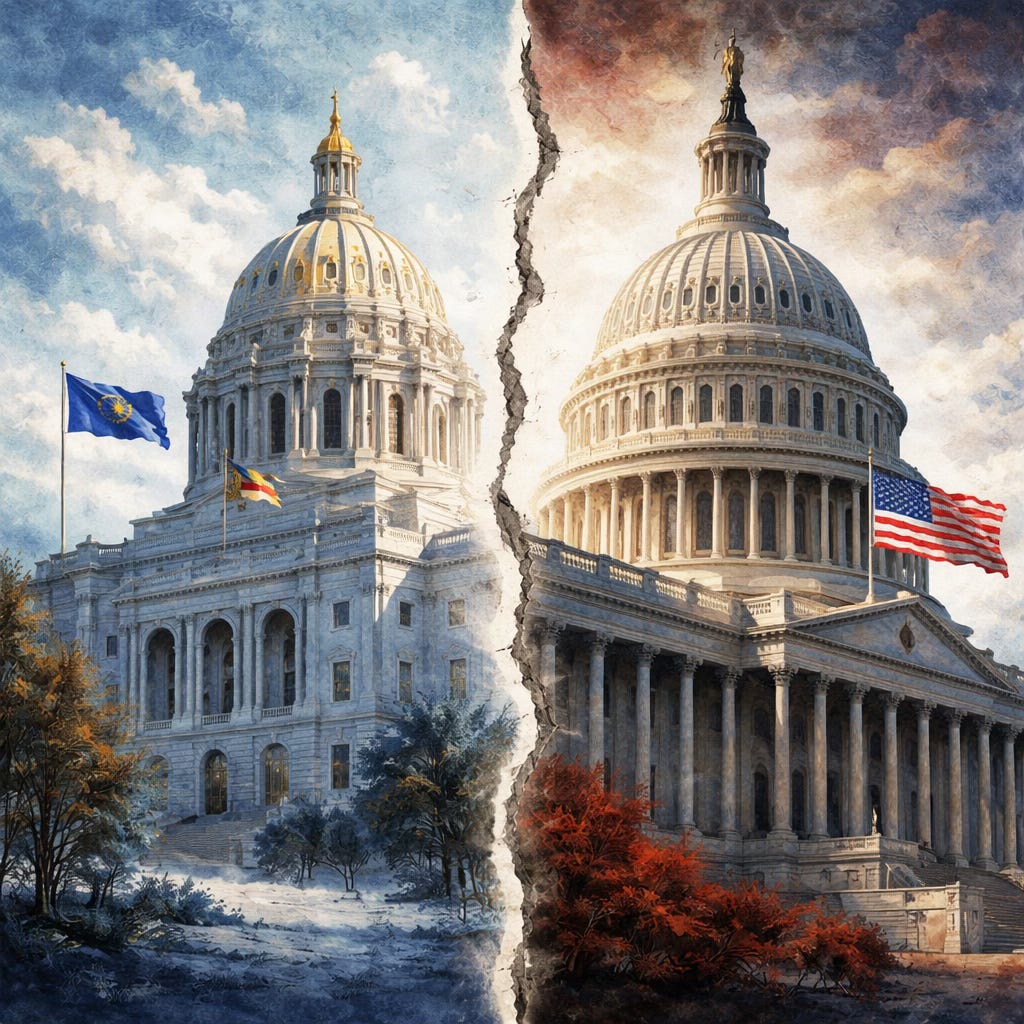
A Shooting, a Badge, and a Boundary Line
I’m writing this with a little humility up front. I am not a lawyer, and I’m not pretending I’ve got access to some private vault of truth. I did spend a long stretch of my working life as an immigration analyst and investigator, which means I’ve got more familiarity with the machinery than most people do, even if I’m not fluent in every statute and case.
That background is why the ICE shooting in Minnesota is sticking in my mind as more than a single event. Not because I want drama, and not because I’m trying to stir fear. It’s because moments like this tend to pull a hidden question into the open.
What exactly is federal power in your daily life, what is state power, and what happens when those two stop cooperating?
If you want to understand the escalation risk, you don’t start with slogans. You start with authority. Who can do what, to whom, where, and with what limits. You exercise unadulterated at objectivity and don’t descend in emotional chaos.
What ICE actually is
ICE sits inside the Department of Homeland Security. It’s not a single kind of cop. It’s two big worlds that share a name.
Enforcement and Removal Operations, civil immigration enforcement (ERO)
ERO is the side most ordinary people picture when they hear ICE. Its basic job is civil immigration enforcement. That includes locating, arresting, detaining, and removing noncitizens who are unlawfully present, removable under the law, or subject to a final order.
Here’s the first boundary that matters to ordinary citizens.
Immigration violations, by themselves, are civil. Not criminal.
That doesn’t mean the consequences are small. They can be life changing. It does mean the legal posture is different from the start. Civil enforcement is supposed to be narrower, more procedural, and more constrained.
ERO also uses administrative warrants, not judicial warrants. That sounds technical until you translate it into real life.
A judicial warrant is signed by a judge. An ICE administrative warrant is not.
Homeland Security Investigations, criminal investigations
HSI is the investigative arm. Human trafficking, drug and weapons trafficking, money laundering, cybercrime, export violations, transnational networks. That’s criminal work, and it often runs in coordination with prosecutors.
HSI agents can have real criminal investigative authority. They are still bound by the Constitution, and they still have to work inside defined federal statutes.
The guardrails that are supposed to protect ordinary people
This is where I always bring it back to the person standing in the hallway, or at the curb, or at their own front door.
ICE is bound by the same Constitution that binds any federal officer.
Fourth Amendment. Fifth Amendment. Due process. Limits on detention. Limits on entry.
The practical guardrails most people should know are these.
ICE administrative warrants are not the same as a judge signed warrant.
ICE cannot force state or local law enforcement to help.
ICE cannot detain a US citizen absent criminal probable cause.
ICE cannot enter a home without consent or a judicial warrant.
That last one is where a lot of real world conflict happens, because it’s also where confusion gets used as a tool. People see a badge, a uniform, a document waved with confidence, and they assume the paper equals a judge. Sometimes it does. Sometimes it does not.
What ICE did right, and where it abused the law in the Renee Nicole Good shooting
This is where I want to slow down, because clarity matters.
Based on what’s publicly known so far, ICE agents were engaged in an enforcement operation they were legally authorized to initiate. They were operating under federal authority. They were not impersonators (though we don’t know if they were from ERO, HSI, or a special unit). They were not acting outside their institutional mandate by being present.
That distinction matters. Pretending otherwise only muddies the analysis.
Where the questions begin is not presence, but posture.
Civil immigration enforcement does not carry the same use of force expectations as criminal policing. The legal and ethical standard assumes restraint, clarity of purpose, and minimal escalation, especially in environments where bystanders are present and the target is not suspected of a violent crime.
When a civil enforcement action results in lethal force against someone who is not the subject of removal, not armed in a conventional sense, and not posing a clear, imminent threat, the justification threshold rises sharply.
That doesn’t mean guilt. It does mean intense scrutiny. It should have immediate legal consequences.
It means asking whether speed replaced caution, whether confusion replaced clarity, and whether authority was asserted in a way that escalated fear rather than controlled it. Malicious intent as many have accused of the ICE agent is harder to determine, but it must also be considered.
It also means acknowledging something uncomfortable. ICE has spent years adopting the visual and tactical language of criminal policing while retaining civil authority. That mismatch makes encounters volatile. People react to what they perceive, not what the statute says. In ICE (as well as many local law enforcement agencies), there is desire to be seen as strong, capable, and well equipped. To many this means taking on the trappings and equipment of a para-military organization. This confuses suspects as well as on-lookers and general public.
If ICE wants the deference of civil enforcement, it has to act like civil enforcement. When it doesn’t, legitimacy erodes even before courts weigh in.
That erosion is the real accelerant.
Where ICE gets in trouble, and what overreach looks like
Not every allegation is true. Not every viral story is accurate. Still, courts and inspectors general keep circling the same fault lines.
Detention that stretches past lawful limits.
Administrative warrants treated as judicial authority.
Citizens swept into enforcement actions.
Civil authority performed with criminal style tactics.
Selective or retaliatory enforcement.
Each one chips away at consent. Each one makes the next confrontation harder to control.
Why the Minnesota moment matters
In a situation like this, a governor hears two kinds of voices.
One says keep order, keep people safe, keep the temperature down.
The other says if federal action is provoking danger or acting outside cooperative norms, the state has a duty to assert legitimacy on behalf of its residents.
That’s where talk of limiting ICE activity or activating the Guard for public safety comes from. Not bravado. Not rebellion. An attempt to say someone here still answers to the people standing in front of them.
But that claim is fragile.
Because the president can federalize the Guard with a signature. Clean on paper. Seismic on the ground.
What Guard refusal actually looks like
People imagine a dramatic mutiny. Real life is quieter.
Before federalization, a Guard under a governor can narrow mission scope, delay deployment pending legal guidance, or refuse tasks that exceed state authority. Governors tread carefully here because pushing soldiers into moral or legal ambiguity creates damage that lasts.
After federalization, the ground shifts.
Guard members fall under federal command and military law. Refusal becomes serious. Consequences can include discipline, loss of career, or prosecution if orders are lawful.
But here’s the part that keeps me up at night.
Most crises don’t involve open refusal. They involve hesitation. Requests for clarification. Slow walking orders that feel legally muddy or morally radioactive. People trying to buy time because they understand the weight of what they’re being asked to do.
That’s when ambiguity creeps in. And ambiguity is dangerous.
Uniforms don’t erase humanity. They just hide it until pressure cracks the surface.
The deeper tension underneath all of this
ICE sits in an unstable zone.
Civil enforcement.
High stakes consequences.
Limited early judicial oversight.
A posture that looks and feels like criminal policing.
When that authority meets state resistance, ICE itself cannot compel compliance. Detainers are requests. Cooperation is voluntary. Courts have been clear about that.
So higher federal levers get tempted.
Federalization.
Emergency powers.
Command replacing consent.
That’s how a shooting becomes a test of federalism.
Where I land in all of this
ICE has real authority. It is also narrower than it performs and more fragile than it admits.
Today, I saw an abuse of deadly force. In the video circling the net, there is no definitive “ah, hah” moment. There was a driver who appeared to be attempting to obey law enforcement direction. At no time did the ICE agents appear to be in any kind of peril. There was no vehicular assault. You don’t run someone down by driving slowly. The ICE agent wasn’t trapped in front of the car. If he truly felt endangered by the automobile, his first reaction would be to jump out of the way, not shoot the driver. The ICE agent was in the wrong. His calculation of the event was at best flawed, and at worst criminally negligent. On this day, ICE’s restraint slipped.
When restraint slips, legitimacy collapses. When legitimacy collapses, escalation becomes easier to justify. When escalation becomes a political instrument, ordinary people become the terrain.
So I’m watching Minnesota not as a prediction, but as a boundary test.
A test of whether civil enforcement stays civil.
Whether state authority is treated as partner or obstacle.
Whether federal power is used to protect or to prove.
A those choices echo longer than any press release.
Support the Work
Light Against Empire is a reader-supported publication and always free. To receive new posts and support my work, consider becoming a free or donation based subscriber.
Further Reading:


