

Democratic Perimeter Update for 02/27/2026 - 03/06/2026
Tracking where democratic norms, federal power, and allied stability are being tested by autocratic pressure at home and abroad.

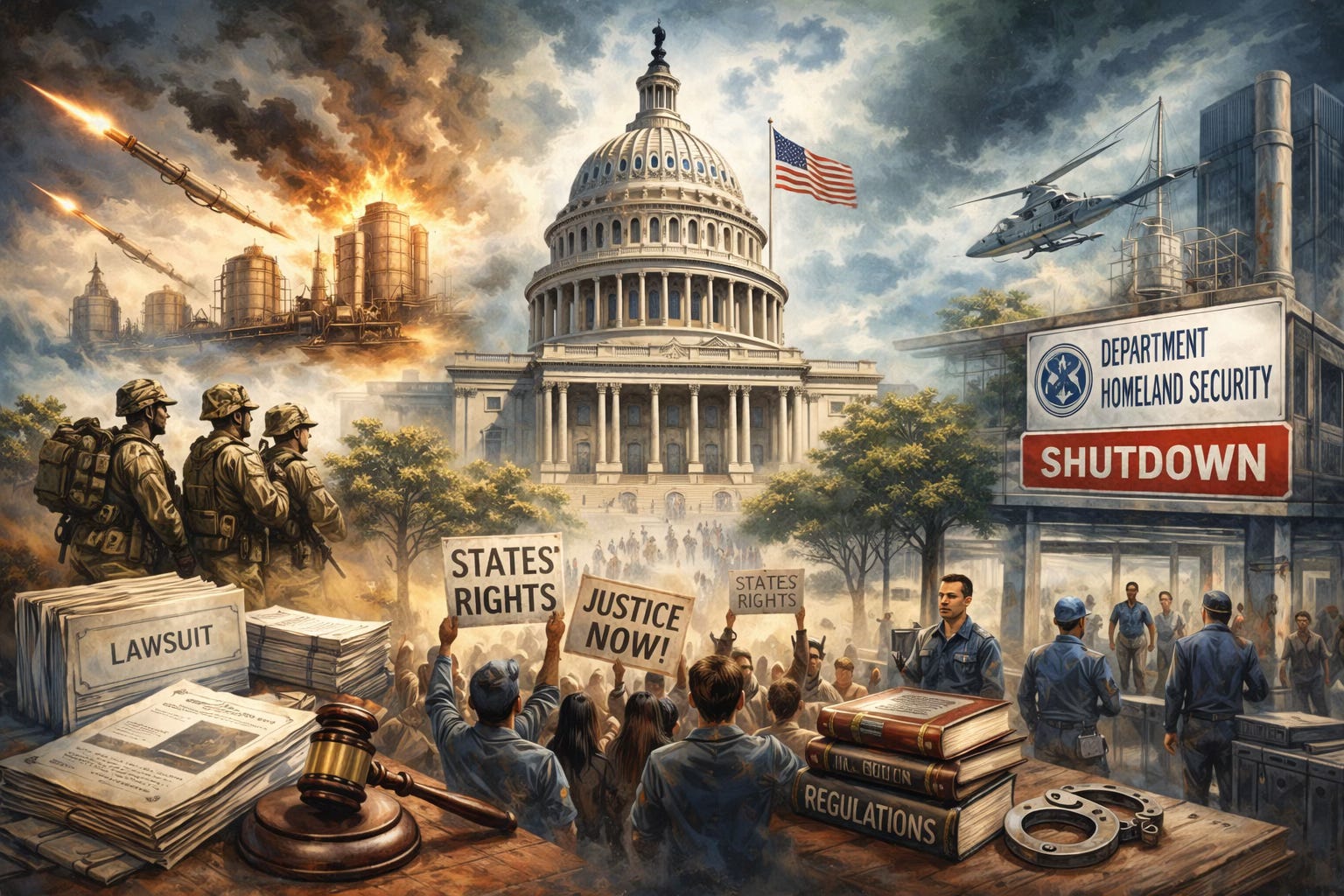
Opening Orientation
This week’s perimeter runs along two seams at once. One is domestic, a widening pattern of federal pressure that shows up through funding threats, rulemaking, and litigation posture. The other is external, the open war with Iran, which the White House is treating as proof of strength, and which will almost certainly function as a domestic attention magnet, a permission structure for exceptional measures, and a stress test for public confidence.
A useful way to think about this week is straightforward. When the public’s nervous system is saturated by war news, fewer people track procedural changes, fewer institutions pick fights they can avoid, and extraordinary actions begin to look routine. That’s the political weather in which quiet overreach becomes easier.
Federal
White House and national security posture
Over the past week I’ve identified several official communications presenting “Operation Epic Fury” as an ongoing military campaign aimed at Iranian capabilities, with a heavy emphasis on dominance, inevitability, and national resolve.
This matters domestically for three reasons. First, it concentrates attention on a single story that’s emotionally consuming. Second, it raises tolerance for temporary expansions of executive authority. Third, it places dissent, oversight, and even routine scrutiny under suspicion, because war quickly becomes a loyalty test.
In the last twenty four hours I also identified a failed congressional effort to limit the conflict. Both chambers considered war powers resolutions intended to restrain the administration’s ability to continue military operations against Iran, and both efforts failed to pass. Congress has therefore declined, at least for now, to assert a formal limit on the president’s conduct of the war.
Supreme Court emergency docket pressure
During this scan I located two emergency docket matters that reflect the current legal temperature. One involves election administration in New York tied to congressional maps. The other involves the parental notification dispute in California concerning student name or pronoun changes, where relief was granted in part.
DOJ posture and institutional guardrails
Beyond the courts, I’m also watching how the executive branch is positioning itself inside the legal system.
During this scan I identified a proposed Justice Department rule that would allow the Attorney General to review allegations and request delays in state bar discipline proceedings involving DOJ attorneys. In practice this could slow or blunt the effect of state level ethics enforcement against federal lawyers.
I also identified litigation in which federal unions amended a lawsuit challenging efforts to move large numbers of federal workers into an at will category and related rule changes affecting appeals and civil service protections.
What this means (Nr. 2 above)
The federal civil service has long operated under a merit system designed to prevent political loyalty tests from determining who keeps their job. If large numbers of federal employees can be moved into at will status, they can be dismissed without the traditional procedural protections that shield civil servants from political pressure. The unions’ lawsuit argues these changes would make it easier for an administration to replace career officials with politically aligned personnel. The administration argues it’s restoring managerial authority over the federal workforce.
Separately, I found that the Justice Department has asked a federal judge to dismiss the lawsuit brought by the American Bar Association challenging executive actions directed at major law firms, continuing a broader legal fight over the administration’s authority in that area.
What this means (Nr. 3 above)
Several executive actions have targeted law firms that represented political opponents or participated in investigations involving the administration. The American Bar Association argues these actions punish lawyers for representing certain clients, which would weaken the independence of the legal profession. The administration argues it has authority over government contracts and regulatory decisions affecting those firms. The central question is whether the federal government can use regulatory and financial pressure against private legal institutions that challenge it in court.
Department of Homeland Security funding standoff
I confirmed that the Department of Homeland Security remains in a partial shutdown posture after funding expired in mid February. The department is one of the largest parts of the federal government and includes agencies such as TSA, Customs and Border Protection, FEMA, and several major national security offices. Essential operations such as airport screening, border security, and cybersecurity monitoring continue, but large numbers of employees are working without pay while other functions remain paused or reduced.
In the last twenty four hours I also identified a new congressional vote on DHS funding. The House passed a bill intended to fund the department through the remainder of the fiscal year, but the Senate failed to advance the measure to the threshold required for passage. As a result, the DHS funding lapse continues.
The dispute remains centered on immigration enforcement conditions tied to the bill. Democratic lawmakers have sought changes to enforcement practices, while Republicans have pushed to pass the House version largely intact. Because Senate rules require bipartisan support, the standoff continues.
Operational effects are now visible. I found reporting indicating that more than one hundred thousand DHS employees are working without pay. Some FEMA travel and administrative work has been delayed, and agencies such as Customs and Border Protection have explored internal funding shifts to maintain payroll for critical personnel.
State and Federal Tension
Across several developments this week I identified a pattern that can best be described in simple terms. Federal money’s being used as leverage. States report threatened withholding of major funding streams, or actual deferrals, tied to compliance with federal immigration enforcement preferences. The legal response’s becoming faster, more coordinated, and more explicit in describing retaliation.
California
I found that California’s Attorney General announced a challenge to threatened withholding of disaster relief and transportation funding, describing the targeting of four Democratic led states tied to refusal to participate in federal immigration enforcement.
The amended complaint language attached to the California filing asserts that FEMA implemented a directive excluding the same four states from release of billions of dollars in disaster relief and recovery funding, with states citing large backlogs in requests.
Minnesota
I located a federal lawsuit announced by Minnesota’s Attorney General over an alleged deferral or withholding of two hundred forty three million dollars in Medicaid payments, warning of near term harm to coverage for low income residents.
Minnesota also appears in the multi state posture described in the California filing, which frames the funding threats as punishment for immigration enforcement refusal.
Maine
During this scan I didn’t identify a Maine specific filing or official state action within the last week that matches the scale of the developments unfolding in California and Minnesota. Maine remains part of the broader litigation landscape around federal grant conditions, but this edition records no major new development.
Canada
I identified that Canada has moved into an active citizen support and evacuation posture tied to the regional war environment. Officials there are working to assist thousands of citizens attempting to leave the Middle East because of disrupted air travel and security concerns.
Canadian leadership has also urged de escalation while maintaining that Iran must not obtain nuclear weapons.
For the perimeter, the signal is straightforward. Allied governments are already moving into crisis logistics, which feeds back into the domestic narrative environment in the United States.
Greenland
During this scan I didn’t locate any new Greenland specific development inside the last week that rises to the level of an official shift or escalatory move. Greenland remains a standing strategic pressure point in this project, but this edition records no material change.
Europe
In Europe the key development this week appears to be fracture rather than unity.
I identified reporting that Spain refused U.S. use of Spanish bases for the Iran operation. Spain hosts key U.S. facilities used for Mediterranean and trans Atlantic military operations, which makes access to those bases strategically significant. The refusal was followed by trade retaliation threats from Washington and a public rebuke from Spanish leadership.
European Commission officials later backed Spain, treating the episode as a test case for pressure from Washington toward allied governments.
From a domestic perspective this matters because alliance friction changes the credibility environment in which U.S. leaders justify exceptional measures.
No Material Change
In this scan I didn’t identify a nationwide CDC policy shift within the last week.
I didn’t locate a new DHS national policy change beyond the funding shutdown and operational posture already noted.
I didn’t identify a Maine specific development comparable in scale to the California and Minnesota cases.
I also didn’t identify a Greenland development beyond the background strategic posture already being tracked.
What to Watch Next
I’m watching for legal escalation around the funding leverage issue. The California amended filing reads less like a single lawsuit and more like a template other states could adopt quickly.
I’m watching the Supreme Court emergency docket pace. When the Court acts on compressed timelines in election administration and cultural disputes, it becomes part of the country’s governing rhythm.
I’m also watching the Justice Department’s move to limit the bite of state bar discipline. Even procedural delays can have real consequences.
The DHS shutdown itself is another pressure point. If the standoff continues, pressure will increase on Congress to adopt either a temporary continuing resolution or a negotiated compromise tied to immigration enforcement provisions.
I’m also watching for signs that the Iran conflict begins to drive supplemental defense funding requests or munitions replenishment debates in Congress, which would signal expectations of a longer campaign.
Finally, I’m watching the domestic shadow of the Iran war. As public attention narrows toward external conflict, administrative and legal changes at home often move with less resistance.
Developments to Monitor
In legal analysis circles I found discussion raising questions about the outer boundary of presidential war powers claims connected to the Iran strikes. These discussions are interpretive and analytical rather than primary government actions, so they belong here rather than in the main federal section.
I also encountered discussion suggesting the Supreme Court may have acted against the administration on tariff authority. I didn’t verify the underlying opinion text in this pass, so confidence remains low and the item remains in this monitoring category.
Monitoring Patterns and Trends (NEW)
This is a standing section of the Democratic Perimeter intended to track direction over time rather than highlight a single event.
Across the last several editions, three patterns continue.
Federal funding’s still being used as leverage in disputes with states, particularly around immigration enforcement. Several states are now moving together in court, which suggests resistance’s beginning to organize rather than appear in isolated cases.
The Supreme Court emergency docket continues to operate at a pace that places the Court inside the immediate political environment rather than above it. Rapid intervention in politically charged disputes is becoming more common.
Finally, the war with Iran now dominates the national attention cycle. When foreign conflict captures public attention this completely, it acts as a solvent that dissolves attention away from domestic procedural changes.
None of these developments is dramatic on its own. Their significance lies in their persistence.
Where This Leaves Us
What emerges from this week’s scan is a familiar pattern wearing a louder costume.
At home, the federal state relationship’s being pulled toward a compliance model, with money serving as the lever and immigration enforcement serving as the test. States are responding with lawsuits that explicitly describe retaliation rather than bureaucratic misunderstanding.
At the same time the Department of Homeland Security remains in funding limbo, with thousands of federal employees working without pay while Congress attempts another vote.
Abroad, the war with Iran’s being framed as national resolve. Whatever its strategic goals, it also functions as a solvent that dissolves attention. Attention narrows. Fear rises. Institutional friction becomes easier to overlook.
That combination isn’t abstract. It’s a mechanism. When a nation’s emotional bandwidth is consumed by war and threat language, the procedural safeguards that normally attract scrutiny tend to operate in quieter light.
The perimeter exists because those quiet places are where the shape of a republic is either preserved, or slowly altered.
Light Against Empire is free for all. If my words have value to you and you’re in a position to help, you can chip in with a monthly or yearly donation. It takes time, energy, and resources to keep Light Against Empire running. Your support keeps the writing alive, the lights on, and the fire burning. Thanks!
Further Reading: