


Opening Orientation
This week’s perimeter isn’t defined by rupture.
It’s defined by consolidation.
Immigration enforcement remains the central axis. Courts are intervening. States are counterbalancing. Federal agencies are expanding authority while defending it in court.
And in one significant arena, the Supreme Court pushed back.
The system is still operating.
It’s operating under sustained strain.
Federal
A federal judge ruled that the IRS violated federal confidentiality law tens of thousands of times by sharing taxpayer address data with ICE. Litigation continues, but the decision places a boundary around interagency data sharing that won’t disappear quietly.
DOJ filed suit against New Jersey, alleging the state interfered with federal immigration enforcement.
DOJ also filed lawsuits against five states seeking access to voter roll records under the NVRA, framing the actions as election integrity enforcement.
DHS publicly rejected concerns that immigration operations would target polling locations during the midterm cycle, after questions were raised by state election officials.
The Office of Legal Counsel posted opinions addressing capital postconviction counsel and immigrant eligibility for public housing and federal benefits. Administrative interpretation continues shaping enforcement beneath headline level.
The Federal Register included a proposed DHS and USCIS rule revising employment authorization for asylum applicants, alongside tariff related presidential actions.
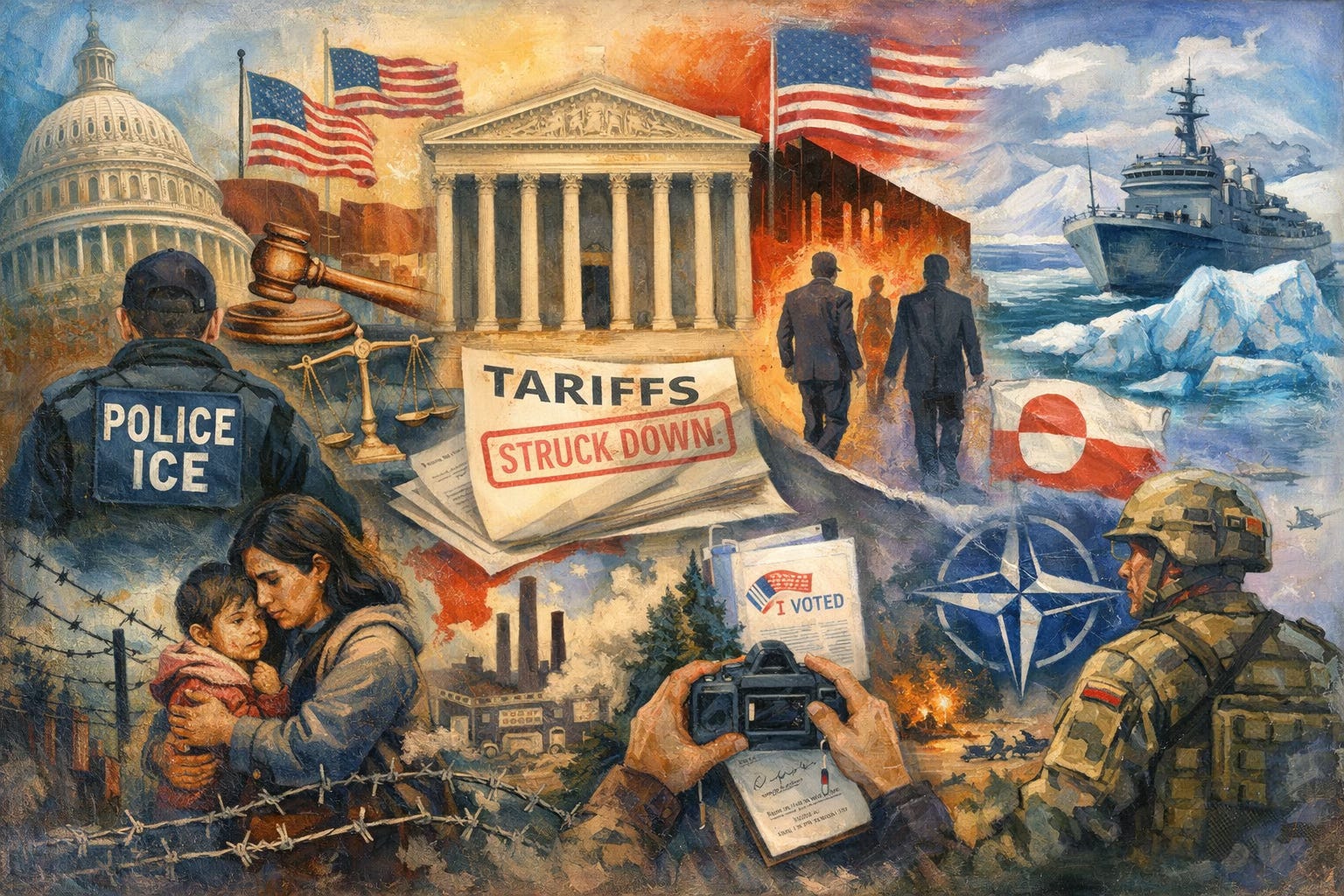
Most significantly, the Supreme Court ruled in Learning Resources, Inc. v. Trump that the administration lacked statutory authority under the International Emergency Economic Powers Act to impose certain tariffs. The Court held that Congress, not the executive, controls tariff power under that framework. The decision limits the scope of emergency economic authority claimed by the administration and reinforces separation of powers in trade policy.
Separately, the Court issued a routine order list and released an opinion in Postal Service v. Konan addressing sovereign immunity in mail loss claims.
The pattern remains clear: enforcement authority is being asserted, litigated, and in some cases constrained.
State and Federal Tension
The National Governors Association conference fractured after two Democratic governors weren’t invited to a White House meeting. Democratic governors declined to attend the governors dinner, and the division became visible.
This isn’t about optics. It’s about coordination.
When governors disengage from formal meeting structures, even symbolically, friction moves from rhetoric into procedure. Federalism doesn’t break in a speech. It erodes in rooms where people stop appearing.
California
Governor Newsom announced new state investment and philanthropic collaboration to support families facing intensified federal enforcement activity.
Federal officials blocked elected leaders from inspecting the Otay Mesa Detention Center, deepening disputes over oversight and transparency.
In Escondido, city officials debated allowing ICE to use a local police firing range, raising questions about how federal operational presence becomes routine at the municipal level.
Across the state, cities and counties are increasing funding for immigrant legal defense services.
California’s posture hasn’t shifted. It’s reinforcing state level capacity while federal pressure remains elevated.
Minnesota
Visible enforcement activity appears reduced compared to earlier surge levels, including fewer detainee flights out of MSP.
However, several hundred ICE agents remain present, and arrests continue. The surge may have ended formally, but operational presence remains significant.
The tempo has adjusted. The posture remains.
Separately, the Minnesota BCA released details in a Brooklyn Center use of force case. While unrelated to immigration, it contributes to the broader law enforcement climate inside the state.
Minnesota’s condition isn’t escalation. It’s sustained pressure at a lower intensity.
Maine
A lawsuit alleges DHS agencies engaged in surveillance and intimidation of legal observers documenting immigration operations in Maine.
The allegations raise direct First Amendment questions about whether citizens and legal observers can document federal enforcement without being tracked or threatened.
If substantiated, the issue moves beyond immigration policy into civil liberties boundaries.
Canada
Canadian officials described private trade discussions with the United States as constructive, while publicly warning that instability in the USMCA review process could chill investment and introduce recurring uncertainty.
The message is layered: cooperation in private, caution in public.
North American trade stability remains conditional.
Greenland
Greenland and Denmark rejected the suggestion that Greenland requires a U.S. hospital ship presence, describing the offer as unnecessary.
In Arctic geopolitics, presence carries weight. So does refusal.
Symbolism in that region signals intent, not decoration.
Europe
EU institutions issued formal updates on internal policy matters, including urban cohesion and consumer protection, while maintaining listings under the EU terrorist framework.
Russia issued warnings about the risk of confrontation between nuclear powers, tied to claims involving the UK and France.
Former UK Prime Minister Boris Johnson urged allies to consider noncombat troop deployments ahead of any Ukraine ceasefire.
Europe’s posture remains forward leaning rather than conciliatory.
No Material Change
No abrupt Supreme Court realignment occurred beyond the tariff ruling.
No large scale domestic emergency declarations were issued.
No dramatic defense posture shifts were announced.
The system remains under pressure, but it hasn’t crossed into acute instability.
What to Watch Next
Whether the administration seeks alternative statutory authority to restore tariff measures constrained by the Court.
Whether IRS ICE data sharing litigation narrows interagency enforcement pathways further.
Whether governors re establish durable coordination channels with the White House.
Whether DHS maintains its stated neutrality around polling locations as midterm infrastructure ramps up.
Whether Maine’s litigation produces early judicial guidance on observer protections.
Whether Minnesota’s enforcement tempo stabilizes or increases again.
Developments to Monitor
Expansion or contraction of local cooperation agreements with ICE.
Additional DOJ voter roll access litigation.
Arctic diplomatic signaling tied to U.S. Greenland posture.
Congressional reaction to the tariff ruling and any legislative response.
Language shifts in USMCA review negotiations.
Where This Leaves Us
The perimeter isn’t collapsing.
It’s consolidating.
Federal authority is pressing outward through litigation, rulemaking, and enforcement. States are reinforcing inward through funding, oversight, and selective resistance. Courts are defining the outer limits of executive reach in real time.
The Supreme Court’s tariff ruling shows that institutional guardrails still function.
But friction is no longer episodic.
It’s structural.
And structural friction, sustained long enough, reshapes institutions quietly and permanently.
Light Against Empire is free for all. If my words have value to you and you’re in a position to help, you can chip in with a monthly or yearly donation. Your support keeps the writing alive, the lights on, and the fire burning.
Further Reading:


I appreciate your summary, Dino. The day to day has been heavy, but we're not done for yet. It's another beautiful day in the city- Take care!