

Democratic Perimeter Update for 02/17-20/2026
Tracking where democratic norms, federal power, and allied stability are being tested by autocratic pressure at home and abroad.

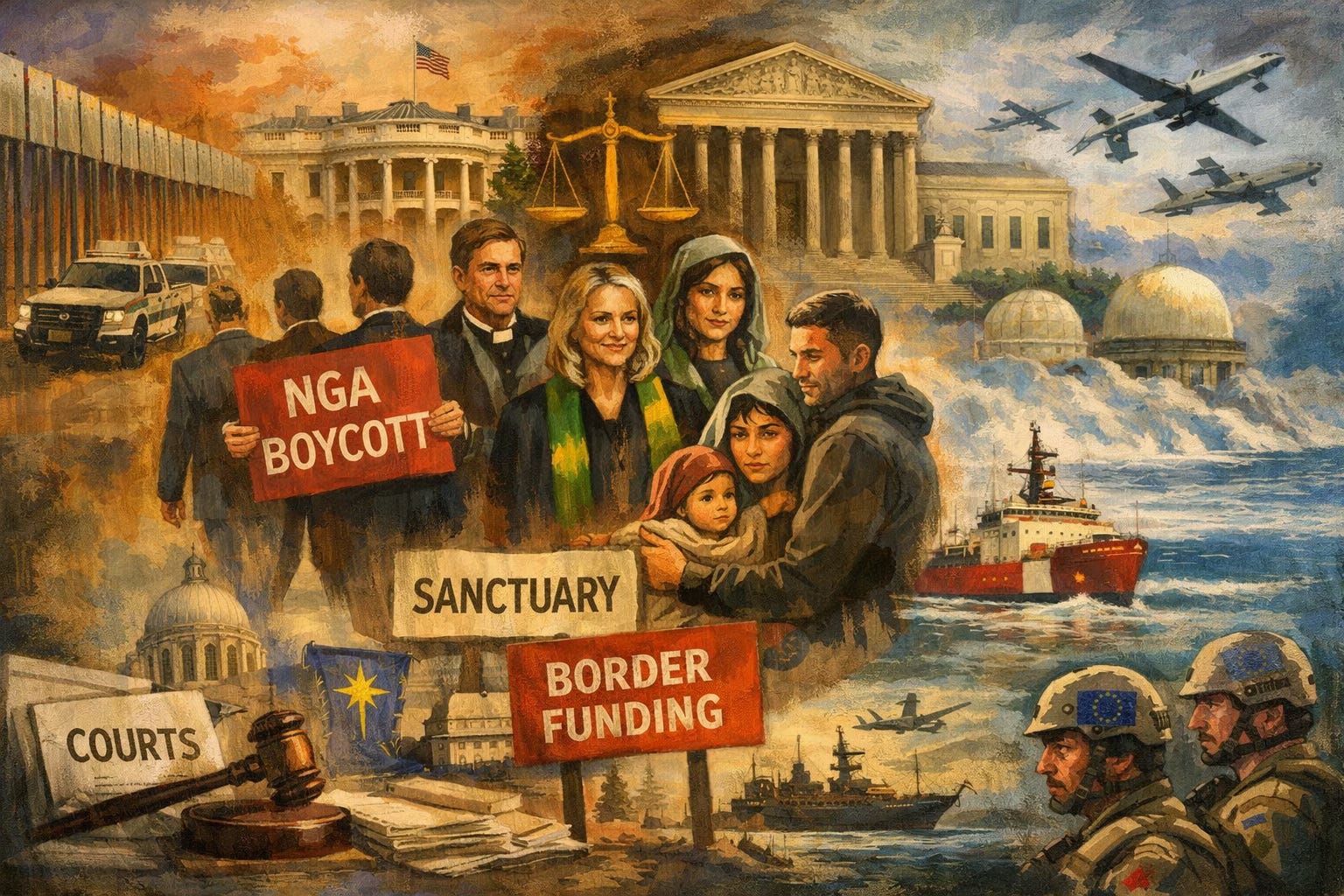
Opening Orientation
This week, the connective tissue between Washington and the states visibly strained.
From February 17 through February 20, enforcement energy continued moving while ordinary governance remained unstable. The partial DHS funding lapse hasn’t halted immigration or border operations. It has reinforced a pattern where administrative continuity is treated as negotiable while enforcement tempo is not.
What changed in this window wasn’t merely policy detail. It was relational temperature. Federal engagement with governors fractured along procedural lines, and civil society actors in at least one major metropolitan area began preparing physical infrastructure in anticipation of federal action.
The strain isn’t episodic. It’s relational. And that distinction matters. When the pressure shifts from isolated events to the connective tissue that links federal authority, state leadership, and community institutions, the perimeter begins to show stress in the spaces between actors rather than only within policy disputes.
That is the defining signal of this edition.
Federal
DHS remains in a partial shutdown posture, with core security functions continuing while administrative support structures and pay processes are strained. Congress hasn’t produced a durable funding resolution. Shutdown governance is becoming normalized rather than exceptional.
At the same time, DHS announced further border wall construction steps tied to dedicated funding streams and waiver authorities. Enforcement and infrastructure expansion proceed even under fiscal instability.
Recent Office of Legal Counsel memoranda reflect continued executive branch attention to statutory interpretation in the post Loper Bright environment. Internal legal framing often precedes operational expansion.
The Supreme Court announced new conflict screening software and enhanced filing disclosure procedures, a modest but visible institutional credibility adjustment.
State and Federal Tension
The federal state interface is widening beyond governors and attorneys general into broader institutional friction.
A rupture occurred within the traditional federal state engagement channel. The National Governors Association withdrew its planned White House meeting after the president declined to invite two Democratic governors, Wes Moore of Maryland and Jared Polis of Colorado, to certain White House events that historically have included all governors regardless of party. In response, a bloc of Democratic governors announced they wouldn’t participate under exclusionary terms, prompting the association to step away from the meeting format.
Presidents of both parties have traditionally met with the full body of governors regardless of political differences. Even during periods of sharp disagreement, the engagement channel itself remained intact. A break in long standing engagement norms is therefore not procedural trivia. It signals strain in the mechanics of intergovernmental coordination.
This wasn’t an isolated complaint. It represented coordinated institutional pushback in defense of bipartisan inclusion. Governors rarely refuse formal White House engagement on process grounds. When they do so collectively, it reflects friction not only over policy, but over access and parity.
That is institutional resistance.
At the same time, the federal state interface is expanding into civil society.
In Minneapolis and Saint Paul, congregations across multiple faith traditions have publicly declared their intent to offer sanctuary and direct support to migrants if ICE operations intensify. Faith leaders involved include Pastor Elizabeth Macaulay of Hennepin Avenue United Methodist Church, Father Jim Cassidy of St. Joan of Arc Catholic Church, and Rabbi Arielle Lekach-Rosenberg of Shir Tikvah Congregation. Their coordination reflects cross denominational mobilization rather than a single faith response.
These congregations are organizing food delivery networks, legal referral systems, rapid response communications, and preparing space for temporary shelter if needed. Sanctuary doesn’t override federal immigration authority where judicial warrants exist. What it represents instead is moral counter posture and communal readiness in anticipation of enforcement escalation.
This is civil readiness.
Taken together, the governors’ withdrawal and sanctuary mobilization show that the perimeter isn’t defined solely by litigation and legislation. Institutional leaders and community networks are adjusting posture in advance of federal action.
California
No major operational rupture surfaced in this narrow window. California continues reinforcing rights education efforts and signaling limits on state level cooperation with federal immigration actions.
The state’s posture remains steady, institutional resistance framed through legal process rather than confrontation.
Minnesota
Minnesota remains a focal point of the immigration enforcement debate. Organizing around the proposed North STAR Act continues, aimed at limiting state and local cooperation with federal immigration authorities.
Litigation surrounding refugee rescreening and detention authority remains active in federal court. The state is functioning as both a site of federal operational pressure and legal counterpressure.
The addition of sanctuary mobilization deepens Minnesota’s role in the perimeter. This is no longer confined to courtroom filings and legislative drafts. It now includes congregational preparation and interfaith coordination.
Maine
Maine’s profile in this window remains more political than operational. Prior federal immigration enforcement activity continues to reverberate in electoral and civic discourse, even as large scale surge operations appear to have stabilized.
The memory of enforcement remains part of the state’s political terrain.
Canada
Canada’s official posture during this period centered on border enforcement messaging, including significant narcotics seizures at a major crossing point. This reinforces the shared border narrative both governments invoke when discussing heightened enforcement and security coordination.
Canada’s broader federal messaging continues to emphasize economic resilience amid trade and supply strain.
Greenland
Greenland remains a sovereignty and alliance cohesion test. Denmark’s King visited Nuuk in a visible unity gesture amid renewed U.S. interest in Greenland’s status.
Diplomatic channels are described as constructive, yet the underlying sovereignty tension persists. Symbolism and strategy are moving in parallel.
Europe
European defense cooperation continues accelerating. A joint initiative among major European military powers focused on drones and low cost strike capabilities underscores the continent’s desire for greater strategic autonomy.
High end joint projects still show internal friction, but the trajectory remains toward capacity building under conditions of uncertainty about U.S. reliability.
No Material Change
No verified constitutional rupture occurred within this reporting window.
There has been no expansion of federal emergency authority.
There has been no National Guard mobilization tied to immigration enforcement in this window.
There has been no announced change to ICE policy regarding sensitive locations such as houses of worship.
There has been no new Supreme Court ruling altering executive immigration authority.
The structural pattern remains consistent: funding instability at the federal level, persistent immigration enforcement activity, state level resistance and cooperation battles, and alliance recalibration in Europe and the Arctic.
What to Watch Next
Watch whether DHS funding negotiations produce structural concessions tied to immigration governance.
Watch Minnesota litigation timelines concerning refugee detention and rescreening authority.
Watch whether sanctuary declarations expand beyond the Twin Cities into additional jurisdictions.
Watch whether future White House engagement with governors remains selectively structured or returns to universal inclusion.
Watch for additional federal waivers tied to border infrastructure expansion.
Developments to Monitor
Faith based sanctuary mobilization is an early warning indicator of perceived enforcement escalation. If similar declarations appear in multiple states simultaneously, that signals a coordinated civil response layer.
Collective gubernatorial withdrawal from federal engagement forums is a secondary but meaningful perimeter signal. If future exclusions produce additional unified pushback, it would indicate sustained executive branch strain between Washington and the states.
Monitor whether ICE enforcement posture changes regarding sensitive locations such as houses of worship. Any operational shift in that domain would mark a significant escalation.
Monitor whether the Supreme Court’s procedural transparency adjustments remain isolated or expand into broader institutional credibility measures.
Where This Leaves Us
The perimeter right now is defined less by surprise and more by accumulation.
Enforcement continues. Funding wavers. Governors withdraw. States legislate. Courts respond. Congregations prepare.
The strain isn’t coming from a single flashpoint. It’s building in relationships.
When institutional leadership and community networks begin adjusting posture before federal action arrives, the system isn’t merely debating policy. It’s recalibrating how authority is experienced.
If those recalibrations remain episodic, the system absorbs them. If they multiply and harden, the connective tissue between federal authority and local legitimacy will face sustained pressure.
That pressure, not any single headline, is the real perimeter story this week.
Light Against Empire is free for all. If my words have value to you and you’re in a position to help, you can chip in with a monthly or yearly donation. Your support keeps the writing alive, the lights on, and the fire burning.
Further Reading:


