

Democratic Perimeter Update for 02/11/2026
Tracking where democratic norms, federal power, and allied stability are being tested by autocratic pressure at home and abroad.

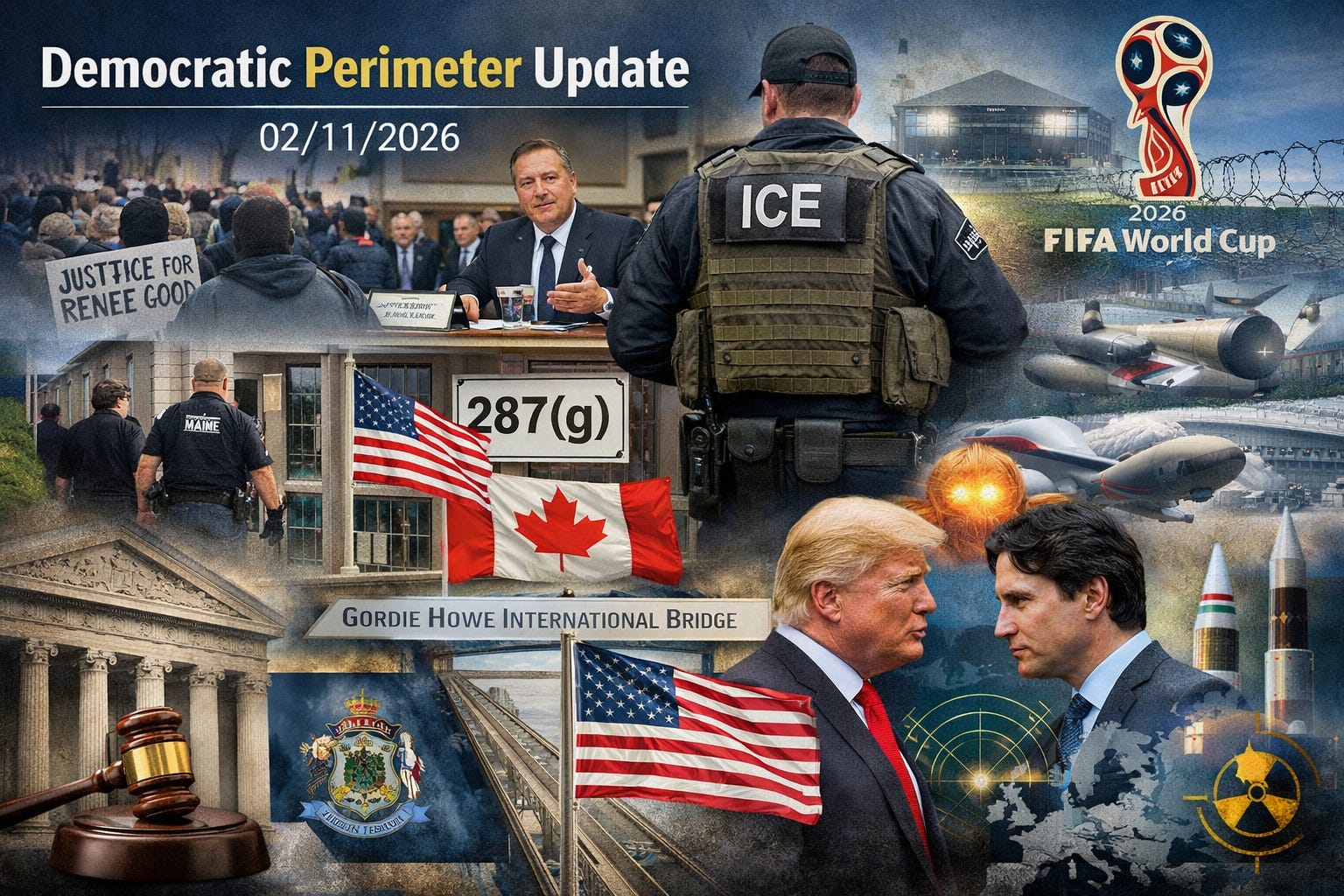
Opening Orientation
The dominant pattern over the last 120 hours is this:
Pressure isn’t producing retreat.
It’s producing refinement.
Federal enforcement posture isn’t collapsing under protest, litigation, or political scrutiny. It’s recalibrating. Local interoperability mechanisms are quietly embedding federal priorities into county systems. Internationally, leverage remains the preferred language of engagement. Even in arms control, expired frameworks are being replaced with informal continuity rather than rupture.
The perimeter didn’t expand dramatically this week.
It consolidated.
Federal
At the federal level, immigration enforcement remains institutionally stable and politically defended.
ICE leadership testified before Congress and rejected calls to demilitarize or significantly restrict operations. Funding debates are occurring, but they’re focused on oversight and conditions, not structural dismantling. The agency is also integrating itself into large scale security planning such as the 2026 FIFA World Cup, signaling that enforcement is considered a permanent operational arm across multiple domains.
Reporting indicates continued physical expansion through newly leased facilities and operational footprint growth nationwide. This isn’t a surge tactic. It’s infrastructure buildout.
Enforcement isn’t episodic.
It’s embedding.
State and Federal Tension
The center of gravity for tension remains in Minnesota, but the more consequential structural development may be happening at the county level.
Across parts of upstate New York, counties have approved 287(g) jail enforcement agreements. These agreements train local corrections personnel to use federal immigration databases and flag detainees for ICE processing.
This doesn’t rely on visible raids.
It relies on interoperability.
It scales quietly.
It embeds locally.
It survives news cycles.
County level federal integration may prove more durable than headline operations.
California
California continues to pursue legal containment strategies.
A federal judge blocked the portion of a state law that attempted to prohibit federal agents from wearing face coverings during operations, while allowing visible identification requirements to stand.
States can shape transparency mechanisms.
They can’t nullify federal authority.
California remains a litigation laboratory. Federal supremacy constraints are visible.
Minnesota
Minnesota remains the most visible enforcement stress test.
A reduction of roughly 700 federal officers was announced, while approximately 2000 remain deployed. Officials frame this as operational adjustment rather than retreat. Governor Walz has adopted a cautious posture, publicly expressing hope for deescalation while refusing to rely solely on federal assurances.
Protests triggered by January’s fatal shootings haven’t disappeared, but the tactical shift is more revealing than the demonstrations.
Reports indicate increased scrutiny of individuals who follow federal agents in vehicles. That reframes friction. Instead of focusing only on targets, enforcement is shaping the legal environment around observers.
The confrontation space is moving.
Less spectacle.
More procedural boundary setting.
That’s refinement under pressure.
Maine
Maine doesn’t show dramatic new developments in this window, but its pattern remains instructive.
Detention cases continue to encounter judicial review and procedural challenge. Maine reflects a quieter containment dynamic where courts shape outcomes incrementally rather than through mass confrontation.
If Minnesota represents visible stress, Maine represents judicial drag.
There’s no surge.
There’s no collapse.
There’s ongoing procedural negotiation.
Canada
This week’s most consequential allied signal involves infrastructure leverage.
The Trump administration publicly threatened to withhold or delay the opening of the Gordie Howe International Bridge between the United States and Canada amid a broader dispute. That bridge is economically critical and symbolically significant for cross border trade and cooperation.
When the opening of a major allied infrastructure project becomes conditional on political alignment, that’s not routine diplomacy. It’s leverage applied through economic choke points.
The issue now appears to be moving toward settlement, but the signal remains:
Allied cooperation is being shaped through conditional pressure rather than quiet coordination.
Canada isn’t in rupture.
It’s operating under visible leverage.
Greenland
No material developments specific to Greenland emerged in this reporting window.
Prior leverage frameworks linking trade, tariffs, and strategic interest remain contextually relevant. There’s no new expansion, and there’s no retraction.
Status remains steady.
Europe
The most meaningful European signal is structural rather than dramatic.
The New START treaty formally expired, yet Russia publicly stated it would remain within prior limits if the United States reciprocates. At the same time, high level military dialogue has resumed between Washington and Moscow.
This isn’t reconciliation.
It’s risk management.
Formal architecture has eroded.
Informal guardrails remain active.
Europe’s perimeter is defined less by battlefield movement and more by channel maintenance.
No Material Change
Several domains showed continuity rather than escalation:
No nationwide suspension of enforcement operations.
No dramatic federal retreat from contested states.
No collapse of local resistance frameworks.
No new treaty architecture replacing expired arms control structures.
The system is absorbing pressure rather than fracturing under it.
What to Watch Next
Whether additional counties adopt 287(g) agreements, especially in politically aligned regions. This is the quiet scalability mechanism.
Whether legal pressure on civic witnessing expands beyond Minnesota.
Whether federal enforcement increasingly shifts toward bureaucratic processing and lower visibility tactics.
Whether funding negotiations attach meaningful operational constraints or remain rhetorical.
Whether allied infrastructure leverage becomes a recurring diplomatic tool.
Whether informal nuclear restraint language solidifies into new architecture or erodes.
Developments to Monitor - NEW SECTION
Developments to Monitor includes credible early-stage developments that haven’t yet altered the ground truth but could shape it if they scale. These items remain provisional and are tracked for pattern emergence, not immediate impact.
Obstruction Clarification
Legal circles are discussing draft federal guidance clarifying what counts as “interference” during immigration operations, particularly filming or following agents. Nothing nationwide has changed yet. But if obstruction definitions expand administratively, friction could shift from enforcement targets to civilian observers.
Interoperability Through Funding
Committee-level DHS budget language is reportedly exploring data-sharing expectations between county jails and federal systems. It hasn’t produced sweeping legislation. If funding quietly conditions cooperation, however, county-level alignment could accelerate without headline votes.
Municipal Liability Shields
Some city councils are debating indemnification policies for local officers who cooperate with federal detainers. These conversations remain isolated. If enacted broadly, they would reduce one of the strongest civil risk brakes on local participation.
Informal Nuclear Continuity
Following the expiration of New START, diplomatic staff-level dialogue continues on deconfliction norms. No treaty replacement exists. If informal restraint hardens into practice without legal architecture, deterrence would shift toward norm-based stability rather than formal agreements.
Where This Leaves Us
The perimeter condition this week is consolidation through refinement.
Federal enforcement isn’t retreating under scrutiny. It’s adjusting tactics, embedding infrastructure, and redistributing friction. County interoperability agreements suggest long term institutionalization. Internationally, even allied infrastructure is being folded into leverage frameworks. In Europe, deterrence stability persists without formal architecture.
Nothing here signals immediate rupture.
Nothing here signals restoration of prior norms.
What it signals is durability under pressure.
Institutions aren’t dissolving.
They’re adapting.
Production Note - Next update will be Monday 16th unless something explodes.
Light Against Empire is free for all. If my words have value to you and you’re in a position to help, you can chip in with a monthly or yearly donation. Your support keeps the writing alive, the lights on, and the fire burning.
Further Reading:


