


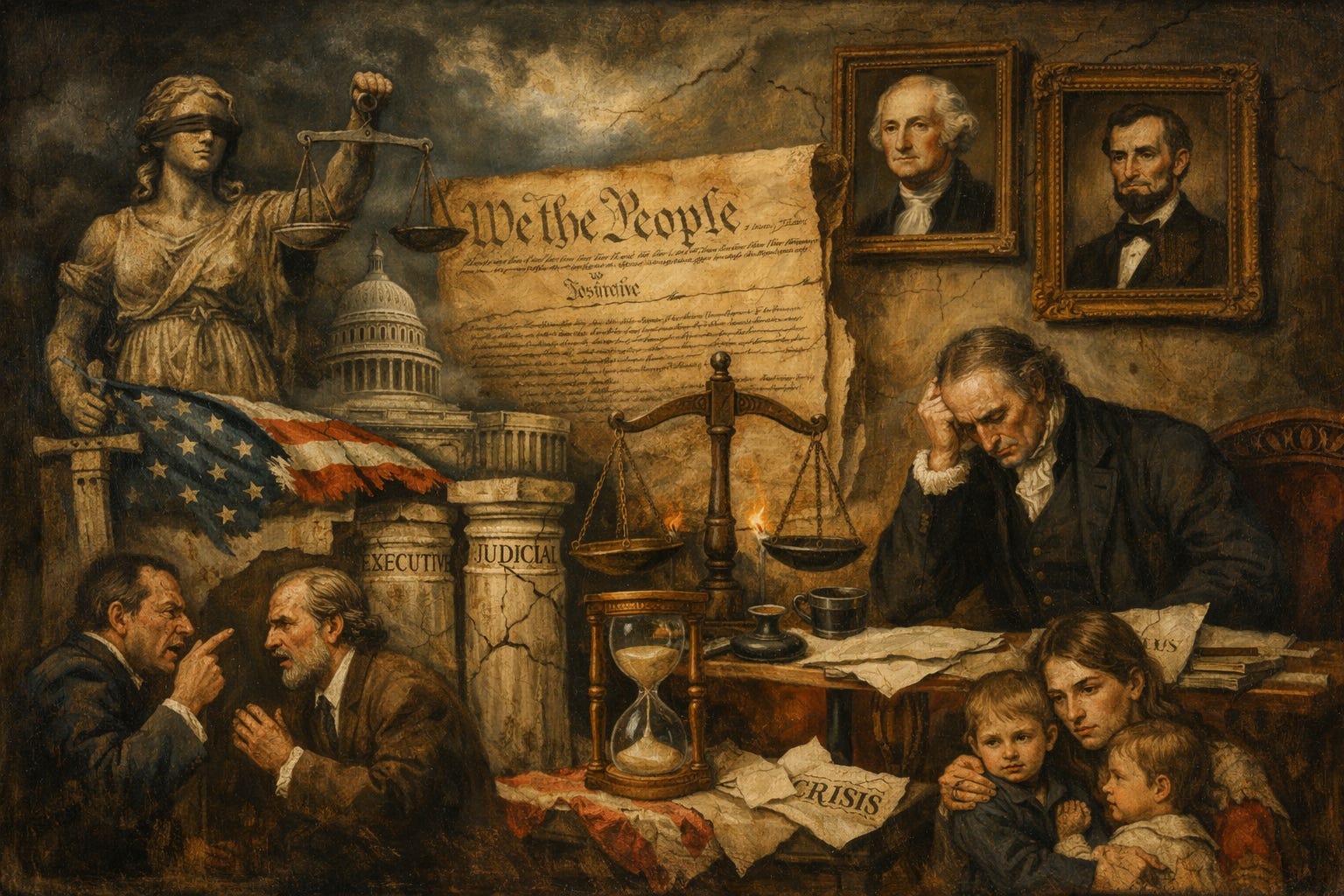
“The people will save their government, if the government itself will do its part only indifferently well.” — Abraham Lincoln
We’re living in a season when confidence feels more fragile than it once did.
We sense it in the tone of our arguments, in the impatience of our politics, in the way disagreement so quickly becomes accusation. We debate whether the system is broken, whether the Constitution has outlived its usefulness, whether this moment is unprecedented. We speak of crisis often enough that the word itself has grown tired.
Yet what we’re experiencing doesn’t resemble collapse.
It resembles weight.
A constitutional republic isn’t designed for comfort. It’s designed for friction. The separation of powers was meant to slow ambition. Federalism was meant to distribute authority. Representation was meant to refine public passion, not inflame it. The machinery of our system was built to move deliberately because speed, in politics, has often served power more than justice.
Strain, then, isn’t proof of failure. It’s proof that forces are meeting resistance.
But strain does something else. It reveals character.
Pressure exposes habits that ease conceals. When decisions must be made quickly, we discover whether we value restraint or dominance. When outcomes frustrate us, we discover whether we accept limits or seek to bypass them. When our preferred leaders face obstacles, we discover whether we defend process or excuse its erosion.
The Constitution can’t supply these answers. It can only assume them.
It assumes citizens willing to lose elections without losing faith. It assumes officeholders who accept constraint without resentment. It assumes that disagreement won’t become dehumanization. These assumptions aren’t written as clauses. They live in culture, in discipline, in habits of self government carried forward from one generation to the next.
When those habits weaken, strain intensifies.
We often speak as if institutions are the primary victims of political coarsening. But institutions are abstractions. They endure on paper. It’s people who feel the consequences first.
When legislative compromise becomes betrayal, families lose stability. When executive convenience overrides deliberation, communities absorb the aftershocks. When courts become the arena for every unresolved political conflict, citizens begin to see law not as shared guardrail but as partisan instrument. The cost isn’t theoretical. It’s borne in trust, in neighborliness, in the quiet confidence that rules apply evenly.
A republic can survive disagreement. It can’t thrive without mutual forbearance.
Forbearance is unfashionable. It lacks spectacle. It demands that we restrain ourselves even when we’re certain we’re right. Yet without it, every election becomes existential. Every policy dispute becomes a test of loyalty. Every temporary majority begins to imagine permanence.
History suggests that free governments rarely unravel in a single moment. More often, they’re worn down by normalization. Emergency becomes habit. Exception becomes precedent. The extraordinary becomes routine. Each individual concession feels modest. The accumulation reshapes expectation.
This is what strain does over time. It tests structure and spirit alike.
Our constitutional order was constructed with foresight, but it was never self executing. It depends on a citizenry willing to practice self restraint even when victory tempts otherwise. It depends on leaders who understand that power exercised without limit corrodes the legitimacy it seeks to command. It depends on voters who care more about durability than dominance.
Law can restrain impulse. It can’t replace character.
Institutions can channel conflict. They can’t manufacture maturity.
If strain reveals habit, what habits are we forming now?
A republic can withstand pressure. What it can’t withstand is a citizenry unwilling to practice the discipline it requires. That discipline isn’t abstract. It’s restraint in victory. It’s steadiness in defeat. It’s seriousness when spectacle tempts us otherwise.
The Constitution was built to endure strain. Whether it does will depend less on its design than on our willingness to live within it.
Up Next
In the next essay, we turn to faction, not as a modern insult but as an old anxiety embedded in the Constitution itself. What did the Founders fear about organized division, and what does our current appetite for partisan loyalty reveal about us?
Light Against Empire is free for all. If my words have value to you and you’re in a position to help, you can chip in with a monthly or yearly donation. Your support keeps the writing alive, the lights on, and the fire burning.
Further Reading:


