


“What stands in the way becomes the way.” — Marcus Aurelius
This essay is the last installment of The Shape of the Right: An Autopsy of American Conservatism, a ten-part exploration of the ideas, myths, and moral compulsions that shaped the American Right. I’m not here to sneer or to support it, but to understand how a movement that began with sermons and self-discipline grew into a politics of grievance and spectacle. Each essay stands on its own, but together they form an autopsy, not of a party, but of a moral psychology that still thinks it’s the soul of the nation.
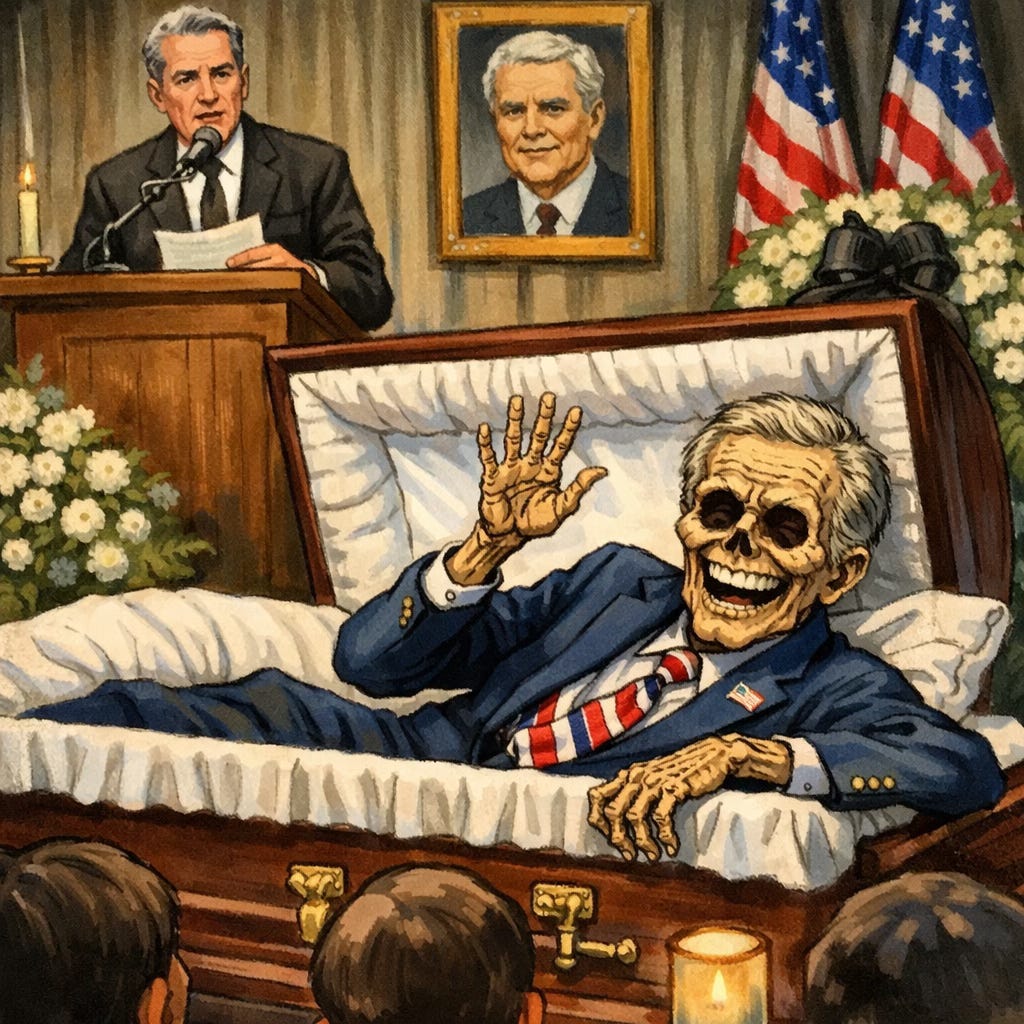
Standing at the Graveside
I keep finding myself at this graveside even though I promised I was done with funerals for ideas. Yet here I am again, hands in my pockets, trying to make sense of the silence. It feels strange to mourn a philosophy. Stranger still to realize I once hoped for its adulthood, as if a political tradition could wake up one morning and finally decide to act its age. There’s a kind of comic absurdity to standing over something that keeps insisting it isn’t dead while offering you all the evidence to the contrary. Still, I’m not here for mockery. I’m here because grief has its own pull. Something in me wants to say goodbye to the version that almost existed.
The Early Promise
Every movement tells a story about itself, and conservatism’s early story still tugs at me. It claimed restraint. It claimed stewardship. It claimed dignity. It claimed to cherish the quiet virtue of tending to what we inherit. At its best, it imagined a world where humility walked ahead of ambition, where limits weren’t enemies but teachers, where time itself was a partner in shaping good judgment. I can respect that. I can even admire it. There’s something noble in any philosophy that believes the world shouldn’t be remade every time someone wakes up with a new idea. But I’ve spent a lifetime in systems that taught me something else. A thing that refuses to grow becomes brittle. A thing that can’t evolve eventually breaks.
I find myself returning to an uncomfortable question. Could a movement so devoted to conserving have ever learned the strange art of becoming something new. I’m not sure the tools were ever there. It’s hard to grow when you believe you’ve already arrived.
The Rite That Never Came
There was a moment when everything might’ve turned out differently. A moment when conservatism could’ve walked through a rite of passage and stepped into adulthood. But that moment never fully formed. Instead it lived with a kind of adolescent temperament it never outgrew. It insisted on purity when the world was offering complexity. It demanded certainty when the truth asked for honesty. It clung to myth while reality stood outside the door politely knocking.
I remember watching this refusal again and again in civic life. A policy debate would surface, and instead of wrestling with its implications, the movement retreated into old slogans like someone grabbing a security blanket. The country changed around it. New generations asked new questions. Knowledge piled up. Evidence offered possibilities. Yet the response arrived like a broken record. The past was perfect, and the present was trespassing.
Fear as Identity
Somewhere along the way, whatever nobility conservatism once possessed began to feel overwhelmed by something much shakier. The anxiety grew louder. The fear became the message. A philosophy that once promised steadiness slid into a chronic panic about cultural dominance and demographic shifts. It started treating every new voice as an invasion, every new idea as a betrayal, every request for accountability as an attack. I’m not sure it meant to happen. Most unravelings don’t announce themselves. They just begin at the edges.
The movement said it wanted to conserve, but fear never conserves anything. Fear only tightens its grip on whatever’s already sliding away.
The Fork in the Road
I sometimes imagine the fork in the road where conservatism might’ve chosen a different route. A version of itself that took stewardship seriously enough to care about climate and community. A version that welcomed humility instead of treating it as a weakness. A version willing to listen to expertise rather than declaring war on it. A version that understood wisdom as a living thing. Not something encased in amber, but something grown through time and experience.
I would’ve gladly met that version of conservatism at the table. I would’ve welcomed it as a partner in the shared work of shaping a country. But that version stayed unborn. The movement marched down the other path. The one paved with grievance and punctuated with warnings about enemies that somehow always looked exactly like the neighbors who disagreed.
The Unlived Future
What we lost in that choice isn’t small. We didn’t just lose a party. We lost a counterbalance. We lost a philosophy that might’ve brought prudence and steadiness into the national conversation. We lost a voice that could’ve tempered the excesses of both sides and reminded us that ambition needs grounding, that power needs humility, that ideas need time to cool before they become law. We lost a tradition that might’ve stood between us and the spectacle that eventually replaced serious governance. If you listen closely, you can almost hear the ghost of that unrealized future clearing its throat.
There’s a dark sort of humor in all this. I can’t pretend I don’t sometimes find myself laughing quietly at the thought of what might’ve happened if anyone in the movement had read Burke all the way through instead of cherry picking him like a buffet. But even that laugh carries a note of sadness. This was a missed opportunity. A genuine one. A country needs more than two parties. It needs two philosophies that take the work seriously.
The Final Goodbye
So here I am again, offering final rites to a dream I once thought might grow into something wise. I’m saying goodbye to the version of conservatism that never learned how to inhabit its own potential. I speak to it as if it were a person who never understood the gift it’d been given. You had the chance to offer steadiness when the world was shaking. You had the chance to honor the quiet work of caretaking. You had the chance to help a country remember that dignity isn’t decoration but responsibility. You had all that within reach, and you never stepped forward to claim it.
There’s something tender in that recognition. Something human. We all know what it feels like to fail our better selves. We all know what it means to lose a version of ourselves we were supposed to grow into. That’s why this feels less like political analysis and more like a farewell to someone who never fully matured. Someone who wanted to be wise without doing any of the work wisdom requires.
A Quiet Question for the Road Ahead
And now we’ve reached the end of this series. An odd journey through collapse, corruption, nostalgia, and the stories we tell ourselves so we can sleep at night. I didn’t write these essays to offer tidy answers. I wrote them because I’ve spent too many years watching the country drift while pretending the tide had nothing to do with our own choices. Walking through this entire series has been its own kind of reckoning. A long conversation about identity and denial and the quiet ways fear reshapes a nation.
Writing all this has changed me. I see the collapse differently now. Not as an event but as an inheritance. Not as a single failure but as a pattern that kept repeating until it became a personality. And still, even after all these pages, I’m not interested in moralizing. I’m not interested in saying here’s what you should learn. I’ve never trusted that way of talking to another person’s conscience.
Instead I find myself standing here, ready to walk away from this graveside, and noticing that I still have one question lingering in my hand like a flower I’m not sure where to place.
What do we become when the ideas that were supposed to guide us refuse to grow with us?
I’ll leave that here for now. Let it follow you out the door the way it’s been following me.
Please Support the Work
This work is free for all because light should never be gated. If these words feel like a lantern in your hands, you can help keep it burning. Your support makes sure the flame doesn’t go out. You can make a monthly or yearly donation below.
Dino’s Homily and Poetry Shop here
Light Against Empire - The Podcast here