


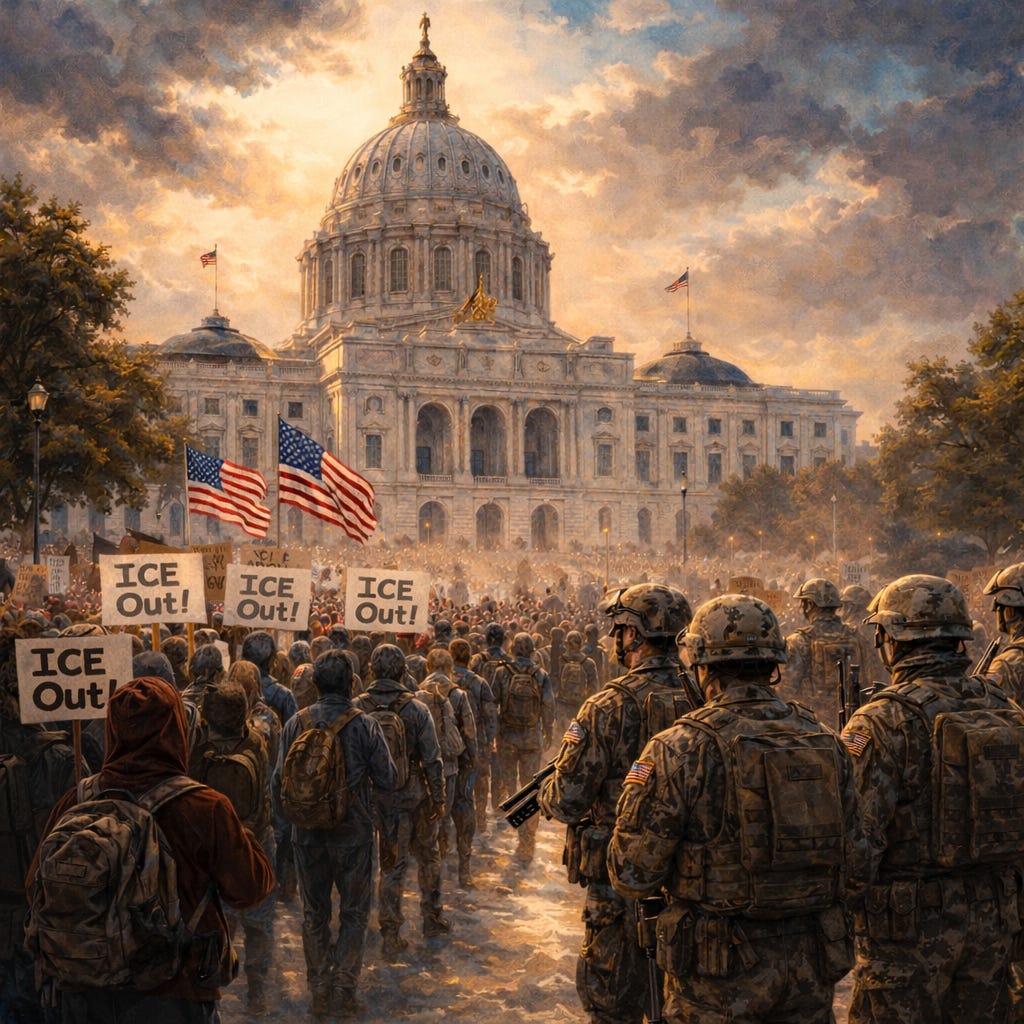
I want to slow this down for a moment and explain why the recent talk about President Trump threatening to invoke the Insurrection Act in Minneapolis should give every one of us pause, regardless of where we land politically.
This isn’t just another escalation. It’s a different category of action.
The Insurrection Act is one of the few remaining legal doors through which a president can deploy military force inside the United States against civilians. Not foreign enemies. Not an invading army. Americans. On American streets.
That alone should make us uneasy.
The Constitution draws a bright line between civilian governance and military power. We don’t always honor that line perfectly, but we’ve treated it as sacred for a reason. The military exists to defend the nation from external threats. Law enforcement exists to manage internal order under civilian control, bound by courts, local authority, and due process.
When those roles blur, history tells us things go bad quickly.
Invoking the Insurrection Act collapses that separation. It allows the president to decide that ordinary law enforcement is no longer sufficient and to substitute soldiers for civilian authority. Once that decision is made, the chain of accountability changes. Soldiers answer to commanders. Commanders answer to the executive. Courts follow behind, if they’re allowed to catch up at all.
That’s the constitutional dilemma.
“There’s a reason you separate military and the police. One fights the enemies of the state, the other serves and protects the people. When the military becomes both, then the enemies of the state tend to become the people.”
This warning isn’t about uniforms or hardware, it’s about logic. Militaries are trained to identify threats, dominate terrain, and neutralize enemies. Police, at least in theory, are meant to preserve civil order among people who retain their rights, even when they break the law. When those roles blur, the governing mindset shifts. Suspicion replaces service. Control replaces consent. The public stops being something to protect and becomes something to manage. That shift doesn’t require a coup or tanks in the street. It happens quietly, through language, posture, and policy, until the presence meant to keep people safe starts treating them as adversaries by default.
In implementing the Insurrection Act the president becomes the judge of when civil authority has failed, the executor of force to correct it, and the political beneficiary of the show of strength. Those powers were never meant to sit comfortably in one set of hands.
Supporters will argue that the Act is legal. And they’re right, technically. It’s still on the books. But legality and legitimacy aren’t the same thing. The Constitution doesn’t just ask whether something can be done. It asks whether it should be done, and under what conditions, and with what safeguards.
Using the military against civilians in a city where state and local governments are still functioning creates a clash of sovereignties. Who’s in charge. Whose authority matters. Which laws apply in the moment force is used.
That’s not abstract. It’s practical.
Once troops are deployed, protest becomes confrontation. Dissent becomes disorder. Mistakes become tragedies. Soldiers aren’t trained to de-escalate civic conflict. They’re trained to dominate space. And when people are already frightened, angry, and mistrustful, the presence of the military doesn’t calm the situation. It hardens it.
There’s also a quieter danger that doesn’t get talked about enough.
Even threatening to use the Insurrection Act changes the ground we’re standing on. It teaches the public that military force is an acceptable tool for resolving political conflict. It teaches future presidents that this option is available. It teaches citizens that protest may be met not with police, or courts, or elections, but with soldiers.
Once that lesson is learned, it doesn’t get unlearned.
None of this requires an actual deployment to do damage. The normalization of the idea does some of the work all by itself.
And here’s the part I can’t shake.
If the executive decides that civil unrest triggered by its own policies justifies military intervention, we’ve entered a feedback loop. Policy creates resistance. Resistance is labeled insurrection. Insurrection justifies force. Force deepens resistance.
That’s not stability. That’s a spiral.
This is why the Insurrection Act has always been treated as a last resort, something invoked rarely and with reluctance, usually at the request of states, not over their objections. The moment it becomes a tool of convenience, it stops being a safeguard and starts being a weapon.
We should be clear-eyed about what’s at stake. This isn’t about Minneapolis alone. It’s about whether the United States remains a civilian-led constitutional republic, or whether we begin drifting toward a system where political problems are managed through shows of force rather than consent.
Once soldiers become a routine answer to civic conflict, the Constitution hasn’t been suspended on paper. It’s been hollowed out in practice.
That’s why this moment matters. Not because it guarantees the worst outcome, but because it opens a door that has always been kept closed for a reason.
Some doors are legal to open.
That doesn’t mean we should walk through them. God protect us all.
Please Support the Work
Light Against Empire is free for all. If my words have value to you and you’re in a position to help, you can chip in with a monthly or yearly donation. Your support keeps the writing alive, the lights on, and the fire burning.
Further Information:


Anybody got any inkling on how the military feels about ICE? Anecdotally, I've heard the cops aren't necessarily enthralled. If both those entities aren't totally invested, I'd argue that other options could be put on the table that might play against the historical type that Dino described. Time is of the essence. I detect a sense of urgency from the sociopaths, who would undoubtedly do a false flag just to kickstart their final solution. I'd be a little nervous if I was an ICE dude.
Thank you again Dino. I am truly frightened for all of us.